
Ronald William Howard born March 1, 1954 is an American film director, producer and actor. Howard first came to prominence as a child actor, guest-starring in several television series, including an episode of The Twilight Zone. He gained national attention for playing young Opie Taylor, the son of Sheriff Andy Taylor (played by Andy Griffith) in the sitcom The Andy Griffith Show from 1960 through 1968. During this time, he also appeared in the musical film The Music Man (1962), a critical and commercial success. He was credited as Ronny Howard in his film and television appearances from 1959 to 1973. Howard was cast in one of the lead roles in the coming-of-age film American Graffiti (1973), and became a household name for playing Richie Cunningham in the sitcom Happy Days, a role he would play from 1974 through 1980.
In 1980, Howard left Happy Days to focus on directing, producing and occasionally writing variety films and television series. His films included the comedies Night Shift (1982), Splash (1984), and Cocoon (1985) as well as the fantasy Willow (1988), the thriller Backdraft (1991), and the newspaper comedy drama film The Paper (1994). In 1995, Howard gained widespread praise and recognition in the historical docudrama Apollo 13 (1995). Howard continued directing such films as the biographical drama A Beautiful Mind (2001), the biographical sports drama Cinderella Man (2005), the historical drama Frost/Nixon (2008), the biographical sports drama Rush (2013), and the historical adventure film In the Heart of the Sea (2016). Howard is also known for directing the children’s fantasy film How the Grinch Stole Christmas (2000) as well as the Robert Langdon film series, The Da Vinci Code (2006), Angels & Demons (2009), and Inferno (2016). Howard also directed Solo: A Star Wars Story (2018) and the documentary films, The Beatles: Eight Days a Week (2016), and Pavarotti (2019).
Howard received the Academy Award for Best Director and Academy Award for Best Picture for A Beautiful Mind and was nominated again for the same awards for Frost/Nixon. In 2003, Howard was awarded the National Medal of Arts. He was inducted into the Television Hall of Fame in 2013. Howard has two stars on the Hollywood Walk of Fame for his contributions in the television and motion pictures industries.
Early life
Howard was born in Duncan, Oklahoma in 1954, the elder son of Jean Speegle Howard (1927–2000), an actress, and Rance Howard (1928–2017), a director, writer, and actor. He has German, English, Scottish, Irish, and Dutch ancestry. His father was born with the surname “Beckenholdt” and took the stage name “Howard” in 1948 for his acting career. Rance Howard was serving three years in the United States Air Force at the time of Ron’s birth. The family moved to Hollywood in 1958, the year before the birth of his younger brother Clint Howard. They rented a house on the block south of the Desilu Studios, where The Andy Griffith Show was later filmed. They lived in Hollywood for at least three years, before moving to Burbank.
Howard was tutored at Desilu Studios in his younger years but continued his schooling at Robert Louis Stevenson Elementary and David Star Jordan Junior High when not working in television, eventually graduating from John Burroughs High School. He later attended the University of Southern California’s School of Cinematic Arts but did not graduate.
Howard has said he knew from a young age he might want to go into directing, thanks to his early experience as an actor.
Acting career
The Andy Griffith Show
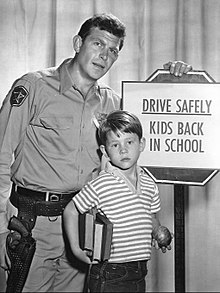
With Andy Griffith in a publicity photo for The Andy Griffith Show (1961)
In 1959, Howard had his first credited film role in The Journey. He appeared in June Allyson’s CBS anthology series The DuPont Show with June Allyson in the episode “Child Lost”; in The Twilight Zone episode “Walking Distance”; a few episodes of the first season of the sitcom Dennis the Menace, as Stewart, one of Dennis’s friends; and several first- and second-season episodes of The Many Loves of Dobie Gillis. Howard played “Timmy” (uncredited) in “Counterfeit Gun”, Season 4, Episode 2 (1960) of the TV series, “The Cheyenne Show.”
In 1960, Howard was cast as Opie Taylor in The Andy Griffith Show. Credited as “Ronny Howard”, he portrayed the son of the title character (played by Andy Griffith) for all eight seasons of the show. Recalling his experiences as a child actor on set, he commented
I was five years old. And I was preoccupied with the prop that was in my hand, because it was a toy turtle. But I had to pretend it was a real turtle that the audience just wasn’t seeing, and it was dead, so I was supposed to be crying and very emotional, and I remember him looking at that little turtle and talking to me about how it was kind of funny to have to pretend that was dead. So I recall just a very relaxed first impression.

With Cara Williams in Pete and Gladys in 1960
In the 1962 film version of The Music Man, Howard played Winthrop Paroo, the child with the lisp; the film starred Robert Preston and Shirley Jones. He also starred in the 1963 film The Courtship of Eddie’s Father, with Glenn Ford.
He appeared as Barry Stewart on The Eleventh Hour in 1965; on I Spy, in the episode “Little Boy Lost”, in 1966; as Henry Fonda’s son in an ABC series, The Smith Family, in 1968; as Jodah, in “Land of the Giants”, in 1969; as a boy whose father was shot, on the TV show “Daniel Boone”, in 1971–72; and as an underage Marine on M*A*S*H in the episode “Sometimes You Hear the Bullet”, in 1973. In the 1970s, he appeared in at least one episode of The Bold Ones, as a teenage tennis player with an illness.
Howard appeared on the 1969 Disneyland Records album The Story and Song from the Haunted Mansion. It featured the story of two teenagers, Mike (Howard) and Karen (Robie Lester), who get trapped inside the Haunted Mansion. Thurl Ravenscroft plays the Narrator, Pete Reneday plays the Ghost Host, and Eleanor Audley plays Madame Leota. Some of the effects and ideas that were planned but never permanently made it to the attraction are mentioned here: the Raven speaks in the Stretching Room, and the Hatbox Ghost is mentioned during the Attic scene. It was reissued in 1998 as a cassette tape titled A Spooky Night in Disney’s Haunted Mansion and on CD in 2009.
In 1974, Howard guest-starred as Seth Turner, the best friend of Jason Walton (Jon Walmsley), in The Waltons, “The Gift”. In the episode, Seth wants to learn to play an instrument in his father’s band, but it looks as if he will not have the time; he has been diagnosed with leukemia. The concept of death – and the unfairness of it all – is an extremely difficult one for Jason to accept, and it is up to Grandpa to help the boy through this crisis. Featured in the cast as Dr. McIvers is Ron Howard’s father Rance Howard.
Happy Days

Richie (Ron Howard) takes a turn on Fonzie’s motorcycle in a scene from Happy Days
Howard played Steve Bolander in George Lucas’ coming-of-age film American Graffiti in 1973. A role in an installment of series Love, American Style, titled “Love and the Television Set”, led to his being cast as Richie Cunningham in the TV series Happy Days (for syndication, the segment was re-titled “Love and the Happy Days”). Beginning in 1974, he played the likeable “buttoned-down” boy, in contrast to Henry Winkler’s “greaser” Arthur “Fonzie”/”The Fonz” Fonzarelli. On the Happy Days set, he developed an on- and off-screen chemistry with series leads Winkler and Tom Bosley. The three remained friends until Bosley’s death in October 2010.
Howard left Happy Days just before the start of its eighth season in 1980 when he was offered a contract to direct television movies for NBC, an arrangement that required Howard to remain exclusive with the network for one year. Howard returned to the show for a guest appearance in November 1983, which allowed a proper send-off for Ritchie Cunningham, whose absence had been explained by having him join the U.S Army and ship off to Greenland. Howard also returned for the series finale in May of 1984, the latter marking one of his last acting roles.
In 1976, Howard played Gillom Rogers in the movie The Shootist, with John Wayne’s final screen performance. Howard’s last significant on-screen role was a reprise of his famous role as Opie Taylor in the 1986 TV movie Return to Mayberry, an Andy Griffith Show reunion reuniting him with Griffith, Don Knotts, and most of the cast. He also appeared in two Happy Days TV reunions: 1992’s The Happy Days Reunion Special, a retrospective hosted by Winkler that aired on ABC; and 2005’s The Happy Days 30th Anniversary Reunion, co-produced by Winkler, where he was again reunited with most of the surviving cast.
Directing career
1980s
Before leaving Happy Days in 1980, Howard made his directing debut with the 1977 low-budget comedy/action film Grand Theft Auto, based on a script he co-wrote with his father, Rance. This came after cutting a deal with Roger Corman, wherein Corman let Howard direct a film in exchange for Howard starring in Eat My Dust!, with Christopher Norris. Howard went on to direct several TV movies for NBC between 1978 and 1982, including the 1982 TV movie, Skyward, starring Bette Davis. His big directorial break came in 1982, with Night Shift, featuring Michael Keaton, Shelley Long, and Henry Winkler.
He has since directed a number of major films, including the fantasy romantic comedy Splash (1984) starring Tom Hanks, Daryl Hannah, Eugene Levy and John Candy. The film was a box office and critical success. He also directed the science fiction comedy-drama Cocoon (1985) starring Don Ameche, Hume Cronyn, Wilfred Brimley, and Brian Dennehy. This film was also a critical and financial hit. In 1988, he directed the dark fantasy drama film Willow starring Val Kilmer and Warwick Davis. Howard’s final work as a director for the 1980s was the family comedy film Parenthood (1989) starring an ensemble cast that includes Steve Martin, Tom Hulce, Rick Moranis, Martha Plimpton, Joaquin Phoenix, Keanu Reeves, Jason Robards, Mary Steenburgen, and Dianne Wiest. The film opened at #1 in its opening weekend, earning $10 million. It eventually grossed over $100 million domestically and $126 million worldwide. The film was a critical hit and received two Academy Award nominations.
1990s

Howard with Tom Hanks and the production crew of Apollo 13 (1995)
Howard continued directing through the 1990s, including the American drama Backdraft revolving around firefighters. The film starred Kurt Russell, Donald Sutherland, and Robert De Niro. Film critics Gene Siskel of the Chicago Tribune and Roger Ebert of the Chicago Sun-Times gave the film a positive review.
In 1992, he directed the western film epic Far and Away starring Tom Cruise and Nicole Kidman. Despite receiving mixed reviews from critics the film was a financial success earning 137 million against its budget of 60 million. In 1994, Howard directed the newspaper comedy drama The Paper with an ensemble starring Michael Keaton, Glenn Close, Marisa Tomei, Jason Alexander, Jason Robards and Robert Duvall. The film received rave reviews with many praising Keaton’s leading performance.
Howard’s direction for the 1995 docudrama film Apollo 13 received praise from critics. The film stars Tom Hanks, Kevin Bacon, and Bill Paxton as the three astronauts members of the Apollo 13 flight crew. The film also featured performances from Gary Sinise, Ed Harris, and Kathleen Quinlan. The film was a massive financial success earning $335 million off a budget of $52 million. The film received widespread critical acclaim with Roger Ebert of the Chicago Sun-Times praised the film in his review saying: “A powerful story, one of the year’s best films, told with great clarity and remarkable technical detail, and acted without pumped-up histrionics.” The film went on the receive 9 Academy Award nominations including Best Picture. Despite all the awards success Howard failed to receive a Academy Award for Best Director nomination.
2000s
In 2000, he directed the live action children’s fantasy film, How the Grinch Stole Christmas based on the Dr. Seuss children’s book. The film starred Jim Carrey as the titular character and featured performances from Jeffrey Tambor, Christine Baranski, Molly Shannon with Anthony Hopkins serving as the film’s narrator. Despite the film receiving mixed reviews from critics, it was a financial success and earned $345 million at the box office.
Howard’s followup film was the biographical drama film A Beautiful Mind starring Russell Crowe as the American mathematician John Nash who struggled with paranoid schizophrenia. The film featured performances from Jennifer Connolly, Ed Harris, Josh Lucas, and Christopher Plummer. The film received positive reviews from critics who praised Crowe’s and Connolly’s performances. The film went on to receive eight Academy Award nominations including a win for Best Picture and a nomination and win for Howard as Best Director.
In 2005, Howard directed the biographical sports drama Cinderella Man based on the true story of heavyweight boxing champion James J. Braddock played by Russell Crowe. The film also starred Renée Zellweger as his wife Mae Braddock, and Paul Giamatti as his trainer Joe Gould. Rotten Tomatoes gave it an approval rating of 80% based on reviews from 214 critics with an average score of 7.4/10. Its consensus states, “With grittiness and an evocative sense of time and place, Cinderella Man is a powerful underdog story. And Ron Howard and Russell Crowe prove to be a solid combination.”
Howard is also known for directing the Robert Langdon films. The series began with The Da Vinci Code (2006) with Tom Hanks as Langdon, featuring performances by Audrey Tautou, Ian McKellen, and Alfred Molina. The sequel was Angels & Demons (2009) with Hanks reprising his role and performances by Ewan McGregor and Stellan Skarsgård. In 2016, Inferno was released with Hanks continuing the role with performances by Felicity Jones, Irrfan Khan and Omar Sy. All three films received mixed reviews but were popular among audiences.
Howard showcased the world premiere of his historical drama film Frost/Nixon at the London Film Festival in October 2008. The film is based on the taped conversations known as the Frost/Nixon interviews between former United States President Richard Nixon and British talk show host David Frost. Frank Langella portrayed Nixon opposite Michael Sheen as Frost. The film was based on the play of the same name by Peter Morgan. The film also featured performances from Mathew Macfadyen, Sam Rockwell, Rebecca Hall, Oliver Platt, Toby Jones, and Kevin Bacon. Despite losing money at the box office, the film was a critical success with website Rotten Tomatoes giving the film an approval rating of 93% with the critical consensus reading, “Frost/Nixon is weighty and eloquent; a cross between a boxing match and a ballet with Oscar worthy performances.” Metacritic gives the film an average score of 80 out of 100, based on 38 critics, indicating “generally favorable reviews”. The film received 5 Academy Award nominations with Howard receiving a nomination for Best Director.
Howard was the recipient of the Austin Film Festival’s 2009 Extraordinary Contribution to Filmmaking Award. Michael Keaton presented him with the Award.
2010s
In 2013, Howard directed sports drama Rush, based on the Hunt–Lauda rivalry between two Formula One drivers, the British James Hunt and the Austrian Niki Lauda during the 1976 Formula 1 motor-racing season. It was written by Peter Morgan and starred Chris Hemsworth as Hunt, Daniel Brühl as Lauda, and Olivia Wilde as Suzy Miller. The film premiered at the 2013 Toronto International Film Festival and received positive reviews from critics.
In 2016, Howard directed the film In the Heart of the Sea about the sinking of the American whaling ship Essex in 1820, an event that inspired Herman Melville’s 1851 novel Moby-Dick. The film featured performances by Chris Hemsworth, Cillian Murphy, Tom Holland, Ben Whishaw, and Brendan Gleeson. The film was a financial failure, but was well reviewed among critics.
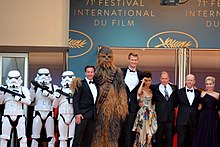
Howard and the cast at the 2018 Cannes Film Festival
Howard took over directing duties on Solo: A Star Wars Story, a film featuring Star Wars character Han Solo in his younger years. The film was released on May 23, 2018. Howard officially replaced directors Phil Lord and Christopher Miller on June 22, 2017; they were let go from their position two days earlier, reportedly due to their refusal to compromise with Lucasfilm over the direction of the film; reportedly the directors encouraged significant improvisations by the actors, which was believed by some at Lucasfilm to be “shifting the story off-course”. At the time, the film was nearly completed, with three and a half weeks left to film and another five weeks of reshoots scheduled. Howard posted on Twitter, “I’m beyond grateful to add my voice to the Star Wars Universe after being a fan since 5/25/77. I hope to honor the great work already done & help deliver on the promise of a Han Solo film.”
In November 2017, Howard announced that he would be teaching his first directing class.
Howard is currently scheduled to direct the film Thirteen Lives, about the Tham Luang cave rescue in 2018. Afterwards, he will direct a biopic of pianist Lang Lang.
2020s
On November 24, 2020, Howard’s drama film Hillbilly Elegy was released on Netflix. The film is based on the memoir of the same name by J. D. Vance and was adapted for the screen by Vanessa Taylor. The film stars Academy Award nominee’s Glenn Close and Amy Adams. The film has received widespread negative reception from critics. The film was received well by general audiences, with a 83% user approval on Rotten Tomatoes.
Imagine Entertainment
Howard is the co-chairman, with Brian Grazer, of Imagine Entertainment, a film and television production company. Imagine has produced several films including Friday Night Lights, 8 Mile, and Inside Deep Throat, as well as the television series 24, Felicity, and Arrested Development which Howard also narrated.
In July 2012, it was announced that Imagine had put into development Conquest for Showtime, a period drama based on the 16th century conquest of the Aztecs by Spanish Conquistadors. To be directed by Howard, the series was originally planned as a feature film before it was decided that the project was more suited to television.
As part of Imagine Entertainment, he appeared in a 1997 print ad for Milk – Where’s your mustache?, in which he wore a cap for Imagine Entertainment and sported a milk mustache. Earlier versions show a younger Ronny Howard on the other side.
In 2009, he appeared in the Jamie Foxx music video “Blame It”.
Personal life
Howard married writer Cheryl Alley (born 1953) on June 7, 1975. They have four children: daughters Bryce Dallas Howard (born 1981), twins Jocelyn Carlyle and Paige Howard (born 1985), and son Reed Cross (born 1987).