
Wheat is a grass widely cultivated for its seed, a cereal grain which is a worldwide staple food. The many species of wheat together make up the genus Triticum; the most widely grown is common wheat (T. aestivum). The archaeological record suggests that wheat was first cultivated in the regions of the Fertile Crescent around 9600 BCE. Botanically, the wheat kernel is a type of fruit called a caryopsis.
Wheat is grown on more land area than any other food crop (220.4 million hectares, 2014). World trade in wheat is greater than for all other crops combined. In 2017, world production of wheat was 772 million tonnes, with a forecast of 2019 production at 766 million tonnes, making it the second most-produced cereal after maize. Since 1960, world production of wheat and other grain crops has tripled and is expected to grow further through the middle of the 21st century. Global demand for wheat is increasing due to the unique viscoelastic and adhesive properties of gluten proteins, which facilitate the production of processed foods, whose consumption is increasing as a result of the worldwide industrialization process and the westernization of the diet.
Wheat is an important source of carbohydrates. Globally, it is the leading source of vegetable protein in human food, having a protein content of about 13%, which is relatively high compared to other major cereals but relatively low in protein quality for supplying essential amino acids. When eaten as the whole grain, wheat is a source of multiple nutrients and dietary fiber.
In a small part of the general population, gluten – the major part of wheat protein – can trigger coeliac disease, noncoeliac gluten sensitivity, gluten ataxia, and dermatitis herpetiformis.
Origin and history
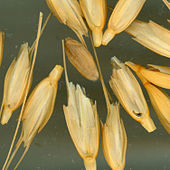
Spikelets of a hulled wheat, einkorn
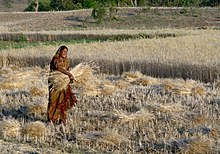
Woman harvesting wheat, Raise district, Madhya Pradesh, India
Cultivation and repeated harvesting and sowing of the grains of wild grasses led to the creation of domestic strains, as mutant forms (‘sports’) of wheat were preferentially chosen by farmers. In domesticated wheat, grains are larger, and the seeds (inside the spikelets) remain attached to the ear by a toughened rachis during harvesting. In wild strains, a more fragile rachis allows the ear to easily shatter and disperse the spikelets. Selection for these traits by farmers might not have been deliberately intended, but simply have occurred because these traits made gathering the seeds easier; nevertheless such ‘incidental’ selection was an important part of crop domestication. As the traits that improve wheat as a food source also involve the loss of the plant’s natural seed dispersal mechanisms, highly domesticated strains of wheat cannot survive in the wild.
Archaeological analysis of wild emmer indicates that it was first cultivated in the southern Levant, with finds dating back as far as 9600 BCE. Genetic analysis of wild einkorn wheat suggests that it was first grown in the Karacadag Mountains in southeastern Turkey. Dated archeological remains of einkorn wheat in settlement sites near this region, including those at Abu Hureyra in Syria, suggest the domestication of einkorn near the Karacadag Mountain Range. With the anomalous exception of two grains from Iraq ed-Dubb, the earliest carbon-14 date for einkorn wheat remains at Abu Hureyra is 7800 to 7500 years BCE.
Remains of harvested emmer from several sites near the Karacadag Range have been dated to between 8600 (at Cayonu) and 8400 BCE (Abu Hureyra), that is, in the Neolithic period. With the exception of Iraq ed-Dubb, the earliest carbon-14 dated remains of domesticated emmer wheat were found in the earliest levels of Tell Aswad, in the Damascus basin, near Mount Hermon in Syria. These remains were dated by Willem van Zeist and his assistant Johanna Bakker-Heeres to 8800 BCE. They also concluded that the settlers of Tell Aswad did not develop this form of emmer themselves, but brought the domesticated grains with them from an as yet unidentified location elsewhere.
The cultivation of emmer reached Greece, Cyprus and Indian subcontinent by 6500 BCE, Egypt shortly after 6000 BCE, and Germany and Spain by 5000 BCE. “The early Egyptians were developers of bread and the use of the oven and developed baking into one of the first large-scale food production industries.” By 4000 BCE, wheat had reached the British Isles and Scandinavia. About two millennia later it reached China.
The oldest evidence for hexaploid wheat has been confirmed through DNA analysis of wheat seeds, dating to around 6400–6200 BCE, recovered from Çatalhöyük. The first identifiable bread wheat (Triticum aestivum) with sufficient gluten for yeasted breads has been identified using DNA analysis in samples from a granary dating to approximately 1350 BCE at Assiros in Macedonia.
From Asia, wheat continued to spread across Europe. In the British Isles, wheat straw (thatch) was used for roofing in the Bronze Age, and was in common use until the late 19th century.
Farming techniques


Technological advances in soil preparation and seed placement at planting time, use of crop rotation and fertilizers to improve plant growth, and advances in harvesting methods have all combined to promote wheat as a viable crop. When the use of seed drills replaced broadcasting sowing of seed in the 18th century, another great increase in productivity occurred.
Yields of pure wheat per unit area increased as methods of crop rotation were applied to long cultivated land, and the use of fertilizers became widespread. Improved agricultural husbandry has more recently included threshing machines, reaper-binder machines (the ‘combine harvester’), tractor-drawn cultivators and planters, and better varieties (see Green Revolution and Norin 10 wheat). Great expansion of wheat production occurred as new arable land was farmed in the Americas and Australia in the 19th and 20th centuries.
-
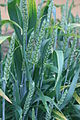
Green wheat a month before harvest
-

Young wheat crop in a field near Solapur, Maharashtra, India
-

Wheat crop near Solapur, India
-

Wheat farm in Behbahan, Iran
-

A combine harvester threshes the wheat, crushes the chaff, then blows chaff across the field. The combine loads the threshed wheat onto a truck or trailer while moving
-

Two tractors deploying a sealed storage method for newly harvested wheat.
-

Map depicting acreage devoted to wheat in Ohio, 1923
Physiology
Leaves emerge from the shoot apical meristem in a telescoping fashion until the transition to reproduction i.e. flowering. The last leaf produced by a wheat plant is known as the flag leaf. It is denser and has a higher photosynthetic rate than other leaves, to supply carbohydrate to the developing ear. In temperate countries the flag leaf, along with the second and third highest leaf on the plant, supply the majority of carbohydrate in the grain and their condition is paramount to yield formation. Wheat is unusual among plants in having more stomata on the upper (adaxial) side of the leaf, than on the under (abaxial) side. It has been theorised that this might be an effect of it having been domesticated and cultivated longer than any other plant. Winter wheat generally produces up to 15 leaves per shoot and spring wheat up to 9 and winter crops may have up to 35 tillers (shoots) per plant (depending on cultivar).
Wheat roots are among the deepest of arable crops, extending as far down as 2m. While the roots of a wheat plant are growing, the plant also accumulates an energy store in its stem, in the form of fructans, which helps the plant to yield under drought and disease pressure, but it has been observed that there is a trade-off between root growth and stem non-structural carbohydrate reserves. Root growth is likely to be prioritised in drought-adapted crops, while stem non-structural carbohydrate is prioritised in varieties developed for countries where disease is a bigger issue. Depending on variety, wheat may be awned or not awned. Producing awns incurs a cost in grain number, but wheat awns photosynthesise more efficiently than their leaves with regards to water usage, so awns are much more frequent in varieties of wheat grown in hot drought-prone countries than those generally seen in temperate countries. For this reason, awned varieties could become more widely grown due to climate change. In Europe, however, a decline in climate resilience of wheat has been observed.
Genetics and breeding
In traditional agricultural systems wheat populations often consist of landraces, informal farmer-maintained populations that often maintain high levels of morphological diversity. Although landraces of wheat are no longer grown in Europe and North America, they continue to be important elsewhere. The origins of formal wheat breeding lie in the nineteenth century, when single line varieties were created through selection of seed from a single plant noted to have desired properties. Modern wheat breeding developed in the first years of the twentieth century and was closely linked to the development of Mendelian genetics. The standard method of breeding inbred wheat cultivars is by crossing two lines using hand emasculation, then selfing or inbreeding the progeny. Selections are identified (shown to have the genes responsible for the varietal differences) ten or more generations before release as a variety or cultivar.
Major breeding objectives include high grain yield, good quality, disease and insect resistance and tolerance to abiotic stresses, including mineral, moisture and heat tolerance. The major diseases in temperate environments include the following, arranged in a rough order of their significance from cooler to warmer climates: eyespot, Stagonospora nodorum blotch (also known as glume blotch), yellow or stripe rust, powdery mildew, Septoria tritici blotch (sometimes known as leaf blotch), brown or leaf rust, Fusarium head blight, tan spot and stem rust. In tropical areas, spot blotch (also known as Helminthosporium leaf blight) is also important.
Wheat has also been the subject of mutation breeding, with the use of gamma, x-rays, ultraviolet light, and sometimes harsh chemicals. The varieties of wheat created through these methods are in the hundreds (going as far back as 1960), more of them being created in higher populated countries such as China. Bread wheat with high grain iron and zinc content has been developed through gamma radiation breeding, and through conventional selection breeding.
International wheat breeding is led by CIMMYT in Mexico. ICARDA is another major public sector international wheat breeder, but it was forced to relocate from Syria in the Syrian Civil War.
Yields
The presence of certain versions of wheat genes has been important for crop yields. Genes for the ‘dwarfing’ trait, first used by Japanese wheat breeders to produce short-stalked wheat, have had a huge effect on wheat yields worldwide, and were major factors in the success of the Green Revolution in Mexico and Asia, an initiative led by Norman Borlaug. Dwarfing genes enable the carbon that is fixed in the plant during photosynthesis to be diverted towards seed production, and they also help prevent the problem of lodging. ‘Lodging’ occurs when an ear stalk falls over in the wind and rots on the ground, and heavy nitrogenous fertilization of wheat makes the grass grow taller and become more susceptible to this problem. By 1997, 81% of the developing world’s wheat area was planted to semi-dwarf wheats, giving both increased yields and better response to nitrogenous fertilizer.
T. turgidum subsp. polonicum is known for its longer glumes and grains, has been bred into main wheat lines for its grain size effect, and likely has contributed these traits to T. petropavlovskyi and the Portuguese landrace group “Arrancada”.
As with many plants, MADS-box influences flower development, and more specifically, as with other agricultural Poaceae, heavily influences the total weight output at the end of the entire grain growing process. Despite that importance, as of 2021 little research has been done into MADS-box and other such spikelet and flower genetics in wheat specifically.
The world record wheat yield is about 17 metric tons per hectare (8 short ton/acre), reached in New Zealand in 2017. A project in the UK, led by Rothamsted Research has aimed to raise wheat yields in the country to 20t/ha by 2020, but in 2018 the UK record stood at 16t/ha, and the average yield was just 8t/ha.
Disease resistance
Wild grasses in the genus Triticum and related genera, and grasses such as rye have been a source of many disease-resistance traits for cultivated wheat breeding since the 1930s. Some resistance genes have been identified against Pyrenophora tritici-repentis, especially races 1 and 5, those most problematic in Kazakhstan.
Hybrid wheats
Because wheat self-pollinates, creating hybrid seed is extremely labor-intensive; the high cost of hybrid wheat seed relative to its moderate benefits have kept farmers from adopting them widely despite nearly 90 years of effort.
F1 hybrid wheat cultivars should not be confused with wheat cultivars deriving from standard plant breeding, which may descend from hybrid crosses further back in its ancestry. Heterosis or hybrid vigor (as in the familiar F1 hybrids of maize) occurs in common (hexaploid) wheat, but it is difficult to produce seed of hybrid cultivars on a commercial scale as is done with maize because wheat flowers are perfect in the botanical sense, meaning they have both male and female parts, and normally self-pollinate. Commercial hybrid wheat seed has been produced using chemical hybridizing agents, plant growth regulators that selectively interfere with pollen development, or naturally occurring cytoplasmic male sterility systems. Hybrid wheat has been a limited commercial success in Europe (particularly France), the United States and South Africa.
Synthetic hexaploids made by crossing the wild goatgrass wheat ancestor Aegilops tauschii, and various other Aegilops, and various durum wheats are now being deployed, and these increase the genetic diversity of cultivated wheats.
Triticale: Wheat-rye hybrid

The smaller grain of wheat on the left, larger kernels of rye next, and triticale on the right – triticale grain is significantly larger than wheat.
In ancient times, wheat was often considered a luxury grain because it had lower yield but better taste and digestibility than competitors like rye. In the 19th century, efforts were made to hybridize the two to get a crop with the best traits of both. This produced triticale, a grain with high potential, but fraught with problems relating to fertility and germination. These have mostly been solved, so that in the 20th century millions of acres of triticale are being grown worldwide.
Gluten
Modern bread wheat varieties have been cross-bred to contain greater amounts of gluten, which affords significant advantages for improving the quality of breads and pastas from a functional point of view. However, a 2020 study that grew and analyzed 60 wheat cultivars from between 1891 and 2010 found no changes in albumin/globulin and gluten contents over time. “Overall, the harvest year had a more significant effect on protein composition than the cultivar. At the protein level, we found no evidence to support an increased immunostimulatory potential of modern winter wheat.”
Water efficiency
Stomata (or leaf pores) are involved in both uptake of carbon dioxide gas from the atmosphere and water vapor losses from the leaf due to water transpiration. Basic physiological investigation of these gas exchange processes has yielded valuable carbon isotope based methods that are used for breeding wheat varieties with improved water-use efficiency. These varieties can improve crop productivity in rain-fed dry-land wheat farms.
Insect resistance
The gene Sm1 protects against the orange wheat blossom midge.
Genome
In 2010, a team of UK scientists funded by BBSRC announced they had decoded the wheat genome for the first time (95% of the genome of a variety of wheat known as Chinese Spring line 42). This genome was released in a basic format for scientists and plant breeders to use but was not a fully annotated sequence which was reported in some of the media. On 29 November 2012, an essentially complete gene set of bread wheat was published. Random shotgun libraries of total DNA and cDNA from the T. aestivum cv. Chinese Spring (CS42) were sequenced in Roche 454 pyrosequencer using GS FLX Titanium and GS FLX+ platforms to generate 85 Gb of sequence (220 million reads) and identified between 94,000 and 96,000 genes. The implications of the research in cereal genetics and breeding includes the examination of genome variation, analysis of population genetics and evolutionary biology, and further studying epigenetic modifications. In 2018 an even more complete Chinese Spring genome was released by a different team.
Then in 2020 some of the same researchers produced 15 genome sequences from various locations and varieties around the world – the most complete and detailed so far – along with examples of their own use of the sequences to localize particular insect and disease resistance factors. The team expects these sequences will be useful in future cultivar breeding.
Varieties
There are around 20 wheat varieties of 7 species grown throughout the world. In Canada different varieties are blended prior to sale. “Identity preserved” wheat that has been stored and transported separately (at extra cost) usually fetches a higher price.
Apart from mutant versions of genes selected in antiquity during domestication, there has been more recent deliberate selection of alleles that affect growth characteristics. Some wheat species are diploid, with two sets of chromosomes, but many are stable polyploids, with four sets of chromosomes (tetraploid) or six (hexaploid).
Einkorn wheat (T. monococcum) is diploid (AA, two complements of seven chromosomes, 2n=14).
Most tetraploid wheats (e.g. emmer and durum wheat) are derived from wild emmer, T. dicoccoides. Wild emmer is itself the result of a hybridization between two diploid wild grasses, T. urartu and a wild goatgrass such as Aegilops searsii or Ae. speltoides. The unknown grass has never been identified among non-extinct wild grasses, but the closest living relative is Aegilops speltoides. The hybridization that formed wild emmer (AABB) occurred in the wild, long before domestication, and was driven by natural selection.
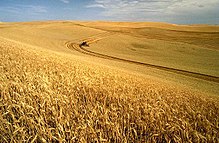
Wheat harvest on the Palouse, Idaho, United States
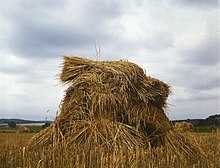
Sheaved and stooked wheat

Traditional wheat sheafing machine
Hexaploid wheats evolved in farmers’ fields. Either domesticated emmer or durum wheat hybridized with yet another wild diploid grass (Aegilops tauschii) to make the hexaploid wheats, spelt wheat and bread wheat. These have three sets of paired chromosomes, three times as many as in diploid wheat.
At the point of the end user – the farmer who is sowing and reaping – the exact variety they have in their field is usually not known. The development of genetic assays which can distinguish the small differences between cultivars is allowing that question to be answered field-by-field, for the first time.
Major cultivated species of wheat
 |
This section needs additional citations for verification. (October 2016)
|
Hexaploid species
- Common wheat or bread wheat (T. aestivum) – A hexaploid species that is the most widely cultivated in the world.
- Spelt (T. spelta) – Another hexaploid species cultivated in limited quantities. Spelt is sometimes considered a subspecies of the closely related species common wheat (T. aestivum), in which case its botanical name is considered to be T. aestivum ssp. spelta.
Tetraploid species
- Durum (T. durum) – A tetraploid form of wheat widely used today, and the second most widely cultivated wheat.
- Emmer (T. dicoccum) – A tetraploid species, cultivated in ancient times but no longer in widespread use.
- Khorasan (T. turgidum ssp. turanicum, also called T. turanicum) is a tetraploid wheat species. It is an ancient grain type; Khorasan refers to a historical region in modern-day Afghanistan and the northeast of Iran. This grain is twice the size of modern-day wheat and is known for its rich nutty flavor.
Diploid species
- Einkorn (T. monococcum) – A diploid species with wild and cultivated variants. Domesticated at the same time as emmer wheat.
Hulled versus free-threshing species

Left: Naked wheat, Bread wheat Triticum aestivum; Right: Hulled wheat, Einkorn, Triticum monococcum. Note how the einkorn ear breaks down into intact spikelets.
The four wild species of wheat, along with the domesticated varieties einkorn, emmer and spelt, have hulls. This more primitive morphology (in evolutionary terms) consists of toughened glumes that tightly enclose the grains, and (in domesticated wheats) a semi-brittle rachis that breaks easily on threshing.
The result is that when threshed, the wheat ear breaks up into spikelets. To obtain the grain, further processing, such as milling or pounding, is needed to remove the hulls or husks. Hulled wheats are often stored as spikelets because the toughened glumes give good protection against pests of stored grain.
In free-threshing (or naked) forms, such as durum wheat and common wheat, the glumes are fragile and the rachis tough. On threshing, the chaff breaks up, releasing the grains.
Naming
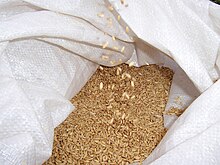
Sack of wheat

Model of a wheat grain, Botanical Museum Greifswald
There are many botanical classification systems used for wheat species, discussed in a separate article on wheat taxonomy. The name of a wheat species from one information source may not be the name of a wheat species in another.
Within a species, wheat cultivars are further classified by wheat breeders and farmers in terms of:
- Growing season, such as winter wheat vs. spring wheat.
- Protein content. Bread wheat protein content ranges from 10% in some soft wheats with high starch contents, to 15% in hard wheats.
- The quality of the wheat protein gluten. This protein can determine the suitability of a wheat to a particular dish. A strong and elastic gluten present in bread wheats enables dough to trap carbon dioxide during leavening, but elastic gluten interferes with the rolling of pasta into thin sheets. The gluten protein in durum wheats used for pasta is strong but not elastic.
- Grain color (red, white or amber). Many wheat varieties are reddish-brown due to phenolic compounds present in the bran layer which are transformed to pigments by browning enzymes. White wheats have a lower content of phenolics and browning enzymes, and are generally less astringent in taste than red wheats. The yellowish color of durum wheat and semolina flour made from it is due to a carotenoid pigment called lutein, which can be oxidized to a colorless form by enzymes present in the grain.
Classes used in North America
The named classes of wheat in English are more or less the same in Canada as in the US, as broadly the same commercial cash crop strains can be found in both.
The classes used in the United States are:
- Durum – Very hard, translucent, light-colored grain used to make semolina flour for pasta and bulghur; high in protein, specifically, gluten protein.
- Hard Red Spring – Hard, brownish, high-protein wheat used for bread and hard baked goods. Bread flour and high-gluten flours are commonly made from hard red spring wheat. It is primarily traded on the Minneapolis Grain Exchange.
- Hard Red Winter – Hard, brownish, mellow high-protein wheat used for bread, hard baked goods and as an adjunct in other flours to increase protein in pastry flour for pie crusts. Some brands of unbleached all-purpose flours are commonly made from hard red winter wheat alone. It is primarily traded on the Kansas City Board of Trade. Many varieties grown from Kansas south are descendant from a variety known as “turkey red”, which was brought to Kansas by Mennonite immigrants from Russia. Marquis wheat was developed to prosper in the shorter growing season in Canada, and is grown as far south as southern Nebraska.
- Soft Red Winter – Soft, low-protein wheat used for cakes, pie crusts, biscuits, and muffins. Cake flour, pastry flour, and some self-rising flours with baking powder and salt added, for example, are made from soft red winter wheat. It is primarily traded on the Chicago Board of Trade.
- Hard White – Hard, light-colored, opaque, chalky, medium-protein wheat planted in dry, temperate areas. Used for bread and brewing.
- Soft White – Soft, light-colored, very low protein wheat grown in temperate moist areas. Used for pie crusts and pastry. Pastry flour, for example, is sometimes made from soft white winter wheat.
Red wheats may need bleaching; therefore, white wheats usually command higher prices than red wheats on the commodities market.
As a food
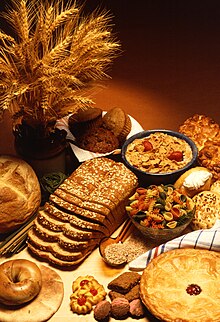
Wheat is used in a wide variety of foods.
| Nutritional value per 100 g (3.5 oz) | |
|---|---|
| Energy | 1,368 kJ (327 kcal) |
|
Carbohydrates
|
71.18 g
|
| Sugars | 0.41 |
| Dietary fiber | 12.2 g |
|
Fat
|
1.54 g
|
|
Protein
|
12.61 g
|
| Vitamins | Quantity
%DV†
|
| Thiamine (B1) |
33%
0.383 mg |
| Riboflavin (B2) |
10%
0.115 mg |
| Niacin (B3) |
36%
5.464 mg |
| Pantothenic acid (B5) |
19%
0.954 mg |
| Vitamin B6 |
23%
0.3 mg |
| Folate (B9) |
10%
38 μg |
| Choline |
6%
31.2 mg |
| Vitamin E |
7%
1.01 mg |
| Vitamin K |
2%
1.9 μg |
| Minerals | Quantity
%DV†
|
| Calcium |
3%
29 mg |
| Iron |
25%
3.19 mg |
| Magnesium |
35%
126 mg |
| Manganese |
190%
3.985 mg |
| Phosphorus |
41%
288 mg |
| Potassium |
8%
363 mg |
| Sodium |
0%
2 mg |
| Zinc |
28%
2.65 mg |
| Other constituents | Quantity |
| Water | 13.1 g |
| Selenium | 70.7 µg |
|
Link to USDA Database Entry
|
|
|
|
| †Percentages are roughly approximated using US recommendations for adults. Source: USDA FoodData Central |
|
Raw wheat can be ground into flour or, using hard durum wheat only, can be ground into semolina; germinated and dried creating malt; crushed or cut into cracked wheat; parboiled (or steamed), dried, crushed and de-branned into bulgur also known as groats. If the raw wheat is broken into parts at the mill, as is usually done, the outer husk or bran can be used in several ways.
Wheat is a major ingredient in such foods as bread, porridge, crackers, biscuits, muesli, pancakes, pasta and noodles, pies, pastries, pizza, semolina, cakes, cookies, muffins, rolls, doughnuts, gravy, beer, vodka, boza (a fermented beverage), and breakfast cereals.
In manufacturing wheat products, gluten is valuable to impart viscoelastic functional qualities in dough, enabling the preparation of diverse processed foods such as breads, noodles, and pasta that facilitate wheat consumption.
Nutrition
In 100 grams, wheat provides 1,368 kilojoules (327 kilocalories) of food energy and is a rich source (20% or more of the Daily Value, DV) of multiple essential nutrients, such as protein, dietary fiber, manganese, phosphorus and niacin (table). Several B vitamins and other dietary minerals are in significant content. Wheat is 13% water, 71% carbohydrates, and 1.5% fat. Its 13% protein content is mostly gluten (75–80% of the protein in wheat).
Wheat proteins have a low quality for human nutrition, according to the new protein quality method (DIAAS) promoted by the Food and Agriculture Organization. Though they contain adequate amounts of the other essential amino acids, at least for adults, wheat proteins are deficient in the essential amino acid, lysine. Because the proteins present in the wheat endosperm (gluten proteins) are particularly poor in lysine, white flours are more deficient in lysine compared with whole grains. Significant efforts in plant breeding are being made to develop lysine-rich wheat varieties, without success as of 2017. Supplementation with proteins from other food sources (mainly legumes) is commonly used to compensate for this deficiency, since the limitation of a single essential amino acid causes the others to break down and become excreted, which is especially important during the period of growth.
100 g (3+1⁄2 oz) of hard red winter wheat contain about 12.6 g of protein, 1.5 g of total fat, 71 g of carbohydrate (by difference), 12.2 g of dietary fiber, and 3.2 mg of iron (17% of the daily requirement); the same weight of hard red spring wheat contains about 15.4 g of protein, 1.9 g of total fat, 68 g of carbohydrate (by difference), 12.2 g of dietary fiber, and 3.6 mg of iron (20% of the daily requirement).
Worldwide production
Wheat is grown on more than 218,000,000 hectares (540,000,000 acres).
The most common forms of wheat are white and red wheat. However, other natural forms of wheat exist. Other commercially minor but nutritionally promising species of naturally evolved wheat species include black, yellow and blue wheat.
Health effects
Consumed worldwide by billions of people, wheat is a significant food for human nutrition, particularly in the least developed countries where wheat products are primary foods. When eaten as the whole grain, wheat is a healthy food source of multiple nutrients and dietary fiber recommended for children and adults, in several daily servings containing a variety of foods that meet whole grain-rich criteria. Dietary fiber may also help people feel full and therefore help with a healthy weight. Further, wheat is a major source for natural and biofortified nutrient supplementation, including dietary fiber, protein and dietary minerals.
Manufacturers of foods containing wheat as a whole grain in specified amounts are allowed a health claim for marketing purposes in the United States, stating: “low fat diets rich in fiber-containing grain products, fruits, and vegetables may reduce the risk of some types of cancer, a disease associated with many factors” and “diets low in saturated fat and cholesterol and rich in fruits, vegetables, and grain products that contain some types of dietary fiber, particularly soluble fiber, may reduce the risk of heart disease, a disease associated with many factors”. The scientific opinion of the European Food Safety Authority (EFSA) related to health claims on gut health/bowel function, weight control, blood glucose/insulin levels, weight management, blood cholesterol, satiety, glycaemic index, digestive function and cardiovascular health is “that the food constituent, whole grain, (…) is not sufficiently characterised in relation to the claimed health effects” and “that a cause and effect relationship cannot be established between the consumption of whole grain and the claimed effects considered in this opinion.”
Concerns
In genetically susceptible people, gluten – a major part of wheat protein – can trigger coeliac disease. Coeliac disease affects about 1% of the general population in developed countries. There is evidence that most cases remain undiagnosed and untreated. The only known effective treatment is a strict lifelong gluten-free diet.
While coeliac disease is caused by a reaction to wheat proteins, it is not the same as a wheat allergy. Other diseases triggered by eating wheat are non-coeliac gluten sensitivity (estimated to affect 0.5% to 13% of the general population), gluten ataxia, and dermatitis herpetiformis.
It has been speculated that FODMAPs present in wheat (mainly fructans) are the cause of non-coeliac gluten sensitivity. As of 2019, reviews have concluded that FODMAPs only explain certain gastrointestinal symptoms, such as bloating, but not the extra-digestive symptoms that people with non-coeliac gluten sensitivity may develop, such as neurological disorders, fibromyalgia, psychological disturbances, and dermatitis.
Other proteins present in wheat called amylase-trypsin inhibitors (ATIs) have been identified as the possible activator of the innate immune system in coeliac disease and non-coeliac gluten sensitivity. ATIs are part of the plant’s natural defense against insects and may cause toll-like receptor 4 (TLR4)-mediated intestinal inflammation in humans. These TLR4-stimulating activities of ATIs are limited to gluten-containing cereals. A 2017 study in mice demonstrated that ATIs exacerbate preexisting inflammation and might also worsen it at extraintestinal sites. This may explain why there is an increase of inflammation in people with preexisting diseases upon ingestion of ATIs-containing grains.
Comparison with other staple foods
The following table shows the nutrient content of wheat and other major staple foods in a raw form on a dry weight basis to account for their different water contents.
Raw forms of these staples, however, are not edible and cannot be digested. These must be sprouted, or prepared and cooked as appropriate for human consumption. In sprouted or cooked form, the relative nutritional and anti-nutritional contents of each of these staples is remarkably different from that of the raw form, as reported in this table.
In cooked form, the nutrition value for each staple depends on the cooking method (for example: baking, boiling, steaming, frying, etc.).
| Staple | Maize (corn) | Rice, white | Wheat | Potatoes | Cassava | Soybeans, green | Sweet potatoes | Yams | Sorghum | Plantain | RDA |
|---|---|---|---|---|---|---|---|---|---|---|---|
| Water content (%) | 10 | 12 | 13 | 79 | 60 | 68 | 77 | 70 | 9 | 65 | |
| Raw grams per 100g dry weight | 111 | 114 | 115 | 476 | 250 | 313 | 435 | 333 | 110 | 286 | |
| Nutrient | |||||||||||
| Energy (kJ) | 1698 | 1736 | 1574 | 1533 | 1675 | 1922 | 1565 | 1647 | 1559 | 1460 | 8,368–10,460 |
| Protein (g) | 10.4 | 8.1 | 14.5 | 9.5 | 3.5 | 40.6 | 7.0 | 5.0 | 12.4 | 3.7 | 50 |
| Fat (g) | 5.3 | 0.8 | 1.8 | 0.4 | 0.7 | 21.6 | 0.2 | 0.6 | 3.6 | 1.1 | 44–77 |
| Carbohydrates (g) | 82 | 91 | 82 | 81 | 95 | 34 | 87 | 93 | 82 | 91 | 130 |
| Fiber (g) | 8.1 | 1.5 | 14.0 | 10.5 | 4.5 | 13.1 | 13.0 | 13.7 | 6.9 | 6.6 | 30 |
| Sugar (g) | 0.7 | 0.1 | 0.5 | 3.7 | 4.3 | 0.0 | 18.2 | 1.7 | 0.0 | 42.9 | minimal |
| Minerals | RDA | ||||||||||
| Calcium (mg) | 8 | 32 | 33 | 57 | 40 | 616 | 130 | 57 | 31 | 9 | 1,000 |
| Iron (mg) | 3.01 | 0.91 | 3.67 | 3.71 | 0.68 | 11.09 | 2.65 | 1.80 | 4.84 | 1.71 | 8 |
| Magnesium (mg) | 141 | 28 | 145 | 110 | 53 | 203 | 109 | 70 | 0 | 106 | 400 |
| Phosphorus (mg) | 233 | 131 | 331 | 271 | 68 | 606 | 204 | 183 | 315 | 97 | 700 |
| Potassium (mg) | 319 | 131 | 417 | 2005 | 678 | 1938 | 1465 | 2720 | 385 | 1426 | 4700 |
| Sodium (mg) | 39 | 6 | 2 | 29 | 35 | 47 | 239 | 30 | 7 | 11 | 1,500 |
| Zinc (mg) | 2.46 | 1.24 | 3.05 | 1.38 | 0.85 | 3.09 | 1.30 | 0.80 | 0.00 | 0.40 | 11 |
| Copper (mg) | 0.34 | 0.25 | 0.49 | 0.52 | 0.25 | 0.41 | 0.65 | 0.60 | – | 0.23 | 0.9 |
| Manganese (mg) | 0.54 | 1.24 | 4.59 | 0.71 | 0.95 | 1.72 | 1.13 | 1.33 | – | – | 2.3 |
| Selenium (μg) | 17.2 | 17.2 | 81.3 | 1.4 | 1.8 | 4.7 | 2.6 | 2.3 | 0.0 | 4.3 |