
The 14th Dalai Lama (spiritual name Jetsun Jamphel Ngawang Lobsang Yeshe Tenzin Gyatso, known as Tenzin Gyatso (Tibetan: བསྟན་འཛིན་རྒྱ་མཚོ་, Wylie: bsTan-‘dzin rgya-mtsho); né Lhamo Thondup), known as Gyalwa Rinpoche to the Tibetan people, is the current Dalai Lama. He is the highest spiritual leader and former head of the country of Tibet. He was born on 6 July 1935, or in the Tibetan calendar, in the Wood-Pig Year, 5th month, 5th day. He is considered a living Bodhisattva, specifically, an emanation of Avalokiteśvara in Sanskrit and Chenrezig in Tibetan. He is also the leader and a monk of the Gelug school, the newest school of Tibetan Buddhism, formally headed by the Ganden Tripa. The central government of Tibet, the Ganden Phodrang, invested the Dalai Lama with temporal duties until his exile in 1959.
The 14th Dalai Lama was born to a farming family in Taktser (Hongya Village), in the traditional Tibetan region of Amdo (administratively Qinghai Province, Republic of China). He was selected as the tulku of the 13th Dalai Lama in 1937 and formally recognized as the 14th Dalai Lama in a public declaration near the town of Bumchen in 1939. As with the recognition process for his predecessor, a Golden Urn selection process was not used. His enthronement ceremony was held in Lhasa on 22 February 1940 and he eventually assumed full temporal (political) duties on 17 November 1950, at the age of 15, after the People’s Republic of China’s occupation of Tibet. The Tibetan government administered the historic Tibetan regions of Ü-Tsang, Kham and Amdo.
Subsequent to the Annexation of Tibet by the People’s Republic of China, during the 1959 Tibetan uprising, the Dalai Lama escaped to India, where he currently lives in exile while remaining the most important spiritual leader of Tibet. On 29 April 1959, the Dalai Lama established the independent Tibetan government in exile in the north Indian hill station of Mussoorie, which then moved in May 1960 to Dharamshala, where he resides. He retired as political head in 2011 to make way for a democratic government, the Central Tibetan Administration.
The Dalai Lama advocates for the welfare of Tibetans and has called for the Middle Way Approach with China to peacefully resolve the issue of Tibet since the early 1970s. The Dalai Lama travels worldwide to give Tibetan Mahayana and Vajrayana Buddhism teachings, and his Kalachakra teachings and initiations are international events. He also attends conferences on a wide range of subjects, including the relationship between religion and science, meets with other world leaders, religious leaders, philosophers and scientists, online and in person. His work includes focus on the environment, economics, women’s rights, nonviolence, interfaith dialogue, physics, astronomy, Buddhism and science, cognitive neuroscience, reproductive health and sexuality.
The Dalai Lama was awarded the Nobel Peace Prize in 1989, and the US Congressional Gold Medal in 2006. Time magazine named the Dalai Lama one of the “Children of Mahatma Gandhi” and Gandhi’s spiritual heir to nonviolence.
Early life and background
Lhamo Thondup was born on 6 July 1935 to a farming and horse trading family in the small hamlet of Taktser, or Chija Tagtser (Chinese: 红崖村; pinyin: Hóngyá Cūn; lit. ‘Redcliff Village’), at the edge of the traditional Tibetan region of Amdo in Qinghai Province.
He was one of seven siblings to survive childhood and one of the three supposed reincarnated Rinpoches in the same family. His eldest sister Tsering Dolma, was sixteen years his senior and was midwife to his mother at his birth. She would accompany him into exile and found Tibetan Children’s Villages. His eldest brother, Thupten Jigme Norbu, had been recognised at the age of three by the 13th Dalai Lama as the reincarnation of the high Lama, the 6th Taktser Rinpoche. His fifth brother, Tendzin Choegyal, had been recognised as the 16th Ngari Rinpoche. His sister, Jetsun Pema, spent most of her adult life on the Tibetan Children’s Villages project. The Dalai Lama has said that his first language was “a broken Xining language which was (a dialect of) the Chinese language”, a form of Central Plains Mandarin, and his family speak neither Amdo Tibetan nor Lhasa Tibetan.

The Dalai Lama as a child
After the demise of the 13th Dalai Lama, in 1935, the Ordinance of Lama Temple Management (Chinese: 管理喇嘛寺廟條例) was published by the Central Government. In 1936, the Method of Reincarnation of Lamas (Chinese: 喇嘛轉世辦法) was published by the Mongolian and Tibetan Affairs Commission of the Central Government. Article 3 states that death of lamas, including the Dalai Lama and Panchen Lama, should be reported to the commission, soul boys should be located and checked by the commission, and a lot-drawing ceremony with the Golden Urn system should be held. Article 6 states that local governments should invite officials from the Central Government to take care of the sitting-in-the-bed ceremony. Article 7 states that soul boys should not be sought from current lama families. Article 7 echoes what the Qianlong Emperor described in The Discourse of Lama to eliminate greedy families with multiple reincarnated rinpoches, lamas. Based on custom and regulation, the regent was actively involved in the search for the reincarnation of the Dalai Lama.
Following reported signs and visions, three search teams were sent out to the north-east, the east, and the south-east to locate the new incarnation when the boy who was to become the 14th Dalai Lama was about two years old. Sir Basil Gould, British delegate to Lhasa in 1936, related his account of the north-eastern team to Sir Charles Alfred Bell, former British resident in Lhasa and friend of the 13th Dalai Lama. Amongst other omens, the head of the embalmed body of the thirteenth Dalai Lama, at first facing south-east, had turned to face the north-east, indicating, it was interpreted, the direction in which his successor would be found. The Regent, Reting Rinpoche, shortly afterwards had a vision at the sacred lake of Lhamo La-tso which he interpreted as Amdo being the region to search. This vision was also interpreted to refer to a large monastery with a gilded roof and turquoise tiles, and a twisting path from there to a hill to the east, opposite which stood a small house with distinctive eaves. The team, led by Kewtsang Rinpoche, went first to meet the Panchen Lama, who had been stuck in Jyekundo, in northern Kham. The Panchen Lama had been investigating births of unusual children in the area ever since the death of the 13th Dalai Lama. He gave Kewtsang the names of three boys whom he had discovered and identified as candidates. Within a year the Panchen Lama had died. Two of his three candidates were crossed off the list but the third, a “fearless” child, the most promising, was from Taktser village, which, as in the vision, was on a hill, at the end of a trail leading to Taktser from the great Kumbum Monastery with its gilded, turquoise roof. There they found a house, as interpreted from the vision—the house where Lhamo Dhondup lived.
The 14th Dalai Lama claims that at the time, the village of Taktser stood right on the “real border” between the region of Amdo and China. According to the search lore, when the team visited, posing as pilgrims, its leader, a Sera Lama, pretended to be the servant and sat separately in the kitchen. He held an old mala that had belonged to the 13th Dalai Lama, and the boy Lhamo Dhondup, aged two, approached and asked for it. The monk said “if you know who I am, you can have it.” The child said “Sera Lama, Sera Lama” and spoke with him in a Lhasa accent, in a dialect the boy’s mother could not understand. The next time the party returned to the house, they revealed their real purpose and asked permission to subject the boy to certain tests. One test consisted of showing him various pairs of objects, one of which had belonged to the 13th Dalai Lama and one which had not. In every case, he chose the Dalai Lama’s own objects and rejected the others.

House where the 14th Dalai Lama was born in Taktser, Amdo
From 1936 the Hui ‘Ma Clique’ Muslim warlord Ma Bufang ruled Qinghai as its governor under the nominal authority of the Republic of China central government. According to an interview with the 14th Dalai Lama, in the 1930s, Ma Bufang had seized this north-east corner of Amdo in the name of Chiang Kai-shek’s weak government and incorporated it into the Chinese province of Qinghai. Before going to Taktser, Kewtsang had gone to Ma Bufang to pay his respects. When Ma Bufang heard a candidate had been found in Taktser, he had the family brought to him in Xining. He first demanded proof that the boy was the Dalai Lama, but the Lhasa government, though informed by Kewtsang that this was the one, told Kewtsang to say he had to go to Lhasa for further tests with other candidates. They knew that if he was declared to be the Dalai Lama, the Chinese government would insist on sending a large army escort with him, which would then stay in Lhasa and refuse to budge. Ma Bufang, together with Kumbum Monastery, then refused to allow him to depart unless he was declared to be the Dalai Lama, but withdrew this demand in return for 100,000 Chinese dollars ransom in silver to be shared amongst them, to let them go to Lhasa. Kewtsang managed to raise this, but the family was only allowed to move from Xining to Kumbum when a further demand was made for another 330,000 dollars ransom: one hundred thousand each for government officials, the commander-in-chief, and the Kumbum Monastery; twenty thousand for the escort; and only ten thousand for Ma Bufang himself, he said.
Two years of diplomatic wrangling followed before it was accepted by Lhasa that the ransom had to be paid to avoid the Chinese getting involved and escorting him to Lhasa with a large army. Meanwhile, the boy was kept at Kumbum where two of his brothers were already studying as monks and recognised incarnate lamas. The payment of 300,000 silver dollars was then advanced by Muslim traders en route to Mecca in a large caravan via Lhasa. They paid Ma Bufang on behalf of the Tibetan government against promissory notes to be redeemed, with interest, in Lhasa. The 20,000-dollar fee for an escort was dropped, since the Muslim merchants invited them to join their caravan for protection; Ma Bufang sent 20 of his soldiers with them and was paid from both sides since the Chinese government granted him another 50,000 dollars for the expenses of the journey. Furthermore, the Indian government helped the Tibetans raise the ransom funds by affording them import concessions.
On 22 September 1938, representatives of Tibet Office in Beijing informed Mongolian and Tibetan Affairs Commission that 3 candidates were found and ceremony of Golden Urn would be held in Tibet.
Released from Kumbum, on 21 July 1939 the party travelled across Tibet on a journey to Lhasa in the large Muslim caravan with Lhamo Dhondup, now 4 years old, riding with his brother Lobsang in a special palanquin carried by two mules, two years after being discovered. As soon as they were out of Ma Bufang’s area, he was officially declared to be the 14th Dalai Lama by the Kashag, and after ten weeks of travel he arrived in Lhasa on 8 October 1939. The ordination (pabbajja) and giving of the monastic name of Tenzin Gyatso were arranged by Reting Rinpoche and according to the Dalai Lama “I received my ordination from Kyabjé Ling Rinpoché in the Jokhang in Lhasa.” There was very limited Chinese involvement at this time. The family of the 14th Dalai Lama was elevated to the highest stratum of the Tibetan aristocracy and acquired land and serf holdings, as with the families of previous Dalai Lamas.
In 1959, at the age of 23, he took his final examination at Lhasa’s Jokhang Temple during the annual Monlam Prayer Festival. He passed with honours and was awarded the Lharampa degree, the highest-level geshe degree, roughly equivalent to a doctorate in Buddhist philosophy.
The Dalai Lama, whose name means “Ocean of Wisdom,” is known to Tibetans as Gyalwa Rinpoche, “The Precious Jewel-like Buddha-Master;” Kundun, “The Presence;” and Yizhin Norbu, “The Wish-Fulfilling Gem.” His devotees, as well as much of the Western world, often call him His Holiness the Dalai Lama, the style employed on the Dalai Lama’s website. According to the Dalai Lama, he had a succession of tutors in Tibet including Reting Rinpoche, Tathag Rinpoche, Ling Rinpoche and lastly Trijang Rinpoche, who became junior tutor when he was nineteen. At the age of 11 he met the Austrian mountaineer Heinrich Harrer, who became his videographer and tutor about the world outside Lhasa. The two remained friends until Harrer’s death in 2006.
Life as the Dalai Lama
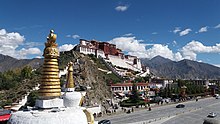
Lhasa’s Potala Palace, today a UNESCO World Heritage Site, pictured in 2019
Historically the Dalai Lamas or their regents held political and religious leadership over Tibet from Lhasa with varying degrees of influence depending on the regions of Tibet and periods of history. This began with the 5th Dalai Lama’s rule in 1642 and lasted until the 1950s (except for 1705–1750), during which period the Dalai Lamas headed the Tibetan government or Ganden Phodrang. Until 1912 however, when the 13th Dalai Lama declared the complete independence of Tibet, their rule was generally subject to patronage and protection of firstly Mongol kings (1642–1720) and then the Manchu-led Qing dynasty (1720–1912).
During the Dalai Lama’s recognition process, the cultural Anthropologist Goldstein writes:
everything the Tibetans did during the selection process was designed to prevent China from playing any role.
Afterwards in 1939, at the age of four, the Dalai Lama was taken in a procession of lamas to Lhasa. The traditional ceremony enthroning the 14th Dalai Lama was attended by observing Chinese and foreign dignitaries after a traditional Tibetan recognition processes.
Sir Basil Gould, the British representative of the Government of India, has left a highly detailed account of the ceremonies surrounding the enthronement of the 14th Dalai Lama in Chapter 16 of his memoir, The Jewel in the Lotus. Gould disputes the Chinese claim to have presided over it. He criticised the Chinese account as follows:
The report was issued in the Chinese Press that Mr Wu had escorted the Dalai Lama to his throne and announced his installation, that the Dalai Lama had returned thanks, and prostrated himself in token of his gratitude. Every one of these Chinese claims was false. Mr Wu was merely a passive spectator. He did no more than present a ceremonial scarf, as was done by the others, including the British Representative. But the Chinese have the ear of the world, and can later refer to their press records and present an account of historical events that is wholly untrue. Tibet has no newspapers, either in English or Tibetan, and has therefore no means of exposing these falsehoods.

Territorial extent of Tibet and approximate line of the Chinese Communist advance in 1950
Tibetan scholar Nyima Gyaincain wrote that based on Tibetan tradition, there was no such thing as presiding over an event, and wrote that the word “主持 (preside or organize)” was used in many places in communication documents. The meaning of the word was different than what we understand today. He added that Wu Zhongxin spent a lot of time and energy on the event, his effect of presiding over or organizing the event was very obvious.
After his enthronement, the Dalai Lama’s childhood was then spent between the Potala Palace and Norbulingka, his summer residence, both of which are now UNESCO World Heritage sites.
Chiang Kai Shek ordered Ma Bufang to put his Muslim soldiers on alert for an invasion of Tibet in 1942. Ma Bufang complied, and moved several thousand troops to the border with Tibet. Chiang also threatened the Tibetans with aerial bombardment if they worked with the Japanese. Ma Bufang attacked the Tibetan Buddhist Tsang monastery in 1941. He also constantly attacked the Labrang monastery.
In October 1950 the army of the People’s Republic of China marched to the edge of the Dalai Lama’s territory and sent a delegation after defeating a legion of the Tibetan army in warlord-controlled Kham. On 17 November 1950, at the age of 15, the 14th Dalai Lama assumed full temporal (political) power as ruler of Tibet.
Cooperation and conflicts with the People’s Republic of China
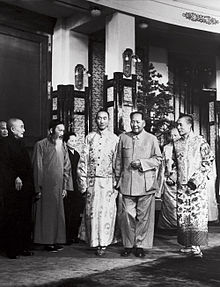
An iconic photo showing Panchen Lama (left), Mao and Dalai Lama (right) at Qinzheng Hall on 11 September 1954, four days before they attended the 1st National People’s Congress.

Mao Zedong and Zhou Enlai meeting with Dalai Lama and Panchen Lama to celebrate Tibetan New Year, 1955

Rare shot of an adult Dalai Lama (right) and Panchen Lama (left) without eyeglasses. 1954–1955.
The Dalai Lama’s formal rule as head of the government in Tibet was brief although he was enthroned as spiritual leader on February 22, 1940. When Chinese cadres entered Tibet in 1950, with a crisis looming, the Dalai Lama was asked to assume the role of head of state at the age of 15, which he did on November 17, 1950. Customarily the Dalai Lama would typically assume control at about the age of 20.
He sent a delegation to Beijing, which ratified the Seventeen Point Agreement without his authorization in 1951. The Dalai Lama believes the draft agreement was written by China. Tibetan representatives were not allowed to suggest any alterations and China did not allow the Tibetan representatives to communicate with the Tibetan government in Lhasa. The Tibetan delegation was not authorized by Lhasa to sign, but ultimately submitted to pressure from the Chinese to sign anyway, using seals specifically made for the purpose. The Seventeen Point Agreement recognized Chinese sovereignty over Tibet, but China allowed the Dalai Lama to continue to rule Tibet internally, and it allowed the system of feudal peasantry to persist.
“So even if it were agreed that serfdom and feudalism existed in Tibet, this would be little different other than in technicalities from conditions in any other “premodern” peasant society, including most of China at that time. The power of the Chinese argument therefore lies in its implication that serfdom, and with it feudalism, is inseparable from extreme abuse,” “based on serfdom, it was not necessarily feudal, and refutes any automatic link with extreme abuse.” “Evidence to support this linkage has not been found by scholars other than those close to Chinese governmental circles.”
The nineteen year old Dalai Lama toured China for almost a year from 1954 to 1955, meeting many of the revolutionary leaders and the top echelon of the Chinese communist leadership who created modern China. He learned Chinese and socialist ideals, as explained by his Chinese hosts, on a tour of China showcasing the benefits of socialism and the effective governance provided to turn the large, impoverished nation into a modern and egalitarian society, which impressed him. In September 1954, he went to the Chinese capital to meet Chairman Mao Zedong with the 10th Panchen Lama and attend the first session of the National People’s Congress as a delegate, primarily discussing China’s constitution. On 27 September 1954, the Dalai Lama was selected as a Vice chairman of the Standing Committee of the National People’s Congress, a post he officially held until 1964.
Mao Zedong who, “according to the Tibetan leader, treated him as a ‘father would treat a son,'” “also showed Tibet’s political leader and its foremost spiritual master its ambivalence to Tibetan Buddhism. The Dalai Lama recounts this episode in his autobiography, My Land and My People,
‘A few days later I had a message from Mao Tse-tung to say that he was coming to see me in an hour’s time. When he arrived he said he had merely come to call. Then something made him say that Buddhism was quite a good religion, and Lord Buddha, although he was a prince, had given a good deal of thought to the question of improving the conditions of the people. He also observed that the Goddess Tara was a kind-hearted woman. After a very few minutes, he left. I was quite bewildered by these remarks and did not know what to make of them.’
The comments Mao made during their last meeting shocked the Dalai Lama beyond belief. ‘My final interview with this remarkable man was toward the end of my visit to China. I was at a meeting of the Standing Committee of the National Assembly when I received a message asking me to go to see him at this house. By then, I had been able to complete a tour of the Chinese provinces, and I was able to tell him truthfully that I had been greatly impressed and interested by all the development projects I had seen. Then he started to give me a long lecture about the true form of democracy, and advised me how to become a leader of the people and how to take heed of their suggestions. And then he edged closer to me on his chair and whispered:
I understand you very well. But of course, religion is poison. It has two great defects: It undermines the race, and secondly it retards the progress of the country. Tibet and Mongolia have both been poisoned by it.'” In his autobiography, Freedom In Exile, the Dalai Lama recalls: “How could he have thought I was not religious to the core of my being?'”
In 1956, on a trip to India to celebrate the Buddha’s Birthday, the Dalai Lama asked the Prime Minister of India, Jawaharlal Nehru, if he would allow him political asylum should he choose to stay. Nehru discouraged this as a provocation against peace, and reminded him of the Indian Government’s non-interventionist stance agreed upon with its 1954 treaty with China.
Long called a “splitist” and “traitor” by China, the Dalai Lama has attempted formal talks over Tibet’s status in China. In 2019, after the United States passed a law requiring the US to deny visas to Chinese officials in charge of implementing policies that restrict foreign access to Tibet, the US Ambassador to China “encouraged the Chinese government to engage in substantive dialogue with the Dalai Lama or his representatives, without preconditions, to seek a settlement that resolves differences”.
The Chinese Foreign Ministry has warned the US and other countries to “shun” the Dalai Lama during visits and often uses trade negotiations and human rights talks as an incentive to do so. China sporadically bans images of the Dalai Lama and arrests citizens for owning photos of him in Tibet. Tibet Autonomous Region government job candidates must strongly denounce the Dalai Lama, as announced on the Tibet Autonomous Region government’s online education platform,
“Support the (Communist) Party’s leadership, resolutely implement the Party’s line, line of approach, policies, and the guiding ideology of Tibet work in the new era; align ideologically, politically, and in action with the Party Central Committee; oppose any splittist tendencies; expose and criticize the Dalai Lama; safeguard the unity of the motherland and ethnic unity and take a firm stand on political issues, taking a clear and distinct stand”.
The Dalai Lama is a target of Chinese state sponsored hacking. Security experts claim “targeting Tibetan activists is a strong indicator of official Chinese government involvement” since economic information is the primary goal of private Chinese hackers. In 2009 the personal office of the Dalai Lama asked researchers at the Munk Center for International Studies at the University of Toronto to check its computers for malicious software. This led to uncovering GhostNet, a large-scale cyber spying operation which infiltrated at least 1,295 computers in 103 countries, including embassies, foreign ministries, other government offices, and organizations affiliated with the Dalai Lama in India, Brussels, London and New York, and believed to be focusing on the governments of South and Southeast Asia. A second cyberspy network, Shadow Network, was discovered by the same researchers in 2010. Stolen documents included a years worth of the Dalai Lama’s personal email, and classified government material relating to India, West Africa, the Russian Federation, the Middle East, and NATO. “Sophisticated” hackers were linked to universities in China, Beijing again denied involvement. Chinese hackers posing as The New York Times, Amnesty International and other organization’s reporters targeted the private office of the Dalai Lama, Tibetan Parliament members, and Tibetan nongovernmental organizations, among others, in 2019.
Exile to India
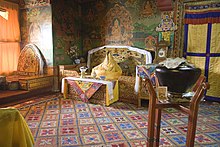
Abandoned former quarters of the Dalai Lama at the Potala. The empty vestment placed on the throne symbolises his absence
Criticism
Ties to India

Stone Plaque at a plantation by Tenzin in Amaravathi
The Chinese press has criticized the Dalai Lama for his close ties with India. His 2010 remarks at the International Buddhist Conference in Gujarat saying that he was “Tibetan in appearance, but an Indian in spirituality” and referral to himself as a “son of India” in particular led the People’s Daily to opine, “Since the Dalai Lama deems himself an Indian rather than Chinese, then why is he entitled to represent the voice of the Tibetan people?” Dhundup Gyalpo of the Tibet Sun replied that Tibetan religion could be traced back to Nalanda in India, and that Tibetans have no connection to Chinese “apart … from a handful of culinary dishes”. The People’s Daily stressed the links between Chinese Buddhism and Tibetan Buddhism had accused the Dalai Lama of “betraying southern Tibet to India”. In 2008, the Dalai Lama said for the first time that the territory India claims and administers as part of Arunachal Pradesh is part of India, citing the disputed 1914 Simla Accord.
Shugden controversy
The Dorje Shugden Controversy reappeared in the Gelug school by the publication of the Yellow Book in 1976, containing stories about wrathful acts of Dorje Shugden against Gelugpas who also practiced Nyingma teachings. In response, the 14th Dalai Lama, a Gelugpa himself and advocate of an “inclusive” approach to the teachings of Tibetan Buddhism, started to speak out against the practice of Dorje Shugden in 1978.
The controversy has attracted attention in the West because of demonstrations held in 2008 and 2014 by Dorje Shugden practitioners. A 2015 Reuters investigation determined “that the religious sect behind the protests has the backing of the Communist Party” and that the “group has emerged as an instrument in Beijing’s long campaign to undermine support for the Dalai Lama”. After the Reuters investigation revealed that China backs it, the Shugden group halted operations and disbanded.
Sexism
In 2010, the Dalai Lama told a reporter that the first time someone asked him about the possibility of a female Dalai Lama, he said “if she is an ugly female, she won’t be very effective, will she?” In 2015 he said at one occasion, “more than 50 years ago” in Paris, he said the line to a reporter of a women’s magazine, that “if female Dalai Lama comes, the face should be very, very attractive.” In 2019, when he was asked about the comment, he repeated it with a laugh, saying that although the real beauty is inner beauty, for human beings, the appearance is also very important. In response to the controversy sparked by the interview, his office released a statement to clarify his remarks and put them into context, expressing that the Dalai Lama “is deeply sorry that people have been hurt by what he said and offers his sincere apologies.” The statement explains, the original context of the Dalai Lama’s referring to the physical appearance of a female successor was “a conversation with the then Paris editor of Vogue magazine, who had invited His Holiness in 1992 to guest-edit the next edition. She asked if a future Dalai Lama could be a woman. His Holiness replied, ‘Certainly, if that would be more helpful,’ adding, as a joke, that she should be attractive.” The statement also noted, the Dalai Lama “consistently emphasizes the need for people to connect with each other on a deeper human level, rather than getting caught up in preconceptions based on superficial appearances.” Nevertheless, many felt that the apology did nothing to address his repeated similar comments throughout the leader’s life, finding them sexist.
Gedhun Choekyi Nyima
In April 2018, the Dalai Lama confirmed the official Chinese claims about Gedhun Choekyi Nyima by saying that he knew from “reliable sources” that the Panchen Lama he had recognized was alive and receiving normal education. He said he hoped that the Chinese-recognised Panchen Lama (Gyaincain Norbu) studied well under the guidance of a good teacher, adding that there were instances in Tibetan Buddhist tradition, of a reincarnated lama taking more than one manifestation.
Public image

The Dalai Lama meeting with U.S. President Barack Obama in 2016

Buddhist temple in Kalmykia, Russia
The Dalai Lama places highly in global surveys of the world’s most admired men, ranking with Pope Francis as among the world’s religious leaders cited as the most admired.
The Dalai Lama’s appeal is variously ascribed to his charismatic personality, international fascination with Buddhism, his universalist values, and international sympathy for the Tibetans. In the 1990s, many films were released by the American film industry about Tibet, including biopics of the Dalai Lama. This is attributed to both the Dalai Lama’s 1989 Nobel Peace Prize as well as to the euphoria following the Fall of Communism. The most notable films, Kundun and Seven Years in Tibet (both released in 1997), portrayed “an idyllic pre-1950 Tibet, with a smiling, soft-spoken Dalai Lama at the helm – a Dalai Lama sworn to non-violence”: portrayals the Chinese government decried as ahistorical.
The Dalai Lama has his own pages on Twitter, Facebook, and Instagram.
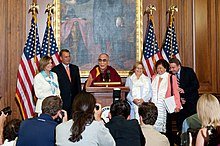
The Dalai Lama meeting with Congressional leaders Nancy Pelosi and John Boehner in 2011
The Dalai Lama has tried to mobilize international support for Tibetan activities. The Dalai Lama has been successful in gaining Western support for himself and the cause of greater Tibetan autonomy, including vocal support from numerous Hollywood celebrities, most notably the actors Richard Gere and Steven Seagal, as well as lawmakers from several major countries. Photos of the Dalai Lama were banned after March 1959 Lhasa protests until after the end of the Cultural Revolution in 1976. In 1996 the Chinese Communist Party once again reinstated the total prohibition of any photo of the 14th Dalai Lama. According to the Tibet Information Network, “authorities in Tibet have begun banning photographs of the exiled Dalai Lama in monasteries and public places, according to reports from a monitoring group and a Tibetan newspaper. Plainclothes police went to hotels and restaurants in Lhasa, the Tibetan capital, on 22 and 23 April and ordered Tibetans to remove pictures of the Dalai Lama …” The ban continues in many locations throughout Tibet today.
In the media
The 14th Dalai Lama has appeared in several non-fiction films including:
- 10 Questions for the Dalai Lama (2006, documentary)
- Dalai Lama Renaissance (2007, documentary)
- The Sun Behind the Clouds (2010)
- Bringing Tibet Home (2013)
- Monk with a Camera (2014, documentary)
- Dalai Lama Awakening (2014)
- Compassion in Action (2014)
He has been depicted as a character in various other movies and television programs including:
- Kundun, 1997 film directed by Martin Scorsese
- Seven Years in Tibet, 1997 film starring Brad Pitt and David Thewlis
- Klovn “Dalai Lama” Season 1, Episode 4 (2005)
- Red Dwarf episode “Meltdown” (1991)
- Song of Tibet, 2000 film directed by Xie Fei.
- The Great Escape “14th Dalai Lama” (2018) on Epic
- “Dalai Lama”, episode of the Indian television series Mega Icons (2019–20) on National Geographic.
The Dalai Lama was featured on 5 March 2017, episode of the HBO late-night talk show Last Week Tonight, in which host John Oliver conducted a comedic interview with the Dalai Lama, focusing on the topics of Tibetan sovereignty, Tibetan self-immolations, and his succession plans.
A biographical graphic novel, Man of Peace, also envisaging the Dalai Lama’s return to Tibet, was published by Tibet House US. The Extraordinary Life of His Holiness the Fourteenth Dalai Lama: An Illuminated Journey, illustrations and text by artist Rima Fujita, narrated by the Dalai Lama, was published by Simon and Schuster in 2021.
Awards and honours
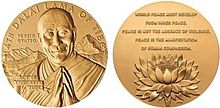
The Congressional Gold Medal was awarded to Tenzin Gyatso in 2007

The Dalai Lama receiving a Congressional Gold Medal in 2007. From left: Speaker of the United States House of Representatives Nancy Pelosi, Senate President pro tempore Robert Byrd and U.S. President George W. Bush
The Dalai Lama has received numerous awards and honors worldwide over his spiritual and political career. For a more complete list see Awards and honors presented to the 14th Dalai Lama.
After the 1989 Tiananmen Square protests and massacre, the Norwegian Nobel Committee awarded him the 1989 Nobel Peace Prize. The Committee officially gave the prize to the Dalai Lama for “the struggle of the liberation of Tibet and the efforts for a peaceful resolution” and “in part a tribute to the memory of Mahatma Gandhi”.
He has also been awarded the:
- 1959 Ramon Magsaysay Award for Community Leadership;
- 1994 Freedom Medal from the Roosevelt Institute;
- 2005 Christmas Humphreys Award from the Buddhist Society in the United Kingdom;
- 2007 Congressional Gold Medal, the highest civilian award bestowed by the American Congress and President. The Chinese government declared this would have “an extremely serious impact” on relations with the United States;
- 2006 Order of the White Lotus by the Republic of Kalmykia for outstanding services and significant contribution to the spiritual revival and prosperity of the republic.
- 2007 Ahimsa Award from the Institute of Jainology in recognition of individuals who embody and promote the principles of Ahimsa (Non-violence); and in
- 2012, Order of the Republic of Tuva by the Tuvan Republic in recognition of the contribution to the upbringing of high spiritual and cultural tolerance, strengthening interreligious and interethnic harmony.
- 2012, the Templeton Prize. He donated the prize money to the charity Save the Children.
In 2006, he became one of only six people ever to be granted Honorary Citizenship of Canada. In 2007 he was named Presidential Distinguished Professor at Emory University in Atlanta, Georgia, the first time he accepted a university appointment. He is the chief Patron of the Maha Bodhi Society of India, conferred upon him at the 2008 Annual General Meeting of the Maha Bodhi Society of India.
Publications
- My Land and My People: The Autobiography of His Holiness the Dalai Lama. Ed. David Howarth. Weidenfeld and Nicolson, 1962. ISBN 978-0446674218
- Deity Yoga: In Action and Performance Tantras. Ed. and trans. Jeffrey Hopkins. Snow Lion, 1987. ISBN 978-0-93793-850-8
- Tantra in Tibet. Co-authored with Tsong-kha-pa, Jeffrey Hopkins. Snow Lion, 1987. ISBN 978-0-93793-849-2
- The Dalai Lama at Harvard. Ed. and trans. Jeffrey Hopkins. Snow Lion, 1988. ISBN 978-0-93793-871-3
- Freedom in Exile: The Autobiography of the Dalai Lama, London: Little, Brown and Co., 1990, ISBN 978-0-349-10462-1
- My Tibet, co-authored with photographer Galen Rowell, 1990, ISBN 978-0-520-08948-8
- The Path to Enlightenment. Ed. and trans. Glenn H. Mullin. Snow Lion, 1994. ISBN 978-1-55939-032-3
- Essential Teachings, North Atlantic Books, 1995, ISBN 1556431929
- The World of Tibetan Buddhism, translated by Geshe Thupten Jinpa, foreword by Richard Gere, Wisdom Publications, 1995, ISBN 0-86171-100-9
- Tibetan Portrait: The Power of Compassion, photographs by Phil Borges with sayings by Tenzin Gyatso, 1996, ISBN 978-0-8478-1957-7
- Healing Anger: The Power of Patience from a Buddhist Perspective. Trans. Thupten Jinpa. Ithaca, NY: Snow Lion, 1997, ISBN 978-1-55939-073-6
- The Gelug/Kagyü Tradition of Mahamudra, co-authored with Alexander Berzin. Ithaca, NY: Snow Lion Publications, 1997, ISBN 978-1-55939-072-9
- The Art of Happiness, co-authored with Howard C. Cutler, M.D., Riverhead Books, 1998, ISBN 978-0-9656682-9-3
- The Good Heart: A Buddhist Perspective on the Teachings of Jesus, translated by Geshe Thupten Jinpa, Wisdom Publications, 1998, ISBN 978-0-86171-138-3
- Kalachakra Tantra: Rite of Initiation, edited by Jeffrey Hopkins, Wisdom Publications, 1999, ISBN 978-0-86171-151-2
- MindScience: An East–West Dialogue, with contributions by Herbert Benson, Daniel Goleman, Robert Thurman, and Howard Gardner, Wisdom Publications, 1999, ISBN 978-0-86171-066-9
- The Power of Buddhism, co-authored with Jean-Claude Carrière, 1999, ISBN 978-0-7171-2803-7
- Opening the Eye of New Awareness, Translated by Donald S. Lopez, Jr., Wisdom Publications, 1999, ISBN 978-0-86171-155-0
- Ethics for the New Millennium, Riverhead Books, 1999, ISBN 978-1-57322-883-1
- Consciousness at the Crossroads. Ed. Zara Houshmand, Robert B. Livingston, B. Alan Wallace. Trans. Thupten Jinpa, B. Alan Wallace. Snow Lion, 1999. ISBN 978-1-55939-127-6
- Ancient Wisdom, Modern World: Ethics for the New Millennium, Little, Brown/Abacus Press, 2000, ISBN 978-0-349-11443-9
- Dzogchen: Heart Essence of the Great Perfection, translated by Geshe Thupten Jinpa and Richard Barron, Snow Lion Publications, 2000, ISBN 978-1-55939-219-8
- The Meaning of Life: Buddhist Perspectives on Cause and Effect, Translated by Jeffrey Hopkins, Wisdom Publications, 2000, ISBN 978-0-86171-173-4
- Answers: Discussions with Western Buddhists. Ed. and trans. Jose Cabezon. Snow Lion, 2001. ISBN 978-1-55939-162-7
- The Compassionate Life, Wisdom Publications, 2001, ISBN 978-0-86171-378-3
- Violence and Compassion: Dialogues on Life Today, with Jean-Claude Carriere, Doubleday, 2001, ISBN 978-0-385-50144-6
- Imagine All the People: A Conversation with the Dalai Lama on Money, Politics, and Life as it Could Be, Coauthored with Fabien Ouaki, Wisdom Publications, 2001, ISBN 978-0-86171-150-5
- An Open Heart, edited by Nicholas Vreeland; Little, Brown; 2001, ISBN 978-0-316-98979-4
- The Heart of Compassion: A Practical Approach to a Meaningful Life, Twin Lakes, Wisconsin: Lotus Press, 2002, ISBN 978-0-940985-36-0
- Sleeping, Dreaming, and Dying, edited by Francisco Varela, Wisdom Publications, 2002, ISBN 978-0-86171-123-9
- Essence of the Heart Sutra: The Dalai Lama’s Heart of Wisdom Teachings, edited by Geshe Thupten Jinpa, Wisdom Publications, 2002, ISBN 978-0-86171-284-7
- The Pocket Dalai Lama. Ed. Mary Craig. Shambhala Pocket Classics, 2002. ISBN 978-1-59030-001-5
- The Buddhism of Tibet. Ed. and trans. Jeffrey Hopkins, Anne C. Klein. Snow Lion, 2002. ISBN 978-1-55939-185-6
- The Art of Happiness at Work, co-authored with Howard C. Cutler, M.D., Riverhead, 2003, ISBN 978-1-59448-054-6
- Stages of Meditation (commentary on the Bhāvanākrama). Trans. Ven. Geshe Lobsang Jordhen, Losang Choephel Ganchenpa, Jeremy Russell. Snow Lion, 2003. ISBN 978-1-55939-197-9
- Der Weg des Herzens. Gewaltlosigkeit und Dialog zwischen den Religionen (The Path of the Heart: Non-violence and the Dialogue among Religions), co-authored with Eugen Drewermann, PhD, Patmos Verlag, 2003, ISBN 978-3-491-69078-3
- The Path to Bliss. Ed. and trans. Thupten Jinpa, Christine Cox. Snow Lion, 2003. ISBN 978-1-55939-190-0
- How to Practice: The Way to a Meaningful Life, translated and edited by Jeffrey Hopkins, 2003, ISBN 978-0-7434-5336-3
- The Wisdom of Forgiveness: Intimate Conversations and Journeys, coauthored with Victor Chan, Riverbed Books, 2004, ISBN 978-1-57322-277-8
- The New Physics and Cosmology: Dialogues with the Dalai Lama, edited by Arthur Zajonc, with contributions by David Finkelstein, George Greenstein, Piet Hut, Tu Wei-ming, Anton Zeilinger, B. Alan Wallace and Thupten Jinpa, Oxford University Press, 2004, ISBN 978-0-19-515994-3
- Dzogchen: The Heart Essence of the Great Perfection. Ed. Patrick Gaffney. Trans. Thupten Jinpa, Richard Barron (Chokyi Nyima). Snow Lion, 2004. ISBN 978-1-55939-219-8
- Practicing Wisdom: The Perfection of Shantideva’s Bodhisattva Way, translated by Geshe Thupten Jinpa, Wisdom Publications, 2004, ISBN 978-0-86171-182-6
- Lighting the Way. Snow Lion, 2005. ISBN 978-1-55939-228-0
- The Universe in a Single Atom: The Convergence of Science and Spirituality, Morgan Road Books, 2005, ISBN 978-0-7679-2066-7
- How to Expand Love: Widening the Circle of Loving Relationships, translated and edited by Jeffrey Hopkins, Atria Books, 2005, ISBN 978-0-7432-6968-1
- Living Wisdom with His Holiness the Dalai Lama, with Don Farber, Sounds True, 2006, ISBN 978-1-59179-457-8
- Mind in Comfort and Ease: The Vision of Enlightenment in the Great Perfection. Ed. Patrick Gaffney. Trans. Matthieu Ricard, Richard Barron and Adam Pearcey. Wisdom Publications, 2007, ISBN 978-0-86171-493-3
- How to See Yourself as You Really Are, translated and edited by Jeffrey Hopkins, 2007, ISBN 978-0-7432-9045-6
- The Leader’s Way, co-authored with Laurens van den Muyzenberg, Nicholas Brealey Publishing, 2008, ISBN 978-1-85788-511-8
- My Spiritual Autobiography compiled by Sofia Stril-Rever from speeches and interviews of the 14th Dalai Lama, 2009, ISBN 9781846042423
- Beyond Religion: Ethics for a Whole World, Mariner Books, 2012, ISBN 054784428X
- The Wisdom of Compassion: Stories of Remarkable Encounters and Timeless Insights, coauthored with Victor Chan, Riverhead Books, 2012, ISBN 978-0-55216923-3
- My Appeal to the World, presented by Sofia Stril-Rever, translated from the French by Sebastian Houssiaux, Tibet House US, 2015, ISBN 978-0-9670115-6-1
- The Book of Joy: Lasting Happiness in a Changing World, coauthored by Archbishop Desmond Tutu, 2016, ISBN 978-0-67007-016-9
- Behind the Smile: The Hidden Side of the Dalai Lama, by Maxime Vivas (author), translated from the French book Not So Zen, Long River Press 2013, ISBN 978-1592651405
Discography
- Inner World (2020)