
Awadhi (Hindi pronunciation: ; अवधी; 𑂃𑂫𑂡𑂲) is an Eastern Hindi language of the Indo-Aryan branch spoken in northern India. It is primarily spoken in the Awadh region of present-day Uttar Pradesh, India. The name Awadh is connected to Ayodhya, the ancient town, which is regarded as the homeland of the Hindu god Rama. It was, along with Braj Bhasha, used widely as a literary vehicle before being displaced by Hindustani in the 19th century.
Linguistically, Awadhi is a language at par with Hindustani. However, it is regarded by the state to be a dialect of Hindi, and the area where Awadhi is spoken to be a part of the Hindi-language area owing to their cultural proximity. As a result, Modern Standard Hindi, rather than Awadhi, is used for school instructions as well as administrative and official purposes; and its literature falls within the scope of Hindi literature.
Alternative names of Awadhi include Baiswāri (after the subregion of Baiswara), as well as the sometimes ambiguous Pūrbī, literally meaning “eastern”, and Kōsalī (named after the ancient Kosala Kingdom).
Geographic distribution
In India
Awadhi is predominantly spoken in the Awadh region encompassing central Uttar Pradesh, along with the lower part of the Ganga-Yamuna doab. In the west, it is bounded by Western Hindi, specifically Kannauji and Bundeli, while in the east there is the Bihari dialect Bhojpuri. In the north, it is bounded by the country of Nepal and in the south by Bagheli, which shares a great resemblance with Awadhi.
The following districts of Awadh speak the language –
- Lakhimpur Kheri,
- Sitapur,
- Lucknow,

Rumi Darwaja of historic state Awadh.
- Unnao, and
- Fatehpur form the western parts of the Awadhi-speaking area.
The central districts included in Awadh form –
- Barabanki,
- Rae Bareli,
- Amethi, and
- Baharich.
The eastern parts include districts of
- Faizabad,
- Ambedkar Nagar,
- Allahabad,
- Kaushambi,
- Sultanpur,
- Pratapgarh
- Gonda,
- Basti
- Jaunpur
- Mirzapur
In Nepal
Awadhi is spoken in two provinces in Nepal:
- Lumbini Province
- Banke District
- Bardiya District
- Dang District
- Kapilvastu District
- Parasi District
- Rupandehi District
- Sudurpashchim Province
- Kailali District
- Kanchanpur District
Outside South Asia
A language influenced by Awadhi (as well as other languages) is also spoken as a lingua franca for Indians in Fiji and is referred to as Fijian Hindi. According to Ethnologue, it is a type of Awadhi influenced by Bhojpuri and is also classified as Eastern-Hindi. Another language influenced by Awadhi (and Bhojpuri) is Caribbean Hindustani, spoken by Indians in the Caribbean countries of Trinidad and Tobago, Suriname, and Guyana. The Hindustani that is spoken in South Africa and Mauritius is also partly influenced by Awadhi. These forms of Awadhi are also spoken by the diaspora in North America, Europe, and Oceania.
Classification

Linguistic classification of Awadhi language.
Awadhi is an Indo-European language and belongs to the Indo-Aryan sub-group of the Indo-Iranian language family. Within the Indo-Aryan dialect continuum, it falls under the East-Central zone of languages and is often recognised as Eastern-Hindi. It’s generally believed that an older form of Ardhamagadhi, which agreed partly with Sauraseni and partly with Magadhi Prakrit, could be the basis of Awadhi.
The closest relative of Awadhi is the Bagheli language as genealogically both descend from the same ‘Half-Magadhi’. Most early Indian linguists regarded Bagheli merely as ‘the southern form of Awadhi’, but recent studies accept Bagheli as a separate dialect at par with Awadhi and not merely a sub-dialect of it.
Phonology
Vowels
Awadhi possesses both voiced and voiceless vowels. The voiced vowels are: /ʌ/, /aː/, /ɪ/, /iː/, /ʊ/, /uː/, /e/, /eː/, /o/, /oː/. The voiceless vowels, also described as “whispered vowels” are: /i̥/, /ʊ̥/, /e̥/.
Vowel Combinations
| Combination | Example | Meaning | |
|---|---|---|---|
| IPA | Transliteration | ||
| /ɪaː/ | /d͡ʒɪaː/ | jiā | “elder sister” |
| /ɪeː/ | /d͡ʒɪeː/ | jiē | “became alive” |
| /ʌiː/ | /nʌiː/ | naī | “new” |
| /ʌɪ/ | /bʰʌɪ/ | bhai | “became” |
| /ʌeː/ | /gʌeː/ | gaē | “(they) went” |
| /ʌʊ/ | /t̪ʌʊ/ | tau | “then” |
| /ʌuː/ | /gʌuː/ | gaū | “cow” |
| /ʊʌ/ | /kʊ̃ʌn/ | kũan | “wells (obl.)” |
| /ʊiː/ | /d̪ʊiː/ | duī | “two” |
| /ʊaː/ | /bʊaː/ | buā | “father’s sister” |
| /uːiː/ | /ruːiː/ | rūī | “cotton” |
| /aːoː/ | /aːoː/ | āō | “come” |
| /aːeː/ | /kʰaːeː/ | khāē | “eaten” |
| /aːiː/ | /aːiː/ | āī | “came” |
| /aːuː/ | /naːuː/ | nāū | “barber” |
| /eːiː/ | /d̪eːiː/ | dēī | “will give” |
| /eːʊ/ | /d̪eːʊ/ | dēu | “give” |
| /oːɪ/ | /hoːɪ/ | hōi | “may be” |
| /oʊ/ | /hoʊ/ | hōu | “be” |
| Combination | Example | Meaning | |
|---|---|---|---|
| IPA | Transliteration | ||
| /ɪeʊ/ | /pɪeʊ/ | pieu | “(you) drank” |
| /ʊɪaː/ | /gʰʊ̃ɪaː/ | ghũiā | “the root of Arum” |
| /aːeʊ/ | /kʰaːeʊ/ | khāeu | “(you) ate” |
| /ʌɪaː/ | /bʰʌɪaː/ | bhaiā | “brother” |
Consonants
| Bilabial | Dental/Alveolar | Retroflex | Palatal | Velar | Glottal | ||
|---|---|---|---|---|---|---|---|
| Nasal | m | n | (ɳ) | (ɲ) | (ŋ) | ||
| Plosive | voiceless | p | t | ʈ | tʃ | k | |
| voiceless aspirated | pʰ | tʰ | ʈʰ | tʃʰ | kʰ | ||
| Affricate | voiced | b | d | ɖ | dʒ | ɡ | |
| voiced aspirated | bʱ | dʱ | ɖʱ | dʒʱ | ɡʱ | ||
| Fricative | voiceless | s | h | ||||
| voiced | ɦ | ||||||
| Flap | plain | ɽ | |||||
| voiced aspirated | ɽʱ | ||||||
| Trill | r | ||||||
| Approximant | ʋ | j | |||||
| Lateral Approximant | l | ||||||
Grammar
Comparative grammar
Awadhi has many features that separate it from the neighbouring Western Hindi and Bihari vernaculars. In Awadhi, nouns are generally both short and long, where Western Hindi has generally short while Bihari generally employs longer and long forms. The gender is rigorously maintained in Western Hindi, Awadhi is a little loose yet largely preserved, while Bihari is highly attenuated. Regarding to postpositions, Awadhi is distinguished from Western Hindi by the absence of agentive postposition in the former, agreeing with Bihari dialects. The accusative-dative postposition in Awadhi is /kaː/ or /kə/ while Western Hindi has /koː/ or /kɔː/ and Bihari has /keː/. The locative postposition in both Bihari and Western Hindi is /mẽː/ while Awadhi has /maː/. The pronouns in Awadhi have /toːɾ-/, /moːɾ-/ as personal genitives while /teːɾ-/, /meːɾ-/ are used in Western Hindi. The oblique of /ɦəmaːɾ/ is /ɦəmɾeː/ in Awadhi while it is /ɦəmaːɾeː/ in Western Hindi and /ɦəmrən’kæ/ in Bihari.
Another defining characteristic of Awadhi is the affix /-ɪs/ as in /dɪɦɪs/, /maːɾɪs/ etc. The neighbouring Bhojpuri has the distinctive (i) /laː/ enclitic in present tense (ii) /-l/ in past tense (iii) dative postposition /-laː/ which separates it from the Awadhi language.
Pronouns
| Singular ‘I/me/my’ | Plural ‘we/us/our’ | |||||||||
|---|---|---|---|---|---|---|---|---|---|---|
| Dir. | Ag. | Obl. | Dat. | Gen. | Dir. | Ag. | Obl. | Dat. | Gen. | |
| Modern Standard Hindi | mãĩ मैं | mãĩ’nē मैंने | mujh मुझ | mujhē मुझे | mērā* मेरा | ham हम | ham’nē हमने | ham हम | hamē̃ हमें | hamārā* हमारा |
| Awadhi | mai (mãy) मै | – | ma(h)i महि | – | mōr* मोर | ham हम | – | ham हम | hamai हमै | hamār* हमार |
| (Substitute or other forms in Awadhi) | – | – | mō मो | mai’kā मइका, mō’kā मोका | – | – | – | – | ham’kā हमका | – |
| Singular | Plural | |||||||||||
|---|---|---|---|---|---|---|---|---|---|---|---|---|
| Dir. | Ag. | Obl. | Dat. | Gen. | Hon. | Dir. | Ag. | Obl. | Dat. | Gen. | Hon. | |
| Modern Standard Hindi | tū | tū’nē | tujh | tujhē | tērā* | – | tum | tum’nē | tum | tumhē̃ | tumhārā* | āp– |
| Awadhi | tū, tui (toi), taĩ (tãy) | – | tu(h)i | – | tōr* | āpu̥ | tum | – | tum | tumai, tohaĩ (tohãy) | tumār*/tohār* | āp– |
| (Substitute or other forms in Awadhi) | – | – | tō | tui’kā, tō’kā (tõh’kā) | – | – | – | – | tum’kā | – | – | |
- Notes:
- ^* indicates a form inflectable for gender and number :
- mor → mōrā (masculine), mōrī (feminine), mōrē (plural)
- hamār → hamrā (masc.), hamrī (fem.), hamrē (pl.)
- tōr→ torā (masc.), torī (fem.), torē (pl.)
- tumar→ tumrā (masc.), tumrī (fem.), tumrē (pl.)
- tohār→ tohrā (masc.), tohrī (fem.), tohrē (pl.)
Word Formation
Following are the morphological processes of stem formation in Awadhi language:
Affixation
An affix is used to alter the meaning or form of a word. It can be either a prefix or a suffix.
- Example: Prefix bē– preceding the root saram means “shameless” while apna followed by –pan means “belonging-ness”.
Compounding
Two or more stems are combined to form one stem.
- Example: nīlkanṭh means “blue bird” and banmānus means “forest man” or “chimpanzee”.
Reduplication
This process involves repetition of certain forms. It may be complete, partial or interrupted.
- Complete reduplication: It denotes continuity of action.
- Example: jāt-jāt for “going on”.
- Partial reduplication: It denotes similarity of one object to other.
- Example: hãpaṭ-dãpaṭ for “panting”.
- Interrupted reduplication: It stresses on the instant condition of the action that follows and expresses abundance of something.
- Example: khētaī khēt “between the fields”; garmaī garam “the very hot”.
Literature
Late-medieval and early-modern India
In this period, Awadhi became the vehicle for epic poetry in northern India. Its literature is mainly divided into: bhaktīkāvya (devotional poetry) and premākhyān (romantic tales).
Bhaktīkāvyas
The most important work, probably in any modern Indo-Aryan language, came from the poet-saint Tulsidas in the form of Ramcharitmanas (1575 C.E.) or “The Lake of the Deeds of Rama”, written in doha-chaupai metre. Its plot is mostly derivative, either from the original Rāmāyaṇa by Valmiki or from the Adhyātma Rāmāyaṇa, both of which are in Sanskrit. Mahatma Gandhi had acclaimed the Ramcharitmanas as “the greatest book of all devotional literature” while western observers have christened it as “the Bible of Northern India”. It is sometimes synonymously referred as ‘Tulsidas Ramayana’ or simply ‘the Ramayana’.

Tulsidas’s compositions Hanuman Chalisa, Pārvatī Maṅgala and Jānakī Maṅgala are also written in Awadhi.
|
अंडकोस प्रति प्रति निज रूपा। |
In each universe I saw my own self, |
| —Tulsidas, 7.81.3 chaupai, Ramcharitmanas | —Translation by R.C Prasad |
|
सिंधु तीर एक भूधर सुंदर। |
On the sea-shore there was a mountain lovely, |
| —Tulsidas, 5.1.3 chaupai, Ramcharitmanas | —Translation |
The first Hindi vernacular adaptation of the ‘Dasam Skandha’ of the Bhagavata Purana, the “Haricharit” by Lalachdas, who hailed from Hastigram (present-day Hathgaon near Rae Bareilly), was concluded in 1530 C.E. It circulated widely for a long time and scores of manuscript copies of the text have been found as far as eastern Uttar Pradesh and Bihar, Malwa and Gujarat, all written in the Kaithi script.
Satyavatī (ca. 1501) of Ishvaradas (of Delhi) under the reign of Sikander Lodi and Avadhabilāsa (1700 C.E.) of Laladas were also written in Awadhi.
Awadhi appeared as a major component in the works of Bhakti saints like Kabir, who used a language often described as being a pancmel khicṛī or “a hotch-potch” of several vernaculars. The language of Kabir’s major work Bijak is primarily Awadhi.
Premākhyāns
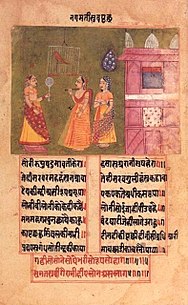

Awadhi also emerged as the favourite literary language of the Eastern Sufis from the last quarter of the 14th century onwards. It became the language of premākhyāns, romantic tales built on the pattern of Persian masnavi, steeped in Sufi mysticism but set in a purely Indian background, with a large number of motifs directly borrowed from Indian lore. The first of such premākhyān in the Awadhi language was Candāyan (1379 C.E.) of Maulana Da’ud. The tradition was carried forward by Jayasi, whose masterpiece, the Padmāvat (1540 C.E.) was composed under the reign of the famous ruler Sher Shah Suri. The Padmavat travelled far and wide, from Arakan to the Deccan, and was eagerly copied and retold in Persian and other languages.
Other prominent works of Jayasi—Kānhāvat, Akhrāvaṭ and Ākhrī Kalām are also written in Awadhi.
I’ll tell you about my great town, the ever-beautiful Jais.
In the satyayuga it was a holy place, then it was called the “Town of Gardens.”
Then the treta went, and when the dvapara came, there was a great rishi called Bhunjaraja.
88,000 rishis lived here then, and dense … and eighty-four ponds.
They baked bricks to make solid ghats, and dug eight-four wells.
Here and there they built handsome forts, at night they looked like stars in the sky.
They also put up several orchards with temples on top.Doha: They sat there doing tapas, all those human avataras.They crossed this world doing homa and japa day and night.
— Jayasi, Kanhavat, ed. Pathak (8), 7-8.
The Awadhi romance Mirigāvatī (ca.1503) or “The Magic Doe”, was written by Shaikh ‘Qutban’ Suhravardi, who was an expert and storyteller attached to the court-in-exile of Sultan Hussain Shah Sharqi of Jaunpur. Another romance named Madhumālatī or “Night Flowering Jasmine” by poet Sayyid Manjhan Rajgiri was written in 1545 C.E.
Amir Khusrau (d. 1379 C.E) is also said to have written some compositions in Awadhi.
Modern India
The most significant contributions to the Awadhi literature in the modern period have come from writers like Ramai Kaka (1915-1982 C.E.), Balbhadra Prasad Dikshit better known as ‘Padhees’(1898-1943 C.E.) and Vanshidhar Shukla (1904-1980 C.E.).
‘Krishnayan’ (1942 C.E.) is a major Awadhi epic-poem that Dwarka Prasad Mishra wrote in imprisonment during the Freedom Movement of India.
Popular culture
Entertainment
The 1961 film Gunga Jumna features Awadhi being spoken by the characters in a neutralised form. In the 2001 film Lagaan, a neutralised form of Awadhi language was used to make it understandable to audiences. The 2009 film Dev.D features an Awadhi song, “Paayaliya”, composed by Amit Trivedi. In the television series Yudh, Amitabh Bachchan spoke parts of his dialogue in Awadhi, which received critical acclaim from the Hindustan Times. Awadhi is also spoken by the residents of Ayodhya and other minor characters in Ramanand Sagar’s 1987 television series Ramayan.
Folk
The genres of folklore sung in Awadh include Sohar, Sariya, Byaah, Suhag, Gaari, Nakta, Banraa (Banna-Banni), Alha, Sawan, Jhula, Hori, Barahmasa, and Kajri.
Sample phrases
The Awadhi language comes with its dialectal variations. For instance, in western regions, the auxiliary /hʌiː/ is used, while in central and eastern parts /ʌhʌiː/ is used.
The following examples were taken from Baburam Saxena’s Evolution of Awadhi, and alternative versions are also provided to show dialectal variations.
| English | Awadhi (IPA) | Awadhi (Devanagari) |
|---|---|---|
| Who were there? | ɦʊãː koː or kəʊn ɾəɦəĩ | हुआँ को (कउन) रहें? |
| alt. ɦʊãː keː or kəʊn ɾəɦəin | alt. हुआँ के/कउन रहेन? | |
| This boy is fine in seeing and hearing. | ɪʊ lʌɾɪkaː d̪eːkʰʌiː sʊnʌiː mə ʈʰiːk hʌiː | इउ लरिका देखई सुनई म ठीक है। |
| alt. ɪ lʌɾɪkaː d̪eːkʰʌiː sʊnʌiː mə ʈʰiːk ʌhʌiː | alt. इ लरिका देखई सुनई म ठीक अहै। | |
| (She) said, let (me) eat a little and give a little to this one too. | kʌɦɪn laːoː t̪ʰoːɽaː kʰaːɪ leːiː t̪ʰoːɽaː jʌhu kɘ d̪ʌɪ d̪eːiː | कहिन, लाओ थोड़ा खाई लेई, थोड़ा यहु का दै देई। |
| alt. kʌɦɪn lyaːvː t̪ʰoːɽaː kʰaːɪ leːiː raːçi keː jʌnhu kɘ d̪ʌɪ d̪eːiː | alt. कहिन, ल्याव थोड़ा खाई लेई, रचि के एन्हुं के दै देई। | |
| Those who go will be beaten. | d͡ʒoː d͡ʒʌɪɦʌĩ soː maːrʊ̥ kʰʌɪɦʌĩ | जो जइहैं सो मारउ खइहैं। |
| alt. d͡ʒèː d͡ʒʌɪɦʌĩ soː maːr kʰʌɪɦʌĩ | alt. जे जइहैं सो मार खइहैं। | |
| Do not shoot at the birds. | cɪɾʌɪjʌn pʌɾ chʌrːaː nə cʌlaːoː | चिरइयन पर छर्रा न चलाओ। |
| alt. cɪɾʌɪjʌn peː chʌrːaː jin cʌlaːwː | alt. चिरइयन पे छर्रा जिन चलाव। |