
Ayodhya Airport
, proposed to rename as Maryada Purushottam Shriram International Airport, is an upcoming international airport in Ayodhya, Uttar Pradesh that will be upgraded from the existing government airstrip. The existing government airstrip is situated between the NH 27 and NH 330 at Sultanpur Naaka, Ayodhya, in the Indian state of Uttar Pradesh. The State Government signed a memorandum of understanding with the Airports Authority of India (AAI) in February 2014 for the development of the airport. As of January 2022, the airport is not operational.
Recent efforts
Efforts by Union Civil Aviation Minister
In 2012, Union Civil Aviation Minister Ajit Singh said “There are three airstrips Faizabad, Moradabad and Meerut. We requested that give these airstrips to us and we will construct airports. Besides at places where there are airports of defence services, we requested the state to provide land and we will construct a separate terminal”. Singh said that the Ministry of Civil Aviation had asked the Chief Minister of Uttar Pradesh, Akhilesh Yadav, to provide the ministry with land to set up nine airports across Uttar Pradesh, and said that having more airports would generate employment and economic growth in Uttar Pradesh.
Development under low-cost airports
In an endeavour to provide air connectivity to different parts of India, development of low-cost airports is the most important component. Instructions have been issued to AAI to identify the most suitable low cost model for development of smaller airports and to develop airports in the smaller cities based on this mode.
Handing over to Airports Authority of India
In 2008, the Ayodhya Airport was handed over by the government of Uttar Pradesh to Airports Authority of India (AAI) to be developed as full-fledged airport along with three others (Meerut, Moradabad and Saifai) by the approval of Uttar Pradesh cabinet. The government of Uttar Pradesh is providing extra land free of cost for the further expansion and for the construction of a terminal.
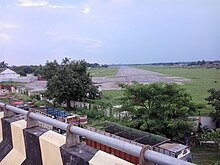
Runway taken from national highway
In 2012, the Uttar Pradesh government had issued formal orders allowing the landing and parking of private aircraft on the airstrip against a fee. According to the government order, any private aircraft can land by paying Rs 500. There will be no parking charges for the first two hours, after which Rs 200 will be charged per day.
The government gave the airstrip to private investors for their pilot training and aircraft maintenance engineering institutes. “The fresh government order for landing and parking is an extension of that project, because now the government will not have to bother much about activities like maintained, which will be taken care of by the institutes,” said Swaroop. The procedure followed earlier to obtain permission for using the airstrip used to be long. The owner of the private aircraft had to contact the respective district magistrate who would further contact the directorate which would take the measures required for landing of the aircraft.
In 2018, the Yogi government expansion of airstrip in Ayodhya. The government later approved an international airport and sanctioned ₹2 billion for acquisition of land.
The airport is still not operational as of January 2022.
Projected length
The state government has decided to acquire more than 280 acres of land around the airstrip and widen it to allow landing of bigger aircraft. Projected airstrip needs to have a width of 45 meters and a length of 2.5 km.
New International Airport Project Updates
- November 27, 2021 – Aviation Minister Scindia announced that ground breaking ceremony (brume poojan) of the Ayodhya International Airport will occur in January 2022. This will be after the ground breaking ceremony of Java airport near Noida. This will make Ayodhya Airport the fifth international airport in Uttar Pradesh (after Lucknow, Varanasi, Kushi Nagar and Jevar).
- December 2, 2021 – Airport Authority of India announced that it has completed the acquisition of about 370 acres of land, much higher than the 290 acres needed for the first phase.