
Central Bank of India (CBI) is an Indian nationalised bank. It is under the ownership of Ministry of Finance , Government of India and is one of the oldest and largest nationalised commercial banks in India. It is based in Mumbai, the financial capital of India and capital city of state of Maharashtra.
Despite its name it is not the central bank of India; the Indian central bank is the Reserve Bank of India.
Although the NDA government has generally favored mergers among public sector banks in India, Central Bank of India has remained a separate entity owing to its pan-India presence. CBI is one of twelve public sector banks in India that was recapitalised in 2009.
As on 31 March 2021, the bank has a network of 4,608 branches, 3,644 ATMs, ten satellite offices and one extension counter. It has a pan-India presence covering all 28 states, Seven out of eight union territories and 574 district headquarters out of all districts in the country.
Central Bank of India has approached the Reserve Bank of India (RBI) for permission to open representative offices in Singapore, Dubai, Doha, and London.
History

A 2010 stamp dedicated to Sorabji Pochkhanawala and the 100th anniversary of the Central Bank of India
The Central Bank of India was established on 21 December 1911 by Sir Sorabji Pochkhanawala with Sir Pherozeshah Mehta as Chairman, and claims to have been the first commercial Indian bank completely owned and managed by Indians.
Early-20th century
By 1918 Central Bank of India had established a branch in Hyderabad. A branch in nearby Secunderabad followed in 1925.
In 1923, it acquired the Tata Industrial Bank in the wake of the failure of the Alliance Bank of Simla. The Tata bank, established in 1917, had opened a branch in Madras in 1920 that became the Central Bank of India, Madras.
Central Bank of India was instrumental in the creation of the first Indian exchange bank, the Central Exchange Bank of India, which opened in London in 1936. However, Barclays Bank acquired Central Exchange Bank of India in 1938.
Also before World War II, Central Bank of India established a branch in Rangoon. The branch’s operations concentrated on business between Burma and India, and especially money transmission via telegraphic transfer. Profits derived primarily from foreign exchange and margins. The bank also lent against land, produce, and other assets, mostly to Indian businesses.
Post-World War II
In 1963, the revolutionary government in Burma nationalized Central Bank of India’s operations there, which became People’s Bank No. 1.
In 1969, the Indian Government nationalized the bank on 19 July, together with 13 others.
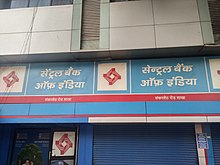
Nameboard of Central Bank of India, Shankar Sheth Road Branch, Pune
In the 1980s the managers of the London branches of Central Bank of India, Punjab National Bank, and Union Bank of India were caught up in a fraud in which they made dubious loans to the Bangladeshi jute trader Rajender Singh Sethia. The regulatory authorities in England and India forced all three Indian banks to close their London branches.
Central Bank of India was one of the first banks in India to issue credit cards in the year 1980 in collaboration with Mastercard.
On its 108th Foundation day Central Bank of India launched its first step towards robotic banking, a robot named “MEDHA”.