
Clifford Lee Burton (February 10, 1962 – September 27, 1986) was an American musician and songwriter who was the bassist for American heavy metal band Metallica from 1983 until his death in 1986. He performed on Kill ‘Em All (1983), Ride the Lightning (1984), and Master of Puppets (1986), the band’s first three studio albums. Burton also received posthumous writing credit on …And Justice for All (1988) for the song “To Live Is to Die”.
While touring in 1986 to support Master of Puppets, Burton died following a bus crash in Sweden. Recognized as an influential musician during his lifetime, Burton remains a prominent musical influence and placed ninth in a 2011 reader poll from Rolling Stone recognizing the greatest bassists of all time. He was posthumously inducted to the Rock and Roll Hall of Fame as a member of Metallica in 2009.
Biography
Early life
Clifford Lee Burton was born in Castro Valley, California, to Ray and Jan Burton. He had two elder siblings, Scott and Connie. Burton’s interest in music began when his father introduced him to classical music and he began taking piano lessons.
In his teenage years, Burton had an interest in rock, classical, country and eventually heavy metal. He began playing the bass at age 13, after the death of his brother. His parents quoted him as saying, “I’m going to be the best bassist for my brother.” He practiced up to six hours per day (even after he joined Metallica). Along with classical and jazz, Burton’s other early influences varied from Southern rock and country to the blues.
Burton cited Geddy Lee, Geezer Butler, Stanley Clarke, Lemmy Kilmister, and Phil Lynott as major influences on his style of bass playing.
Career
While still a student at Castro Valley High School, Burton formed his first band called EZ-Street. The band took its name from a Bay Area topless bar. Other members of EZ-Street included future Faith No More guitarist “Big” Jim Martin as well as Faith No More and Ozzy Osbourne drummer Mike Bordin. Burton and Martin continued their musical collaboration after becoming students at Chabot College in Hayward, California. Their second band, Agents of Misfortune, entered the Hayward Area Recreation Department’s Battle of the Bands contest in 1981. Their audition was recorded on video and features some of the earliest footage of Burton’s playing style. The video also shows Burton playing parts of what would soon be two Metallica songs: his signature bass solo, “(Anesthesia) – Pulling Teeth”, and the chromatic intro to “For Whom the Bell Tolls”. Burton joined his first major band, Trauma, in 1982. Burton recorded the track “Such a Shame” with the band on the second Metal Massacre compilation.
In 1982, Trauma traveled to Los Angeles to perform at the Whisky a Go Go. Among those in attendance were James Hetfield and Lars Ulrich, both members of Metallica, which had formed the previous year. Upon hearing, as Hetfield described it, “this amazing shredding” (which later became “(Anesthesia) – Pulling Teeth”), the two went in search of what they thought was an amazing guitar player. When they learned that what they had heard was a bass solo by Burton, they decided to recruit him for their own band. They asked him to replace departed bassist Ron McGovney, and since Burton thought that Trauma was “starting to get a little commercial”, he agreed. The idea of having to move to Los Angeles did not sit well with him, and said he would join only if the band would relocate from Los Angeles to his native San Francisco Bay Area. Metallica, eager to have Burton in the band, left their origin of Los Angeles to make a home in El Cerrito, a town located across the bay from San Francisco.
Burton’s first recording with Metallica was the Megaforce demo. A demo tape the band had made prior to Burton’s joining, No Life ’til Leather, managed to come into the hands of Jon Zazula, owner of Megaforce Records. The band relocated to Old Bridge, New Jersey, and quickly secured a recording contract with Zazula’s label. Their debut album, Kill ‘Em All, features Burton’s famous solo piece, “(Anesthesia) – Pulling Teeth”, which showcased his use of effects, such as a wah-wah pedal, not commonly used by bass guitarists.
Metallica’s debut album, Kill ‘Em All, was originally intended to inherit the name of one of their earlier demo releases (predating Burton’s participation), which was Metal Up Your Ass, but the record company did not like the title and insisted on changing it. After the band learned of the change, Burton said “We should just kill ’em all, man,” which gave the band members an idea for the new title. The album was released on July 25, 1983, through Megaforce Records.
The band’s second studio album, Ride the Lightning, showcased the band’s increasing musical growth. Burton’s songwriting abilities were growing, and he received credit on six of the album’s eight songs. Burton’s playing style and use of effects is showcased on two tracks: the chromatic intro to “For Whom the Bell Tolls”, and the “lead bass” on “The Call of Ktulu”.
The increase of musicianship on Ride the Lightning caught the attention of major record labels. Metallica was signed to Elektra Records, and began working on its third album, Master of Puppets, which is considered by most critics to be a landmark album in heavy metal. Among the tracks featured in the album are the instrumental “Orion” (which features a prominent lead bass section) and the title track, which was Burton’s favorite Metallica song. Master of Puppets is the band’s commercial breakthrough release, and Burton’s final album with Metallica.
Burton’s final performance was in Stockholm, Sweden, at the Solnahallen Arena on September 26, 1986, one day before his death. The final song he performed was “Fight Fire With Fire”.
Death
In Sweden, on the Damage Inc. tour in support of Master of Puppets, the band members complained that the sleeping cubicles on their tour bus were unsatisfactory and uncomfortable. To decide who received pick of the bunks, Kirk Hammett and Burton drew playing cards. On the evening of September 26, 1986, Burton won the game with an ace of spades, thereby getting the first choice of bunk. Burton turned to Hammett and said “I want your bunk”; Hammett then responded, “Fine, take my bunk, I’ll sleep up front, it’s probably better up there anyway.” Burton was sleeping shortly before 7:00 a.m. on September 27 when, according to the driver, the bus skidded off the road (the E4, 12 miles (19 km) north of Ljungby), and flipped onto the grass in Kronoberg County. Burton was thrown through the window of the bus, which fell on top of him and killed him.
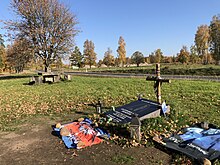
Cliff Burton memorial stone October 15, 2018

Cliff Burton memorial stone October 15, 2018
The bus driver said that the crash was caused by the bus hitting a patch of black ice on the road, but James Hetfield later stated that he first believed the bus flipped because the driver was drunk. Hetfield also stated that he walked long distances down the road looking for black ice and found none. When local freelance photographer Lennart Wennberg (who attended the crash scene the following morning) was asked in a later interview about the likelihood that black ice caused the accident, he said it was “out of the question” because the road was dry and the temperature around 2 °C (36 °F), above the freezing point of 0 °C (32 °F). This was confirmed by police who – like Hetfield – also found no ice on the road. Ljungby detective Arne Pettersson was reported in a local newspaper to have said the tracks at the accident site were exactly like ones seen when drivers fall asleep at the wheel. However, the driver stated under oath that he had slept during the day and was fully rested; his testimony was confirmed by the driver of a second tour bus that was carrying the band’s crew and equipment. The driver was determined not at fault for the accident and no charges were brought against him.
Legacy
Burton’s body was cremated and the ashes were scattered at the Maxwell Ranch. At the ceremony, the song “Orion” was played. Shortly after Burton’s death, Jason Newsted from Flotsam and Jetsam became Metallica’s new bassist.
Metallica wrote a tribute to Burton titled “To Live Is to Die” for …And Justice for All. Burton also received a writing credit for the lyrics in the middle of the song. A non-Metallica tribute to Burton is the song “In My Darkest Hour” by thrash metal band Megadeth. According to Dave Mustaine, after hearing of Burton’s death, he sat down and wrote the music for the song in one sitting. The lyrics, however, are unrelated to Burton’s death. Mustaine was Metallica’s lead guitarist in the early days and was a close friend of Burton at the time.
On October 3, 2006, a memorial stone was unveiled in Sweden near the scene of the fatal crash. The lyrics “…cannot the Kingdom of Salvation take me home” from “To Live Is to Die” are written on Burton’s memorial stone.
Thrash metal band Anthrax dedicated its album Among the Living to him, as did Metal Church with The Dark.
On April 4, 2009, Burton was posthumously inducted into the Rock and Roll Hall of Fame, with fellow Metallica bandmates James Hetfield, Lars Ulrich, and Kirk Hammett. Subsequent bassists Jason Newsted and Robert Trujillo were inducted as well. During the ceremony, the induction was accepted by his father Ray Burton, who shared the stage with the band and said that Cliff’s mother was Metallica’s biggest fan.
A biography, To Live Is to Die: The Life and Death of Metallica’s Cliff Burton, written by Joel McIver, was published by Jawbone Press in June 2009. Hammett provided the book’s foreword.
In November 2016, Metallica released the album Hardwired… to Self-Destruct. The deluxe version of the album features a series of live recordings at Berkeley, California’s legendary record store Rasputin Music in celebration of Record Store Day on April 16, 2016. The song “Fade to Black” was played with lead singer Hetfield dedicating the song to Burton. During the song Hetfield yells, “Can you hear us Cliff?”
In 2017, it was revealed that Burton’s parents had been donating his posthumous royalty payments to a scholarship fund for music students at his alma mater Castro Valley High School.
In 2018, the Alameda County, California, Board of Supervisors issued a proclamation declaring February 10, 2018, which would have been Burton’s 56th birthday, as “Cliff Burton Day” after a fan petition successfully passed.
The S&M2 concert in 2019 featured San Francisco Symphony bassist Scott Pingel paying tribute to Burton by playing his signature bass solo, “Anesthesia (Pulling Teeth)”, using an electric double bass with pedal effects.