
Coal in India has been mined since 1774 and is now the second fastest mined in the world, producing 716 million metric tons (789 million short tons) in 2018. In 2017, India had 315.14 billion metric tons (347.38 billion short tons) of coal. The estimated total reserves of lignite coal that month was 44.70 billion metric tons (49.27 billion short tons). Due to high demand and poor average quality, India imports coking coal to meet the requirements of its steel plants. India’s coal imports have risen from 49.8 million metric tons (0.0549 billion short tons) in 2007–08 to 191 million metric tons (0.211 billion short tons) in 2016–17. India’s coal exports rose from 1.63 million metric tons (1.80 million short tons) in 2007–08 to 2.44 million metric tons (2.69 million short tons) in 2012–13, but subsequently declined to 1.77 million metric tons (1.95 million short tons) in 2016–17. Dhanbad city is the largest coal producing city and is called the Coal Capital of India. State-owned Coal India had a monopoly on coal mining between its nationalisation in 1973 and 2018.
Coal-fired power plants have been criticised for breaking environmental laws, and phasing out coal would have short-term health and environmental benefits greatly exceeding the costs.
History
Coal in India was first mined in 1774 when John Sumner and Suetonius Grant Heatly of the East India Company commenced commercial exploitation in the Raniganj Coalfield along the Western bank of Damodar River. Growth remained slow for nearly a century due to low demand. The introduction of steam locomotives in 1853 boosted demand, and coal production rose to an annual average of 1 million metric tons (1.1 million short tons). India produced 6.12 million metric tons (6.75 million short tons) of coal per year by 1900 and 18 million metric tons (20 million short tons) per year by 1920. Coal production rose steadily over the next few decades, and was boosted by demand caused by World War I. Production slumped in the interwar period, but rose to 30 million metric tons (33 million short tons) by 1946 largely as a result of World War II.
In the regions of British India known as Bengal, Bihar and Odisha, the Indians pioneered Indian involvement in coal mining from 1894. They broke the previous monopolies held by British and other Europeans, establishing many collieries. Seth Khora Ramji Chawda of Sinugra was the first Indian to break the British monopoly in the Jharia Coalfields. Other Indian communities followed the example of the Kshatriyas in the Dhanbad-Jharia-Bokaro fields after the 1930s. These included the Punjabis, Kutchis, Marwaris, Gujaratis, Sindhis and Hindustanis. Following independence, the Government of India introduced several 5-year development plans. Annual production rose to 33 million metric tons (36 million short tons) at the beginning of the First Five Year Plan. The National Coal Development Corporation (NCDC) was established in 1956 with the aim of increasing coal production efficiently by systematic and scientific development of the coal industry.
The Indira Gandhi administration nationalized coal mining in phases – coking coal mines in 1971–72 and non-coking coal mines in 1973. With the enactment of the Coal Mines (Nationalization) Act, 1973, all coal mines in India were nationalized on 1 May 1973. This policy was reversed by the Narendra Modi administration four decades later. In March 2015, the government permitted private companies to mine coal for use in their own cement, steel, power or aluminium plants. The Coking Coal Mines (Nationalization) Act, 1972 and the Coal Mines (Nationalization) Act, 1973 were repealed on 8 January 2018. In the final step toward denationalization, on 20 February 2018, the government permitted private firms to enter the commercial coal mining industry. Under the new policy, mines will be auctioned to the firm offering the highest per tonne price. The move broke the monopoly over commercial mining that state-owned Coal India has enjoyed since nationalisation in 1973.
Pre-independence
Commercial exploitation of coal in India began in 1774 with John Sumner and Suetonius Grant Heatly of the East India Company in the Raniganj Coalfield along the Western bank of Damodar River. The growth of Indian coal mining remained slow for nearly a century due to low demand. The introduction of steam locomotives in 1853 boosted demand, and coal production rose to an annual average of 1 million metric tons (1.1 million short tons). India produced 6.12 million metric tons (6.75 million short tons) of coal per year by 1900 and 18 million metric tons (20 million short tons) per year by 1920. Coal production received another boost during the First World War due to increased demand, but slumped again in the early 1930s. Production reached a level of 29 million metric tons (32 million short tons) by 1942 and 30 million metric tons (33 million short tons) by 1946.
In the regions of British India known as Bengal, Bihar and Odisha, the many Indians pioneered Indian involvement in coal mining from 1894. They broke the previous monopolies held by British and other Europeans, establishing many collieries at locations such as Khas Jharia, Jamadoba, Balihari, Tisra, Katrasgarh, Kailudih, Kusunda, Govindpur, Sijua, Sijhua, Loyabad, Dhansar, Bhuli, Bermo, Mugma, Chasnala-Bokaro, Bugatdih, Putki, Chirkunda, Bhowrah, Sinidih, Kendwadih, and Dumka.
Seth Khora Ramji Chawda of Kutch was the first Indian to break the British monopoly in the Jharia Coalfields. Natwarlal Devram Jethwa says that
The East Indian Railway in 1894–95 extended its line from Barakar to Dhanbad via Katras and Jharia. Messrs. Khora Ramji in 1894 was working on railway lines contract of Jharia branch line and with his brother Jetha Lira was also building Jharia Railway Station, when he discovered coal in Jharia belt. The location of his three collieries named Jeenagora, Khas Jherria, Gareria is mentioned also in 1917 Gazetteers of Bengal, Assam, Bihar and Odisha.
Other Indian communities followed the example of the him in the Dhanbad-Jharia-Bokaro fields after the 1930s. These included the Punjabis, Kutchis, Marwaris, Gujaratis, Bengalis and Hindustanis.
Post-independence
Following independence, the Government of India introduced several 5-year development plans. Annual production rose to 33 million metric tons (36 million short tons) at the beginning of the First Five Year Plan. The National Coal Development Corporation (NCDC), a Government of India Undertaking, was established in 1956 with the collieries owned by the railways. The NCDC aimed to increase coal production efficiently by systematic and scientific development of the coal industry. The Singareni Collieries Company Ltd. (SCCL) which was already in operation since 1945 and which became a Government company under the control of Government of Andhra Pradesh in 1956. The coal industry in India was thus controlled by state-owned companies in the 1950s. Today, SCCL is a joint undertaking of Government of Telangana and Government of India sharing its equity in 51:49 ratio.
Nationalisation of coal mines
Right from its genesis, the commercial coal mining in modern times in India has been dictated by the needs of the domestic consumption. India has abundant domestic reserves of coal. Most of these are in the states of Jharkhand, Odisha, West Bengal, Bihar, Chhattisgarh, Telangana and Madhya Pradesh. On account of the growing needs of the steel industry, a thrust had to be given on systematic exploitation of coking coal reserves in Jharia coalfield. Adequate capital investment to meet the burgeoning energy needs of the country was not forthcoming from the private coal mine owners.
Unscientific mining practices adopted by some of them and poor working conditions of labor in some of the private coal mines became matters of concern for the Government. On account of these reasons, the Central Government took a decision to nationalize the private coal mines. The nationalization was done in two phases, the first with the coking coal mines in 1971–72 and then with the non-coking coal mines in 1973. In October 1971, the Coking Coal Mines (Emergency Provisions) Act, 1971 provided for taking over in public interest of the management of coking coal mines and coke oven plants pending nationalization. This was followed by the Coking Coal Mines (Nationalization) Act, 1972 under which the coking coal mines and the coke oven plants other than those with the Tata Iron & Steel Company Limited and Indian Iron & Steel Company Limited, were nationalized on 1 May 1972 and brought under the Bharat Coking Coal Limited (BCCL), a new Central Government Undertaking. Another enactment, namely the Coal Mines (Taking Over of Management) Act, 1973, extended the right of the Government of India to take over the management of the coking and non-coking coal mines in seven States including the coking coal mines taken over in 1971. This was followed by the nationalization of all these mines on 1 May 1973 with the enactment of the Coal Mines (Nationalization) Act, 1973 which determined the eligibility of coal mining in India.
All non-coking coal mines were nationalized in 1973 and placed under Coal Mines Authority of India. In 1975, Eastern Coalfields Limited, a subsidiary of Coal India Limited, was formed. It took over all the earlier private collieries in Raniganj Coalfield. Raniganj Coalfield covers an area of 443.50 square kilometres (171.24 sq mi) and has total coal reserves of 8,552.85 million metric tons (9,427.90 million short tons). Eastern Coalfields puts the reserves at 29.72 billion metric tons (32.76 billion short tons) which makes it the second largest coalfield in the country (in terms of reserves).
The North East Indian states enjoys special privileges under constitution of India. The Sixth Schedule of constitution and article 371 of constitution allows state governments to formulate its own policy to recognize customary tribal laws. For example, Nagaland has its own coal policy which allows its natives to mine coal from their respective lands. Similarly, coal mining in Meghalaya was rampant till imposition of ban on coal mining by National Green Tribunal. The Nagaland Coal and Meghalaya Coal has large buyers in North India, Central India and Eastern India.
Denationalisation of coal mines
Parliament enacted the Coal Mines (Special Provisions) Act, 2015 in March 2015 containing provisions enabling the government to allocate coal mines through auctions. The law also permitted private players to mine coal for use in their own cement, steel, power or aluminium plants. On 20 February 2018, the Cabinet Committee on Economic Affairs (CCEA) permitted private firms to enter the commercial coal mining industry in India. Under the new policy, mines will be auctioned to the firm offering the highest per tonne price. The move broke the monopoly over commercial mining that state-owned Coal India has enjoyed since nationalisation in 1973.
The Coking Coal Mines (Nationalization) Act, 1972 and the Coal Mines (Nationalization) Act, 1973 were repealed by the Repealing and Amending (Second) Act, 2017 on 8 January 2018.
Reserves
India has the fourth largest coal reserves in the world. As on 31 March 2019, India had 326.49 billion metric tons (359.89 billion short tons) of the resource. The known reserves of coal rose 2.34% over the previous year, with the discovery of an estimated 7.47 billion metric tons (8.23 billion short tons). The estimated total reserves of lignite coal as on 31 March 2019 was 45.76 billion metric tons (50.44 billion short tons), an increase of 0.22% from the previous year. Coal deposits are primarily found in eastern and south-central India. Jharkhand, Odisha, Chhattisgarh, West Bengal, Madhya Pradesh, Telangana and Maharashtra accounted for 98.09% of the total known coal reserves in India. As on 31 March 2019, Jharkhand and Odisha had the largest coal deposits of 25.88% and 24.76% respectively.
The energy derived from coal in India is about twice that of the energy derived from oil, whereas worldwide, energy derived from coal is about 30% less than energy derived from oil.
Distribution of coal reserves by states

The Dhanbad mine complex.
The following table shows the estimated coal reserves in India by state as of 31 March 2019.
| State | Coal Reserves (in billion metric tonnes) |
Type of Coalfield |
|---|---|---|
| Jharkhand | 84.51 | Gondwana |
| Odisha | 80.83 | Gondwana |
| Chhattisgarh | 59.91 | Gondwana |
| West Bengal | 31.67 | Gondwana |
| Madhya Pradesh | 28.80 | Gondwana |
| Telangana | 21.84 | Gondwana |
| Maharashtra | 12.68 | Gondwana |
| Andhra Pradesh | 1.61 | Gondwana |
| Bihar | 1.83 | Gondwana |
| Uttar Pradesh | 1.06 | Gondwana |
| Meghalaya | 0.58 | Tertiary |
| Assam | 0.51 | Tertiary |
| Nagaland | 0.45 | Tertiary |
| Sikkim | 0.10 | Gondwana |
| Arunachal Pradesh | 0.09 | Tertiary |
| India | 326.49 |
Distribution of lignite reserves by states
The following table shows the estimated lignite reserves in India by state as of 2018.
| State | Coal Reserves (in billion metric tonnes) |
|---|---|
| Tamil Nadu | 36.13 |
| Rajasthan | 6.35 |
| Gujarat | 2.72 |
| Pondicherry | 0.42 |
| Jammu and Kashmir | 0.03 |
| Kerala | 0.01 |
| West Bengal | 0.00 |
| India | 45.66 |
Production

Coal production in India, 1950–2012
India is the second largest producer of coal in the world, after China. The production of coal was 728.72 million metric tons (803.28 million short tons) in 2018–19, a growth of 7.89% over the previous year. The production of lignite was 44.28 million metric tons (48.81 million short tons) in 2018–19, a decrease of 5.06% over the previous fiscal.
Washing
Coal washing is an integral part of the coal production process in which raw coal from mines is washed to remove the ash content to make it fit for feeding into boilers such as those in steel plants. Coal washeries are generally not a part of coal mines in India, with some exceptions.
There were 60 coal washeries in India as on 31 March 2019 with a total installed capacity of 146.53 million tonnes per year.
Health effects
 |
This section needs expansion. You can help by adding to it. (June 2020)
|
The health and environmental impact of the coal industry is serious in India. One study found that 90% of households surveyed in a village near a coal mine reported health problems in the last year, compared to 52% of households from villages at least 40 km (25 mi) away from a mine. Additionally, the villages closest to the mine had the greatest incidence of self-reported health problems. Health effects of coal ash are also a problem.
Environmental effects
|
This section needs expansion. You can help by adding to it. (August 2020)
|
In 2020 UN secretary general António Guterres said that India should stop building coal-fired power stations before the end of the year and end fossil fuel subsidies.
Consumption
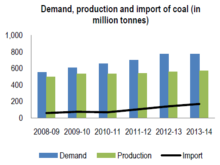
Demand, production and import of coal (in million tonnes)
Industries in India consumed 968.25 MT of raw coal in 2018–19, growing by 7.76% over the previous fiscal. The largest consumers of coal in India are electricity generation (637.95 MT), the steel and washery industries (69.50 MT), the sponge iron industry (12.23 MT) and the cement industry (8.82 MT). Consumption of lignite stood at 45.81 MT in 2018–19. Electricity generation alone accounts for 82.23% of the total lignite consumption.
Due to high demand and poor average quality, India is forced to import high quality coal to meet the requirements of steel plants. India’s coal imports have risen from 73.26 million metric tons (0.08076 billion short tons) in 2009–10 to 235.24 million metric tons (0.25931 billion short tons) in 2018–19. India’s coal exports declined from 2.45 million metric tons (2.70 million short tons) in 2008–09 to 1.31 million metric tons (1.44 million short tons) in 2018–19.
Electricity generation
Coal generated over 70% of electricity produced in 2017–18, while lignite accounted for 3.6% of electricity generation. India’s electricity sector consumed over 70% of the coal produced in the country in 2013. In 2020 think tank Carbon Tracker estimated that 17% of coal-fired plants were already more expensive than new renewables and that 85% would be by 2025.
A large part of Indian coal reserve is similar to Gondwana coal. It is of low calorific value and high ash content. The carbon content is low in India’s coal, and toxic trace element concentrations are negligible. The natural fuel value of Indian coal is poor. On average, the Indian power plants using India’s coal supply consume about 0.7 kg of coal to generate a kWh, whereas United States thermal power plants consume about 0.45 kg of coal per kWh. This is because of the difference in the quality of the coal, as measured by the Gross Calorific Value (GCV). On average, Indian coal has a GCV of about 4500 Kcal/kg, whereas the quality elsewhere in the world is much better; for example, in Australia, the GCV is 6500 Kcal/kg approximately. India imported nearly 95 Mtoe of steam coal and coking coal which is 29% of total consumption to meet the demand in electricity, cement and steel production.
Coal mafia
The state-owned coal mines of Bihar (now Jharkhand after the division of Bihar state) were among the first areas in India to see the emergence of a sophisticated mafia, beginning with the mining town of Dhanbad. It is alleged that the coal industry’s trade union leadership forms the upper echelon of this arrangement and employs caste allegiances to maintain its power. Pilferage and sale of coal on the black market, inflated or fictitious supply expenses, falsified worker contracts and the expropriation and leasing-out of government land have allegedly become routine. A parallel economy has developed with a significant fraction of the local population employed by the mafia in manually transporting the stolen coal for long distances over unpaved roads to illegal mafia warehouses and points of sale.
The coal mafia has had a negative effect on Indian industry, with coal supplies and quality varying erratically. Higher quality coal is sometimes selectively diverted, and missing coal is replaced with stones and boulders in railway cargo wagons. A human corpse has been discovered in a sealed coal wagon.
In June 2012, the Bollywood epic Gangs of Wasseypur was released portraying the coal mafia in the area of Dhanbad. The movie received overwhelming response and was declared a hit. Another Bollywood movie Gunday was also loosely based upon coal mafia.