
Deccani (also known as Deccani Urdu and Deccani Hindi) or Dakni, Dakhni, Dakhini, Dakkhani and Dakkani (دکنی, dekanīor dakhanī), is a variety of Hindustani spoken in the Deccan region of India and the native language of the Deccani people. Commonly associated with Urdu, the historical dialect sparked the development of Urdu literature during the late-Mughal period, and was a predecessor to and later influenced modern day Hindi. The modern variety spoken today, however, is heavily influenced by Standard Urdu. The northern dialects (e.g. Hyderabadi Urdu) are virtually indistinguishable from Standard Urdu, apart from accent and certain vocabulary, while the southern dialects more closely resemble the historical language. It arose as a lingua franca under the Bahmaniand later Deccan Sultanates, ca. 1300 AD, as trade and migration from the north introduced Hindustani to Southern India. It differs from Hindustani because of the strong influence of Marathi, Telugu and Kannada spoken in the states of Maharashtra, Telangana, Andhra Pradesh and Karnataka.
The term “Deccani” and its variants are often used in two different contexts: a historical, obsolete one, referring to the medieval-era literary predecessor of Hindi-Urdu; and an oral one, referring to the lect spoken in many areas of the Deccan today. Both contexts have intricate historical ties.
History
Origin and Growth
As a predecessor of modern Hindustani, Deccani has its origins in the contact dialect spoken around Delhi, known by names such as Hindavi and Dehlavi. In the early 14th century, this dialect was introduced in the Deccan region through the military exploits of Alauddin Khalji. In 1327 AD, Muhammad bin Tughluq shifted his Sultanate’s capital from Delhi to Daulatabad (near present-day Aurangabad, Maharashtra), causing a mass migration; governors, soldiers and common people moved south, bringing the dialect with them. At this time (and for the next few centuries) the cultural centres of the northern Indian subcontinent were under Persian linguistic hegemony.
The Bahmani Sultanate was formed in 1347 AD with Daulatabad as its capital. This was later moved to Gulbarga and once again, in 1430, to Bidar. By this time, the dialect had acquired the name Dakhni, from the name of the region itself, and had become a lingua franca for the linguistically diverse people of the region. Although the Bahmanids were Persianate and had Persian as their official language, they were open to regional languages, and so Deccani received royal patronage. During their 150-year rule, the dialect saw a burgeoning literary culture, as religious texts were made in it. The Sufis in the region (such as Shah Miranji) were an important vehicle of Deccani; they used it in their preachings since regional languages were more accessible (than Persian) to the general population. This era also saw production of the masnavi Kadam Rao Padam Rao by Fakhruddin Nizami in the region around Bidar. It is the earliest available manuscript of the Hindavi/Dehlavi/Deccani language, and contains loanwords from local languages such as Telugu and Marathi. Digby suggests that it was not produced in courtly settings.
Height
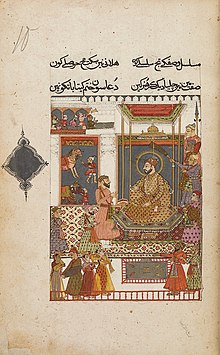
Illustrated page from ibn-e-Nishati’s “Phulban” (Flower Garden), a Deccani Urdu rendition of an unknown Persian work. Written under the patronage of Abdullah Qutb Shah, depicted here seated on a throne.
In the early 16th century, the Bahmani Sultanate splintered into the Deccan Sultanates. These were also Persianate in culture, but were characterised by an affinity towards regional languages. They are largely responsible for the development of the Deccani literary tradition, which became concentrated at Golconda and Bijapur. Numerous Deccani poets were patronised in this time. According to Shaheen and Shahid, Golconda was the literary home of Asadullah Wajhi (author of Sab Ras), ibn-e-Nishati (Phulban), and Ghwasi (Tutinama). Bijapur played host to Hashmi Bijapuri, San‘ati, and Mohammed Nusrati over the years.
The rulers themselves participated in these cultural developments. Muhammad Quli Qutb Shah of the Golconda Sultanate wrote poetry in Deccani, which was compiled into a Kulliyat. It is widely considered to be the earliest Urdu poetry of a secular nature. Ibrahim Adil Shah IIof the Bijapur Sultanate produced Kitab-e-Navras (Book of the Nine Rasas), a work of musical poetry written entirely in Deccani.
Although the poets of this era were well-versed in Persian, they were characterised by a preference for indigenous cultures. As a result, the language they cultivated emphasised the Sanskritic roots of Deccani, and borrowed from neighbouring languages (especially Marathi; Matthews states that Dravidian influence was much less). In this regard, Shaheen and Shahid note that literary Deccani has historically been very close to spoken Deccani (unlike the northern tradition that has always exhibited diglossia). San’ati says in his poetry:
|
Jisé Farsī kā na kuch gyān hai, |
Those who have no knowledge of Persian; |
However, as the language of court and culture, Persian nevertheless served as the model for poetic forms, and a good amount of Persian and Arabic vocabulary was present in the works of these writers. Hence Deccani tended to balance Indian and Persian influences,though it did always retain mutual intelligibility with the northern Dehlavi. This contributed to the cultivation of a distinct Deccani identity, separate from the Islamic rulers from the north; many poets proudly extolled the Deccan region and its culture.
Decline
The conquest of the Deccan by Aurangzeb in the 17th century connected the southern regions of the subcontinent to the north, and introduced a hegemony of northern tastes. This began the decline of Deccani poetry, as literary patronage in the region decreased. The sociopolitical context of the period is reflected in Hashmi Bijapuri’s poem, composed two years after the fall of Bijapur, in a time when many southern poets were pressured to change their language and style for patronage:
|
Tujé chākrī kya tu apnīch bōl, |
Why bother about patrons, in your own words do state; |
The literary centres of the Deccan had been replaced by the capital of the Mughals, so poets migrated to Delhi for better opportunities. A notable example is that of Wali Deccani(1667–1707), who adapted his Deccani sensibilities to the northern style and produced a divan in this variety. His work inspired the Persianate poets of the north to compose in the local dialect, which in their hands became an intermediate predecessor of Hindustani known as Rekhta. This accelerated the downfall of Deccani literature, as Rekhta came to dominate the competing dialects of Mughal Hindustan. The advent of the Asaf Jahis slowed this down, but despite their patronage of regional culture, Deccani Urdu’s literary tradition died. However, the spoken variety has lived on in the Deccani Muslims, retaining some of its historical features and continuing to be influenced by the neighbouring Dravidian languages.
Modern era
The term Deccani today is given to a Hindustani lect spoken natively by the Muslims of South India (who are known as the Deccanis). It is considered to be the modern, spoken variety of the historical Deccani dialect, and inherits many features from it. The term Deccani distinguishes the lect from standard Urdu – however, it is commonly considered a “variety” of Urdu, and often gets subsumed under this name, both by its own speakers and the official administration. The demise of the literary tradition has meant that Deccani uses standard Urdu as its formal register (i.e. for writing, news, education etc).
Features
Deccani is characterised by the retention of medieval-era features from Hindustani’s predecessor dialects, that have disappeared in today’s Hindi-Urdu. It is also distinguished by grammar and vocabulary influences from Marathi, Kannada, and Telugu, due to its prolonged use as a lingua franca in the Deccan. A non-exhaustive list of its unique features, compared with standard Urdu where possible:
| Deccani | Standard Urdu equivalent | Notes |
|---|---|---|
| minje, tume | mujhe, tum | Pronouns: Singular first and second person. |
| humna, tumna | humen, tumen | |
| un, in, une, ine, | uss, iss | Pronouns: Singular third person. |
| uno, unon | uss log/woh log | Pronouns: Plural third person. |
| suffix -aan (logaan, mardaan) | -ān for some words (ladkiyaan) and -ein, -on for others (auratein, bacchon) | Denotes plural of the noun. |
| apan | hum log | Is third person but often used in first person too. |
| suffix -ich (main idharich hoon) | hi (main idhar hi hoon) | Adds emphasis. Matthews comments that this is “probably from Marathi”. |
| kaiku, ki (kaiku kiya) | kyon (kyon kiya) | |
| po (main ghar po hoon) | par (main ghar par hoon) | Not an exclusive swap; both are used. |
| suffix -ingaa (kal jaingaa, ab karingaa) | -enge (kal jayenge, ab karenge) | Plural of future tense for second and third person. |
| sangaat (Yusuf sangaat jao) | ke saath (Yusuf ke saath jao) | Not an exclusive swap; both are used. |
| nakko (nakko karo) | (approximately) Mat, nahin (mat karo) | From Marathi. |
| kathey (Aaj chutti hai kathey) | Means “it seems” or “apparently”. | |
| Pronunciation | ||
| ku (Salim ku dedhey) | ko (Salim ko dedhey) | Urdu “ko” is pronounced generally as “ku”. E.g. mereku vs mujko, tereku vs tujko. |
| jaatein, kartein | jaate hain, karte hain | |
| kh ( خ ) | q ( ق ) | Though not always, Deccani speakers tend to pronounce q as kh. e.g. Khuli Khutub Shah instead of Quli Qutub Shah. |
Some of these features are not common to all speakers, as there tends to be regional variation. Mustafa names some varieties of Deccani as “(Telugu) Dakkhini, Kannada Dakkhini, and Tamil Dakkhini”, based on their influence from the dominant Dravidian language in the spoken region. He further divides Telugu Deccani into two linguistic categories, corresponding to: Andhra Pradesh, which he says has more Telugu influence; and Telangana, with more influence from standard Urdu. The latter is seen especially in the variety of Telangana’s capital, Hyderabadi Urdu.
Deccani’s use of Urdu as a standard register, and contact with Hindustani (widespread in India), has led to some of its distinctive features disappearing.

Areas where Hindustani (Khariboli) are spoken vs. Deccani
Culture
Deccani finds a cultural core in and around Telangana’s capital Hyderabad, where the highest concentration of speakers are; Telangana is one of the only two states of India to provide “Urdu” official status. Deccani Urdu in Hyderabad has found a vehicle of expression through humor and wit, which manifests in events called “Mazahiya Mushaira”, poetic symposiums with comedic themes. An example of Deccani, spoken in such a context at Hyderabad:
|
Buzdil hai woh jo jeetey ji marne se darr gaya |
It’s a coward who fears death while still alive, |
| — Ghouse Khamakha |
Additionally, the Deccani Film Industry is based in Hyderabad, and its movies are produced in Hyderabadi Urdu.
Legacy
Deccani and Urdu
Deccani, built on a base of Delhi Hindavi, influenced the development of Urdu (also known as Rekhta). This was achieved primarily through the continual interaction of Sufi poets, courtesans and public between the Deccan and the Mughal Courts and the Khadi Boli heartland. Hyderabad was the southernmost city of North India. Noteworthy are the contributions of Wali Dakhni (also known as Wali Aurangabadi and Wali Gujarati), a famous poet of Dakhni, who visited Delhi in 1700. He astonished the poets of Delhi with his ghazals. He drew wide applause from the Persian-speaking poets, some of whom, after listening to Wali, also adopted the language of the people, ‘Urdu’, as the medium of their poetic expressions. Prominent poets—Shah Hatem, Shah Abro and Mir Taqi Mir—were among his admirers.
At that time in Delhi, the court poets were composing in Persian and Arabic. For others, Braj and Awadhi were the languages of literary and religious expressions. The spoken language of all was Khadi Boli. When the poets listened to Wali in Dakhni language (which is also a variant of Khari Boli) they were struck by the fact that the spoken language of the people was capable of such rich literary expression. These events were important for they hastened the adoption of Urdu, in the early 18th century, as the language for literary and religious expression (in which Deccani played the role of a catalyst).
Being a literary language, Deccani used the Perso-Arabic script for writing the language. After Aurangzeb’s conquest of the Deccan, the northerners came into contact with Deccani, and imported the practice of writing in the Perso-Arabic script, which eventually became the standard practice for Urdu all over the Indian subcontinent.
Deccani and Hindi

Deccani in the Indo-European languages’ family tree, is represented under Urdu, and is a Hindustani language.
Suniti Kumar Chattopadhyay also maintained that it was Deccani that established the use of Khari Boli replacing Braj in the North. In fact, even the name Hindi for the language originated in the South. A Tamil, Kazi Mahamud Bahari, used the word Hindi for Deccani in the 17th century in his Sufi poem Man Lagan. Renaming Deccani as Hindi was probably a symbolic gesture by him to extend the geographical reach of this language.
Classification
Deccani is part of the Indo-Aryan grouping of the Indo-European languages. The Deccani language has puzzled linguists for years, and its specific classification is a confusing subject, it could be a direct descendant, or sister language of Urdu, or be a Persianization of the Marathi language. It was also declared as the National language of the former defunct Hyderabad State.