Delaware (/ˈdɛləwɛər/ ( listen) DEL-ə-wair) is a state in the Mid-Atlantic region of the United States, bordering Maryland to its south and west; Pennsylvania to its north; and New Jersey and the Atlantic Ocean to its east. The state takes its name from the adjacent Delaware Bay, in turn named after Thomas West, 3rd Baron De La Warr, an English nobleman and Virginia’s first colonial governor.
Delaware occupies the northeastern portion of the Delmarva Peninsula and some islands and territory within the Delaware River. It is the second-smallest and sixth-least populous state, but also the sixth-most densely populated. Delaware’s largest city is Wilmington, while the state capital is Dover, the second-largest city in the state. The state is divided into three counties, having the lowest number of counties of any state; from north to south, they are New Castle County, Kent County, and Sussex County. While the southern two counties have historically been predominantly agricultural, New Castle is more urbanized, being part of the Delaware Valley Metropolitan Statistical Area centered on Philadelphia. Although included in the Southern United States by the Census Bureau, Delaware’s geography, culture, and history combine elements of the Mid-Atlantic and Northeastern regions of the country.
Before its coastline was explored by Europeans in the 16th century, Delaware was inhabited by several groups of Native Americans, including the Lenape in the north and Nanticoke in the south. It was initially colonized by Dutch traders at Zwaanendael, near the present town of Lewes, in 1631. Delaware was one of the Thirteen Colonies that took part in the American Revolution. On December 7, 1787, Delaware became the first state to ratify the Constitution of the United States, and has since been known as The First State. Since the turn of the 20th century, Delaware is also a de facto onshore corporate haven, in which by virtue of its corporate laws, the state is the domicile of over half of all New York Stock Exchange-listed business and over three-fifths of the Fortune 500.
Toponymy
The state was named after Delaware Bay, which in turn derived its name from Thomas West, 3rd Baron De La Warr (1577–1618), the first governor of the Colony of Virginia. The Delaware people, a name used by Europeans for Lenape people indigenous to the Delaware Valley, also derive their name from the same source.
The name de La Warr is from Sussex and of Anglo-French origin. It came probably from a Norman lieu-dit La Guerre. This toponymic could derive from Latin ager, from the Breton gwern or from the Late Latin varectum (fallow). The toponyms Gara, Gare, Gaire (the sound often mutated in ) also appear in old texts cited by Lucien Musset, where the word ga(i)ra means gore. It could also be linked with a patronymic from the Old Norse verr.
History
 |
This section needs additional citations for verification. (December 2018)
|
Native Americans
Before Delaware was settled by European colonists, the area was home to the Eastern Algonquian tribes known as the Unami Lenape, or Delaware, who lived mostly along the coast, and the Nanticoke who occupied much of the southern Delmarva Peninsula. John Smith also shows two Iroquoian tribes, the Kuskarawock and Tockwogh, living north of the Nanticoke—they may have held small portions of land in the western part of the state before migrating across the Chesapeake Bay. The Kuskarawocks were most likely the Tuscarora.
The Unami Lenape in the Delaware Valley were closely related to Munsee Lenape tribes along the Hudson River. They had a settled hunting and agricultural society, and they rapidly became middlemen in an increasingly frantic fur trade with their ancient enemy, the Minqua or Susquehannock. With the loss of their lands on the Delaware River and the destruction of the Minqua by the Iroquois of the Five Nations in the 1670s, the remnants of the Lenape who wished to remain identified as such left the region and moved over the Alleghany Mountains by the mid-18th century. Generally, those who did not relocate out of the state of Delaware were baptized, became Christian and were grouped together with other persons of color in official records and in the minds of their non-Native American neighbors.
Colonial Delaware
The Dutch were the first Europeans to settle in present-day Delaware in the middle region by establishing a trading post at Zwaanendael, near the site of Lewes in 1631. Within a year all the settlers were killed in a dispute with area Native American tribes. In 1638 New Sweden, a Swedish trading post and colony, was established at Fort Christina (now in Wilmington) by Peter Minuit at the head of a group of Swedes, Finns and Dutch. The colony of New Sweden lasted 17 years. In 1651 the Dutch, reinvigorated by the leadership of Peter Stuyvesant, established a fort at present-day New Castle, and in 1655 they conquered the New Sweden colony, annexing it into the Dutch New Netherland. Only nine years later, in 1664, the Dutch were conquered by a fleet of English ships by Sir Robert Carr under the direction of James, the Duke of York. Fighting off a prior claim by Cecil Calvert, 2nd Baron Baltimore, Proprietor of Maryland, the Duke passed his somewhat dubious ownership on to William Penn in 1682. Penn strongly desired access to the sea for his Pennsylvania province and leased what then came to be known as the “Lower Counties on the Delaware” from the Duke.
Penn established representative government and briefly combined his two possessions under one General Assembly in 1682. However, by 1704 the Province of Pennsylvania had grown so large their representatives wanted to make decisions without the assent of the Lower Counties, and the two groups of representatives began meeting on their own, one at Philadelphia, and the other at New Castle. Penn and his heirs remained proprietors of both and always appointed the same person Governor for their Province of Pennsylvania and their territory of the Lower Counties. The fact that Delaware and Pennsylvania shared the same governor was not unique. From 1703 to 1738 New York and New Jersey shared a governor. Massachusetts and New Hampshire also shared a governor for some time.
Dependent in early years on indentured labor, Delaware imported more slaves as the number of English immigrants decreased with better economic conditions in England. The colony became a slave society and cultivated tobacco as a cash crop, although English immigrants continued to arrive.
American Revolution

A two-shilling, six-pence banknote issued by Delaware in 1777
Like the other middle colonies, the Lower Counties on the Delaware initially showed little enthusiasm for a break with Britain. The citizenry had a good relationship with the Proprietary government, and generally were allowed more independence of action in their Colonial Assembly than in other colonies. Merchants at the port of Wilmington had trading ties with the British.
New Castle lawyer Thomas McKean denounced the Stamp Act in the strongest terms, and Kent County native John Dickinson became the “Penman of the Revolution.” Anticipating the Declaration of Independence, Patriot leaders Thomas McKean and Caesar Rodney convinced the Colonial Assembly to declare itself separated from British and Pennsylvania rule on June 15, 1776. The person best representing Delaware’s majority, George Read, could not bring himself to vote for a Declaration of Independence. Only the dramatic overnight ride of Caesar Rodney gave the delegation the votes needed to cast Delaware’s vote for independence.
Initially led by John Haslet, Delaware provided one of the premier regiments in the Continental Army, known as the “Delaware Blues” and nicknamed the “Blue Hen’s Chicks”. In August 1777 General Sir William Howe led a British army through Delaware on his way to a victory at the Battle of Brandywine and capture of the city of Philadelphia. The only real engagement on Delaware soil was the Battle of Cooch’s Bridge, fought on September 3, 1777, at Cooch’s Bridge in New Castle County, although there was a minor Loyalist rebellion in 1778.
Following the Battle of Brandywine, Wilmington was occupied by the British, and State President John McKinly was taken prisoner. The British remained in control of the Delaware River for much of the rest of the war, disrupting commerce and providing encouragement to an active Loyalist portion of the population, particularly in Sussex County. Because the British promised slaves of rebels freedom for fighting with them, escaped slaves flocked north to join their lines.
Following the American Revolution, statesmen from Delaware were among the leading proponents of a strong central United States with equal representation for each state.
Slavery and race
Many colonial settlers came to Delaware from Maryland and Virginia, where the population had been increasing rapidly. The economies of these colonies were chiefly based on labor-intensive tobacco and increasingly dependent on African slaves because of a decline in working class immigrants from England. Most of the English colonists had arrived as indentured servants (contracted for a fixed period to pay for their passage), and in the early years the line between servant and slave was fluid.
Most of the free African-American families in Delaware before the Revolution had migrated from Maryland to find more affordable land. They were descendants chiefly of relationships or marriages between white servant women and enslaved, servant or free African or African-American men. Under slavery law, children took the social status of their mothers, so children born to white women were free, regardless of their paternity, just as children born to enslaved women were born into slavery. As the flow of indentured laborers to the colony decreased with improving economic conditions in England, more slaves were imported for labor and the caste lines hardened.
By the end of the colonial period, the number of enslaved people in Delaware began to decline. Shifts in the agriculture economy from tobacco to mixed farming resulted in less need for slaves’ labor. In addition local Methodists and Quakers encouraged slaveholders to free their slaves following the American Revolution, and many did so in a surge of individual manumissions for idealistic reasons. By 1810 three-quarters of all blacks in Delaware were free. When John Dickinson freed his slaves in 1777, he was Delaware’s largest slave owner with 37 slaves. By 1860, the largest slaveholder owned 16 slaves.
Although attempts to abolish slavery failed by narrow margins in the legislature, in practical terms the state had mostly ended the practice. By the 1860 census on the verge of the Civil War, 91.7% of the black population were free; 1,798 were slaves, as compared to 19,829 “free colored persons”.
An independent black denomination was chartered in 1813 by freed slave Peter Spencer as the “Union Church of Africans”. This followed the 1793 establishment in Philadelphia of the African Methodist Episcopal Church by Richard Allen, which had ties to the Methodist Episcopal Church until 1816. Spencer built a church in Wilmington for the new denomination. This was renamed as the African Union First Colored Methodist Protestant Church and Connection, more commonly known as the A.U.M.P. Church. In 1814, Spencer called for the first annual gathering, known as the Big August Quarterly, which continues to draw members of this denomination and their descendants together in a religious and cultural festival.
Delaware voted against secession on January 3, 1861, and so remained in the Union. While most Delaware citizens who fought in the war served in the regiments of the state, some served in companies on the Confederate side in Maryland and Virginia Regiments. Delaware is notable for being the only slave state from which no Confederate regiments or militia groups were assembled. Delaware essentially freed the few slaves who were still in bondage shortly after the Civil War but rejected the 13th, 14th, and 15th Amendments to the Constitution; the 13th Amendment was rejected on February 8, 1865, the 14th Amendment was rejected on February 8, 1867, and the 15th Amendment was rejected on March 18, 1869. Delaware officially ratified the 13th, 14th, and 15th amendments on February 12, 1901.
Reconstruction and industrialization
During the Reconstruction Era that followed the Civil War, Democratic Redeemer governments led by the South’s Bourbon aristocracy continued to dominate the region and imposed explicitly white supremacist regimes in the former slave states. The Delaware legislature declared blacks to be second-class citizens in 1866 and restricted their voting rights despite the Fifteenth Amendment, ensuring continued Democratic success in the state throughout most of the nineteenth century. Fearful that the 1875 Civil Rights Act passed by Congress might establish social equality, Delaware legislators passed Jim Crow laws that mandated racial segregation in public facilities. The state’s educational system was segregated by operation of law. Delaware’s segregation was written into the state constitution, which, while providing at Article X, Section 2, that “no distinction shall be made on account of race or color”, nonetheless required that “separate schools for white and colored children shall be maintained.”
Beginning in the late nineteenth century, the Wilmington area grew into a manufacturing center. Investment in manufacturing in the city grew from $5.5 million in 1860 to $44 million in 1900. The most notable manufacturer in the state was the chemical company DuPont, which to this day is heavily credited with making the state what it is today in many ways. Because of Wilmington’s growth, local politicians from the city and New Castle County pressured the state government to adopt a new constitution providing the north with more representation. However, the subsequent 1897 constitution did not proportionally represent the north and continued to give the southern counties disproportionate influence.
As manufacturing expanded, businesses became major players in state affairs and funders of politicians through families such as the Du Ponts. Republican John Addicks attempted to buy a US Senate seat multiple times in a rivalry with the Du Ponts until the passage of the Seventeenth Amendment. The allegiance of industries with the Republican party allowed them to gain control of the state’s governorship throughout most of the twentieth century. The GOP ensured blacks could vote because of their general support for Republicans and thus undid restrictions on black suffrage.
Delaware benefited greatly from World War I because of the state’s large gunpowder industry. DuPont, the most dominant business in the state by WWI, produced an estimated 40% of all gunpowder used by the Allies during the war. It produced nylon in the state after the war and began investments into General Motors. Additionally, the company invested heavily in the expansion of public schools in the state and colleges such as the University of Delaware in the 1910s and 1920s. This included primary and secondary schools for blacks and women. Delaware suffered less during the Great Depression than other states, but the depression spurred further migration from the rural south to urban areas.
World War II to present
Like in World War I, the state enjoyed a big stimulus to its gunpowder and shipyard industries in World War II. New job opportunities during and after the war in the Wilmington area coaxed blacks from the southern counties to move to the city. The proportion of blacks constituting the city’s population rose from 15% in 1950 to over 50% by 1980. The surge of black migrants to the north sparked white flight, in which middle class whites moved from the city to suburban areas, leading to de facto segregation of Northern Delaware’s society. In the 1940s and 1950s, Delaware attempted to integrate its schools, although school segregation in the state would not end until 1967. The University of Delaware admitted its first black student in 1948, and local courts ruled that primary schools had to be integrated. Delaware’s integration efforts partially inspired the US Supreme Court’s decision in Brown v. Board of Education, which found racial segregation in United States public schools to be unconstitutional. The end result of the Brown ruling was that Delaware became fully integrated, albeit with time and much effort.
In October 1954, the city of Milford became the scene of one of the country’s first pro-segregation boycotts after eleven black students were enrolled in the previously all-white Milford High School. Mass protests continued in Milford; the school board eventually ceded to the protestors, expelling the black students. The ensuing unrest, which included cross burnings, rallies, and pro-segregation demonstrations, contributed to desegregation in most of Southern Delaware being delayed for another ten years. Throughout the state, integration only encouraged more white flight, and poor economic conditions for the black population led to some violence during the 1960s. Riots broke out in Wilmington in 1967 and again in 1968 in response to the assassination of Martin Luther King Jr, after which the National Guard occupied the city for nine months to prevent further violence.
Since WWII, the state has been generally economically prosperous and enjoyed relatively high per capita income because of its location between major cities like Philadelphia, New York, and Washington, DC. Its population grew rapidly, particularly in the suburbs in the north where New Castle county became an extension of the Philadelphia metropolitan area. Americans, including migrants from Puerto Rico, and immigrants from Latin America flocked to the state. By 1990, only 50% of Delaware’s population consisted of natives to the state.
Geography
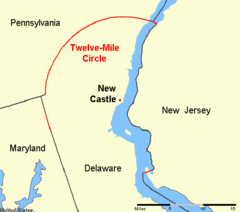
The Twelve-Mile Circle
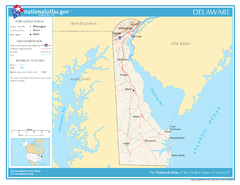
Map of Delaware

Sunset in Woodbrook, Delaware

The Blackbird Pond on the Blackbird State Forest Meadows Tract in New Castle County, Delaware

A field north of Fox Den Road, along the Lenape Trail in Middle Run Valley Natural Area
Delaware is 96 miles (154 km) long and ranges from 9 miles (14 km) to 35 miles (56 km) across, totaling an area of either 1,982 square miles (5,130 km2), or 2,489 square miles (6,450 km2) making it the second-smallest state in the United States after Rhode Island. Delaware is bounded to the north by Pennsylvania; to the east by the Delaware River, Delaware Bay, New Jersey and the Atlantic Ocean; and to the west and south by Maryland. Small portions of Delaware are also situated on the eastern side of the Delaware River sharing land boundaries with New Jersey. The state of Delaware, together with the Eastern Shore counties of Maryland and two counties of Virginia, form the Delmarva Peninsula, which stretches down the Mid-Atlantic Coast.
The definition of the northern boundary of the state is unusual. Most of the boundary between Delaware and Pennsylvania was originally defined by an arc extending 12 miles (19.3 km) from the cupola of the courthouse in the city of New Castle. This boundary is often referred to as the Twelve-Mile Circle. Although the Twelve-Mile Circle is often claimed to be the only territorial boundary in the U.S. that is a true arc, the Mexican boundary with Texas includes several arcs, and many cities in the South (such as Plains, Georgia) also have circular boundaries.
This border extends all the way east to the low-tide mark on the New Jersey shore, then continues south along the shoreline until it again reaches the 12-mile (19 km) arc in the south; then the boundary continues in a more conventional way in the middle of the main channel (thalweg) of the Delaware River.
To the west, a portion of the arc extends past the easternmost edge of Maryland. The remaining western border runs slightly east of due south from its intersection with the arc. The Wedge of land between the northwest part of the arc and the Maryland border was claimed by both Delaware and Pennsylvania until 1921, when Delaware’s claim was confirmed.
Topography
Delaware is on a level plain, with the lowest mean elevation of any state in the nation. Its highest elevation, located at Ebright Azimuth, near Concord High School, is less than 450 feet (140 m) above sea level. The northernmost part of the state is part of the Piedmont Plateau with hills and rolling surfaces.
The Atlantic Seaboard fall line approximately follows the Robert Kirkwood Highway between Newark and Wilmington; south of this road is the Atlantic Coastal Plain with flat, sandy, and, in some parts, swampy ground. A ridge about 75 to 80 feet (23 to 24 m) high extends along the western boundary of the state and separates the watersheds that feed Delaware River and Bay to the east and the Chesapeake Bay to the west.
Climate

Delaware Köppen climate classification is humid subtropical.
Since almost all of Delaware is a part of the Atlantic coastal plain, the effects of the ocean moderate its climate. The state lies in the humid subtropical climate (Köppen Cfa) zone. Despite its small size (roughly 100 miles (160 km) from its northernmost to southernmost points), there is significant variation in mean temperature and amount of snowfall between Sussex County and New Castle County. Moderated by the Atlantic Ocean and Delaware Bay, the southern portion of the state has a milder climate and a longer growing season than the northern portion of the state. Delaware’s all-time record high of 110 °F (43 °C) was recorded at Millsboro on July 21, 1930. The all-time record low of −17 °F (−27 °C) was also recorded at Millsboro, on January 17, 1893. The hardiness zones are 6b, 7a and 7b.
Environment
The transitional climate of Delaware supports a wide variety of vegetation. In the northern third of the state are found Northeastern coastal forests and mixed oak forests typical of the northeastern United States. In the southern two-thirds of the state are found Middle Atlantic coastal forests. Trap Pond State Park, along with areas in other parts of Sussex County, for example, support the northernmost stands of bald cypress trees in North America.
Environmental management
Delaware provides government subsidy support for the clean-up of property “lightly contaminated” by hazardous waste, the proceeds for which come from a tax on wholesale petroleum sales.
Municipalities
Wilmington is the state’s most populous city (70,635) and its economic hub. It is located within commuting distance of both Philadelphia and Baltimore. Dover is the state capital and the second most populous city (38,079).
Counties
- Kent
- New Castle
- Sussex
Cities
- Delaware City
- Dover
- Harrington
- Lewes
- Middletown
- Milford
- New Castle
- Newark
- Rehoboth Beach
- Seaford
- Wilmington
Towns
- Bellefonte
- Bethany Beach
- Bethel
- Blades
- Bowers
- Bridgeville
- Camden
- Cheswold
- Clayton
- Dagsboro
- Delmar
- Dewey Beach
- Ellendale
- Elsmere
- Farmington
- Felton
- Fenwick Island
- Frankford
- Frederica
- Georgetown
- Greenwood
- Hartly
- Henlopen Acres
- Houston
- Kenton
- Laurel
- Leipsic
- Little Creek
- Magnolia
- Millsboro
- Millville
- Milton
- Newport
- Ocean View
- Odessa
- Selbyville
- Slaughter Beach
- Smyrna
- South Bethany
- Townsend
- Viola
- Woodside
- Wyoming
Villages
- Arden
- Ardencroft
- Ardentown
Unincorporated places
- Bear
- Brookside
- Christiana
- Clarksville
- Claymont
- Dover Base Housing
- Edgemoor
- Glasgow
- Greenville
- Gumboro
- Harbeson
- Highland Acres
- Hockessin
- Kent Acres
- Lincoln City
- Long Neck
- Marshallton
- Mount Pleasant
- North Star
- Oak Orchard
- Omar
- Pennyhill
- Pike Creek
- Rising Sun-Lebanon
- Riverview
- Rodney Village
- Roxana
- Saint Georges
- Sandtown
- Stanton
- Wilmington Manor
- Woodland
- Woodside East
- Yorklyn
-
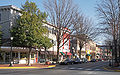
Dover
-

Newark
-
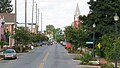
Seaford
-
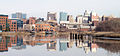
Wilmington
The table below lists the ten largest municipalities in the state based on the 2018 United States census estimate.
|
Largest cities or towns in Delaware 2018 census estimates
|
|||||||||
|---|---|---|---|---|---|---|---|---|---|
| Rank | Name | County | Pop. | ||||||
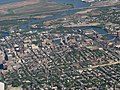 Wilmington 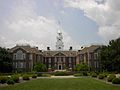 Dover |
1 | Wilmington | New Castle | 70,635 |  Newark  Middletown |
||||
| 2 | Dover | Kent | 38,079 | ||||||
| 3 | Newark | New Castle | 33,673 | ||||||
| 4 | Middletown | New Castle | 22,582 | ||||||
| 5 | Smyrna | New Castle/Kent | 11,580 | ||||||
| 6 | Milford | Kent/Sussex | 11,353 | ||||||
| 7 | Seaford | Sussex | 7,861 | ||||||
| 8 | Georgetown | Sussex | 7,427 | ||||||
| 9 | Elsmere | New Castle | 5,981 | ||||||
| 10 | New Castle | New Castle | 5,529 | ||||||
Demographics

Delaware population density map
| Historical population | |||
|---|---|---|---|
| Census | Pop. | %± | |
| 1790 | 59,096 | — | |
| 1800 | 64,273 | 8.8% | |
| 1810 | 72,674 | 13.1% | |
| 1820 | 72,749 | 0.1% | |
| 1830 | 76,748 | 5.5% | |
| 1840 | 78,085 | 1.7% | |
| 1850 | 91,532 | 17.2% | |
| 1860 | 112,216 | 22.6% | |
| 1870 | 125,015 | 11.4% | |
| 1880 | 146,608 | 17.3% | |
| 1890 | 168,493 | 14.9% | |
| 1900 | 184,735 | 9.6% | |
| 1910 | 202,322 | 9.5% | |
| 1920 | 223,003 | 10.2% | |
| 1930 | 238,380 | 6.9% | |
| 1940 | 266,505 | 11.8% | |
| 1950 | 318,085 | 19.4% | |
| 1960 | 446,292 | 40.3% | |
| 1970 | 548,104 | 22.8% | |
| 1980 | 594,338 | 8.4% | |
| 1990 | 666,168 | 12.1% | |
| 2000 | 783,600 | 17.6% | |
| 2010 | 897,934 | 14.6% | |
| 2020 | 989,948 | 10.2% | |
| 2021 (est.) | 1,003,384 | 1.4% | |
| Source: 1910–2020 | |||
The United States Census Bureau determined that the population of Delaware was 989,948 on April 1, 2020, an increase since the 2010 United States census at 897,934.
Delaware’s history as a border state has led it to exhibit characteristics of both the Northern and the Southern regions of the United States. Generally, the rural Southern (or “Slower Lower”) regions of Delaware below the Chesapeake and Delaware Canal embody a Southern culture, while densely-populated Northern Delaware above the canal—particularly Wilmington, a part of the Philadelphia metropolitan area—has more in common with that of the Northeast. The U.S. Census Bureau designates Delaware as one of the South Atlantic States, but it is commonly associated with the Mid-Atlantic States and/or northeastern United States by other federal agencies, the media, and some residents.
Delaware is the sixth most densely populated state, with a population density of 442.6 people per square mile, 356.4 per square mile more than the national average, and ranking 45th in population. Delaware is one of five U.S. states (Maine, Vermont, West Virginia, Wyoming) that do not have a single city with a population over 100,000 as of the 2010 census. The center of population of Delaware is in New Castle County, in the town of Townsend.
As of 2011, 49.7% of Delaware’s population younger than one year of age belonged to minority groups (i.e., did not have two parents of non-Hispanic white ancestry). In 2000 approximately 19% of the population were African-American and 5% of the population is Hispanic (mostly of Puerto Rican or Mexican ancestry).
Race and ethnicity
According to the 2010 United States census, the racial composition of the state was 68.9% White American (65.3% Non-Hispanic White, 3.6% White Hispanic), 21.4% Black or African American, 0.5% American Indian and Alaska Native, 3.2% Asian American, 0.0% Native Hawaiian and other Pacific Islander, 3.4% some other race, and 2.7% Multiracial American. Ethnically, Hispanics and Latin Americans of any race made up 8.2% of the population. The 2019 American Community Survey estimated the state had a racial and ethnic makeup of 61.% non-Hispanic whites, 23.2% Black or African American, 0.7% American Indian or Alaska Native, 4.1% Asian, 0.1% Pacific Islander, 2.7% multiracial, and 9.6% Hispanic or Latin American of any race.
In the Native American community, the state has a Native American group (called in their own language Lenni Lenape) which was influential in the colonial period of the United States and is today headquartered in Cheswold, Kent County, Delaware. A band of the Nanticoke tribe of American Indians today resides in Sussex County and is headquartered in Millsboro, Sussex County, Delaware.
| Racial composition | 1990 | 2000 | 2010 |
|---|---|---|---|
| White | 80.3% | 74.6% | 68.9% |
| Black | 16.9% | 19.2% | 21.4% |
| Asian | 1.4% | 2.1% | 3.2% |
| Native | 0.3% | 0.4% | 0.5% |
| Native Hawaiian and other Pacific Islander |
– | – | – |
| Other race | 1.1% | 2.0% | 3.4% |
| Two or more races | – | 1.7% | 2.7% |
Birth data
Note: Births in table do not add up because Hispanics are counted both by their ethnicity and by their race, giving a higher overall number.
| Race | 2013 | 2014 | 2015 | 2016 | 2017 | 2018[90] | 2019[91] | 2020[92] | 2021[93] |
|---|---|---|---|---|---|---|---|---|---|
| White: | 7,204 (66.5%) | 7,314 (66.7%) | 7,341 (65.7%) | … | … | … | … | … | … |
| > Non-hispanic White | 5,942 (54.8%) | 5,904 (53.8%) | 5,959 (53.4%) | 5,827 (53.0%) | 5,309 (48.9%) | 5,171 (48.7%) | 5,024 (47.6%) | 4,949 (47.6%) | 5,042 (48.1%) |
| Black | 3,061 (28.3%) | 2,988 (27.2%) | 3,134 (28.1%) | 2,832 (25.7%) | 2,818 (26.0%) | 2,773 (26.1%) | 2,804 (26.5%) | 2,722 (26.2%) | 2,711 (25.9%) |
| Asian | 541 (5.0%) | 644 (5.9%) | 675 (6.1%) | 627 (5.7%) | 646 (6.0%) | 634 (6.0%) | 624 (5.9%) | 617 (5.9%) | 538 (5.1%) |
| American Indian | 25 (0.2%) | 26 (0.2%) | 16 (0.1%) | 13 (0.1%) | 23 (0.2%) | 10 (0.1%) | 18 (0.2%) | 18 (0.2%) | 12 (0.1%) |
| Hispanic (of any race) | 1,348 (12.4%) | 1,541 (14.0%) | 1,532 (13.7%) | 1,432 (13.0%) | 1,748 (16.1%) | 1,710 (16.1%) | 1,737 (16.4%) | 1,768 (17.0%) | 1,826 (17.4%) |
| Total Delaware | 10,831 (100%) | 10,972 (100%) | 11,166 (100%) | 10,992 (100%) | 10,855 (100%) | 10,621 (100%) | 10,562 (100%) | 10,392 (100%) | 10,482 (100%) |
- Since 2016, data for births of White Hispanic origin are not collected, but included in one Hispanic group; persons of Hispanic origin may be of any race.
Languages
As of 2000, 91% of Delaware residents of age 5 and older spoke only English at home; 5% spoke Spanish. French was the third-most spoken language at 0.7%, followed by Chinese at 0.5% and German at 0.5%. Legislation had been proposed in both the House and the Senate in Delaware to designate English as the official language. Neither bill was passed in the legislature.
Sexual orientation
A 2012 Gallup poll found that Delaware’s proportion of lesbian, gay, bisexual, and transgender adults stood at 3.4 percent of the population. This constitutes a total LGBT adult population estimate of 23,698 people. The number of same-sex couple households in 2010 stood at 2,646. This grew by 41.65% from a decade earlier. On July 1, 2013, same-sex marriage was legalized, and all civil unions would be converted into marriages.
Religion
As of 2014, the Pew Research Center estimated Delaware is mostly Christian. Although Protestants account for almost half of the population, the Roman Catholic Church is the largest single denomination in the state. The Association of Religion Data Archives reported in 2010 that the three largest denominational groups in Delaware by number of adherents are the Catholic Church at 182,532 adherents, the United Methodist Church with 53,656 members reported, and non-denominational Evangelical Protestant with 22,973 adherents reported. By 2020, the Public Religion Research Institute determined 61% of the population was Christian.
The Roman Catholic Diocese of Wilmington and the Episcopal Diocese of Delaware oversee the parishes within their denominations. The A.U.M.P. Church, the oldest African-American denomination in the nation, was founded in Wilmington. It still has a substantial presence in the state. Reflecting new immigrant populations, an Islamic mosque has been built in the Ogletown area, and a Hindu temple in Hockessin.
Delaware is home to an Amish community which resides west of Dover in Kent County, consisting of nine church districts and about 1,650 people. The Amish first settled in Kent County in 1915. In recent years, increasing development has led to the decline in the number of Amish living in the community.
A 2012 survey of religious attitudes in the United States found that 34% of Delaware residents considered themselves “moderately religious”, 33% “very religious”, and 33% as “non-religious”. At the 2014 Pew Research survey, 23% of the population were irreligious; the 2020 Public Religion Research Institute’s survey determined 31% of the population were irreligious.
Economy
Affluence
| DE County | March 2010 | March 2011 |
|---|---|---|
| New Castle | 229,000 | 216,000 |
| Sussex | 323,000 | 296,000 |
| Kent | 186,000 | 178,000 |
According to a 2020 study by Kiplinger, Delaware had the seventeenth largest number of millionaires per capita in the United States, with a ratio of 6.98 percent, 0.7 percent from 2013 in ration but falling eight places in ranking. Delaware had 25,937 millionaires as of 2020. The median income for all Delaware households as of 2020 was $64,805.
Agriculture

Picking Peaches in Delaware from an 1878 issue of Harper’s Weekly
Delaware’s agricultural output consists of poultry, nursery stock, soybeans, dairy products and corn.
Industries
As of October 2019, the state’s unemployment rate was 3.7%.
The state’s largest employers are:
- government (State of Delaware, New Castle County)
- education (University of Delaware, Delaware Technical Community College)
- banking (Bank of America, M&T Bank, JPMorgan Chase, Citigroup, Deutsche Bank)
- chemical, pharmaceutical, technology (DuPont de Nemours Inc., AstraZeneca, Syngenta, Agilent Technologies)
- healthcare (ChristianaCare (Christiana Hospital), Bayhealth Medical Center, Nemours Children’s Hospital, Delaware)
- farming, specifically chicken farming in Sussex County (Perdue Farms, Mountaire Farms, Allen Family Foods)
- retail (Walmart, Walgreens, Acme Markets)
Industrial decline
Since the mid-2000s, Delaware has seen the departure of the state’s automotive manufacturing industry (General Motors Wilmington Assembly and Chrysler Newark Assembly), the corporate buyout of a major bank holding company (MBNA), the departure of the state’s steel industry (Evraz Claymont Steel), the bankruptcy of a fiber mill (National Vulcanized Fibre), and the diminishing presence of AstraZeneca in Wilmington.
In late 2015, DuPont announced that 1,700 employees, nearly a third of its footprint in Delaware, would be laid off in early 2016. The merger of E.I. du Pont de Nemours & Co. and Dow Chemical Company into DowDuPont took place on September 1, 2017.
Incorporation in Delaware
More than half of all U.S. publicly traded companies, and 63% of the Fortune 500, are incorporated in Delaware. The state’s attractiveness as a corporate haven is largely because of its business-friendly corporation law. Franchise taxes on Delaware corporations supply about a fifth of the state’s revenue. Although “USA (Delaware)” ranked as the world’s most opaque jurisdiction on the Tax Justice Network’s 2009 Financial Secrecy Index, the same group’s 2011 Index ranks the U.S. fifth and does not specify Delaware. In Delaware, there are more than a million registered corporations, meaning there are more corporations than people.
Food and drink
Title 4, chapter 7 of the Delaware Code stipulates that alcoholic liquor be sold only in specifically licensed establishments, and only between 9:00 a.m. and 1:00 a.m. Until 2003, Delaware was among the several states enforcing blue laws and banned the sale of liquor on Sunday.
Media
Newspapers
Two daily newspapers are based in Delaware, the Delaware State News, based in Dover and covering the two southern counties, and The News Journal covering Wilmington and northern Delaware. The state is also served by several weekly, monthly and online publications.
Television
No standalone television stations are based solely in Delaware. The northern part of the state is served by network stations in Philadelphia and the southern part by network stations in Salisbury, Maryland. Philadelphia’s ABC affiliate, WPVI-TV, maintains a news bureau in downtown Wilmington. Salisbury’s CBS affiliate, WBOC-TV, maintains bureaus in Dover and Milton. Three Philadelphia-market stations—PBS member WHYY-TV, Ion affiliate WPPX, and MeTV affiliate WDPN-TV—all have Wilmington as their city of license, but maintain transmitters at the market antenna farm in Roxborough, Philadelphia and do not produce any Delaware-centric programming.
Radio
There are a numerous radio stations licensed in Delaware. WDEL 1150AM, WHGE-LP 95.3 FM, WILM 1450 AM, WJBR-FM 99.5, WMPH 91.7 FM, WSTW 93.7 FM, WTMC 1380 AM and WWTX 1290AM are licensed from Wilmington. WRDX 92.9 FM is licensed from Smyrna. WDOV 1410AM, WDSD 94.7 FM and WRTX 91.7 FM are licensed from Dover.
Tourism

Rehoboth Beach is a popular vacation spot during the summer months.

Fort Delaware State Park on Pea Patch Island is a popular spot during the spring and summer. A ferry takes visitors to the fort from nearby Delaware City.
Delaware is home to First State National Historical Park, a National Park Service unit composed of historic sites across the state including the New Castle Court House, Green, and Sheriff’s House, Dover Green, Beaver Valley, Fort Christina, Old Swedes’ Church, John Dickinson Plantation, and the Ryves Holt House.[124] Delaware has several museums, wildlife refuges, parks, houses, lighthouses, and other historic places.
Rehoboth Beach, together with the towns of Lewes, Dewey Beach, Bethany Beach, South Bethany, and Fenwick Island, comprise Delaware’s beach resorts. Rehoboth Beach often bills itself as “The Nation’s Summer Capital” because it is a frequent summer vacation destination for Washington, D.C., residents as well as visitors from Maryland, Virginia, and in lesser numbers, Pennsylvania. Vacationers are drawn for many reasons, including the town’s charm, artistic appeal, nightlife, and tax-free shopping. According to SeaGrant Delaware, the Delaware beaches generate $6.9 billion annually and over $711 million in tax revenue.[125]
Delaware is home to several festivals, fairs, and events. Some of the more notable festivals are the Riverfest held in Seaford, the World Championship Punkin Chunkin formerly held at various locations throughout the state since 1986, the Rehoboth Beach Chocolate Festival, the Bethany Beach Jazz Funeral to mark the end of summer, the Apple Scrapple Festival held in Bridgeville, the Clifford Brown Jazz Festival in Wilmington, the Rehoboth Beach Jazz Festival, the Sea Witch Halloween Festival and Parade in Rehoboth Beach, the Rehoboth Beach Independent Film Festival, the Nanticoke Indian Pow Wow in Oak Orchard, Firefly Music Festival, and the Return Day Parade held after every election in Georgetown.
In 2015, tourism in Delaware generated $3.1 billion, which makes up five percent of the state’s GDP. Delaware saw 8.5 million visitors in 2015, with the tourism industry employing 41,730 people, making it the 4th largest private employer in the state. Major origin markets for Delaware tourists include Philadelphia, Baltimore, New York City, Washington, D.C., and Harrisburg, with 97% of tourists arriving to the state by car and 75% of tourists coming from a distance of 200 miles (320 km) or less.[126]
Delaware is also home to two large sporting venues. Dover Motor Speedway is a race track in Dover, and Frawley Stadium in Wilmington is the home of the Wilmington Blue Rocks, a Minor League Baseball team.
Education
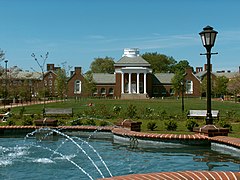
University of Delaware in Newark
In the early 1920s, Pierre S. du Pont served as president of the state board of education. At the time, state law prohibited money raised from white taxpayers from being used to support the state’s schools for black children. Appalled by the condition of the black schools, du Pont donated four million dollars to construct 86 new school buildings.
Delaware was the origin of Belton v. Gebhart (1952), one of the four cases which were combined into Brown v. Board of Education, the Supreme Court of the United States decision that led to the end of officially segregated public schools. Significantly, Belton was the only case in which the state court found for the plaintiffs, thereby ruling that segregation is unconstitutional.
Unlike many states, Delaware’s educational system is centralized in a state Superintendent of Education, with local school boards retaining control over taxation and some curriculum decisions. This centralized system, combined with the small size of the state, likely contributed to Delaware becoming the first state, after completion of a three-year, $30 million program ending in 1999, to wire every K-12 classroom in the state to the Internet.
As of 2011, the Delaware Department of Education had authorized the founding of 25 charter schools in the state, one of them being all-girls.
All teachers in the State’s public school districts are unionized. As of January 2012, none of the State’s charter schools are members of a teachers union. One of the State’s teachers’ unions is Delaware State Education Association (DSEA).
Colleges and universities
- Delaware College of Art and Design
- Delaware State University
- Delaware Technical & Community College
- Goldey-Beacom College
- University of Delaware—Ranked 63rd in the U.S. and in top 201–250 in the world (Times Higher Education World University Rankings 2018)
- Widener University School of Law
- Wilmington University
Transportation

Delaware’s license plate design, introduced in 1959, is the longest-running one in U.S. history.
The transportation system in Delaware is under the governance and supervision of the Delaware Department of Transportation, also known as “DelDOT”. Funding for DelDOT projects is drawn, in part, from the Delaware Transportation Trust Fund, established in 1987 to help stabilize transportation funding; the availability of the Trust led to a gradual separation of DelDOT operations from other Delaware state operations. DelDOT manages programs such as a Delaware Adopt-a-Highway program, major road route snow removal, traffic control infrastructure (signs and signals), toll road management, Delaware Division of Motor Vehicles, the Delaware Transit Corporation (branded as “DART First State”, the state government public transportation organization), among others. In 2009, DelDOT maintained 13,507 lane-miles, totaling 89 percent of the state’s public roadway system, the rest being under the supervision of individual municipalities. This far exceeds the national average (20 percent) for state department of transportation maintenance responsibility.
Roads
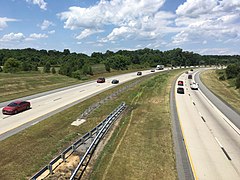
Delaware Route 1 (DE 1) is a partial toll road linking Fenwick Island and Wilmington.
One major branch of the U.S. Interstate Highway System, Interstate 95 (I-95), crosses Delaware southwest-to-northeast across New Castle County. Two Auxiliary Interstate Highway routes are also located in the state. Interstate 495 (I-495) is an eastern bypass of Wilmington. Interstate 295 (I-295) is a bypass of Philadelphia which begins south of Wilmington. In addition to Interstate highways, there are six U.S. highways that serve Delaware: U.S. 9, U.S. 13, U.S. 40, U.S. 113, U.S. 202, and U.S. 301. There are also several state highways that cross the state of Delaware; a few of them include DE 1, DE 9, and DE 404. U.S. 13 and DE 1 are primary north–south highways connecting Wilmington and Pennsylvania with Maryland, with DE 1 serving as the main route between Wilmington and the Delaware beaches. DE 9 is a north–south highway connecting Dover and Wilmington via a scenic route along the Delaware Bay. U.S. 40 is a primary east–west route, connecting Maryland with New Jersey. DE 404 is another primary east–west highway connecting the Chesapeake Bay Bridge in Maryland with the Delaware beaches. The state also operates three toll highways, the Delaware Turnpike, which is I-95, between Maryland and New Castle; the Korean War Veterans Memorial Highway, which is DE 1, between Wilmington and Dover; and the U.S. 301 toll road between the Maryland border and DE 1 in New Castle County.
A bicycle route, Delaware Bicycle Route 1, spans the north–south length of the state from the Maryland border in Fenwick Island to the Pennsylvania border north of Montchanin. It is the first of several signed bike routes planned in Delaware.
Delaware has about 1,450 bridges, 95 percent of which are under the supervision of DelDOT. About 30 percent of all Delaware bridges were built before 1950, and about 60 percent of the number are included in the National Bridge Inventory. Some bridges not under DelDOT supervision includes the four bridges on the Chesapeake and Delaware Canal, which are under the jurisdiction of the U.S. Army Corps of Engineers, and the Delaware Memorial Bridge, which is under the bi-state Delaware River and Bay Authority.
It has been noted that the tar and chip composition of secondary roads in Sussex County makes them more prone to deterioration than are the asphalt roadways in almost the rest of the state. Among these roads, Sussex (county road) 236 is among the most problematic.
Ferries

Cape May–Lewes Ferry
Three ferries operate in the state of Delaware:
- Cape May–Lewes Ferry crosses the mouth of Delaware Bay between Lewes, Delaware, and Cape May, New Jersey.
- Woodland Ferry (a cable ferry) crosses the Nanticoke River southwest of Seaford.
- Forts Ferry Crossing connects Delaware City with Fort Delaware and Fort Mott, New Jersey.
Rail and bus
hide
Culture and entertainmentFestivalsSports
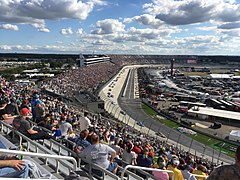
NASCAR racing at Dover Motor Speedway in Dover
As Delaware has no franchises in the major American professional sports leagues, many Delawareans follow either Philadelphia or Baltimore teams. In the WNBA, the Washington Mystics enjoy a major following due to the presence of Wilmington native and University of Delaware product Elena Delle Donne. The University of Delaware’s football team has a large following throughout the state, with the Delaware State University and Wesley College teams also enjoying a smaller degree of support. Delaware is home to Dover Motor Speedway and Bally’s Dover. Dover Motor Speedway, also known as the Monster Mile, is one of only 10 tracks in the nation to have hosted 100 or more NASCAR Cup Series races. Bally’s Dover is a popular harness racing facility. It is the only co-located horse- and car-racing facility in the nation, with the Bally’s Dover track located inside the Dover Motor Speedway track. Delaware is represented in rugby by the Delaware Black Foxes, a 2015 expansion club. Delaware has been home to professional wrestling outfit Combat Zone Wrestling (CZW). CZW has been affiliated with the annual Tournament of Death and ECWA with its annual Super 8 Tournament. Delaware’s official state sport is bicycling. Sister stateDelaware’s sister state in Japan is Miyagi Prefecture. DelawareansProminent Delawareans include the du Pont family of politicians and businesspersons, and current United States president Joe Biden, whose family has resided in Delaware since his first marriage. |
||||||||||||||||||||||||||||||||||||||||||||||||||||||||||||||||||||||||||||||||||||||||||||||||||||||
|---|---|---|---|---|---|---|---|---|---|---|---|---|---|---|---|---|---|---|---|---|---|---|---|---|---|---|---|---|---|---|---|---|---|---|---|---|---|---|---|---|---|---|---|---|---|---|---|---|---|---|---|---|---|---|---|---|---|---|---|---|---|---|---|---|---|---|---|---|---|---|---|---|---|---|---|---|---|---|---|---|---|---|---|---|---|---|---|---|---|---|---|---|---|---|---|---|---|---|---|---|---|---|