
India has a parliamentary system as defined by its constitution, with power distributed between the central government and the states. India’s democracy is the largest democracy in the world.
The President of India is the ceremonial head of state of the country and supreme commander-in-chief for all defense forces in India. However, it is the Prime Minister of India, who is the leader of the party or political alliance having a majority in the national elections to the Lok Sabha. The Prime Minister is the leader of the executive branch of the Government of India. The Prime Minister is the chief adviser to the President of India and the head of the Union Council of Ministers.
India is regionally divided into States (and Union Territories) and each State has a Governor who is the state’s head, but the executive authority rests with the Chief Minister who is the leader of the party or political alliance that has won a majority in the regional elections otherwise known as State Assembly Elections that exercises executive powers in that State. The respective State’s Chief Minister has executive powers within the State and works jointly with the Prime Minister of India or their ministers on matters that require both State and Central attention. Some Union Territories also elect an Assembly and have a territorial government and other (mainly smaller) Union Territories are governed by a person appointed by the President of India.
The President of India monitors the rule of law through their appointed governors in each State and on their recommendation can take over the executive powers from the Chief Minister of the State, temporarily when the elected representatives of the State government have failed to create a peaceful environment and has deteriorated into chaos. The President of India dissolves the existing State government if necessary, and a new election is conducted.
Elections
The Election Commission is the federal body of India which is enacted under the provisions of the Constitution, responsible for monitoring and administering all the electoral processes of India. This body is responsible for ensuring elections are free and fair, without any bias.
Election ensures the conduct of members pre-elections, during elections, and post-elections are as per the statutory legislation.
All election-related disputes are handled by the Election Commission. The Supreme Court of India has held that where the enacted laws are silent or make insufficient provisions to deal with a given situation in the conduct of elections, the Election Commission has the residuary powers under the Constitution to act as appropriate.The first election Commissioner was Sukumar Sen.
Types of elections
Elections in the Republic of India include elections for
- President of India,
- Vice President of India,
- Members of the Parliament in Rajya Sabha (Upper house) and Lok Sabha (Lower house),
- Members of State Legislative Councils,
- Members of State Legislative Assemblies (includes legislative assemblies of three union territories – Jammu and Kashmir, National Capital Territory of Delhi and Puducherry)
- Members of local governance bodies (Municipal bodies and Panchayats),
- By-election is held when a seat-holder of a particular constituent dies, resigns, or is disqualified.
Parliamentary general elections (Lok Sabha)
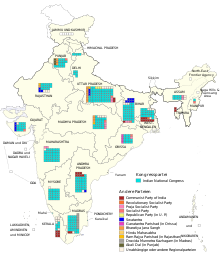
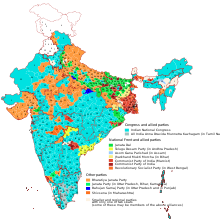
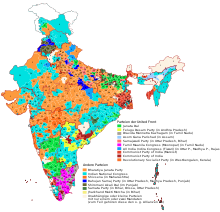
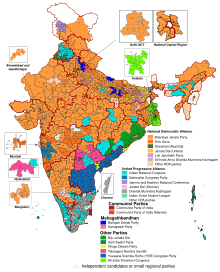
Members of Lok Sabha (House of the People) or the lower house of India’s Parliament are elected by being voted upon by all adult citizens of India, who crossed 18 years from a set of candidates who stand in their respective constituencies. Every adult citizen of India can vote only in their constituency. Candidates who win the Lok Sabha elections are called ‘Member of Parliament’ and hold their seats for five years or until the body is dissolved by the President on the advice of the council of ministers. The house meets in the Lok Sabha Chambers of the Sansad Bhavan in New Delhi, on matters relating to the creation of new laws, removing or improving the existing laws that affect all citizens of India. Elections take place once in 5 years to elect 543 members for the Lok Sabha (Lower house).
 |
 |
 |
 |
 |
 |
 |
 |
 |
 |
 |
 |
 |
 |
 |
 |
 |
History of Lok Sabha elections
| Colour key for parties |
|---|
|
All India Anna Dravida Munnetra Kazhagam
Bharatiya Jana Sangh
Bharatiya Janata Party
Communist Party of India
Communist Party of India (Marxist)
Dravida Munnetra Kazhagam
Indian National Congress
Indian National Congress (Indira)
Janata Party
Janata Dal
Janata Party (Secular)
Praja Socialist Party
Samajwadi Party
Socialist Party
Swatantra Party
Telugu Desam Party
|
| Lok Sabha elections | |||||||||||||
|---|---|---|---|---|---|---|---|---|---|---|---|---|---|
| Lok Sabha (Election) |
Total Seats | First | Second | Third | |||||||||
| Political party | Seats | Percentage of votes | Political party | Seats | Percentage of votes | Political party | Seats | Percentage of votes | |||||
| 1st (1951–52) |
489 | Indian National Congress | 364 | 44.99% | Communist Party of India | 16 | 3.29% | Socialist Party | 12 | 10.59% | |||
| 2nd (1957) |
494 | Indian National Congress | 371 | 47.78% | Communist Party of India | 27 | 8.92% | Praja Socialist Party | 19 | 10.41% | |||
| 3rd (1962) |
494 | Indian National Congress | 361 | 44.72% | Communist Party of India | 29 | 9.94% | Swatantra Party | 18 | 7.89% | |||
| 4th (1967) |
520 | Indian National Congress | 283 | 40.78% | Swatantra Party | 44 | 8.67% | Bharatiya Jana Sangh | 35 | 9.31% | |||
| 5th (1971) |
518 | Indian National Congress | 352 | 43.68% | Communist Party of India (Marxist) | 25 | 5.12% | Communist Party of India | 23 | 4.73% | |||
| 6th (1977) |
542 | Janata Party | 295 | 41.32% | Indian National Congress | 154 | 34.52% | Communist Party of India (Marxist) | 22 | 4.29% | |||
| 7th (1980) |
529 | Indian National Congress (Indira) | 353 | 42.69% | Janata Party (Secular) | 41 | 9.39% | Communist Party of India (Marxist) | 37 | 6.24% | |||
| 8th (1984) |
541 | Indian National Congress | 414 | 48.12% | Telugu Desam Party | 30 | 4.06% | Communist Party of India (Marxist) | 22 | 5.72% | |||
| 9th (1989) |
529 | Indian National Congress | 197 | 39.53% | Janata Dal | 143 | 17.79% | Bharatiya Janata Party | 85 | 11.36% | |||
| 10th (1991) |
534 | Indian National Congress | 244 | 36.40% | Bharatiya Janata Party | 120 | 20.07% | Janata Dal | 59 | 11.73% | |||
| 11th (1996) |
543 | Bharatiya Janata Party | 161 | 20.29% | Indian National Congress | 140 | 28.80% | Janata Dal | 46 | 8.08% | |||
| 12th (1998) |
543 | Bharatiya Janata Party | 182 | 25.59% | Indian National Congress | 141 | 25.82% | Communist Party of India (Marxist) | 32 | 5.16% | |||
| 13th (1999) |
543 | Bharatiya Janata Party | 182 | 23.75% | Indian National Congress | 114 | 28.30% | Communist Party of India (Marxist) | 33 | 5.40% | |||
| 14th (2004) |
543 | Indian National Congress | 145 | 26.53% | Bharatiya Janata Party | 138 | 22.16% | Communist Party of India (Marxist) | 43 | 5.66% | |||
| 15th (2009) |
543 | Indian National Congress | 206 | 28.55% | Bharatiya Janata Party | 116 | 18.80% | Samajwadi Party | 23 | 3.23% | |||
| 16th (2014) |
543 | Bharatiya Janata Party | 282 | 31.34% | Indian National Congress | 44 | 19.52% | All India Anna Dravida Munnetra Kazhagam | 37 | 3.31% | |||
| 17th (2019) |
543 | Bharatiya Janata Party | 303 | 37.70% | Indian National Congress | 52 | 19.67% | Dravida Munnetra Kazhagam | 24 | 2.36% | |||
| 18th (2024) |
543 | TBA | – | – | TBA | – | – | TBA | – | – | |||
State Assembly elections
Members of State Legislative Assembly, are elected directly by voting, from a set of candidates who stands in their respective constituencies. Every adult citizen of India can vote only in their constituency. Candidates who win the State Legislative Assemblies elections are called ‘Member of Legislative Assembly’ (MLA) and hold their seats for five years or until the body is dissolved by the Governor. The house meets in the respective state, on matters relating to the creation of new laws, removing or improving the existing laws that affect all citizens living in that state.
The total strength of each assembly depends on each State, mostly based on size and population. Similar to the Lok Sabha elections, the leader of the majority party/alliance takes oath as Chief Minister of the State.
The Election Commission conducts the elections and provides voluntary facility to 80 years plus aged electors to vote through ballot papers at their homes depending upon polling booth accessibility. Elections are taken up enthusiastically by major portion of the population who turn out in high numbers. For example, An 83-year-old woman, Dolma, cast her vote at Chasak Bhatori polling station in Pangi area of Chamba district after covering 14 kilometers walking on a snowy road during 2022 assembly elections in Himachal Pradesh.
| State/UT | 1950s | 1960s | 1970s | 1980s | 1990s | 2000s | 2010s | 2020s |
|---|---|---|---|---|---|---|---|---|
| AP | AS 1955 1957 |
1962 1967 |
1972 1978 |
1983 1985 1989 |
1994 1999 |
2004 2009 |
2014 2019 |
2024 |
| AR | – | – | 1978 | 1980 1984 |
1990 1995 1999 |
2004 2009 |
2014 2019 |
2024 |
| AS | 1952 1957 |
1962 1967 |
1972 1978 |
1983 1985 |
1991 1996 |
2001 2006 |
2011 2016 |
2021 |
| BR | 1952 1957 |
1962 1967 1969 |
1972 1977 |
1980 1985 |
1990 1995 |
2000 2005 (Feb) 2005 (Oct) |
2010 2015 |
20202025 |
| CG | State didn’t exist. Was part of MP. (Established in 2000) | 2003 2008 |
2013 2018 |
2023 | ||||
| DL | 1952 | – | – | – | 1993 1998 |
2003 2008 |
2013 2015 |
20202025 |
| GA | – | 1963 1967 |
1972 1977 |
1980 1984 1989 |
1994 1999 |
2002 2007 |
2012 2017 |
2022 |
| GJ | – | 1962 1967 |
1972 1975 |
1980 1985 |
1990 1995 1998 |
2002 2007 |
2012 2017 |
2022 |
| HR | – | 1967 1968 |
1972 1977 |
1982 1987 |
1991 1996 |
2000 2005 2009 |
2014 2019 |
2024 |
| HP | 1952 | 1967 | 1972 1977 |
1985 | 1990 1993 1998 |
2003 2007 |
2012 2017 |
2022 |
| JK | 1951 1957 |
1962 1967 |
1972 1977 |
1983 1987 |
1996 | 2002 2008 |
2014 | 2024 |
| JH | State didn’t exist. Was part of Bihar. (Established in 2000) | 2005 2009 |
2014 2019 |
2024 | ||||
| KA | Mysore 1952 Mysore 1957 |
Mysore 1962 Mysore 1967 |
Mysore 1972 1978 |
1983 1985 1989 |
1994 1999 |
2004 2008 |
2013 2018 |
2023 |
| KL | 1952 Thiru-Kochi 1954 Thiru-Kochi 1957 |
1960 1965 1967 |
1970 1977 |
1980 1982 1987 |
1991 1996 |
2001 2006 |
2011 2016 |
2021 |
| MP | Bhopal 1952 MB 1952 MP 1952 VP 1952 1957 |
1967 | 1972 1977 |
1980 1985 |
1990 1993 1998 |
2003 2008 |
2013 2018 |
2023 |
| MH | – | 1962 1967 |
1972 1978 |
1980 1985 |
1990 1995 1999 |
2004 2009 |
2014 2019 |
2024 |
| MN | – | 1967 | 1972 1974 |
1980 1984 |
1990 1995 |
2000 2002 2007 |
2012 2017 |
2022 |
| ML | – | – | 1972 1978 |
1983 1988 |
1993 1998 |
2003 2008 |
2013 2018 |
2023 |
| MZ | – | – | 1972 1978 1979 |
1984 1987 1989 |
1993 1998 |
2003 2008 |
2013 2018 |
2023 |
| NL | – | 1964 1969 |
1974 1977 |
1982 1987 1989 |
1993 1998 |
2003 2008 |
2013 2018 |
2023 |
| OR | 1952 1957 |
1961 1967 |
1971 1974 1977 |
1980 1985 |
1990 1995 |
2000 2004 2009 |
2014 2019 |
2024 |
| PB | 1952 1957 |
1962 1967 1969 |
1972 1977 |
1980 1985 |
1992 1997 |
2002 2007 |
2012 2017 |
2022 |
| PY | – | 1964 1969 |
1974 1977 |
1980 1985 |
1990 1991 1996 |
2001 2006 |
2011 2016 |
2021 |
| RJ | 1952 1957 |
1962 1967 |
1972 1977 |
1980 1985 |
1990 1993 1998 |
20032008 2013 |
2018 | 2023 |
| SK | – | – | 1979 | 1985 1989 |
1994 1999 |
2004 2009 |
20142019 | 2024 |
| TN | 1952 1957 |
1962 1967 |
1971 1977 |
1980 1984 1989 |
1991 1996 |
2001 2006 |
2011 2016 |
2021 |
| TS | 1952 |  |
2014 2018 |
2023 | ||||
| TR | – | |||||||