
The Hanafi school (Arabic: حَنَفِي, romanized: Ḥanafī) is one of the four traditional major Sunni schools (madhabs) of Islamic jurisprudence(fiqh). Its eponym is the 8th-century Kufan scholar, Abū Ḥanīfa an-Nu‘man ibn Thābit, a tabi‘i of Persian origin whose legal views were preserved primarily by his two most important disciples, Abu Yusuf and Muhammad al-Shaybani.
Under the patronage of the Abbasids, the Hanafi school flourished in Iraq and spread eastwards, firmly establishing itself in Khorasanand Transoxiana by the 9th-century, where it enjoyed the support of the local Samanid rulers. Turkic expansion introduced the school to the Indian subcontinent and Anatolia, and it was adopted as the chief legal school of the Ottoman Empire.
The Hanafi school is the maddhab with the largest number of adherents, followed by approximately one third of Muslims worldwide.It is prevalent in Turkey, the Balkans, the Levant, Central Asia, the Indian subcontinent, Egypt and Afghanistan, in addition to parts of Russia, China and Iran. The other primary Sunni legal schools are the Maliki, Shafi`i and Hanbali schools.
Methodology
Hanafi usul recognises the Quran, hadith, consensus (ijma), legal analogy (qiyas), juristic preference (istihsan) and normative customs (urf) as sources of the Sharia. Abu Hanifa is regarded by modern scholarship as the first to formally adopt and institute qiyas as a method to derive Islamic law when the Quran and hadith are silent or ambiguous in their guidance; and is noted for his general reliance on personal opinion (ra’y).
The foundational texts of Hanafi madhhab, credited to Abū Ḥanīfa and his students Abu Yusuf and Muhammad al-Shaybani, include Al-fiqh al-akbar (theological book on jurisprudence), Al-fiqh al-absat (general book on jurisprudence), Kitab al-athar (thousands of hadiths with commentary), Kitab al-kharaj and Kitab al-siyar (doctrine of war against unbelievers, distribution of spoils of war among Muslims, apostasy and taxation of dhimmi).
Istihsan
The Hanafi school favours the use of istihsan, or juristic preference, a form of ra’y which enables jurists to opt for weaker positions if the results of qiyas lead to an undesirable outcome for the public interest (maslaha). Although istihsan did not initially require a scriptural basis, criticism from other schools prompted Hanafi jurists to restrict its usage to cases where it was textually supported from the 9th-century onwards.
History
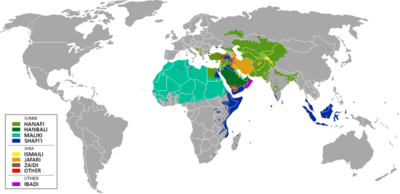
Map of the Muslim world. Hanafi (light green) is the Sunni school predominant in Turkey, the Western Middle East, Western and Nile river region of Egypt, Central Asia, Afghanistan, Pakistan, Bangladesh, and parts of Southeast Europe, India, China and Russia. An estimated one-third of all Muslims living in Muslim majority countries worldwide follow Hanafi law.
As the fourth Caliph, Ali had transferred the Islamic capital to Kufa, and many of the first generation of Muslims settled there. The Hanafi school of law based many of its rulings on the earliest Islamic traditions as transmitted by Sahaba residing in Iraq. Thus, the Hanafi school came to be known as the Kufan or Iraqi school in earlier times. Ali and Abdullah, son of Masud, formed much of the base of the school, as well as other personalities such as Muhammad al-Baqir, Ja’far al-Sadiq, and Zayd ibn Ali. Many jurists and historians had lived in Kufa including one of Abu Hanifa’s main teachers, Hammad ibn Sulayman.
The Sunni & 6th Shi’ite Imam Ja’far al-Sadiq (a descendant of the Islamic Nabi (Prophet) Muhammad) was reportedly a teacher of Sunni Imams Abu Hanifah and Malik ibn Anas, who in turn was a teacher of Imam Ash-Shafi‘i,:121 who in turn was a teacher of Imam Ahmad ibn Hanbal. Thus all of the four great Imams of Sunni Fiqh are connected to Ja’far, whether directly or indirectly.
In the early history of Islam, Hanafi doctrine was not fully compiled. The fiqh was fully compiled and documented in the 11th century.
The Turkish rulers were some of the earliest adopters of the relatively more flexible Hanafi fiqh, and preferred it over the traditionalist Medina-based fiqhs which favored correlating all laws to Quran and Hadiths and disfavored Islamic law based on discretion of jurists. The Abbasids patronized the Hanafi school from the 10th century onwards. The Seljuk Turkish dynasties of 11th and 12th centuries, followed by Ottomans, adopted Hanafi fiqh. The Turkic expansion spread Hanafi fiqh through Central Asia and into Indian subcontinent, with the establishment of Seljuk Empire, Timurid dynasty, Khanates, Delhi Sultanate, Bengal Sultanate and Mughal Empire. Throughout the reign of Emperor Aurangzeb, the Hanafi based Fatawa-e-Alamgiri served as the legal, juridical, political, and financial code of most of South Asia.