
Haridwar district ( pronunciation (help·info)) also spelled as Hardwar is a district in Garhwal which is a part of Uttarakhand, India. It is headquartered at Haridwar which is also its largest city. The district is ringed by the districts Dehradun in the north and east, Pauri Garhwal in the east and the Uttar Pradesh districts of Muzaffarnagar and Bijnor in the south and Saharanpur in the west.
Haridwar district came into existence on 28 December 1988 as part of Saharanpur Divisional Commissionary, On 24 September 1998 Uttar Pradesh Legislative Assembly passed the ‘Uttar Pradesh Reorganisation Bill’, 1998′, eventually the Parliament also passed the Indian Federal Legislation – ‘Uttar Pradesh Reorganisation Act 2000’, and thus on 9 November 2000, Haridwar became part of the newly formed Uttarakhand (then Uttaranchal), the 27th state of the Republic of India.
As of 2011 it is the most populous district of Uttarakhand (out of 13). Important towns in the district are Haridwar, BHEL Ranipur, Roorkee, Manglaur, Dhandera, Jhabrera, Laksar, Landhaura and Mohanpur Mohammadpur.
Geography
Haridwar district, covering an area of about 12.3 km per square, is in the southwestern part of Uttarakhand state of India. Its latitude and longitude are 29.96-degree north and 78.16-degree east respectively.
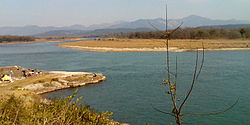
Neel Dhara Bird Sanctuary at the main Ganges Canal, before Bhimgoda barrage, also showing signs of an ancient port.
The river Ganges flows through it in a series of channels separated from each other called aits, most of which are wooded. Other minor seasonal streams are Ranipur Rao, Pathri Rao, Rawii Rao, Harnaui Rao, and Begam Nadi. A large part of the district is forested.
Climate
Average temperatures are mostly cooler than that of other parts of the country.
Nature and wildlife
The wooded Rajaji National Park, a wildlife sanctuary, is within the bounds of the district and is accessible through different gates; Ranipur and Chilla Gates are just about 9 km from Haridwar. Sureshvari Devi Mandir, a temple of Goddess Sureshwari, is situated in Rajaji National Park. Cheela Dam is a picnic spot with a dam and a man-made lake nearby; elephants and other wild animals could be easily spotted here. Neel Dhara Pakshi Vihar is a bird sanctuary, situated on the main Ganges river, or Neel Dhara, at the Bhimgoda Barrage; it is visited by bird watchers and home to migratory birds during the winter season.
History

Prince Bhagirath in penance for the salvation of 60,000 of his ancestors.
Legends and Epics period
A discourse of Bhishma Pitamah in the Vana Parva (Tirtha-yatra Parva) Section XC of The Mahabharata notes:
- O! Yudhishthira, the spot where Ganga rusheth past, cleaving the foremost of mountains which is frequented by Gandharvas and Yakshas and Rakshasas and Apsaras, and inhabited by hunters, and Kinnaras, is called Gangadwara (Haridwar). O! King, Sanatkumara regardeth that spot visited by Brahmarshis, as also the Tirtha Kanakhala (that is near to it), as sacred.
According to Hindu texts, King Daksha Prajapati, father of Dakshayani (Sati), Lord Shiva’s first wife, was a ruler here. He performed a yagna, to which he deliberately did not invite Lord Shiva. When he arrived uninvited, he was further insulted by the king, seeing which Sati felt infuriated and self-immolated herself in the Yagna Kund, or Sati Kund as it is called now, situated in Kankhal. The heart and navel of Sati had fallen at the place which is the present site of the Maya Devi Temple, Haridwar, dating back to the 11th century. Daksha was later killed by Virabhadra, born out of Shiva’s anger. Subsequently, the king was brought to life and given a goat’s head by Shiva.
Skanda Purana mentions a legend, in which Chanda-Munda, the Army Chief of local Demon Kings Shumbh and Nishumbha were killed here by goddess Chandi at a place, which got the name Chandi Devi Temple.
Sage Kapila had an Ashram here. The legendary King Bhagirath, the great-grandson of the Suryavanshi King Sagar, (an ancestor of Rama), is said to have brought the river Ganges down from heaven, through years of penance in Satya Yuga, for the salvation of 60,000 of his ancestors from the curse of the saint Kapila.
Lord Vishnu is said to have left his footprint on the stone that is set in the upper wall of Har-Ki-Pauri (literally, “footsteps of the Lord”), where the Holy Ganges touches it at all times. Devout Hindus perform ritualistic bathing here on the banks of the river Ganges, an act considered to be the equivalent of washing away one’s sins to attain Moksha.
Seven sages or Saptarishis, namely Kashyapa, Vashisht, Atri, Vishwamitra, Jamadagni, Bharadwaja and Gautam, are said to have meditated at the site of Sapt Rishi Ashram & Sapt Rishi Sarovar, a place near Haridwar, where the Ganges split into seven currents, so that the Rishis would not be disturbed by the flow.
In the Vanaparva of the Mahabharat, where sage Dhaumya tells Yudhishthira about the tirthas of India, Gangadwar, i.e. Haridwar and Kankhal, have been referred to; the text also mentions that Agastya Rishi did penance here, with the help of his wife, Lopamudra (the princess of Vidharba).
It is said that while Pandavas were going to Himalayas through Haridwar, prince Bhima drew water from the rocks here, by thrusting his knee (goda) into the ground at the present site of ‘Bhimagoda’ situated at a distance of about 1 km from Har-ki-Pauri.
Ancient period
Archaeological findings have proved that terra cotta culture dating between 1700 BCE and 1200 BCE existed in this region.
Haridwar came under the rule of the Maurya Empire (322–185 BCE), and later under the Kushan Empire (c. 1st–3rd centuries).
It is believed that the sacred Ghat Har ki Pauri was constructed by King Vikramaditya (1st century BC) in memory of his brother Bharthari, who had come to Haridwar and meditated on the banks of holy Ganges and died here.
First ancient era written evidence of Haridwar is found in the accounts of a Chinese traveller, Huan Tsang, who visited India in 629 AD, during the reign of King Harshavardhan (590–647). He records Haridwar as ‘Mo-yu-lo’, the remains of which still exist at Mayapur, a little to the south of the modern Haridwar town; among the ruins are a fort and three temples, decorated with broken stone sculptures. He also mentions the presence of a temple, north of Mo-yu-lo called ‘Gangadwara’, Gateway of the Ganges.
It is believed that Adi Shankracharya had visited this region and the existing main statue of Chandi Devi Temple was established by him in 8th century A.D.
Medieval period
Haridwar region was a part of Delhi Sultanate. The armies of Emperor Timur (1336–1405), a Turkic conqueror, had passed through this region on 13 January 1399 to attack Delhi.
During his visit, first Sikh Guru, Guru Nanak (1469–1539) bathed at Haridwar’s ‘Kushwan Ghat’, wherein the famous, ‘watering the crops’ episode took place. His visit is today commemorated by a gurudwara (Gurudwara Nanakwara); according to two Sikh Janamsakhis, this visit took place on the Baisakhi day in 1504 AD. He later had also visited Kankhal en route to Kotdwara in Garhwal. Besides this, third Sikh Guru, Sri Amar Das also visited Hardwar twenty two times during his lifetime.
The Mughal period: Ain-e-Akbari, written by Abul Fazal in the 16th century during the reign of Mughal Emperor Akbar, refers to Maya (Mayapur), known as Hardwar on the Ganges, as sacred city of Hindus. It also mentions that during his travels, and also while at home, Mughal Emperor Akbar drank water from the Ganges river, which he called ‘the water of immortality’. Special people were stationed at Sorun and later Haridwar to dispatch water, in sealed jars, to wherever he was stationed.
It is said that Akbar’s famous Commander-in-Chief, Raja Man Singh of Amber, laid the foundation of the present day city of Haridwar and also renovated the ghats at Har-ki-pauri. After his death, his ashes are also said to have been immersed at Brahma Kund by Mughal emperor Akbar himself. Brahma Kund (literally “Brahma’s reservoir”) at Har ki Pauri, Haridwar is one among the four sites where drops of the elixir of immortality, Amrita, accidentally spilled over from the pitcher, in which it was being carried away by the celestial bird Garuda, after the Samudra manthan by the Devas and the Asuras. The famous Kumbh Melas are held at these four sites in rotation, to commemorate the event. Thomas Coryat, an English traveller, who visited the city in the reign of Emperor Jahangir (1596–1627) mentions it as ‘Haridwara’, the capital of Shiva.
British Raj

Head of Ganges Canal, Haridwar, ca 1894–1898.
The Ganges Canal was opened in 1854 after the work began in April 1842, prompted by the famine of 1837–38. The unique feature of the canal is the half-kilometre-long aqueduct over Solani river at Roorkee, which raises the canal 25 metres above the original river.
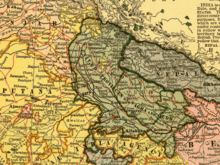
Haridwar as a part of the United Province, 1903
Post Independence period
In 1947, when India achieved independence from the British colonial subjugation, the region of present Haridwar district was a part of the then Saharanpur district, in the United Province of the British Raj; the province was renamed as Uttar Pradesh state of India. The Haridwar district came into existence on 28 December 1988 as part of Saharanpur Divisional Commissionary. On 24 September 1998 Uttar Pradesh Legislative Assembly passed the ‘Uttar Pradesh Reorganisation Bill’, 1998′; eventually the Parliament also passed the Indian Federal Legislation – ‘Uttar Pradesh Reorganisation Act, 2000’ – and thus on 9 November 2000, Haridwar district became part of the newly formed Uttarakhand (then Uttaranchal), the 27th state in the Republic of India.
Demographics
| Year | Pop. | ±% p.a. |
|---|---|---|
| 1901 | 329,839 | — |
| 1911 | 311,436 | −0.57% |
| 1921 | 296,103 | −0.50% |
| 1931 | 329,914 | +1.09% |
| 1941 | 373,042 | +1.24% |
| 1951 | 427,574 | +1.37% |
| 1961 | 504,582 | +1.67% |
| 1971 | 670,764 | +2.89% |
| 1981 | 890,260 | +2.87% |
| 1991 | 1,124,488 | +2.36% |
| 2001 | 1,447,187 | +2.56% |
| 2011 | 1,890,422 | +2.71% |
| source: | ||