
The Indo-Iranian languages (also Indo-Iranic languages or Aryan languages) constitute the largest and southeasternmost extant branch of the Indo-European language family. They have more than 1.5 billion speakers, stretching from Europe (Romani), Turkey (Kurdish and Zaza–Gorani) and the Caucasus (Ossetian) eastward to Xinjiang (Sarikoli) and Assam (Assamese), and south to Sri Lanka (Sinhala) and the Maldives (Maldivian), with branches stretching as far out as Oceania and the Caribbean for Fiji Hindi and Caribbean Hindustani respectively. Furthermore, there are large diaspora communities of Indo-Iranian speakers in northwestern Europe (the United Kingdom), North America (United States, Canada), Australia, South Africa, and the Persian Gulf Region (United Arab Emirates, Saudi Arabia).
The common ancestor of all of the languages in this family is called Proto-Indo-Iranian—also known as Common Aryan—which was spoken in approximately the late 3rd millennium BC. The three branches of the modern Indo-Iranian languages are Indo-Aryan, Iranian, and Nuristani. A fourth independent branch, Dardic, was previously posited, but recent scholarship in general places Dardic languages as archaic members of the Indo-Aryan branch.
Languages
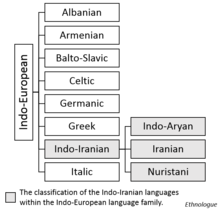
Chart classifying Indo-Iranian languages within the Indo-European language family
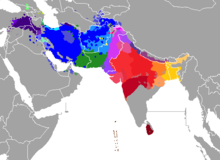
Distribution of the Indo-Iranian languages
The Indo-Iranian languages consist of three groups:
- Indo-Aryan/Indic
- Iranian/Iranic
- Nuristani
Indo-Iranian languages are spoken by more than 1.5 billion people. The languages with the most speakers are a part of the Indo-Aryan group: Hindi–Urdu (~590 million) including region based populated dialects Bhojpuri (40 million), Awadhi (40 million), Maithili (35 million), Marwari (30 million), Rajasthani (20 million), Chhattisgarhi (18 million), Bengali (205 million), Punjabi (100 million), Marathi (75 million), Gujarati (50 million), Odia (35 million), Sindhi (25 million), Assamese (24 million), Sinhala (19 million), Nepali (17 million), Bishnupuriya (12 million) and Rangpuri (15 million). Among the Iranian branch, major languages are Persian(90 million), Pashto (ca. 50 million), Kurdish (35 million), and Balochi (8 million). There are also many smaller languages.
| Part of a series on |
| Indo-European topics |
|---|
 |
History
 |
This section needs expansion. You can help by adding to it. (December 2018)
|
The common proto-language of the Indo-Iranian languages is Proto-Indo-Iranian language, which has been reconstructed.
The oldest attested Indo-Iranian languages are Vedic Sanskrit, Older and Younger Avestan and Old Persian (ancient Iranian languages). A few words from another Indo-Aryan language (see Indo-Aryan superstrate in Mitanni) are attested in documents from the ancient Mitanni and Hittite kingdoms in the Near East.
Within the Indo-European family, Indo-Iranian belongs to the Satem group. Various proposals have been made that link the Indo-Iranian languages with other subgroups of Indo-European (like Graeco-Aryan, which posits a close relationship with Greek and Armenian), but these remain without wider acceptance.
Features
Innovations shared with other languages affected by the satem sound changes include:
- Fronting and assibilation of the Proto-Indo-European (PIE) palato-velar stops: *kʲ, *gʲʰ, *gʲ > *t͡ʃ, *d͡ʒʰ, *d͡ʒ
- The merger of the PIE labiovelar and plain velar stops: *kʷ, *gʷʰ, *gʷ > *k, *gʰ, *g
- The Ruki sound law
Innovations shared with Greek include:
- The vocalization of the PIE syllabic nasals *m̥, *n̥ to *a (may be independent developments)
- Grassmann’s law (may be independent developments)
Innovations unique to Indo-Iranian include:
- The lowering of PIE *e to *a
- *o was also lowered to *a, though this occurred in several other Indo-European languages as well.
- The PIE laryngeal *H between consonants became *i, though it was apparently reduced to zero in Iranian.
- The use of a verb root *kr̥- to derive verbal forms from nouns.
- The use of *-yá- to derive passive verbs from roots.
- Brugmann’s law