
Indo-Persian culture refers to a cultural synthesis present in the Indian subcontinent, characterized by the absorption or integration of Persian aspects into the various cultures of Pakistan, India and Bangladesh. The first large-scale introduction of Persian influence and culture to the Indian subcontinent was by Muslim rulers of Turkic and Afghan origin with Persianate societies and Persianized cultures. This socio-cultural synthesis arose steadily through the Delhi Sultanate from the 13th to 16th centuries, and the Mughal Empire from then onwards until the 19th century. Various Muslim Turko-Persian rulers, such as the 11th-century Sultan Mahmud Ghaznavi, rapidly pushed for the heavy Persianization of conquered territories in northwestern India (present-day Pakistan), where Islamic influence was also firmly established.
Persian was the official language of most Muslim dynasties in the Indian subcontinent, such as the Delhi Sultanate, the Bengal Sultanate, the Bahmani Sultanate, the Mughal Empire and their successor states, and the Sikh Empire. It was also the dominant cultured language of poetry and literature. Many of the Sultans and nobility in the Sultanate period were Persianized Turks from Central Asia who spoke Turkic languages as their mother tongues. The Mughals were also culturally Persianized Central Asians (of Turko-Mongol origin on their paternal side), but spoke Chagatai Turkic as their first language at the beginning, before eventually adopting Persian. Persian became the preferred language of the Muslim elite of northern India. Muzaffar Alam, a noted scholar of Mughal and Indo-Persian history, suggests that Persian became the official lingua franca of the Mughal Empire under Akbar for various political and social factors due to its non-sectarian and fluid nature. The influence of these languages led to a vernacular called Hindustani that is the direct ancestor language of today’s Urdu and Hindi.
The Persianization of the Indian subcontinent resulted in its incorporation into the cosmopolitan Persianate world of Ajam, known today academically as Greater Iran, which historically gave many inhabitants a secular, Persian identity.
In contemporary India, Pakistan and Bangladesh
Indo-Persian culture has helped produce certain composite traditions within the Indian subcontinent that survive to this day, of which the Urdu language and literature is notable. The legacy of Indo-Persianate culture moreover can also be seen in much of the Mughal architecture within Lahore, Delhi, Dhaka, and Agra, latterly of which the Taj Mahal is world-renowned. Hindustani classical music also received some influence from the Persian culture, but the nature of these influences remain unclear. In many ways, the absorption and assimilation of Persian or Persianate culture within India may be compared to the gradual (if sometimes problematic) absorption of English, British or Western culture generally of which the English language is perhaps the most notable and controversial within both India and Pakistan today. The influence of Persian language moreover may be seen in the considerable proportion of loanwords absorbed into the vernaculars of the north, north-east and north-west of the Indian subcontinent including Punjabi, Gujarati, Urdu, Hindi, Bengali, Kashmiri and Pashto. Universities in India, Pakistan and Bangladesh also operate Persian language faculties.
History
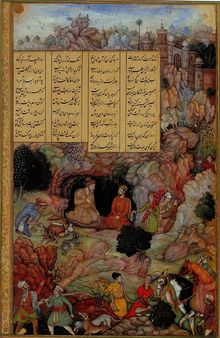
Alexander Visits the Sage Plato, from Khamsa-e Nizami by the Indo-Persian poet Amir Khusro.
With the presence of Muslim culture in the region in the Ghaznavid period, Lahore and Uch were established as centers of Persian literature. Abu-al-Faraj Runi and Masud Sa’d Salman (d. 1121) were the two earliest major Indo-Persian poets based in Lahore. The earliest of the “great” Indo-Persian poets was Amir Khusrow (d. 1325) of Delhi, who has since attained iconic status within the Urdu speakers of the Indian subcontinent as, among other things, the “father” of Urdu literature.
Delhi sultanate and the Mughal era
Indo-Persian culture and to varying degrees also Turkic culture flourished side-by-side during the period of the Delhi Sultanate (1206–1526). The invasion of Babur in 1526, the end of the Delhi Sultanate, and the establishment of what would become the Mughal Empire would usher the golden age of Indo-Persian culture with particular reference to the art and architecture of the Mughal era.
The Mughal Era to the British Raj: Persian persisted as the language of the Mughals up to and including the year 1707 which marked the death of the Emperor Aurangzeb, generally considered the last of the “Great Mughals”. Thereafter, with the decline of the Mughal empire, the 1739 invasion of Delhi by Nader Shah and the gradual growth initially of the Hindu Marathas and later the European power within the Indian subcontinent, Persian or Persian culture commenced a period of decline although it nevertheless enjoyed patronage and may even have flourished within the many regional empires or kingdoms of the Indian subcontinent including that of the Sikh Maharaja Ranjit Singh (r. 1799–1837).
Persian as a language of governance and education was abolished in 1839 by the British and the last Mughal emperor Bahadur Shah Zafar, even if his rule was purely symbolic or ceremonial, was overthrown in 1857 by the British.
Further, C.E. Bosworth wrote about the Central Asian’s Persian (Tajiks→Ghurids) influence on India: “…The sultans were generous patrons of the Persian literary traditions of Khorasan, and latterly fulfilled a valuable role as transmitters of this heritage to the newly conquered lands of northern India, laying the foundations for the essentially Persian culture which was to prevail in Muslim India until the 19th century…”
Bengal

The Lattan Mosque in Gaur, which was the first capital of the Persianate Sultanate of Bengal.
Bengal was the easternmost frontier of the Persian cultural sphere. For over 600 years (1204-1837), the Persian language was an official language in Bengal, including during the provincial period of the Delhi Sultanate; the independent period of the Bengal Sultanate; the dominion period of the Bengal Subah in the Mughal Empire; and the quasi-independent Nawabi period. Bengal was the subcontinent’s wealthiest region for centuries, where Persian people, as well as Persianate Turks, settled in the Ganges delta to work as teachers, lawyers, poets, administrators, soldiers and aristocrats. The Bengali language continues to have a significant amount of Persian loanwords. A popular literary creole emerged mixing Persian and Bengali which came to be known as Dobhashi. Several Bengali cities were once centres of Persian prose and poetry. Hafez, one of the masters of Persian poetry, kept a notable correspondence with Sultan Ghiyasuddin Azam Shah and they composed a poem together. The Mughal period saw the zenith of Persian cultural expression in Bengal. During the Bengali Renaissance, Persian was studied by not only Muslim but even Hindu scholars, including Raja Ram Mohan Roy. From the mid-eighteenth century towards the 19th century, five to six daily magazines were published in Calcutta, most notably the Durbin and the Sultan al-Akhbar. The use of Persian as an official language was prohibited by Act no. XXIX of 1837 passed by the President of the Council of India in Council on 20 November 1837.
Bahamani and Deccan sultanates
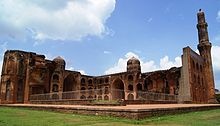
Ruins of a madrassa built by Mahmud Gawan, the Bahamani minister.

Gol Gumbaz, the mausoleum of Mohammed Adil Shah, Sultan of Bijapur.
The medieval Bahamani Sultanate and its successor Deccan sultanates of Central India had heavy Persian influence. The Bahamani sultans actively recruited Persian or Persianized men in their administration. Sultan Firuz (1397-1422) would send ships from his ports in Goa and Chaulto the Persian Gulf to bring back talented men of letters, administrators, jurists, soldiers and artisans. This includes the high born Iranian Mahmud Gawan (1411-1481) who rose to become a powerful a powerful minister of that state during the reign of another Bahamani Sultan.
According to Richard Eaton, even the Hindu Vijayanagara empire from the same period was highly Persianized in its Culture. The royal quarters of the capital had many Persian architectural elements such as domes and vaulted arches.
The Bahmani Sultanate disintegrated into five Deccan Sultanates, similar in culture. Hyderabad, built by the Golconda Sultanate in the 16th century, was inspired from Isfahan. The use of Persian as a court language in Hyderabad continued under the Nizams of Hyderabad, and was only replaced by Urdu in 1886.
The court language during the Deccan sultanate period was Persian or Arabic, however, Marathi was widely used during the period especially by Adil Shahi of Bijapur and the Ahmadnagar Sultanate. Although the rulers were Muslims, the local feudal landlords and the revenue collectors were Hindus and so was the majority of the population. Political expediency made it important for the sultans to make use of Marathi. Nevertheless, Marathi in official documents from the era is totally Persianised in its vocabulary. The Persian influence continues to this day with many Persian derived words used in every day speech such as bāg (Garden), kārkhānā (factory), Shahar (city), bāzār (market), dukān (shop), hushār (clever), kāgad (paper), khurchi (chair), zamin (land), zāhirāt (advertisement), and hazār (thousand).
During the British Raj
Given that the Mughals had historically symbolized Indo-Persian culture to one degree or another, the overthrow of Bahadur Shah Zafar and the institution of the British Raj in 1858 may be considered as marking the end of the Indo-Persian era, even if, after First War of Independence in 1857, Persian would still retain an audience and even produce commendable literature such as the philosophical poetry of Muhammad Iqbal (d. 1938). The British would absorb elements of the culture’s architectural style into the buildings of the Raj, producing Indo-Saracenic architecture.
Cuisine
The Indo-Persian synthesis led to the development of cuisine that combined indigenous foods and ingredients, with the tastes and methods of the Turko-Persians. This was especially under the Mughals, who invited cooks (bawarchis) from various parts of the Islamic world. This resultant cuisine is referred to as Mughlai cuisine, and has left a great impact on the regional eating habits of South Asia. It was further developed in the kitchens of regional Islamic powers, leading to distinctive styles such as the Awadhi and Hyderabadi cuisines.
Due to this synthesis, the Indian subcontinent shares with Central and West Asia foods such as naan and kebab, but has also become home to unique dishes such as biryani.
Architecture
The Indian subcontinent’s Islamic period produced architecture that drew stylistically from Persianate culture, using features such as domes, iwans, minars, and baghs. These monuments also featured uniquely Indian features that became distinctive to the architectural style, such as corbelled arches and jali. The main buildings produced were mosques, forts, and tombs, many of which still stand today. Additionally, early Islamic rulers tended to use spolia from Hindu, Buddhist, and Jain monuments, resulting in an Indianized style which would be refined by later kingdoms.
Usage of this style was not restricted to Islamic rulers, as the members and rulers of other religions incorporated it in their monuments. Sikh architecture is a notable example of this. The Hindu Vijayanagara Empire used Indo-Persian architecture in courtly monuments.
Music
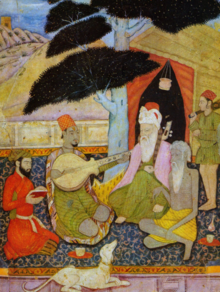
Golkonda 1660-1670. Musician plays a form of rubab. Related instruments include the medieval Iranian rubab, the rubab of Afghanistan, Pakistan and Northern India, the Indian sarod, sursingar and kamaica, the Nepali-Tibetan-Bhutanese tungana, the Pamiri rubaband the Uyghur rawap. The family of instruments blended Persian and Indian cultures, and has been played by Hindus, Buddhists and Muslims.
Prior to Islamic conquest, the Indian subcontinent had a history of musical practice that drew from Sanskritic culture. The subsequent Indo-Persian synthesis resulted in an influx of Iranian musical elements, leading to further developments in the region’s musical culture through the patronage of new Persianate rulers. This appears to have been the impetus for divergence in indigenous music, leading to Hindustani classical music. Some of the main instruments used in this style, such as the sitar and sarod, are thought to have close historical ties with Persian instruments (for an example, see setar). Musical genres such as khyal and tarana, and the musical performance of ghazals, are examples of the Indo-Persian musical confluence. Notably, the Sufi devotional music of qawwali bears evident impact from Persian influence, such as the frequent usage of Persian poems.
The creation of many of these practices is credited to 13th-century poet, scholar, and musician Amir Khusrau.