
The iPhone 11 is a smartphone designed, developed, and marketed by Apple Inc. It is the 13th generation, lower-priced iPhone, succeeding the iPhone XR. It was unveiled on September 10, 2019, alongside the higher-end iPhone 11 Pro flagship at the Steve Jobs Theater in Apple Park, Cupertino, by Apple CEO Tim Cook. Preorders began on September 13, 2019, and the phone was officially released on September 20, 2019, one day after the official public release of iOS 13.
The prominent changes compared with the iPhone XR are the Apple A13 Bionic chip, and an ultra-wide dual-camera system.[5] While the iPhone 11 Pro comes with an 18 W Lightning to USB-C fast charger, the iPhone 11 comes with the same 5 W charger found on previous iPhones, though the 18 W charger is compatible with both models.[6][7]
History[edit]
Details regarding the smartphone were widely leaked before the official release. Complete specifications and renderings of the phone were publicized, many of which turned out to be correct, such as advancements in the camera and retainment of the ‘notch’ design around the frontal camera featured since the iPhone X.[8][9][10] The official event invite sent out to developers, which contained a graphic featuring an Apple logo made of layered colored glass, suggested new colors for the phone. A patent filed by Apple earlier in the year also hinted at a new camera design.[11][12]
Design[edit]
The iPhone 11 is available in six colors: Purple, Yellow, Green, Black, White, and Product (Red). A notch is at the front for the TrueDepth camera system and speaker, similar to its predecessor, the iPhone XR. A bump in the back is for the cameras and the flash that is the same size as the iPhone 11 Pro, although the iPhone 11 only has two cameras compared to the Pro’s three cameras.[7][4] Also, the iPhone 11 has a matte glass rear camera housing and glossy glass back, while the iPhone 11 Pro has a glossy glass rear camera housing and matte glass back. The Apple logo is now centered on the back of the device with no text, a change from previous models.

All colors of iPhone 11 except yellow
| Color | Name |
|---|---|
| Black | |
| White | |
| Purple | |
| Yellow | |
| Green | |
| Product (Red) |
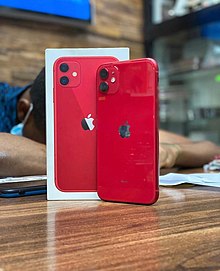
iPhone 11 in Product (Red)
Specifications[edit]
Hardware[edit]
The iPhone 11, along with the iPhone 11 Pro, uses Apple’s A13 Bionic processor, which contains a third-generation neural engine. It has three internal storage options: 64 GB, 128 GB, and 256 GB.[13] It also has 4 GiB of RAM.[14] The iPhone 11 has an IP68 water- and dust-resistant rating along with dirt and grime, and is water-resistant up to 2 m (6.6 ft) for 30 minutes. However, the manufacturer’s warranty does not cover liquid damage to the phone. Also, like previous iPhones, both phones do not have a headphone jack, and come with wired EarPods with a Lightning connector.[7][14] The iPhone 11 is the first smartphone with built-in ultra-wideband hardware, via its Apple U1 chip.[15][16][17]
Display[edit]
The iPhone 11 has a 6.1 in (15.5 cm) IPS LCD, unlike the Pro models which have OLED displays.
The resolution is 1792 × 828 pixels (1.5 megapixels at 326 ppi) with a maximum brightness of 625 nits and a 1400:1 contrast ratio. It supports Dolby Vision, HDR10, True-Tone, and a wide color gamut. As with the iPhone 11 Pro, XR, XS, and X, the display has a notch at the top for the TrueDepth camera system and the speaker. The display has an oleophobic coating, making it fingerprint-resistant.[7][14] Apple announced in September 2019 that both the iPhone 11 and iPhone 11 Pro would show a warning notification if a display were replaced with an unauthorized part. Apple stated that problems with the phone could arise if the wrong parts or procedures were used during the repair process.[18]
Camera[edit]
The iPhone 11 includes a dual-lens 12 MP rear camera array. It has one ƒ/2.4 ultra wide-angle lens with a 120° field of view and 2× optical zoom out, and one ƒ/1.8 wide-angle lens. The iPhone 11 supports 4K video at up to 60 fps and 1080p slow motion at up to 240 fps.[7] The phone also features an audio zoom feature, which focuses audio on the area on which is being zoomed in, similar to the Pro model.[14] Both of the cameras support video, although only the primary lens has OIS. It supports portrait mode with six portrait lighting effects, depth control, and an advanced bokeh effect. The phone also has an automatic night mode allowing the camera to take brighter pictures with reduced noise in low-light environments. Also, a redesigned camera app adds new features such as a scroll wheel for choosing between the different lenses and a feature called “QuickTake”, which allows the user to long-press the shutter button to take a video. Apple has also announced a new Deep Fusion feature that takes advantage of AI and machine learning for image processing, and was released via iOS 13.2 software update on October 29.[7][14][19]
Software[edit]
The iPhone 11 was supplied with iOS 13,[20] which includes Siri, Face ID (through the TrueDepth camera), and Apple Pay, and supports Apple Card. As of September 16, 2020, the iPhone 11 is now compatible with iOS 14.
Reception[edit]
The iPhone 11 drew generally positive reviews after its launch.[20][21] Reviews generally praised the phone’s performance, battery life, and cameras, while criticizing the display as passable, but aging quickly. Reviewers also criticized the notch as being far too large for 2019. According to Counterpoint Research’s Market Pulse, it was the second best-selling model globally for 2019, in less than four months of launch.[22]
Controversy[edit]
Power adapter and EarPods[edit]
Apple, through an environmental initiative, has removed the EarPods and power adapter from all new iPhone boxes starting October 2020, including the iPhone 11. Removing these items is claimed to reduce e-waste and permit a smaller iPhone box, allowing more devices to be transported simultaneously to decrease carbon footprint. However, Apple now includes a USB-C to Lightning cable, incompatible with the existing USB-A power adapters that Apple previously supplied with their devices. Upgraders can still use their existing iPhone power adapters and cables, but users wanting fast charging capabilities will have to purchase a USB-C power adapter separately.[23]
Timeline of iPhone models[edit]
