
Jojo Rabbit is a 2019 comedy-drama film written and directed by Taika Waititi, adapted from Christine Leunens’s 2008 book Caging Skies. Roman Griffin Davis portrays the title character, Johannes “Jojo” Betzler, a ten-year-old Hitler Youth member who finds out that his mother (Scarlett Johansson) is hiding a Jewish girl (Thomasin McKenzie) in their attic. He must then question his beliefs, while dealing with the intervention of his imaginary friend (Waititi), a fanciful version of Adolf Hitler with a comedic stand on the politics of the war. The film also stars Archie Yates, Rebel Wilson, Stephen Merchant, Alfie Allen, and Sam Rockwell.
Waititi crafted the screenplay in 2011, a year after his mother told him of Caging Skies. He rewrote the first draft, which is a rough adaptation of the novel, as it did not contain much comedy; it was also in the rewritten version that Adolf’s character was included. The project was halted in 2012, where it landed on the Black List, and casting started in 2018, with several actors being enlisted amid principal photography. A co-production between the United States, New Zealand, and Czech Republic, the film started production in May 2018 and finished two months later, with reshoots done in early 2019. Michael Giacchino composed the film’s score in London; old-time compositions and songs were also incorporated into the film.
Jojo Rabbit had its world premiere at the 44th Toronto International Film Festival on September 8, 2019, where it won the Grolsch People’s Choice Award. It was released theatrically in the United States on October 18, 2019, and in New Zealand on October 24, 2019. The film polarized critics, who drew praise for the cast performances, direction, screenplay, themes, visual style, and music, but also some criticism for its comedic portrayal of Nazis and unrealism. It, however, was well received by general audiences according to polls. It was chosen by the National Board of Review and the American Film Institute as one of the ten best films of the year, and received several accolades, including the Academy Award for Best Adapted Screenplay at the 92nd Academy Awards.
Plot
During the collapse of Nazi Germany in the fictional town of Falkenheim, ten-year-old Johannes “Jojo” Betzler joins the Deutsches Jungvolk, the junior section of the Hitler Youth. He is heavily indoctrinated with Nazi ideals manifested by imaginary friend Adolf, a buffoonish version of Adolf Hitler. At a training camp run by Captain Klenzendorf, he is nicknamed “Jojo Rabbit” after refusing to kill a rabbit to prove his worthiness. Pepped up by Adolf, he returns to prove himself, throwing a Stielhandgranate without supervision; it explodes at his feet, leaving him scarred and limping. His mother, Rosie, insists to the now-demoted Klenzendorf that Jojo still be included; he is given small tasks such as spreading propaganda leaflets and collecting scrap for the war effort.
Alone at home one day, Jojo discovers Elsa Korr, a teenage Jewish girl and his late sister Inge’s former classmate, hiding behind the walls of Inge’s attic bedroom. Jojo is both terrified of and aggressive towards Elsa. The two are left in a stalemate, as the revelation that Rosie is hiding Elsa would lead to the execution of all three of them. Jojo continues to interact with her, in order to uncover her “Jew secrets” so he can “expose” the Jewish race. Despite so, he often empathizes with Elsa, apologizing to her when he offends. Elsa is both saddened and amused by Jojo’s beliefs, using antisemitic canards to show Jojo the cowardice of the ideologies he was bred. Jojo slowly becomes infatuated with the caring and engaging Elsa, and frequently forges love letters from Elsa’s fiancé Nathan. As they get closer, Jojo begins questioning his beliefs, causing Adolf to scold him over his degrading patriotism.
After indirectly expressing her opposition towards Nazism earlier, Rosie is spotted by Jojo leaving an anti-Nazi message in town. While Rosie has not been home for some time, the Gestapo stops by to investigate, with Klenzendorf in tow. Elsa poses as Inge and although Klenzendorf knows her true identity, he hides it from the Gestapo. Elsa is convinced that the Gestapo are aware of the deception. Later, Jojo finds Rosie hanged at a gallows in the public square. Devastated, he returns home and tries to stab Elsa, but breaks down in tears, feeling guilty. Elsa later reveals that Jojo’s lost father also rebelled against Hitler in Italy, contrary to what Jojo was taught. His beliefs on Nazism quickly shift, and he starts seeing the actual inhumanity of the cruel regime.
Following Hitler’s suicide, the Allies close in. Weak in power and with only Japan by their side, the civilian population, including the Jungvolk, is armed to defend the city. Despondent, Jojo hides until the battle ends, with the Allies occupying the city. Wearing a Jungvolk jacket, he is seized by Russian soldiers alongside a wounded Klenzendorf, revealed to be gay. After a brief conversation, Klenzendorf tells Jojo to look after his “sister”, then tears off Jojo’s Jungvolk coat and loudly denounces him as a Jew to ensure that the soldiers do not execute him. The soldiers drag Jojo away as Klenzendorf is executed by firing squad.
Fearing that Elsa—the only person he has left—will leave him as an orphan, Jojo tells her Germany won the war. Recognizing her despair, he forges a letter from Nathan, claiming that he and Jojo have figured out a way to smuggle her to Paris. Elsa confesses that Nathan died of tuberculosis the previous year. Jojo tells her he loves her, and she tells him she loves him as a younger brother. A disheveled Adolf angrily confronts Jojo for siding with Elsa, but Jojo kicks him out the window. Outside, Elsa sees American soldiers and realizes that the Allies have won the war. After slapping Jojo in the face for lying, they dance in the street, now free.
Cast
- Roman Griffin Davis as Jojo, a young German boy who is a member of the Deutsches Jungvolk
- Thomasin McKenzie as Elsa, a Jewish girl whom Rosie hides in her home
- Taika Waititi as Adolf, Jojo’s imaginary friend version of Adolf Hitler
- Rebel Wilson as Fräulein Rahm, an instructor of the League of German Girls in the Jungvolk camp
- Stephen Merchant as Captain Herman Deertz, a Gestapo agent
- Alfie Allen as Freddy Finkel, the second-in-command to Captain Klenzendorf
- Sam Rockwell as Captain Klenzendorf, an army officer who runs a Jungvolk camp
- Scarlett Johansson as Rosie, Jojo’s mother who is secretly anti-Nazi
- Archie Yates as Yorki, Jojo’s best friend and a member of the Jungvolk too
Identical twins Gilby and Hardy Griffin Davis, younger brothers of Roman Griffin Davis, portray a series of Hitlerjugend clones in the care of Fräulein Rahm in cameo appearances. Joe Weintraub, Brian Caspe, Gabriel Andrews, and Billy Rayner portray Junker, Mueller, Klum, and Frosch, the fellow agents of Deertz.
Rachel House starred in a scene as an American soldier who gave a speech about America saving the day in the immediate aftermath of the war. The scene was later deleted in the released version; House expressed relief, calling it “clever but completely unneeded.” Although she did not appear in the released version, she was said to be an important participant for the project, particularly to Davis, to whom she became an acting coach.
Production
Development and casting
INT. JOJO’S HOUSE – ROSIE’S ROOM – LATER
Jojo sits on the bed as Elsa brushes her hair.
Yep, she’s beautiful.
As he watches her, Jojo shivers a little. He looks down and sees butterflies in his stomach, then looks back at Elsa, worried.
Yep, he’s in love.
—Waititi wrote the screenplay in an overall colloquial language
Waititi had the idea for Jojo Rabbit in 2010, when his mother introduced him to Christine Leunens’ 2008 novel Caging Skies. As a person bored with generic World War II stories, he decided to adapt the novel. The taboo subject matter did not prevent him from pursuing the project: he looked at it as a motivation, and thought of it as a challenge to be bold in filmmaking. He also considered the film a “love letter to all mothers”, with a loving mother character present in the film. Leunens was later informed of the adaptation in an email by Waititi.
The screenplay was written in 2011. Waititi thought of it as being written in the right time, with various prejudices rocketing at the time. Waititi did not create a “straight-out drama” as it would make the film cliché: he instead used humor to build the narrative, then throw dramas that may shock the audience. Some of the characters’ names were taken from Waititi’s friends, he noted. The first draft did not contain Hitler, but Waititi rewrote the whole thing again. Broadly speaking, the first draft lacks comedy, due to it being a rough adaptation from Caging Skies, which Waititi described as a complete drama. Leunens described it as faithful yet original, comparing it with the painting Guernica. Regarding storyboards, Waititi made one only if the scene has a number of actors. However, the film did not immediately start production; instead, it was landed at the Black List of top unproduced screenplays in 2012. In February that year at the International Film Festival Rotterdam, CineMart showed interest in the script; it was credited to contribute to the development of Jojo Rabbit. After being involved in other projects, Waititi went back to Jojo Rabbit in 2018, whereupon casting associates were dispatched to primary schools in the United Kingdom and New Zealand to find potential child actors.
To find the right actor portraying Jojo Betzler, Waititi and the casting team, led by casting director Des Hamilton, watched about 1,000 audition tapes, and later accepted Roman Griffin Davis. Davis was initially being auditioned for Ford v Ferrari, but later also auditioned for Jojo Rabbit and ended up entering the latter project. Davis stated that portraying Jojo, a Nazi fanatic, is a challenge, as his real life state sides more towards Elsa’s character. Thomasin McKenzie was later chosen to portray Elsa Korr, as being a “really pretty, very cool girl who has this hard attitude” which hopefully would make Jojo’s infatuation towards her in the film sensical. Although McKenzie did research on World War II in the perspective of a Jewish girl, she said that she had created the character of Elsa by herself, with Waititi giving her a teaser to how he imagined Elsa. In March 2018, Scarlett Johansson was cast as Rosie. Although the film’s premise was new to her, Johansson stated that she immediately fell in love with the character.
In March 2018, it was revealed that Waititi would direct, write, co-produce, and co-star in the film, as Adolf. Speaking of the context of the role, Waititi stated “It’s my version of… a lonely boy’s best version of his hero, which is really his dad,” referring to the fact that in the film, Jojo is desperate to join Hitler’s ranks during World War II. He did not initially intend to play the character, but production company Fox Searchlight Pictures decided to. Waititi recalled being embarrassed on set. He also stated that he did not put on the effort to play a strong Hitler role and did not do much research, “because I just didn’t think he deserved it.”
The following month, Sam Rockwell was cast as Captain Klenzendorf. Rockwell looked for inspiration from comedians like Bill Murray and Walter Matthau, as he felt they resembled his assigned character. In June 2018, Alfie Allen was cast as Freddy Finkel, Stephen Merchant as Captain Herman Deertz, and Rebel Wilson as Fräulein Rahm.
Filming


Jojo Rabbit, produced with a budget of $14 million, was credited as a co-production between the United States, New Zealand, and the Czech Republic. Principal photography for the film occurred between May 28 and July 21, 2018, at various places in Prague, Žatec, Úštěk, Kytín, Dolní Beřkovice, Hořín, Lenešice, and the Petschek Palace. The former Lenešice sugar factory was used to film the war scenes. Production designer Ra Vincent chose these pre-war, un-bombed places “because they have so much character and give the feeling of being the most German of all the Czech cities that we have visited, with a lot of baroque architecture in the German style.” The Barrandov Studios were also used for filming most of the interior scenes, which Vincent thought of as a great choice, considering Nazi propaganda used to be filmed there. Vincent chose Úštěk to film the exterior due to the “ornate” color palette of the architecture, said to connect with Jojo’s character.
The set design for the Betzler’s house, filmed at a 7,000 square feet (650 m2) soundstage, is characterized by elegant details such as thick door frames, windows recessed deeply into the stone walls, a wood-paneled hallway and a curved staircase. Broadly, it features Art Deco architecture rampant in the 1930s. Victorian architecture and muted color palette is utilized for Inge’s bedroom, in order to give a neutral ground for Jojo and Elsa to bond. It is conceptualized that the Betzlers is a middle-class family, wealthy enough to own a three-bedroom house.
Waititi enforced a rule on the film’s set that prohibited the crew and actors from using cell phones, in order to retain focus and create a calming environment. Waititi allowed the crew and actors to experiment with their work or characters by themselves, as he had no strict hope on how the film should play itself. This was also stated to be a third reason why the prohibition was warranted. Other directors, including Quentin Tarantino, have also used this rule before. He also did not give much direction to the actors in order to not make performances stiff. He also did not show the full picture of Rosie when she was hanged, thinking it was unethical to showcase the deaths of family members.
The actors described having a fun experience on set, saying that Waititi is engaging to work with. ” easy-going and fun, and you feel like you have the freedom to explore the character and try different things, and there’s no embrassment or you don’t feel vulnerable in front of the whole crew. You just have the confidence to give it a go and see what happens”, McKenzie further elaborated.
Reshoots were implemented starting in February 2019. They mainly focused on scenes set during winter, and also included filming a scene where Jojo follows a butterfly, which was achievable working with Luma Pictures.
Cinematography and visual effects

The pavement and buildings further away were in reality blue screens. Jojo Rabbit was shot in a 1:85:1 aspect ratio, as most scenes incorporate more than two people. Lively color palette is used to symbolize Jojo’s amusement towards the Nazi regime.
Mihai Mălaimare Jr. was enlisted as the film’s cinematographer amid doing reshoots for The Hate U Give in Atlanta, and joined the project five days later. He discussed with Waititi, and agreed to depict Jojo Rabbit in a colorful and vibrant way, a primary motif of the film, taking some inspirations from a film he had previously worked on, Youth Without Youth, which featured colorful World War II footages, contrasting the typical desaturated and grayscale historical footages. Cabaret was also a visual reference used for the cinematography. Despite such, Mălaimare organized for the melancholic scenes to look more desaturated, corresponding Jojo’s emotions. Magnum Photos images of children during World War II also serve as inspirations for the cinematography style: “They were still playing, and they were still doing normal kid stuff, the closer you look at the photo, you realize something is wrong—like, ‘Oh, in this one, they are wearing gas masks,’ or ‘They are playing close to a pile of bomb’—all these situations that we felt were very close to our story.”
He and Waititi also agreed on the decision not to use hand-held cameras, in order to retain its classical style. Equipped with a dolly, an Arri Alexa SXT with Super 35 format, supplemented with Hawk V-Lite 1.3x anamorphic lenses and Vantage One T1 spherical lenses, was used instead. Around five tests were implemented to determine the aspect ratio for the film. He chose a 1:85:1 anamorphic format, considering that there are lots of scenes with two people indoors. Small five-watt LED lights were used as lightings for the actors. Though point-of-view shots were sometimes used, the main approach to make the film from the eyes of Jojo is to lower the camera height to that of Davis’. Waititi gave the liberty for actors to also give cinematography advices, some of which were better than Waititi’s suggestions, according to Mălaimare himself. Symmetry and horizons are the main composition approach to the cinematography, which he called a major contributor to the plot flow.
Amplifying the cinematography is visual effects supervisor Jason Chen, a previous collaborator of Waititi. He worked with Clear Angle Studios to set up 3D scanners on tripods at Žatec. The scanners shoot laser beams, rotating 360 degrees, scanning the surrounding architecture in order to give an accurate representation of them. They also scanned Czech streets with historical relevance to Jojo Rabbit, especially the town square Jojo lives, which was once a frequent place for Hitler to rally at. Aside, a major contributor to the visual effects of the film was Luma Pictures, who utilized blue screens to incorporate elements like explosions, tanks, smoke, gunfire, and more in post-production. The glow of bombs going off in the distance, meanwhile, were using matte paintings. They also incorporated snow into scenes shot during summer but was, within Jojo Rabbit‘s universe, set in winter. This was achievable by photographing various snows on the streets, and combine them to the film, a technique known as “background plate.”
Costume design
Mayes C. Rubeo, who had previously collaborated with Waititi, became Jojo Rabbit‘s costume designer. In an “intensive” conversation about the costumes, Waititi favored “formal, elegant” fashion, as it matched the kind of clothing people used to wear back in the era, according to his research. He also wanted a design that symbolizes the joy of childhood: bright, vivid colors, stressing the ambition to contrast typical historical films. Rubeo interpreted these as Italian neorealism, a filmmaking style rampant in the 1940s.
Rubeo started with scouring through vintage Italian houses for the costume for Rosie, though she also created several of her blouses and dresses by herself. She wanted her clothing to be distinctive that it will resonate with the audience throughout the film in order to assist them in the scene where Rosie is found hanged. Concerning that specific scene, Rubeo chose a pair of single lace-up red and white spectator shoes made by the Toronto shoemaker Jitterbug, based on a sketch she made. Imagining Rosie as “the friend of Elsa Schiaparelli”, Rubeo flew to New York City, where she discussed about the costume with actor Johansson. Rosie’s short-sleeve sweater is characterized with “plaid and zigzag Missoni-style patterns”. She is completed with high-waist baggy pants, as well as several other accessories, offering her character a “chic” look.
The basis of Jojo’s Jungvolk uniform is on the assumption that he is “trying to be the policeman of his household”, especially when he wears it even in his house. Though Rubeo found vintage Jungvolk uniforms in Berlin, she noted the need for more sizes for the extras, causing her and the clothing department to sew them, a total of 250, themselves. For Adolf, Rubeo chose the typical brown Nazi Party style, in order to highlight the absurdities of his character, though a “voluminous” pair of riding pants were used to highlight his imaginary state and insecurities. The Hollywood Reporter described it as “paper-bag colored”, “khaki”, and “safari-style”. In total, three Adolf uniforms were sewed.
Portraying Captain Klenzendorf, Rockwell reached out to Rubeo and showed her a photo of Murray on Saturday Night Live, saying that he wanted such design. For an experimental uniform Klenzendorf is written to wear in the Jojo Rabbit‘s screenplay, Rubeo went for a “glitzier”, “heroic”, and “flamboyant” approach, creating to him an “unorthodox” outfit, showcasing the character’s creativity despite “know almost nothing about the rules of design.” She said that creating Klenzendorf’s outfit “was fun to do”.
Elsa’s clothing palette, being a confined character, is made monochromatic. In addition, Rubeo made six different versions for a paper uniform Yorki wears in the final battle scene. She made it out of paper and carboard, with some cotton. As the war ensues, Yorki’s uniform degrades, with only a vest left as the war concludes.
Editing
Editor Tom Eagles said that Waititi did not sat by his side to judge his editing while it was ongoing: “He’s interested in what you have to say and what you might bring to the edit.” Eagles was given two weeks to edit Jojo Rabbit and gave some prior suggestions, of which Eagles “cautiously” implemented. The film was edited using Avid Media Composer. Eagles utilized ScriptSync to compare scenes with the screenplay. The rough cut is 165 minutes, with the director’s cut being the finalized version; it is 108 minutes.
Music
Waititi enlisted Academy Award-winning composer Michael Giacchino to score the film. Giacchino recalled Waititi saying, “Do you remember what you did for Up? Just do that.” Contrary to what he usually does, Giacchino read the screenplay and discussed the tone of the score with Waititi, who said that he doesn’t need a comical tone as the film itself is already comical. When asking himself “What feeling do you want people to walk away with from this movie?”, Giacchino answered to himself: “Jojo going from a closed-off, blinders-on attitude about the world to having his worldview smashed open to starting to see everything in a very different way.”
Initially, Giacchino created an 11-minute suite “that showed the course of character.” The main melody of the suite is played throughout the film in various different styles, ranging from marches to adagios, which adapts to the emotion embodying the specific scene. In the first version, a German children’s choir was also sung, which when translated praises Nazism and fascism; Giacchino hoped that by the end of the film, the feeling of the lyrics would get to the audiences.
In the other tracks, he laid his inspiration towards old-time European classical music such as those of Frédéric Chopin, Franz Liszt, and Erik Satie. Giacchino recalled he was feeling a challenge in creating such tracks which also blend to the emotions of the film. Following the suite, he composed a 22-piece orchestra with a string quartet at its center, as well as piano, a couple of guitars, some brass and percussion. Though Giacchino is used to composing a 100-piece, he felt that in Jojo Rabbit, “the smaller the orchestra, the more emotional the sound.” Waititi responded positively to Giacchino’s score, thinking that it “elevated the film to a new level, increasing the emotional resonance and tying the themes, characters and world of the movie together.” He later recorded a 35-piece orchestra at Abbey Road Studios.
The soundtrack also contains contemporary music, notably “Helden”, the German version of “Heroes” by David Bowie, and “Komm, gib mir deine Hand”, the German version of “I Want to Hold Your Hand” by the Beatles. While watching documentaries on the Hitler Youth during research, Waititi noted “similarities between the crowd at Hitler’s rallies and the frenzy at Beatles concerts”. Giacchino helped secure the rights to the song by contacting Paul McCartney, with whom he had previously worked. Other soundtracks include “Tabú” (Lecuona Cuban Boys), “The Dipsy Doodle” (Ella Fitzgerald), “I Don’t Wanna Grow Up” (Tom Waits), “Everybody’s Gotta Live” (Love), “Mama” (Roy Orbison), “Waltz And Chorus From Faust” (Roger Wagner Chorale), and “Frühlingsstimmen” (Johann Strauss II). These, amongst “Jojo’s Theme” and “Rosie’s Nocturne” from the score album, are bundled at a separate album. Both albums were released on the same day of Jojo Rabbit‘s theatrical release, with the vinyl version released on December 6.
| No. | Title | Length |
|---|---|---|
| 1. | “Jojo’s March” | 1:01 |
| 2. | “Rabbit Got Your Tongue” | 1:20 |
| 3. | “How Jojo Got His Name” | 0:30 |
| 4. | “Adolf Einleitung in Cheek” | 1:02 |
| 5. | “Catch the Antelopers” | 0:33 |
| 6. | “Grenade and Bear It” | 0:45 |
| 7. | “Jojo’s Infirmary Period” | 0:53 |
| 8. | “A New Uni-deform” | 1:12 |
| 9. | “From Poster to Postest” | 0:25 |
| 10. | “The Secret Room” | 5:14 |
| 11. | “Pickled Pink” | 0:44 |
| 12. | “Negotiate Your Heart Out” | 1:05 |
| 13. | “Beyond Questions” | 1:07 |
| 14. | “No Weak Jews” | 0:50 |
| 15. | “The Elsa Prophecy” | 0:20 |
| 16. | “A Boy of Letters” | 0:27 |
| 17. | “A Game of Names” | 0:30 |
| 18. | “Mother Joker” | 1:16 |
| 19. | “A Few of My Shiniest Things” | 1:38 |
| 20. | “Eye of the Tiger” (String Quartet Version) | 2:08 |
| 21. | “Get to the Back of the HQ” | 0:16 |
| 22. | “Proving Your Metal” | 0:49 |
| 23. | “Elsa’s Art Appreciation” | 1:55 |
| 24. | “Gestapo Making Sense” | 4:01 |
| 25. | “Don’t Speech My Pants” | 1:01 |
| 26. | “A Butterfly’s Wings” | 1:16 |
| 27. | “Rosie’s Nocturne” | 2:36 |
| 28. | “The Kids Are All Reich” | 2:39 |
| 29. | “Allies Well That Ends Well” | 0:58 |
| 30. | “New World Order” | 0:57 |
| 31. | “A Few Too Germany” | 1:10 |
| 32. | “What Elsa Is New” | 2:01 |
| 33. | “Nathan’s Last Letter” | 0:51 |
| 34. | “The Adolf in the Room” | 0:41 |
| 35. | “A World to the Wise” | 0:46 |
| 36. | “Elsa Behaved” | 0:38 |
| 37. | “Jojo’s Theme” | 3:53 |
| Total length: | 49:45 | |
Marketing and release
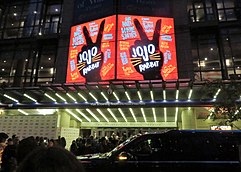
Premiere of the film at the 44th Toronto International Film Festival
In March 2019, distributor Searchlight’s parent company 21st Century Fox was acquired by Disney. As Jojo Rabbit featured mature themes, several Disney executives worried that releasing the film would ruin their reputation as a family-friendly channel; it was also said to be “too edgy” for Disney, as put out by Variety. However, they remained optimistic on the film’s success, arguing that it has a good message, and that it diversifies their scope, said CEOs Bob Iger and Alan Horn.
To market the film, the Jojo Rabbit official Twitter account released a scene from the German World War II film Downfall, which had been a popular asset for memes, wherein subtitles would mistranslate the dialogues to something humorous, mostly known as the Angry Hitler meme. In the Jojo Rabbit version, Hitler is driven insane with the news of Waititi, a Polynesian Jew, creating a film poking fun at Hitler. He decides to create his own Hitler film, and orders to the director of Thor: Ragnarok to direct, who is also Waititi. Additionally, a teaser was released on July 24, 2019, and a trailer was released on September 3, 2019. The poster was unveiled shortly after.
Jojo Rabbit had its world premiere at the 44th Toronto International Film Festival on September 8, 2019. It screened at Fantastic Fest in Austin on September 19, 2019, and opened the San Diego International Film Festival on October 15, 2019. It also screened at various other film festivals in Chicago, Philadelphia, Hawaii, New Orleans, Chapel Hill, Middleburg, and at the UK Jewish Film Festival. The film was theatrically released in the United States on October 18, 2019, opening in several cities before expanding in the following weeks and playing in 798 theaters in the U.S. nationwide beginning November 8, 2019. Jojo Rabbit was released in New Zealand on 24 October 2019. In other countries, it was released within the vicinity of January and February 2020. In the United States, it remained in theaters for around 70 weeks, with the latest recorded release being March 19, 2020.
20th Century Fox Home Entertainment released the film as a digital download on February 4, 2020 and on DVD and Blu-ray disc formats in the United States on February 18. In international territories, the film was released on DVD and Blu-ray by Walt Disney Studios Home Entertainment. It consists of several special features, including three deleted scenes (“Imaginary Göring”, “Little Piggies”, “Adolf Dies Again”), outtakes, a featurette titled “Inside Jojo Rabbit“, an audio commentary, and two of its trailers. It is also equipped with English closed captions, as well as French and Spanish subtitles. Later, the film was released on Hotstar, HBO Max, Sky Cinema, Now TV, and Hulu. It also airs on various HBO networks, and was released on February 23 on Disney+’s Star sub-brand.
Reception
Box office
Jojo Rabbit grossed $33.4 million in the United States and Canada, $3,958,886 in New Zealand, and $57 million in other territories, for a worldwide total of $90.3 million.
In its limited opening weekend, the film made $349,555 from five theaters, an average of $69,911 per venue (the fourth-best of 2019). The film expanded to 55 theaters in 10 cities the following week, making $1 million, and in its third weekend, it grossed $2.3 million from 256 theaters. It went wide the following weekend, making $4 million from 802 theaters. The film’s theater count peaked the following weekend, making $2.8 million from 995 theaters, before making $1.6 million in its sixth weekend. In the immediate aftermath of its Academy Award for Best Picture nomination, the film experienced a box office boost, with 895 more theaters screening it. As of January 19, 2020, it was screened at 1,005 American theaters, “the largest expansion of any Oscar contender” according to TheWrap. During the weekend, it earned $1.8 million, bringing to a total of $23.8 million. In the Oscar weekend, during the film’s 17th week of release, it made $1.5 million from 1,096 theaters, for a running total of $30.3 million.
During its American debut, it ranked 15 by number of daily gross. After clinging between 16 and 17 for three days, it dropped to 18 for two days, then 21, before climbing back to 15 for two days, and dropping to 16. After achieving 17th place for two days, it went up to 14, and steeply dropped to 18. It ranked between 10 to 15 for 37 days straight, before briefly touching 20th place. Starting from February 21, 2020 to its closing date, it gradually dropped from 21 to 32. Weekly, it’s highest grossing was from November 8-14, it’s fourth weekend, where it earned 11th place.
Critical response
On the review aggregator Rotten Tomatoes, the film holds an approval rating of 80% based on 419 reviews, with an average rating of 7.60/10. The website’s critics consensus reads: “Jojo Rabbit‘s blend of irreverent humor and serious ideas definitely won’t be to everyone’s taste—but either way, this anti-hate satire is audacious to a fault.” Metacritic, which uses a weighted average, assigned the film a score of 58 out of 100, based on 57 critics, indicating “mixed or average reviews”. Audiences polled by CinemaScore gave the film an average grade of “A” on an A+ to F scale, while those at PostTrak gave it an overall positive score of 96%, with 87% saying they would definitely recommend it.
Brian Truitt, writing for USA Today, gave the film four out of four stars, calling it “brilliant Nazi-mocking satire”, praising the performances and writing: “As much as it makes you laugh, Waititi’s must-watch effort is a warm hug of a movie that just so happens to have a lot of important things to say.” In a positive review, Steve Pond of TheWrap wrote that “there’s real heart in Jojo Rabbit, too. This is a dark satire that finds a way to make a case for understanding. As circumstances slowly chip away at Jojo’s hate-driven worldview, the black comedy finds room for some genuinely touching moments.”
Richard Roeper of the Chicago Sun-Times awarded the movie 3.5 out of four stars, lauding it as “uncomfortably funny, unapologetically insensitive, cheerfully outrageous” and concludes that writer-director Waititi “delivers a timely, anti-hate fractured fairy tale.” In another positive review, Stephanie Zacharek of Time Magazine writes: “It’s Waititi’s ability to balance unassailable goofy moments with an acknowledgment of real-life horrors that makes the movie exceptional.” Adam Graham of the Detroit News gave it the grade “A−”, calling it an “enchanting, whimsical satire about the absurdity of war as seen through a child’s eyes” as well as “a smart, accessible, inclusive film that opens doors at a time when many are slamming them shut.”
Variety‘s Owen Gleiberman said that the film “creates the illusion of danger while playing it safe” and wrote that “it lacks the courage of its own conventionality. It’s a feel-good movie, all right, but one that uses the fake danger of defanged black comedy to leave us feeling good about the fact that we’re above a feel-good movie.” Eric Kohn of IndieWire gave the film a grade of “C”, writing that “Despite a few flashes of tragedy, Jojo Rabbit lingers in a charming muddle of good vibes without really confronting their implications. may be one of the few working directors capable of injecting quirky scenarios with real depth, but in this case, he reduces the underlying circumstances—you know, that Holocaust thing—to a superficial prop.”
A. O. Scott of The New York Times wrote that “The particulars of the evil can seem curiously abstract, and the portrayal of goodness can feel a bit false, and forced” and that “Elsa’s Jewishness has no real content. She exists mainly as a teaching moment for Johannes. Her plight is a chance for him to prove his bravery.” Keith Uhlich of Slant Magazine gave the film zero stars, criticising the film’s premise, lack of historical accuracy and realism, and use of anti-semitic canards and stereotypes, and wrote that Waititi’s performance as Hitler is “aiming for The Great Dictator but barely hitting Ace Ventura.” Little White Lies‘ Hannah Woodhead criticised the film for its inclusion of a sympathetic Nazi character, Captain Klenzendorf, writing that it “feels oddly impartial, keen to note that actually, there were some Nice Nazis Too. That’s not really something we need to hear in 2019, with white nationalism back in vogue and on the march across much of western civilisation.”
The film received a negative critical reception in the UK, with Robbie Collin giving it one-star out of five, and saying that he was, “aghast”, saying that the scenes at the camp were, “the laziest rip-off of Moonrise Kingdom I’ve seen in my life”, and saying that, “there’s no sense that anything is at stake…it sentimentalises and trivialises the Holocaust…the stuff that JoJo is indoctrinated with is made up of old Borat lines, and that’s not what anti-Semitism is.” Peter Bradshaw also gave it a one-star rating, saying, “There are no insights to be had – and no laughs”, and calling it, “strangely redundant”. Mark Kermode was slightly more positive, but still said that it was, “neither sharp enough nor funny enough to cut to the heart of its subject matter.”
Historical accuracy

Jungvolk boys fanfare trumpeters at a Nazi rally in the town of Worms in 1933
Despite being a loose depiction of World War II, Jojo Rabbit accurately depicts various aspects of the era. Boys in the Hitler Youth did spread propaganda and collect scraps like Jojo does, and Stielhandgranates were popularized during World War II. Several mentions of the Axis powers are also said to be accurate, although the film fictionalized a convergence of American and Soviet soldiers in the same battle. The “free Germany” sign style used in the film are also fictional, though other styles were present.
Bundling various historical sources, Time thinks that the film depicted the Nazi regime from a children’s eyes accurately. Many Jungvolk children recalled the experience as fun, and looked upon the regime in innocent mindsets. A memoir from former member Alfons Heck described the program as “an exciting life, free from parental supervision, filled with ‘duties’ that seemed sheer pleasure.” Though girls were not given much physical activities as seen in the film, they were given womanly duties such as farming, cooking, cleaning, singing, swimming, gymnastics and running, which has the purpose of keeping their bodies in good shape to be able to find a mate and descend their ideology to future children.
Jojo Rabbit also divided experts of the Holocaust at a panel discussion following a screening in the Museum of Tolerance. Rick Trank, producer of The Long Way Home, felt that while it has a creative premise, the lack of historical context makes the film detrimental to young viewers who may misunderstand the premise and thought of the film’s elements as real in entirety. However, Claudia Wiedeman, director of education at the USC Shoah Foundation, said that with the right educational methods and tools, the film could be a useful resource for the youth learning about World War II. Brian Levin, director of the Center for the Study of Hate & Extremism and professor of criminal justice at California State University, San Bernardino, applauded the film for using sarcasm—an easy-to-understand modern language—to depict Nazi Germany.
Accolades
| Award | Date of ceremony | Category | Recipient(s) | Result | Ref(s) |
|---|---|---|---|---|---|
| AACTA Awards | January 3, 2020 | Best International Screenplay | Taika Waititi | Won | |
| Academy Awards | February 9, 2020 | Best Picture | Carthew Neal, Taika Waititi and Chelsea Winstanley | Nominated | |
| Best Supporting Actress | Scarlett Johansson | Nominated | |||
| Best Adapted Screenplay | Taika Waititi | Won | |||
| Best Production Design | Ra Vincent and Nora Sopková | Nominated | |||
| Best Costume Design | Mayes C. Rubeo | Nominated | |||
| Best Film Editing | Tom Eagles | Nominated | |||
| American Cinema Editors | January 17, 2020 | Best Edited Feature Film – Comedy or Musical | Won | ||
| Art Directors Guild Awards | February 1, 2020 | Excellence in Production Design for a Period Film | Ra Vincent | Nominated | |
| Belgian Film Critics Association | December 28, 2020 | Grand Prix | Jojo Rabbit | Nominated | |
| British Academy Film Awards | February 2, 2020 | Best Actress in a Supporting Role | Scarlett Johansson | Nominated | |
| Best Adapted Screenplay | Taika Waititi | Won | |||
| Best Costume Design | Mayes C. Rubeo | Nominated | |||
| Best Editing | Tom Eagles | Nominated | |||
| Best Original Score | Michael Giacchino | Nominated | |||
| Best Production Design | Ra Vincent and Nora Sopková | Nominated | |||
| Casting Society of America | January 30, 2020 | Feature Studio Or Independent – Comedy | Des Hamilton | Won | |
| Costume Designers Guild Awards | January 28, 2020 | Excellence in Period Film | Mayes C. Rubeo | Won | |
| Critics’ Choice Movie Awards | January 12, 2020 | Best Picture | Jojo Rabbit | Nominated | |
| Best Supporting Actress | Scarlett Johansson | Nominated | |||
| Best Young Actor/Actress | Roman Griffin Davis | Won | |||
| Thomasin McKenzie | Nominated | ||||
| Archie Yates | Nominated | ||||
| Best Adapted Screenplay | Taika Waititi | Nominated | |||
| Best Comedy | Jojo Rabbit | Nominated | |||
| Directors Guild of America Awards | January 25, 2020 | Outstanding Directing – Feature Film | Taika Waititi | Nominated | |
| Golden Globe Awards | January 5, 2020 | Best Motion Picture – Musical or Comedy | Jojo Rabbit | Nominated | |
| Best Actor – Motion Picture Musical or Comedy | Roman Griffin Davis | Nominated | |||
| Grammy Awards | March 14, 2021 | Best Compilation Soundtrack for Visual Media | Jojo Rabbit – Various Artists | Pending | |
| Hollywood Critics Association Awards | January 9, 2020 | Best Picture | Jojo Rabbit | Nominated | |
| Best Male Director | Taika Waititi | Nominated | |||
| Best Adapted Screenplay | Won | ||||
| Best Performance by an Actor or Actress 23 and Under | Roman Griffin Davis | Nominated | |||
| Thomasin McKenzie | Nominated | ||||
| Hollywood Film Awards | November 3, 2019 | Cinematography Award | Mihai Mălaimare Jr. | Won | |
| Production Design Award | Ra Vincent | Won | |||
| Hollywood Music in Media Awards | November 23, 2019 | Best Original Score in a Feature Film | Michael Giacchino | Nominated | |
| Humanitas Prize | January 24, 2020 | Comedy or Musical Feature Film | Jojo Rabbit | Won | |
| Location Managers Guild Awards | 24 October 2020 | Outstanding Locations in a Period Film | Jan Adler | Nominated | |
| Producers Guild of America Awards | January 18, 2020 | Best Theatrical Motion Picture | Jojo Rabbit | Nominated | |
| Satellite Awards | December 19, 2019 | Best Actor – Motion Picture Comedy/Musical | Taika Waititi | Nominated | |
| Best Adapted Screenplay | Nominated | ||||
| Screen Actors Guild Awards | January 19, 2020 | Outstanding Performance by a Cast in a Motion Picture | Alfie Allen, Roman Griffin Davis, Scarlett Johansson, Thomasin McKenzie, Stephen Merchant, Sam Rockwell, Taika Waititi and Rebel Wilson | Nominated | |
| Outstanding Performance by a Female Actor in a Supporting Role | Scarlett Johansson | Nominated | |||
| Toronto International Film Festival | September 15, 2019 | Grolsch People’s Choice Award | Jojo Rabbit | Won | |
| Writers Guild of America Awards | February 1, 2020 | Best Adapted Screenplay | Taika Waititi | Won |