
Korean shamanism or Korean folk religion, also known as Shinism or Sinism (Korean: 토속신앙 Tosok Shinang) or Shindo (Korean: 신도; Hanja: 神道, “way of the spirits/gods”), is the polytheistic and animistic ethnic religion of Korea which dates back to prehistory and consists of the worship of gods (신 shin) and ancestors (조상 josang) as well as nature spirits. When referring specifically to the shamanic practice (Korean: 무속, Hanja: 巫俗; musog or musok), the term Muism (Hangul:무속신앙 musok shinang) is used.
The general word for “shaman” in Koreanis mu (Hangul: 무, Hanja: 巫). In contemporary terminology, they are called mudang (무당, 巫堂) if female or baksu if male, although other terms are used locally. The Korean word mu is synonymous of the Chinese word wu 巫, which defines both male and female shamans. The role of the mudang is to act as intermediary between the spirits or gods and humanity in order to solve hitches in the development of life, through the practice of gut rituals.
Central to Korean shamanism is the belief in many different gods, supernatural beings and ancestor worship. The mu are described as chosen persons.(see: Korean mythology)
Korean shamanism has influenced some Korean new religions, such as Cheondoism and Jeungsanism, and some Christian churches in Korea make use of practices rooted in shamanism.
The mythology of Korean shamanism is orally recited during gut rituals. In Jeju, these are called bon-puri.
Contents
- Terminology
- Names of the religion
- Names of the shamans
- Types and roles of shamans
- Categories of mu
- “Self-loss” and “divine light” experiences
- Myths about the origin of the shamans
- Princess Bari (바리 공주)
- Chogong bon-puri (초공 본 풀이)
- Gongsim
- Practices
- Gut rites (굿)
- Purification (정화, 부정 풀이, 부정 치기)
- History
- Branchings
- Temples
- See also
- Footnotes
- References
- Notes
- Bibliography
- Further reading
Terminology

A baksu.
Names of the religion
Besides “Shinism” and “Muism”, other terms used to define Korean shamanism include Goshindo (고신도, 古神道; “way of the ancestral gods”), used in the context of the new religious movement of Daejongism, and Pungwoldo (風月道, “way of brightness”), used by the Confucian scholar Choe Chiwon between the 9th and the 10th century.Shamanic associations in modern South Korea use the terms Shindo or Mushindo(무신도 “shamanic way of the spirits”) to define their congregations or membership, and musogin (“people who do shamanism”) to define the shamans.
Names of the shamans
The Korean word 무 mu is related to the Chinese term 巫 wu, which defines shamans of either sex, and likely also to the Mongolic “Bo” and Tibetan “Bon”. Already in records from the Yi dynasty, mudang has a prevalent usage.Mudang itself is explained in relation to Chinese characters, as originally referring to the “hall”, 堂 tang, of a shaman. A different etymology, however, explains mudang as stemming directly from the Siberian term for female shamans, utaganor utakan.
Mudang is used mostly, but not exclusively, for female shamans. Male shamans are called by a variety of names, including sana mudang (literally “male mudang“) in the Seoul area, or baksu mudang, also shortened baksu (“doctor”, “healer”), in the Pyongyang area. According to some scholars, baksu is an ancient authentic designation of male shamans, and locutions like sana mudangor baksu mudang are recent coinages due to the prevalence of female shamans in recent centuries. Baksu may be a Korean adaptation of terms loaned from Siberian languages, such as baksi, balsi or bahsih.
The theory of an indigenous or Siberian origin of Korean shamanic terminology is more reasonable than theories which explain such terminology as originating in Chinese, given that Chinese culture influenced Korea only at a relatively recent stage of Korean history. Likely, when Koreans adopted Chinese characters they filtered their previously oral religious culture through the sieve of Chinese culture.
Types and roles of shamans
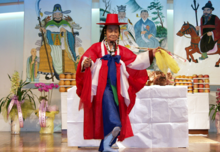
Mudang Oh Su-bok, mistress of the dodang-gut of Gyeonggi, holding a service to placate the angry spirits of the dead.
Categories of mu
There are four basic categories of Korean shamans, referred to by the dominant local name for shamans.
The mudang-type shamans are traditionally found in northern Korea: the provinces of Hamgyong, Pyongan, Hwanghae, and northern Gyeonggi, including the capital of Seoul. They are initiated into shamanism by sinbyeong, an illness caused by a god entering their bodies, and is cured only through initiation. They share their body with the soul of a specific deity, referred to as mom-ju (“lord of the body”). During shamanic rituals, they undergo trance possession and speak with the voice of the god being invoked.
The dan’gol-type shamans are priests and not shamans in the strict sense. They are found in the southern and eastern provinces of Gangwon, Gyeongsang, Chungcheong, and Jeolla, although they are increasingly displaced by the dominance of Seoul-style shamanism in South Korea. The dan’gol are hereditary, rather than being initiated by a supernatural experience. They have no supernatural powers, are not associated with their own gods, and do not undergo trance possession. They merely worship a number of gods with a fixed set of rituals. Unlike mudang-type shamans, dan’gol-type shamans are associated with the gods of their specific community.
The simbang-type shamans are found only in Jeju Island, and combine features of the mudang and dan’gol types. Like the mudang, the simbang of Jeju are associated with a specific set of gods. But these gods do not inhabit the shaman’s body but are externalized in the form of the mengdu, a set of sacred ritual implements in which the gods and spirits of dead shamans are embodied. The simbang‘s basic task is to understand the divine message conveyed by their mengdu and to use the mengdu to worship the gods.
The myeongdu-type shamans co-occur with the dan’gol-type shamans. They are believed to be possessed by the spirits of dead children, and are able to divine the future but do not participate in general rituals for the gods.
“Self-loss” and “divine light” experiences
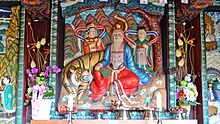
Altar of a Sansingak, “Mountain God shrine”. Mountain God shrines are often controlled by Buddhist temples. This one belongs to the Jeongsusa(Jeongsu Temple) of Ganghwa Island.
People who become shamans are believed to be “chosen” by gods or spirits through a spiritual experience known as shinbyeong (신병 (神病); “divine illness“), a form of ecstasy, which entails the possession from a god and a “self-loss”. This state is said to manifest in symptoms of physical pain and psychosis. Believers assert that the physical and mental symptoms are not subject to medical treatment, but are healed only when the possessed accepts a full communion with the spirit.
The illness is characterized by a loss of appetite, insomnia, visual and auditory hallucinations. The possessed then undergoes the naerim-gut, a ritual which serves both to heal the sickness and to formally establish the person as a shaman.
Korean shamans also experience shinmyeong (신명 (神明); “divine light”), which is the channeling of a god, during which the shaman speaks prophetically.Shinmyeong is also experienced by entire communities during the gut hold by the shaman, and is a moment of energisation which relieves from social pressure, both physical and mental.
Myths about the origin of the shamans
Korean shamanic narratives include a number of myths that discuss the origins of shamans or the shamanic religion. These include, the Princess Bari myth, the Gongsim myth, and the Chogong bon-puri myth.
Princess Bari (바리 공주)
The Princess Bari narrative is found in all regions except Jeju. Roughly one hundred versions of the myth have been transcribed by scholars as of 2016, around half of those since 1997. As of 1998, all known versions were sung only during gut rituals held for the deceased. Princess Bari is therefore a goddess closely associated with funeral rites. Bari’s exact role varies according to the version, sometimes failing to become a deity at all, but she is usually identified as the patron goddess of shamans, the conductor of the souls of the dead, or the goddess of the Big Dipper.
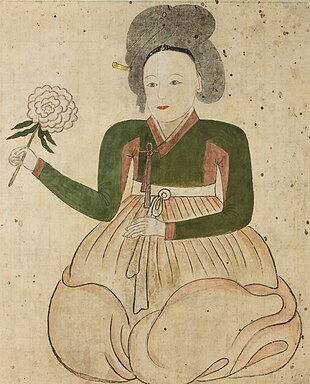
Princess Bari holding the flower of resurrection. Painting for shamanic rituals, eighteenth century.
Despite the large number of versions, most agree upon the basic story. The first major episode shared by almost all versions is the marriage of the king and queen. The queen gives birth to six consecutive daughters who are treated luxuriously. When she is pregnant a seventh time, the queen has an auspicious dream. The royal couple takes this as a sign that she is finally bearing a son and prepares the festivities. Unfortunately, the child is a girl. The disappointed king orders the daughter to be thrown away, dubbing her Bari, from Korean 버리- beori- “to throw away.” In some versions, she must be abandoned two or three times because she is protected by animals the first and second times. The girl is then rescued by a figure such as the Buddha (who regrets upon seeing her that he cannot take a woman as his disciple), a mountain god, or a stork.
Once Bari has grown, one or both of her parents fall gravely ill. They learn that the disease can only be cured through medicinal water from the Western Heaven. In the majority of versions, the king and queen ask their six older daughters to go fetch the water, but all of them refuse. Desperate, the king and queen order Princess Bari to be found again. In other versions, the royal couple is told in a dream or a prophecy to find their daughter. In any case, Bari is brought to court. She agrees to go to the Western Heaven and departs, usually wearing the robes of a man.
The details of Bari’s quest differ according to the version. In one of the oldest recorded narratives, recited by a shaman from near Seoul in the 1930s, she meets the Buddha after having gone three thousand leagues. Seeing through her disguise and remarking that she is a woman, the Buddha asks if she can truly go another three thousand leagues. When Bari responds that she will keep going even if she is to die, he gives her a silk flower, which turns a vast ocean into land for her to cross. She then liberates hundreds of millions of dead souls who are imprisoned in a towering fortress of thorns and steel.
When Bari finally arrives at the site of the medicinal water, she finds it defended by a supernatural guardian (of varying nature) who also knows that she is a woman, and obliges her to work for him and bear him sons. Once this is done―she may give birth to as many as twelve sons, depending on the version―she is allowed to return with the medicinal water and the flowers of resurrection. When she returns, she finds that her parents (or parent) have already died and that their funerals are being held. She interrupts the funeral procession, opens the coffin lids, and resurrects her parents with the flowers and cures them with the water. In most versions, the princess then attains divinity.
Chogong bon-puri (초공 본 풀이)
The Chogong bon-puri is a shamanic narrative whose recitation forms the tenth ritual of the Great Gut, the most sacred sequence of rituals in Jeju shamanism.The Chogong bon-puri is the origin myth of Jeju shamanic religion as a whole, to the point that shamans honor the myth as the “root of the gods” and respond that “it was done that way in the Chogong bon-puri” when asked about the origin of a certain ritual. It also explains the origin of the mengdu, the sacred metal objects that are the source of a Jeju shaman’s authority. As with most works of oral literature, multiple versions of the narrative exist. The summary given below is based on the version recited by the high-ranking shaman An Sa-in (1912—1990).

Shamanic ritual in Jeju Island. The modern rituals are said to be the same as the ones the triplets performed to resurrect Noga-danpung-agassi in the Chogong bon-puri.
Jimjin’guk and Imjeong’guk, a rich couple, are nearing fifty but still have no children. A Buddhist priest visits from the Hwanggeum Temple and tells them to make offerings in his temple for a hundred days. They do so, and a girl is miraculously born. They name her Noga-danpung-agissi. When the girl is fifteen, both of her parents leave temporarily. They imprison her behind two doors with seventy-eight and forty-eight locks each and tell the family servant to feed her through a hole, so that she cannot leave the house while they are absent.
The Buddhist priest of the Hwanggeum Temple learns of the great beauty of Noga-danpung-agissi and visits the house to ask for alms. When the girl points out that she cannot leave the house, the priest takes out a bell and rings it three times, which breaks every lock. When she comes out wearing a veil of chastity, he strokes her head three times and leaves. Noga-danpung-agissi then becomes pregnant. When her parents return, they decide to kill her to restore the family’s honor. When the family servant insists that she be killed instead, the parents relent and decide to expel both instead. Her father gives Noga-danpung-agissi a golden fan as she leaves.
The two decide to go to the Hwanggeum Temple, encountering various obstacles and crossing many strange bridges on the way. The servant explains the etymology of the bridges, connecting each name to the process of Noga-danpung-agissi’s expulsion from the family. They eventually reach the temple and meet the priest, who banishes her to the land of the goddess of childbirth. Alone there, she gives birth to triplets who tear out of her two armpits and her breasts.Having bathed them in a brass tub, she names the three boys Sin-mengdu, Bon-mengdu, and Sara-salchuk Sam-mengdu.
The family lives an impoverished life. At the age of eight, the three brothers become manservants of three thousand corrupt aristocrats who are preparing for the civil service examinations. Seven years later, the aristocrats go to Seoul to pass the examinations and take the triplets with them. The aristocrats leave the triplets stranded atop a pear tree on the way, but they are rescued by a local nobleman who is forewarned by a dream of dragons ensnared on the tree. They reach Seoul and are the only people to pass the examinations. Outraged, the aristocrats imprison Noga-danpung-agissi in the “palace of Indra of the three thousand heavens.” This is generally understood as a metaphor for the aristocrats killing her, with other versions explicitly mentioning a murder.
The triplets visit their father, who makes them abandon their old lives and become shamans in order to save their mother. He asks his sons what they saw first when they came to the temple, and they respond that they saw heaven, earth, and the gate. The priest accordingly gives them the first cheonmun, or divination discs, with the Chinese characters 天 “heaven”, 地 “earth”, and 門 “gate” inscribed. The triplets hold the first shamanic rituals as their father has ordered them to do, aided by Neosameneo-doryeong, the young god of shamanic music. The rituals successfully resurrect their mother. The triplets then summon a master smith from the East Sea to forge the first mengdu implements. In some versions, this smith’s mengdu are unsound, and the triplets’ father summons a celestial smith named Jeon’gyeongnok to forge good-quality mengdu. In any case, the triplets store them in a palace where their mother and Neosameneo-doryeong will keep watch over them. They then ascend into the afterlife to become divine judges of the dead, wielding the sacred shamanic knives that they will use to bring justice to the aristocrats.
Some time later, the daughter of a state councillor falls seriously ill every ten years: at the age of seven, seventeen, twenty-seven and so forth. At the age of seventy-seven, she realizes that she is sick with sinbyeong, a disease sent down by the gods and cured only by initiation into shamanism. However, there are no ritual devices that she can use. She goes to the palace where the ritual implements are kept and prays to the triplets, who give her the sacred objects necessary for the shamanic initiation rite. The councilor’s daughter is the first truly human shaman, and her receiving the ritual objects represents the first generational transfer of shamanic knowledge.
Gongsim
Practices
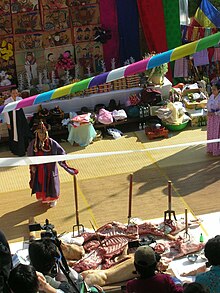
A famous mudang holding a five-days long gut in rural South Korea in 2007.
Gut rites (굿)
The gut or kut are the rites performed by Korean shamans, involving offerings and sacrifices to gods and ancestors. They are characterised by rhythmic movements, songs, oracles and prayers. These rites are meant to create welfare, promoting commitment between the spirits and humankind.
Through song and dance, the shaman begs the gods to intervene in the fortune of humans. The shaman wears a very colourful costume and normally speaks in ecstasy. During a rite, the shaman changes his or her costume several times. Rituals consist of various phases, called gori.
There are different types of gut, which vary from region to region.
Purification (정화, 부정 풀이, 부정 치기)
Purity of both the body and the mind is a state that is required for taking part in rituals. Purification is considered necessary for an efficacious communion between living people and ancestral forms. Before any gut is performed, the altar is always purified by fire and water, as part of the first gori of the ritual itself. The colour white, extensively used in rituals, is regarded as a symbol of purity. The purification of the body is performed by burning white paper.
History
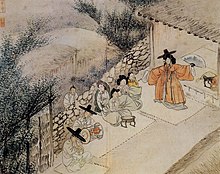
The depiction of a mudangperforming at a gut in the painting entitled Munyeo sinmu (무녀신무, 巫女神舞), made by Shin Yunbok in the late Joseon (1805).
Korean shamanism goes back to prehistoric times, pre-dating the introduction of Buddhism and Confucianism, and the influence of Taoism, in Korea. It is similar to Chinese Wuism. Vestiges of temples dedicated to gods and spirits have been found on tops and slopes of many mountains in the peninsula.
Although many Koreans converted to Buddhism when it was introduced to the peninsula in the 4th century, and adopted as the state religion in Silla and Goryeo, it remained a minor religion compared to Korean shamanism.
Since the 15th century, in the state of Joseon, things changed with the adoption of Neo-Confucianism as the state religion. Non-Confucian religions were suppressed and Korean shamanism started to be regarded as a backward relic of the past. In the late 19th and 20th century, a series of circumstances, namely the influence of Christian missionaries and the disruption of society caused by modernisation, contributed to a further weakening of Korean shamanism, ultimately paving the way for a significant growth of Christianity.
In the 1890s, when the Joseon dynasty was collapsing, Protestant missionaries gained significant influence through the press, leading a demonisation of Korean traditional religion and even campaigns of violent suppression of local cults.Protestant demonisation would have had a long-lasting influence on all subsequent movements which promoted a complete elimination of Korean shamanism.
During the Japanese rule over Korea, the Japanese tried to incorporate Korean shamanism within, or replace it with, State Shinto. For a short period in the 1940s, however, after the defeat of the Japanese, Korean shamanism was identified as the pure Korean national essence.
The situation of Korean shamanism worsened after the division of Korea and the establishment of a northern Socialist government and a southern pro-Christian government. South Korean anti-superstition policies in the 1970s and 80s forbade traditional religion and wiped out all ancestral shrines. These policies were particularly tough under the rule of Park Chung-hee. In North Korea, all shamans and their families were targeted as members of the “hostile class” and were considered to have bad songbun, “tainted blood”.
In recent decades, Korean shamanism has experienced a resurgence in South Korea, while in North Korea, according to demographic analyses, approximately 16% of the population practises some form of traditional ethnic religion or shamanism.
Branchings
Since the early 19th century, a number of movements of revitalisation or innovation of traditional Korean shamanism arose. They are characterised by an organised structure, a codified doctrine, and a body of scriptural texts. They may be grouped into three major families: the family of Daejongism or Dangunism, the Donghak-originated movements (including Cheondoism and Suunism), and the family of Jeungsanism (including Jeungsando, Daesun Jinrihoe, the now-extinct Bocheonism, and many other sects).
Temples

A shamanic shrine in Ansan, South Korea. On the left window it shows a manja, which in South Korea denotes a shamanic facility.
Unlike China, Japan, Vietnam or Taiwan, Korean folk temples aren’t commonly found in cities, but villages, mountains and farmland. Neo-Confucianism in Joseon was the most exclusive and separatist teaching among the East Asian teachings. Additionally it did not approve of the supernatural power or the spirits/ghosts, so it was a fatal blow to shamanism. The teachings of Confucianism strongly emphasised rationality; for the Confucian scholars shamanism was just a vulgar thing, and they wanted to be rid of it as quickly as possible. Consequently the shamans were degraded to the lowest class, and for them entry to the cities was banned. Thus shamanism became a religion for the lower class of peasants, especially for women.
When Buddhism was introduced in Korea, its temples were built on or near the shaman mountain-spirit shrines. Still today, one can see buildings at these Buddhist temple sites dedicated to the shaman mountain-spirits Sansin (Korean: 산신). Most buddhist temples in Korea have a Sansin-gak (Korean: 산신각), the choice of preference over other shrines, typically a small shrine room set behind and to the side of the other buildings. It is also common for the sansingak to be at a higher elevation than the other shrine rooms, just as the mountain itself towers above the temple complex. The sansin-gak maybe a traditional wooden structure with a tile roof, or in more modern and less wealth temples, a more simple and utilitarian room. Inside will be a waist height shrine with either a statue and mural painting, or just a mural painting. Offerings of candles, incense, water and fruit are commonly supplemented with alcoholic drinks, particularly Korea’s rustic rice wine makkgoli. This further serves to illustrate the non-Buddhist nature of this deity, even when he resides inside a temple. And yet, on the floor of this small shine room one will frequently see a monk’s cushion and moktak: evidence of the regular Buddhist ceremonies held there. Sansin may not be enshrined in a separate shrine, but in a Samseonggak or in the Buddha hall, to one side of the main shrine. Sansin shrines can also be found independent of Buddhist temples.
There are shamanic temples dotted around Seoul, maybe one or two. But most of the time, they operate out of commercial temples called gutdang (Korean: 굿당). A shaman will rent a room for the day, and customers meet her there to carry out the ritual. There could be five rituals going at the same time in this building, the shamans go where the clients are. There are over 400 shrines on the rural island of Jeju which the people there have worshipped for centuries, it is the highest concentration in Korea taking into account the Island’s small population. The fact that the local Buddhist tradition had gone nearly extinct under persecution by the Neo-Confucian Joseon state, so that there remained very few goldfish monks.
The korean folk religion was suppressed in different times and this led to a declining number of shrines. The destruction, neglect, or dilapidation of shamanic shrines was particularly extensive in the movement Misin tapa undong (“to defeat the worship of gods”). However, the 1970s and 1980s saw the most zealous anti-religion campaign and destruction of korean shrines with the Saemaul Undong(Korean: 새마을 운동). In recent years there have been cases of reconstruction of shrines and resumption of rites in some villages.