
Leatherhead is a town in Surrey, England, on the right bank of the River Mole, and at the edge of the contiguous built-up area of London. Its local district is Mole Valley. Records exist of the place from Anglo Saxon England. It has a combined theatre and cinema, which is at the centre of the re-modelling following late 20th century pedestrianisation. The town is situated 21 mi (34 km) south of central London and 13 mi (21 km) northeast of the Surrey county town of Guildford.
Just northeast of the midpoint of Surrey and at a junction of ancient north–south and east–west roads, elements of the town have been a focus for transport throughout its history. A main early spur to this was the construction of the bridge over the seasonally navigable River Mole in the early medieval period. Later the Swan Hotel provided 300 years of service to horse-drawn coaches. In the late 20th century the M25 motorway was built nearby. Leatherhead is typical of many towns which form part of the London commuter belt with many residents commuting daily into the UK capital.
Toponymy
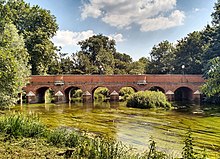
Leatherhead Town Bridge over the River Mole was rebuilt by George Gwilt in 1782-3 and may originally date from the late medieval period.
The origins and meaning of the name ‘Leatherhead’ are uncertain. Early spellings include Leodridan (880), Leret (1086), Lereda (1156), Ledreda (1160) and Leddrede (1195).
Initially, the name was thought to derive from the Anglo-Saxon lēod-rida, meaning ‘a place where people ride ‘. This origin is now considered highly unlikely as Lēod does not exist in any other English place-name, and ride is speculation. Richard Coates has suggested a more plausible derivation from the Brythonic lēd-rïd (as in the modern Welsh “Llwyd rhyd” meaning ‘grey ford’). This theory has been strengthened by further studies which suggest that the Anglo-Saxon form is a distortion of the original British name.
History
Pre-1066
The earliest evidence of human activity in Leatherhead comes from the Iron Age. Flints, a probable well and two pits were discovered in 2012 during building work on Garlands Road and the finds suggested that the site was also used in the early Roman period. Traces of Iron Age field systems and settlement activity have been observed at Hawks Hill, Fetcham (about 1 km (0.62 mi) southwest of the town centre) and on Mickleham Downs (about 3 km (2 mi) to the south). Also to the south, the Druid’s Grove at Norbury Park may have been used for pre-Christian pagan gatherings.
The route of Stane Street, the Roman road from London to Chichester, passes about 2.5 km (1.6 mi) southeast of the town. Barrows beside the A246 provide evidence for a second late Romano-British road that ran from a junction with Stane Street close to Ashtead Church, crossing the Mole at Leatherhead Bridge and continuing towards Effingham.
The first known reference to Leatherhead is in the will of Alfred the Great in 880, in which land at ‘Leodridan’ was bequeathed to his son, Edward the Elder.
The early settlement appears to have grown up on the east side of the River Mole: the site of an Anglo-Saxon burial ground is identified on the west side of the river at Hawk’s Hill. Leatherhead lay within the Copthorne hundred by the formation of the Kingdom of England.
Governance
The medieval history of Leatherhead is complex, since the parish was divided into a number of manors. The town appears in Domesday Book of 1086 as Leret. It was held by Osbern de Ow as a mesne lord to William I. Its Domesday assets were one church, belonging to Ewell, with 40 acres (160,000 m2). It rendered £1. To the south was the manor of Thorncroft, which was held by Richard son of Gilbert as tenant-in-chief. To the north was the manor of Pachesham, subdivided into two parts each held by a mesne lord to the tenant-in-chief, Bishop Odo of Bayeux. Finally there are sporadic mentions in surviving documents of a manor called ‘Minchin’, which may have belonged to Kilburn Priory in Middlesex.
For the majority of its history, Thorncroft Manor appears to have remained as a single, intact entity, with the exception of the subinfeudation of Bocketts Farm, which took place before 1300. In 1086, the manor was held by Richard fitz Gilbert and it passed through his family (the Clares) to his granddaughter, Margaret de Clare, who married into the de Montfitchet family of Essex. Her great-grandson, Richard de Montfichet, sold the manor to John de Cheresbure in around 1190 and it was next purchased by Philip Basset and his second wife, Ela, Countess of Warwick in around 1255. In 1266, they granted Thorncroft (which provided an income of £20 per year) to Walter de Merton, who used it to endow the college in Oxford that he had founded in 1264. Merton College remained the lords of the manor until 1904 and the continuity of ownership ensured that an almost complete set of manorial rolls from 1278 onwards has been preserved. In 1497, Richard FitzJames, the Warden of the College, authorised the expenditure of £37 for a new manor house, which was used until the Georgian era.
In contrast, the manor of Pachesham became fragmented as the Middle Ages progressed. By the time of Domesday book, it was already divided into two parts, the smaller of which was later referred to as ‘Pachenesham Parva’. No written record of either part of the manor survives from the subsequent 200 years, but in 1286 land was recorded as passing to Eustace de Hacche. De Haache rebuilt the manor house in around 1293, which he enclosed with a moat. Excavations of the manor house site (now known as The Mounts) in the mid-20th century, provided evidence of several medieval buildings, including a hall, a chapel and a probable stable block. The value of the manor appears to have declined in the mid-14th century and in 1386, it was let to William Wimbledon for an annual sum of £20. In 1393, one year after a serious fire had destroyed much of Leatherhead, Wimbledon defaulted on the rent and was accused of dismantling several of the manor buildings. From the start of the 15th century, the manor land was divided between twelve lessees and then disappears from the historical record.
Records of Pachenesham Parva from around 1330 suggest that it comprised 46 ha (114 acres) of land on the east bank of the river, to the north west of the town centre. The manor appears to have remained intact through the Middle Ages and land was added to the estate as the remainder of Pachesham was broken up. By the early 17th century, the area was known as Randalls Farm, which, in 1805, covered an area of 182 ha (450 acres).
Reforms during the Tudor period replaced the day-to-day administration of towns such as Leatherhead in the hands of the vestry of the parish church. The vestry was charged with appointing a parish constable, maintaining a lock-up and organising a basic fire service. Until 1834, it also administered poor relief and was responsible for building a workhouse on Kingston Road in 1808.
During the 19th century, local government reforms gradually removed the duties of running of the town’s infrastructure and services from the vestry. The Poor Law Amendment Act 1834 placed the workhouse in the care of a board of guardians at Epsom and the Local Government Act 1888 transferred many administrative responsibilities to the newly formed Surrey County Council. The Leatherhead Urban District Council (UDC) was formed six years later and in 1903 the county council was placed in charge of the town’s National Schools. The Local Government Act 1972 created Mole Valley District Council (MVDC), by combining the UDCs of Leatherhead and Dorking with the majority of the Dorking and Horley Rural District.
Transport and communications
Leatherhead developed at a crossing point of the River Mole at the intersection between the north-south Kingston-Dorking and east-west Epsom-Guildford roads. The original position of the ford is unclear, but it may have been around 90 m (100 yd) upstream of the present Leatherhead Bridge at a point where a continuation of Elm Road would meet the river.
The first indication of a bridge at Leatherhead is a local deed dated to 1250, which relates to land in the town and which was witnessed by a “Simon of the Bridge”. Later that century, in around 1286, a Peter Dryaw of Fetcham is recorded as mortgaging the annual rent of a house “at the bridge in the town of Ledderede” to Merton College, Oxford. It is possible that the construction of the first bridge coincided with an expansion of the town and the enlargement of the parish church, which took place around 1200.
It is not clear to what extent the Mole was used for navigation in the past, but in the early Middle Ages, it is likely that shallow-bottomed craft were able to reach Leatherhead from the Thames for much of the year. In the late 13th century, Thorncroft Manor purchased a shout, a type of boat up to 16 metres (52 ft) in length used to carry produce to market. Several schemes were proposed to make the Mole navigable in 17th and 18th centuries, none were enacted.

Extract from Twenty Four Miles Round London (1820) by William Mogg showing the turnpike roads to Guildford, Epsom and Dorking
The turnpike road between Epsom and Horsham, which ran through Leatherhead, was authorised by Parliament in 1755. Turnpikes to Guildford and Kingston were opened in 1758 and 1811 respectively. The tollhouse was near to the site of the present Leatherhead Institute. Stagecoaches, which had begun to run through Leatherhead to London in the 1680s, increased in frequency after the building of the turnpikes. By 1838 there were daily coaches to Arundel, Bognor and Worthing, which typically stopped at the Swan Inn in the High Street. With the arrival of the railway line at Epsom in 1847, the long-distance coaches were discontinued and horse-drawn omnibuses took over local journeys.
The first railway to arrive in Leatherhead was built by Epsom and Leatherhead Railway Company. The line, which terminated at a station in Kingston Road, opened on 1st February 1859. Initially all trains were operated by the London and South Western Railway (LSWR) and, for the first two months, only ran as far as Epsom. The completion of the line through Worcester Park enabled these services to be extended to London Waterloo from April of the same year and, in August 1859, the London, Brighton and South Coast Railway (LBSCR) began to run trains to London Bridge.
The Mole Gap through the North Downs had been identified as a potential railway corridor as early as the early 1830s, but the line south from Leatherhead to Dorking was not opened until 1867. The Kingston Road station, which had been laid out as a terminus, was closed and two new adjacent stations (either side of the present Station Approach) were opened. The LBSCR station, which was closer to the town, was the only one connected to the line to Dorking. It was designed by C. H. Driver in fine gothic revival style and is the station that survives today. The LSWR built its station as a terminus, but its line was extended westwards to Bookham in 1885. The two railway companies were amalgamated in 1923, when the Southern Railway was formed.
All railway lines through Leatherhead were electrified in 1925 and the LSWR station was closed in 1927. In the late 1930s, a southward extension of the Chessington branch line was proposed, however the creation of the Metropolitan Green Belt following the end of WWII prevented the scheme from being enacted.
The construction of the A24 bypass (between Givons Grove and Leatherhead Common) started in 1931 and the final section opened in May 1934. Young Street (the A264 between Bocketts Farm and Givons Grove) was built by the Corps of Royal Canadian Military Engineers between June 1940 and May 1941.
Commerce
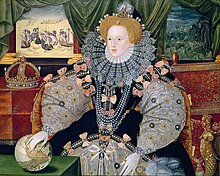
Portrait of Elizabeth I (1588)
The right to hold a weekly market and an annual fair was granted to Leatherhead in 1248 by Henry III. The market place is thought to have been at the junction of Bridge Street, North Street and High Street and the town stocks were probably in the same area. The market appears to have ended in the mid-Elizabethan era, however the annual fair continued and in the late 17th century was held on 8th September, the feast of the Nativity of Mary.
The construction of the turnpikes, and later the railways, attracted wealthier residents, many of whom had accumulated their wealth as businessmen in London and who had had no previous connection to the area. By the start of the Victorian era, these new incomers were beginning to influence the local economy. In the 1841 census, 18.5% of inhabitants were employed in agriculture-related trades, but 23.6% were employed as servants, but forty years later, the proportion employed in farming had fallen to 5.4%. As the 19th century progressed, small, family-based manufacturing firms were beginning to grow, including brick-making, milling of logs, tanning, shoemaking, malting and brewing.
Larger-scale industries arrived in Leatherhead in the first half of the 20th century. In 1928, the Rayon manufacturing company opened a factory in Ermyn Way close to the border with Ashtead parish and was replaced ten years later by the manufacturing plant for Goblin Vacuum Cleaners. Also in the 1930s, a silk-making farm and electrical cable factory were established in the town. Following WW2, Ronson, the US-based manufacturer of cigarette lighters, opened a manufacturing plant at Dorincourt, to the north of the town and relocated to Randalls Road in 1953.
Large-scale manufacturing in Leatherhead was short lived and as the 20th century progressed, the town started to attract service sector industries. Among the research institutes formerly based in the town, Leatherhead Food Research was founded in 1919 and the Central Electricity Research Laboratories (CERL) opened in 1950. Both organisations left the town in the early 2000s. The Ronson and Goblin factories closed in the early 1980s and their sites were redeveloped, in the latter case for the UK headquarters of Esso. The UK head offices of Unilever (on the site of the former CERL) and Hyundai were opened in Leatherhead in 2008 and 2020 respectively.
Modern era
Once parish industries included Ronson’s Lighters and Goblin Vacuum Cleaners. Both were used as ammunition plants in the Second World War. Most of the assembly plants pulled out of Leatherhead in the late 1970s or early 1980s, in favour of commerce, transport and distribution.
In the 1940s and 1950s Leatherhead/Ashtead was made home to a Remploy factory, which was designed to provide work for disabled people in the local area. On 22 May 2007, Remploy announced that the Leatherhead factory would close, along with 42 other sites.
In the late 1970s and early 1980s, Mole Valley District Council modernised the town, with a pedestrianised high street and a large one-way system.
In October 1985, the town was joined to the UK motorway system, when the M25 motorway was opened between Wisley and Reigate. Leatherhead became Junction 9, which has non-aligned entry/exit points on each side.
National and Local Government
UK Parliament
Leatherhead is in the Mole Valley parliamentary constituency, which has been represented in the House of Commons since 1997 by Sir Paul Beresford (Conservative). Kenneth Baker served as the local MP from 1983 to 1997 and was elevated to the House of Lords as Baron Baker of Dorking in 1997.
County Council
Councillors are elected to Surrey County Council every four years. The town is part of the ‘Leatherhead and Fetcham East’ ward.
| First Elected | Member | Ward | |
|---|---|---|---|
| 2005 | Tim Hall | Leatherhead and Fetcham East | |
District Council
Five councillors represent the town on Mole Valley District Council (the headquarters of which are in Dorking):
| Election | Member | Ward | |
|---|---|---|---|
| 2016 | Bridget Kendrick | Leatherhead North | |
| 2018 | Emma Norman | Leatherhead North | |
| 2019 | Keira Vyvyan-Robinson | Leatherhead North | |
| 2014 | Tim Ashton | Leatherhead South | |
| 2021 | Simon Moss | Leatherhead South | |
Leatherhead was an urban district until 1974. It is now part of Mole Valley District, with Dorking as the administrative centre of Mole Valley District Council. On the Mole Valley coat of arms, Dorking is represented by two cocks and Leatherhead by a swan. On the shield the wavy lines are for the River Mole, the acorns are for the district’s three parks, and the points are for the North Downs and Greensand Ridge.
Twin town
Since 2004, Leatherhead has been twinned with Triel-sur-Seine (Île-de-France, France).
Demography and housing
| Ward | Detached | Semi-detached | Terraced | Flats and apartments | Caravans/temporary/mobile homes/houseboats | Shared between households |
|---|---|---|---|---|---|---|
| Leatherhead North | 307 | 906 | 575 | 1,381 | 6 | 2 |
| Leatherhead South | 737 | 331 | 171 | 670 | 4 | 4 |
Region-wide, 28% of dwellings were detached houses and 22.6% were apartments.
| Ward | Population | Households | % Owned outright | % Owned with a loan | hectares |
|---|---|---|---|---|---|
| Leatherhead North | 7,035 | 3,177 | 19 | 31 | 617 |
| Leatherhead South | 4,281 | 1,913 | 44 | 30 | 637 |
The proportion of households who owned their home outright compares to the regional average of 35.1%. The proportion who owned their home with a loan compares to the regional average of 32.5%. The remaining % is made up of rented dwellings (plus a negligible % of households living rent-free).
Economy
 |
This article needs additional citations for verification. (January 2009)
|
Leatherhead formerly had a number of light manufacturing businesses, such as the Ronson’s lighter factory, but in and around the 1980s many closed or moved on. Recent years have seen the emergence of several industrial parks, and the town has attracted many service and headquarters operations, including well known companies.
The town has long been home to a cluster of research centres and research-focused businesses. ERA Technology Ltd is an engineering consultancy that has been in Leatherhead since the 1920s. Nearby is Leatherhead Food Research. The same area of west Leatherhead was home to the Central Electricity Research Laboratory (CERL), the main research lab for the CEGB until its dissolution in 2001.
A recently established local business cluster is that of racing cars. Lister Cars, makers of Lister Storm, Le Mans racing cars, are based in the town, and in nearby Dorking, while P1 International was founded here in 2000 by ex-Formula One World Champion Damon Hill.
The headquarters of the Police Federation of England and Wales is in Leatherhead.
Major local businesses
- AIRCOM International a provider of mobile telephone network management solutions has its headquarters in Randall’s Research Park in Leatherhead.
- CGI (formerly Logica) has had several offices on different sites in the town and is now on the Springfield Drive site.
- ERA Technology Ltd, a strategic business unit based in Leatherhead.
- ExxonMobil has several major divisions based at ExxonMobil House in Leatherhead, including its ExxonMobil Aviation and ExxonMobil Marine businesses, as well as its aviation fuels operations.
- Halliburton Company has an office in Leatherhead, with its Landmark based there.
- KBR has offices in Leatherhead, with its Granherne subsidiary based there.
- Robert Dyas, hardware chain is based in Leatherhead
- Unilever PLC has its UK and Ireland headquarters in Leatherhead at the purpose-built Unilever House – home to the following consumer brands: Bertolli, Cif, Colman’s, Domestos, Dove, Flora, Hellmann’s, Knorr, Lynx, Marmite, Persil, Radox, Sure, Surf, Toni & Guy, Tresemme, VO5 and Wall’s ice cream.
Public services
Utilities
The town gasworks were built in 1850, close to the junction of Kingston Road and Barnett Wood Lane by the Leatherhead Gas Company. The first gas was produced in February 1851 and was primarily used for street lighting, but also supplied some private houses. Until the railway was opened in 1859, coal was delivered by road from Epsom. In 1911, the Leatherhead company acquired that of Cobham and from 1929 supplied gas to Woking via a connection at Effingham Junction. In 1936, the company was acquired by the Wandsworth Gas Company and the Leatherhead gasworks closed two years later.

The Leatherhead pumping station was constructed in 1935 by the East Surrey Water Company.
The first public water supply in Leatherhead was created in 1884, when a stream-driven pumping station, capable of lifting 90,000 litres (20,000 imp gal) per hour, was constructed in Waterways Road. A second diesel-powered station was constructed alongside the first in 1935 and was later converted to electric power. The steam-powered works were demolished in 1992.
An electricity generating station was opened in Bridge Street in 1902. Initially it was capable of generating 75 kW of power, but by the time of its closure in 1941, its installed capacity was 2.2 MW. Under the Electricity (Supply) Act 1926, Leatherhead was connected to the National Grid, initially to a 33 kV supply ring, which linked the town to Croydon, Epsom, Dorking and Reigate. In 1939, the ring was connected to the Wimbledon-Woking main via a 132 kV substation at Leatherhead.
Emergency services
Leatherhead is served by these emergency services:
- Surrey Police. Dorking Police Station.
- South East Coast Ambulance Service as of 1 July 2006, is the local NHS Ambulance Services Trust.
- Leatherhead Fire Station station is in Fetcham and is operated by Surrey Fire & Rescue Service
The Vestry was responsible for organising the local fire service in the 18th and early 19th centuries. The west door of the parish church was enlarged in 1759, in order to accommodate the town fire engine, which was housed in the tower. In 1821, the engine was moved to an existing building on North Street and a new fire station was built on the same road in 1859. The first motor fire engine was delivered to the town in 1926 and was housed in a new building close to the river.
Healthcare
The nearest hospital with an A&E is Epsom Hospital, 5.3 km (3.3 mi) away. As of 2021, the town has two GP practices (on Kingston Road and Upper Fairfield Road), two dental practices and one optician.
Transport
Rail

The entrance to Leatherhead railway station.
Leatherhead railway station is to the west of the town centre and is managed by Southern. It is served by trains to London Victoria via Sutton, to London Waterloo via Wimbledon, to Horsham via Dorking and to Guildford via Bookham.
Buses
Route 32 from Dorking to Guildford via Shere and to Redhill via Earlswood is run by Compass Bus. Route 21 (Epsom – Dorking – Crawley) is run by Metrobus and route 408 (Epsom – Cobham) is run by Falcon Buses. Route 465 from Kingston upon Thames to Dorking is run by London United. Route 478 to Guildford is run by Reptons Coaches and Route 479 from Epsom to Guildford via Leatherhead is run by Arriva Kent & Sussex and Stagecoach.
Long distance footpaths
Leatherhead station is the northern terminus of the Mole Gap Trail, which rus south through Norbury Park to Dorking station.
Education
The earliest record of a school in Leatherhead is from 1596, when reference is made to a charity school for ten boys, which was probably held in the tower of the parish church. Two bequests are recorded in the 18th century to fund the salary of a schoolmaster. In 1838 a boys’ school was established in Highlands Road by the then Vicar, Benjamin Chapman, and a girls’ school followed a year later.
State schools
Leatherhead Trinity School opened in 2010, having been created by a merger of three existing schools. It traces its origins to the All Saints School, which opened in 1877 in Kingston Road. Trinity School is a primary school and educates children up to the age of eleven.
St Peter’s Roman Catholic Primary School was founded in September 1947 and was initially located next to St Peter’s Church in Garlands Road. The school’s present site in Grange Road was opened in 1958.
Therfield School was founded in Kingston Road as the County Upper Mixed Senior School in 1913. It moved to Dilston Road in 1953 and was renamed in 1964 after John de Therfield, a former lord of the manor of Paccesham, who was awarded the land in 1205 by King John.
St Andrew’s Catholic School was founded in Grange Road in 1935 by five nuns from the Order of St Andrew. The main school building was constructed in 1952 and, in 1971, the school became a co-educational comprehensive.
West Hill School is a special school for children with learning needs. It was founded in 1963.
Independent schools
Downsend School was founded in Hampstead in 1898 and moved to its current site in stages between 1918 and 1940. The school underwent a period of expansion in the late 1970s and 1980s, which included the purchase of pre-preparatory departments in Leatherhead, Ashtead and Epsom. In 2002, the school was sold by the Linford family (who had owned it since its opening) to Asquith Court Schools Ltd and it was bought by Cognita in 2006. In 2017, the school announced that it would build a new study centre to accommodate students studying for GCSEs.
St John’s School was founded in St John’s Wood in 1851 by Ashby Haslewood and moved to Leatherhead in 1872. Initially intended for the sons of poor clergymen, the school began to accept fee-paying pupils at the start of the 20th century. In 1989, girls were accepted into the sixth form and the school became fully coeducational from 2012. Several parts of the school are Grade II listed, including the library, formerly the chapel, which was built in 1876.
Places of Worship
Anglo-Saxon minster
The church mentioned in Domesday Book is thought to have been an Anglo-Saxon minster, a large church with a small team of priests who ministered to the royal vill and its dependent parishes. It is described as a belonging to Ewell and being held by Osbern of Eu, a prebend at St Paul’s Cathedral. Its location in the town is unknown, but an enclave of land in the north west of the parish is recorded as belonging to Ewell in the 13th century and this may be the remnant of the glebe lands of the former minster. The church was probably a constructed from wood and, like other similar minsters, likely lost influence as Norman manors superseded the Anglo-Saxon hundreds as the principal division of local administration.
St Mary and St Nicholas Church
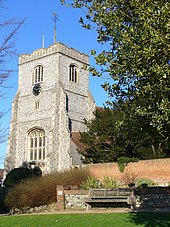
Tower of St Mary and St Nicholas Church
The Church of St Mary and St Nicholas is thought to have originally been built as the estate chapel for the manor of Thorncroft. Although it is not mentioned in Domesday book, the oldest parts date from around 1080 and it may have superseded the Anglo-Saxon minster as the parish church at the start of the 12th century. Shortly after 1100, it was granted to Colchester Abbey, which held it until 1279. The earliest parts of the building that survive are from the 1240s, when the church is thought to have undergone a major expansion that included the addition of side aisles. Much of the chancel dates from the first half of the 14th century and this work may have been commissioned by Leeds Priory in Kent, which was given the church by Edward III in 1341. The dedication to Mary and Nicholas, who were the joint patrons of the Priory, probably occurred at this time.
The tower was built in around 1500 and is set at an angle to the rest of the building, so that its east wall protrudes into the nave. It originally had a tall spire, which was blown down in the Great Storm of 1703. A major rebuilding of the church took place in the second half of the 19th century, during which much of the roof was replaced. Renovation works between 2018 and 2020, uncovered several vaults beneath the floor including one belonging to the Boulton Family who had lived at Thorncroft Manor in the 18th century.
Catholic Church of Our Lady and St Peter
The Catholic Church of Our Lady and St Peter was constructed in 1923 and was partly financed by the newspaper proprietor, Sir Edward Hulton. The Gothic Revival building was designed by Joseph Goldie and the stained glass windows were installed in the 1930s. The Stations of the Cross were designed in Caen stone by the sculptor Eric Gill.
Methodist Church

Methodist Church, Church Road
John Wesley, the founder of Methodism, visited Leatherhead only once in his lifetime. On 23 February 1791, he preached his final sermon in a house on Bull Hill, one week before his death. Despite his visit, there appears to have been no significant Methodist community in the town until the mid-19th century, when a small group of worshipers began meeting in Bridge Street. The first purpose-built place of worship, the ‘Iron Chapel’, so-named because it was primarily constructed of metal, was erected in 1887 on Church Road. The following year, the congregation numbered around 50, but grew rapidly to over 4000 by 1891. Two years later, a new brick building, the present church, was constructed. The Iron Chapel, behind the new church, remained standing and was used for the Sunday school, but was replaced in 1903 by a new hall.
Other
- Disciples Church (Calvary Chapel Leatherhead)
Culture
Theatre and cinema
Leatherhead’s theatrical history dates from at least Tudor times. In 1890 the Victoria Hall opened in High Street and presented popular melodramas. In 1910, it was converted to a picture house, putting on the new “films”, at first silent but later showing “talkies”.
In 1939, the Crescent Cinema, with over 1,000 seats, was built in Church Street. Run by a local family, it prospered until the 1960s.
Two attempts in the late 1940s to reinvent the Victoria Hall as a theatre were unsuccessful. However the basement was converted to the “Green Room Club”, and then in 1950 the theatre became home to the small “Under Thirty Theatre Group”, who had good connections with the London theatre scene. Performances in the small building often featured leading actors and became increasingly popular, even as the building itself deteriorated.
Following a public fund-raising effort, September 1969 saw the opening by Princess Margaret of a replacement facility, the Thorndike Theatre, named after Dame Sybil Thorndike. Designed by Roderick Ham, the theatre was a complete ‘cultural centre’ whose radical open walkways and exposed concrete finish are thought to have influenced the later National Theatre in London.
For 30 years, the Thorndike Theatre maintained a reputation for high quality drama, and especially for presenting ‘trial run’ pre-West End shows. However, the theatre always struggled for funding, and closed in 1997. After four years of physical dereliction, it was taken over by a religious group.
Later the Leatherhead Theatre presented regular drama and acted as a theatrical centre for the area.
Leatherhead Drama Festival
Leatherhead Drama Festival began in 2004 and is the UK’s largest drama festival of its type, in which schools and drama groups from around Surrey and beyond compete each year for the Sir Michael Caine Drama Awards, the Richard Houghton Awards and the ‘Fire & Iron’ New Writing Awards. Sir Michael Caine, patron of the festival, presents the awards, filming schedule permitting, at the Gala Awards Night each year.
Music

Siouxsie Sioux
|
|
This section needs additional citations for verification. (February 2019)
|
The band John’s Children, which included sometime frontman Marc Bolan, was formed in the town in 1963 by Andy Ellison and Chris Townson, former pupils of nearby Box Hill School.
Surrey Sound recording studio was established in 1974 by producer Nigel Gray in a former village hall in the north of the town. Early demo pieces for, among others, the Wombles and Joan Armatrading were followed, by the recording of much of the early repertoire of the Police. Other groups recording there included Godley & Creme, Siouxsie and the Banshees, Rick Astley, the Lotus Eaters, Alternative TV and Bros. The studio was sold by Gray in 1987.
Fictional references

Martian war machines. An illustration by Warwick Goble.
|
|
This section does not cite any sources. (February 2019)
|
- H. G. Wells’s novel The War of the Worlds features Leatherhead. On about the tenth day following the Martian invasion of Earth, the entire town (where the narrator has sent his wife for safety) is obliterated: “it had been destroyed, with every soul in it, by a Martian. He had swept it out of existence, as it seemed, without any provocation, as a boy might crush an ant-hill, in the mere wantonness of power.”
- In the TV series The Hitchhiker’s Guide to the Galaxy, the house that was used as Arthur Dent’s residence is in Leatherhead.
- The film I Want Candy (released 23 March 2007) has the tagline: “Two lads from Leatherhead are making a movie…and it’s all gone pear-shaped”. However, the film is not set in Leatherhead.
- That Mitchell and Webb Look took a jab at Leatherhead in series two, episode four. In it, a librarian comments to a customer that she is “possibly one of the stupidest people I’ve ever met. And I lived in Leatherhead for six miserable years.”
- Monty Python’s Flying Circus makes reference to Leatherhead in the “Red Indian in Theatre” sketch, when Eric Idle, in Native American costume says, “When moon high over prairie, when wolf howl over mountain, when mighty wind roar through Yellow Valley, we go Leatherhead Rep – block booking, upper circle – whole tribe get it on three and six each.”
- Robyn Hitchcock refers to Leatherhead in the song “Clean Steve,” immediately before the key change.
- The video game Sherlock is partially set in Leatherhead.
Sport
Leisure Centre
The Leisure Centre was opened in 1975 by the Leatherhead Urban District Council (LUDC) and was extended in the 1980s with the addition of the Mole Barn. Plans to build a new centre on the site were drawn up by Mole Valley District Council prior to 2006, but instead the facility was given a 20-month, £12.6m refit and a further extension, which was opened by the Duke of Kent in March 2011. The upgraded centre includes a redesigned reception and entrance area, a new gym, aerobics studio, sauna and play areas.
Leatherhead Football Club
There is a local football team Leatherhead F.C. (“The Tanners”) who play at Fetcham Park Grove. In the 1974–75 season the Tanners were drawn against First Division Leicester City at home in the FA Cup Fourth Round Proper. With the game switched to Filbert Street, the BBC’s Match of the Day cameras and over 32,000 people saw a dramatic match: Leicester won 3–2. Leicester City went on to play Arsenal in the next round. In the 2017–18 FA Cup they reached the second round proper where they were tied away to Wycombe Wanderers.
Tourist attractions
Bocketts Farm
Bocketts Farm covers an area of 52 ha (128 acres) to the south west of the town. Formerly part of the manor of Thorncroft, it was subinfeudated in around 1170. Both the farmhouse and the timber-framed granary date from around 1800 and are Grade II listed. The farm was purchased by the Gowing family in 1990 and was opened to the public two years later.
Leatherhead Museum

Leatherhead Museum
Leatherhead Museum was opened in 1980 by the Leatherhead & District Local History Society. It houses a wide range of historical artefacts and permanent displays explain the history of the town from its origins to the present day. Hampton Cottage, the building in Church Street in which the museum is based, dates from before 1682.
River Mole local nature reserve
The River Mole local nature reserve is a 23.3-hectare (58-acre) protected corridor that stretches along the banks for the river from Young Street (in the south) to Waterway Road in the north. It was designated in 2005 for its diversity of plant and animal species.
Notable buildings and landmarks

Cherkley Court
Cherkley Court
Cherkley Court was constructed in around 1870 for Abraham Dixon, a wealthy industrialist from the Midlands. It was substantially rebuilt after a fire in 1893 and was sold in 1910 to Max Aitken, 1st Baron Beaverbrook, the Canadian-born owner of the Daily Express. Following the death of Beaverbrook’s son in 1984, the estate was owned by the Beaverbrook Foundation until 2011, when it was sold to a consortium of private investors. Despite considerable local opposition, the house was converted to a luxury hotel, spa and golf course, which opened in 2017.
Leatherhead Institute
The Leatherhead Institute was built in 1892 and given to the town by Abraham Dixon. Dixon’s intention was to provide educational, social and recreational opportunities to local residents. During WW2, it housed the local Food and Fuel Offices. A major restoration project was completed in 1987.
Running Horse
The Running Horse pub dates back to 1403 and is one of the oldest buildings in Leatherhead. It is on the bank of the River Mole, at the southern approach to the town centre. Legend has it that Elizabeth I once spent a night at the inn when floods made the River Mole impossible to cross.
The Mansion
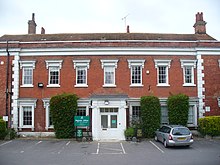
The Mansion
The Mansion, in Church Street, houses the public library, register office and council offices. The present building dates from 1739, but was partially remodelled around 1810. A map of the town from 1600 show a house on the site, which may formerly have been the manor house for the manor of Michin. During the Elizabethan and Stuart periods, the town was associated with several notable people. Edmund Tylney, Master of the Revels, who was in effect the official censor of the time to Queen Elizabeth I and who may have lived in Leatherhead Mansion. A Wetherspoons pub in High Street is now named after him.
War Memorial
The War Memorial in North Street was designed by Stock, Page and Stock, a London firm of architects and was dedicated in April 1921. It consists of a long, single-storey building with 11 open arches, constructed of brick and flint. The arches face a terraced garden, in which there is a free-standing cross made of Portland stone. The land on which the memorial stands was given to the town by CF Leach, who funded much of the building work and whose son had been a second lieutenant in the Scots Guards. In total, 186 names are inscribed on stone tablets inside the cloister-like structure, of whom 117 died in WW1. The memorial is protected by a Grade II listing.
Wesley House
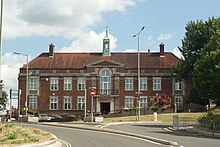
Wesley House, the former local council offices
The art-deco Wesley House, on Bull Hill, was built in 1935 as the offices of the Leatherhead Urban District Council (LUDC). It was designed by the architects CH Rose and HR Gardner and was constructed of red brick. The original council chamber is preserved at the rear of the property. Wesley house was vacated by the LUDC in 1983, when it became part of Mole Valley District Council.
The town

Leatherhead Town Bridge
Symbol
The symbol of Leatherhead is a swan holding a sword in its beak. This can be seen on the old Leatherhead coat of arms, and on the Mole Valley coat of arms. The insignia of Leatherhead Football Club includes a swan, as do the logos of the Swan Shopping Centre, Therfield School and the leisure centre.
Town centre

Bank in Leatherhead town centre
The town is above the river, and set away from the parks. Until the 1970s, it had many shops. However accidents occurred from increased traffic close to winding bends and narrow pavements. Since then the central streets have been pedestrianised or partly blocked off, leading to a decline in the number of pedestrians and shop closures in favour of out-of-town supermarkets. The construction of the Swan Centre and its supermarket, brought some revitalisation. In 2002, the high street was voted one of the worst in the United Kingdom in a BBC poll.
The theatre (see below) is also a cinema and has art exhibitions. In the late 1990s the town centre’s only hotel, the Bull Hotel, closed down and was subsequently demolished. A Lidl store was built on the site and opened in February 2007. Early in the 21st century, Travelodge opened a new hotel on the site of the old Swan Hotel.
Givons Grove
The Givons Grove estate, to the south of the town, was developed in the late 1920s and early 1930s. Originally a constituent of Thorncroft Manor, it was an area of arable land, known as ‘Gibbons Farm’, named after a prominent local family. In the late 1780s, Henry Boulton, the then leaseholder of Thorncroft Manor and the owner of the Pachesham estate, built ‘Givons Grove House’, which was occupied for a short time by Sir William Altum. The house remained in the ownership of the Boulton family until 1859 and in 1865, it was bought by Thomas Grissell, the owner of Norbury Park. In 1919, the Givons Grove estate was bought by the aircraft manufacturer, Humphrey Verdon Roe, whose wife, Marie Stopes, would live at Norbury Park for 20 years from 1938.
North Leatherhead or Leatherhead Common
North Leatherhead or Leatherhead Common is the area north of the Kingston Road Bridge, bordered to the north by Leatherhead Golf Course, Ashtead Common and the M25 motorway and to the south by the railway which forks by the town centre. It includes the town’s main secondary school, Therfield School, and part of the Trinity School, as well as the bulk of the town’s social housing.
Here is the Royal Oak pub and the North Leatherhead Community Association (NLCA) or social club in a former school building next to the Kingston Road Playing Fields and playground.
Local area
The village of Fetcham may be considered part of Leatherhead, especially as a postal area. The border with Fetcham blends into Leatherhead. Ashtead is separated from Leatherhead by the M25. Also close by are Headley Heath, Oxshott Woods, Box Hill and Bookham Common.
In the village of Headley, a military hospital, Headley Court (formerly RAF Headley Court), provides long-term rehabilitation to injured members of the British Armed Forces. Its playing fields can be used by helicopters.
Notable people
- Harold Auten VC DSC (1891–1964), recipient of the Victoria Cross during the First World War, was born in Leatherhead.
- John Drinkwater Bethune (1762–1844) lived at Thorncroft Manor just outside the town from about 1838 until his death and is buried in the churchyard of the parish church.
- Sir Thomas Bloodworth (1620–1682), Lord Mayor of London during the Great Fire of 1666, lived at Thorncroft Manor.
- Ted Bowley (1890–1974), English Test cricketer.
- Michael Caine (born 1933), lives in Leatherhead and is patron to the Leatherhead Drama Festival.
- Donald Campbell (1921–1967), Bluebird pilot and fastest man on land and water, lived in Leatherhead.
- John Campbell-Jones (1930–2020), former Formula One racing driver.
- Leonard Dawe (1889–1963), footballer, teacher and crossword compiler for the Daily Telegraph; while living in Leatherhead in 1944 he was wrongly suspected of espionage by inserting codewords for Operation Overlord into his puzzles.
- Admiral Sir John Thomas Duckworth (1747–1817), accomplished Royal Naval officer who served under Nelson.
- Andy Ellison (born 1946) and Chris Townson (1947–2008), founding members of the band John’s Children, and former pupils at Box Hill School.
- Badri Patarkatsishvili collapsed and died in his mansion in Leatherhead.
- Richard Patterson (b. 1963) and his brother Simon Patterson (b. 1967), both artists, were born in the town.
- Jean Ross (1911–1973), an English writer was educated in Leatherhead and briefly confined in a nearby sanatorium as a young woman.
- Madron Seligman (1918–2002), Member of the European Parliament and friend of Edward Heath.
- Marie Stopes (1880–1958), family planning pioneer, lived in the town.
- Edward Wilkins Waite (1854–1924) was a noted local landscape painter.