
Les Misérables is a French historical novel by Victor Hugo, first published in 1862, that is considered one of the greatest novels of the 19th century.
In the English-speaking world, the novel is usually referred to by its original French title. However, several alternatives have been used, including The Miserables, The Wretched, The Miserable Ones, The Poor Ones, The Wretched Poor, The Victims and The Dispossessed. Beginning in 1815 and culminating in the 1832 June Rebellion in Paris, the novel follows the lives and interactions of several characters, particularly the struggles of ex-convict Jean Valjean and his experience of redemption.
Examining the nature of law and grace, the novel elaborates upon the history of France, the architecture and urban design of Paris, politics, moral philosophy, antimonarchism, justice, religion, and the types and nature of romantic and familial love. Les Misérables has been popularized through numerous adaptations for film, television and the stage, including a musical.
Novel form
Upton Sinclair described the novel as “one of the half-dozen greatest novels of the world”, and remarked that Hugo set forth the purpose of Les Misérables in the Preface:
So long as there shall exist, by reason of law and custom, a social condemnation, which, in the face of civilization, artificially creates hells on earth, and complicates a destiny that is divine with human fatality; so long as the three problems of the age—the degradation of man by poverty, the ruin of women by starvation, and the dwarfing of childhood by physical and spiritual night—are not solved; so long as, in certain regions, social asphyxia shall be possible; in other words, and from a yet more extended point of view, so long as ignorance and misery remain on earth, books like this cannot be useless.
Towards the end of the novel, Hugo explains the work’s overarching structure:
The book which the reader has before him at this moment is, from one end to the other, in its entirety and details … a progress from evil to good, from injustice to justice, from falsehood to truth, from night to day, from appetite to conscience, from corruption to life; from bestiality to duty, from hell to heaven, from nothingness to God. The starting point: matter, destination: the soul. The hydra at the beginning, the angel at the end.
The novel contains various subplots, but the main thread is the story of ex-convict Jean Valjean, who becomes a force for good in the world but cannot escape his criminal past. The novel is divided into five volumes, each volume divided into several books, and subdivided into chapters, for a total of 48 books and 365 chapters. Each chapter is relatively short, commonly no longer than a few pages.
The novel as a whole is one of the longest ever written, with 655,478 words in the original French. Hugo explained his ambitions for the novel to his Italian publisher:
I don’t know whether it will be read by everyone, but it is meant for everyone. It addresses England as well as Spain, Italy as well as France, Germany as well as Ireland, the republics that harbour slaves as well as empires that have serfs. Social problems go beyond frontiers. Humankind’s wounds, those huge sores that litter the world, do not stop at the blue and red lines drawn on maps. Wherever men go in ignorance or despair, wherever women sell themselves for bread, wherever children lack a book to learn from or a warm hearth, Les Misérables knocks at the door and says: “open up, I am here for you”.
Digressions
More than a quarter of the novel—by one count 955 of 2,783 pages—is devoted to essays that argue a moral point or display Hugo’s encyclopedic knowledge but do not advance the plot, nor even a subplot, a method Hugo used in such other works as The Hunchback of Notre-Dame and Toilers of the Sea. One biographer noted that “the digressions of genius are easily pardoned”. The topics Hugo addresses include cloistered religious orders, the construction of the Paris sewers, argot, and the street urchins of Paris. The one about convents he titles “Parenthesis” to alert the reader to its irrelevance to the story line.
Hugo devotes another 19 chapters (Volume II, Book I) to an account of—and a meditation on the place in history of—the Battle of Waterloo, the battlefield which Hugo visited in 1861 and where he finished writing the novel. It opens volume 2 with such a change of subject as to seem the beginning of an entirely different work. The fact that this ‘digression’ occupies such a large part of the text demands that it be read in the context of the ‘overarching structure’ discussed above. Hugo draws his own personal conclusions, taking Waterloo to be a pivot-point in history, but definitely not a victory for the forces of reaction.
Waterloo, by cutting short the demolition of European thrones by the sword, had no other effect than to cause the revolutionary work to be continued in another direction. The slashers have finished; it was the turn of the thinkers. The century that Waterloo was intended to arrest has pursued its march. That sinister victory was vanquished by liberty.
One critic has called this “the spiritual gateway” to the novel, as its chance encounter of Thénardier and Colonel Pontmercy foreshadows so many of the novel’s encounters “blending chance and necessity”, a “confrontation of heroism and villainy”.
Even when not turning to other subjects outside his narrative, Hugo sometimes interrupts the straightforward recitation of events, his voice and control of the story line unconstrained by time and sequence. The novel opens with a statement about the bishop of Digne in 1815 and immediately shifts: “Although these details in no way essentially concern that which we have to tell…” Only after 14 chapters does Hugo pick up the opening thread again, “In the early days of the month of October, 1815…”, to introduce Jean Valjean.
Hugo’s sources
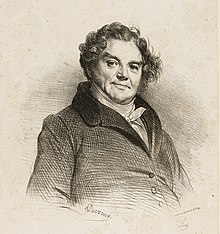
Eugène Vidocq, whose career provided a model for the character of Jean Valjean
An incident Hugo witnessed in 1829 involved three strangers and a police officer. One of the strangers was a man who had stolen a loaf of bread, similar to Jean Valjean. The officer was taking him to the coach. The thief also saw the mother and daughter playing with each other which would be an inspiration for Fantine and Cosette. Hugo imagined the life of the man in jail and the mother and daughter taken away from each other.
Valjean’s character is loosely based on the life of the ex-convict Eugène François Vidocq. Vidocq became the head of an undercover police unit and later founded France’s first private detective agency. He was also a businessman and was widely noted for his social engagement and philanthropy. Vidocq also inspired Hugo’s “Claude Gueux” and Le Dernier jour d’un condamné (The Last Day of a Condemned Man).
In 1828, Vidocq, already pardoned, saved one of the workers in his paper factory by lifting a heavy cart on his shoulders as Valjean does. Hugo’s description of Valjean rescuing a sailor on the Orion drew almost word for word on a Baron La Roncière’s letter describing such an incident. Hugo used Bienvenu de Miollis (1753–1843), the Bishop of Digne during the time in which Valjean encounters Myriel, as the model for Myriel.
Hugo had used the departure of prisoners from the Bagne of Toulon in one of his early stories, Le Dernier Jour d’un Condamné. He went to Toulon to visit the Bagne in 1839 and took extensive notes, though he did not start writing the book until 1845. On one of the pages of his notes about the prison, he wrote in large block letters a possible name for his hero: “JEAN TRÉJEAN”. When the book was finally written, Tréjean became Valjean.
In 1841, Hugo saved a prostitute from arrest for assault. He used a short part of his dialogue with the police when recounting Valjean’s rescue of Fantine in the novel. On 22 February 1846, when he had begun work on the novel, Hugo witnessed the arrest of a bread thief while a duchess and her child watched the scene pitilessly from their coach. He spent several vacations in Montreuil-sur-Mer.
During the 1832 revolt, Hugo walked the streets of Paris, saw the barricades blocking his way at points, and had to take shelter from gunfire.:173–174 He participated more directly in the 1848 Paris insurrection, helping to smash barricades and suppress both the popular revolt and its monarchist allies.:273–276
Victor Hugo drew his inspiration from everything he heard and saw, writing it down in his diary. In December 1846, he witnessed an altercation between an old woman scavenging through rubbish and a street urchin who might have been Gavroche. He also informed himself by personal inspection of the Paris Conciergerie in 1846 and Waterloo in 1861, by gathering information on some industries, and on working-class people’s wages and living standards. He asked his mistresses, Léonie d’Aunet and Juliette Drouet, to tell him about life in convents. He also slipped personal anecdotes into the plot. For instance Marius and Cosette’s wedding night (Part V, Book 6, Chapter 1) takes place on 16 February 1833, which is also the date when Hugo and his lifelong mistress Juliette Drouet made love for the first time.
Plot
Volume I: Fantine

Fantine by Margaret Hall
The story begins in 1815 in Digne, as the peasant Jean Valjean, just released from 19 years’ imprisonment in the Bagne of Toulon—five for stealing bread for his starving sister and her family and fourteen more for numerous escape attempts—is turned away by innkeepers because his yellow passport marks him as a former convict. He sleeps on the street, angry and bitter.
Digne’s benevolent Bishop Myriel gives him shelter. At night, Valjean runs off with Myriel’s silverware. When the police capture Valjean, Myriel pretends that he has given the silverware to Valjean and presses him to take two silver candlesticks as well, as if he had forgotten to take them. The police accept his explanation and leave. Myriel tells Valjean that his life has been spared for God, and that he should use money from the silver candlesticks to make an honest man of himself.
Valjean broods over Myriel’s words. When opportunity presents itself, purely out of habit, he steals a 40-sous coin from 12-year-old Petit Gervais and chases the boy away. He quickly repents and searches the city in panic for Gervais. At the same time, his theft is reported to the authorities. Valjean hides as they search for him, because if apprehended he will be returned to the galleys for life as a repeat offender.
Six years pass and Valjean, using the alias Monsieur Madeleine, has become a wealthy factory owner and is appointed mayor of Montreuil-sur-Mer. Walking down the street, he sees a man named Fauchelevent pinned under the wheels of a cart. When no one volunteers to lift the cart, even for pay, he decides to rescue Fauchelevent himself. He crawls underneath the cart, manages to lift it, and frees him. The town’s police inspector, Inspector Javert, who was an adjutant guard at the Bagne of Toulon during Valjean’s incarceration, becomes suspicious of the mayor after witnessing this remarkable feat of strength. He has known only one other man, a convict named Jean Valjean, who could accomplish it.
Years earlier in Paris, a grisette named Fantine was very much in love with Félix Tholomyès. His friends, Listolier, Fameuil, and Blachevelle were also paired with Fantine’s friends Dahlia, Zéphine, and Favourite. The men abandon the women, treating their relationships as youthful amusements. Fantine must draw on her own resources to care for her and Tholomyès’ daughter, Cosette. When Fantine arrives at Montfermeil, she leaves Cosette in the care of the Thénardiers, a corrupt innkeeper and his selfish, cruel wife.
Fantine is unaware that they are abusing her daughter and using her as forced labor for their inn, and continues to try to meet their growing, extortionate and fictitious demands. She is later fired from her job at Jean Valjean’s factory, because of the discovery of her daughter, who was born out of wedlock. Meanwhile, the Thénardiers’ monetary demands continue to grow. In desperation, Fantine sells her hair and two front teeth, and she resorts to prostitution to pay the Thénardiers. Fantine is slowly dying from an unspecified disease.
A dandy named Bamatabois harasses Fantine in the street, and she reacts by striking him. Javert arrests Fantine. She begs to be released so that she can provide for her daughter, but Javert sentences her to six months in prison. Valjean (Mayor Madeleine) intervenes and orders Javert to release her. Javert resists but Valjean prevails. Valjean, feeling responsible because his factory turned her away, promises Fantine that he will bring Cosette to her. He takes her to a hospital.
Javert comes to see Valjean again. Javert admits that after being forced to free Fantine, he reported him as Valjean to the French authorities. He tells Valjean he realizes he was wrong, because the authorities have identified someone else as the real Jean Valjean, have him in custody, and plan to try him the next day. Valjean is torn, but decides to reveal himself to save the innocent man, whose real name is Champmathieu. He travels to attend the trial and there reveals his true identity. Valjean returns to Montreuil to see Fantine, followed by Javert, who confronts him in her hospital room.
After Javert grabs Valjean, Valjean asks for three days to bring Cosette to Fantine, but Javert refuses. Fantine discovers that Cosette is not at the hospital and fretfully asks where she is. Javert orders her to be quiet, and then reveals to her Valjean’s real identity. Weakened by the severity of her illness, she falls back in shock and dies. Valjean goes to Fantine, speaks to her in an inaudible whisper, kisses her hand, and then leaves with Javert. Later, Fantine’s body is unceremoniously thrown into a public grave.
Volume II: Cosette

Portrait of “Cosette” by Emile Bayard, from the original edition of Les Misérables (1862)
Valjean escapes, is recaptured, and is sentenced to death. The king commutes his sentence to penal servitude for life. While imprisoned in the Bagne of Toulon, Valjean, at great personal risk, rescues a sailor caught in the ship’s rigging. Spectators call for his release. Valjean fakes his own death by allowing himself to fall into the ocean. Authorities report him dead and his body lost.
Valjean arrives at Montfermeil on Christmas Eve. He finds Cosette fetching water in the woods alone and walks with her to the inn. He orders a meal and observes how the Thénardiers abuse her, while pampering their own daughters Éponine and Azelma, who mistreat Cosette for playing with their doll. Valjean leaves and returns to make Cosette a present of an expensive new doll which, after some hesitation, she happily accepts. Éponine and Azelma are envious. Madame Thénardier is furious with Valjean, while her husband makes light of Valjean’s behaviour, caring only that he pay for his food and lodging.
The next morning, Valjean informs the Thénardiers that he wants to take Cosette with him. Madame Thénardier immediately accepts, while Thénardier pretends to love Cosette and be concerned for her welfare, reluctant to give her up. Valjean pays the Thénardiers 1,500 francs, and he and Cosette leave the inn. Thénardier, hoping to swindle more out of Valjean, runs after them, holding the 1,500 francs, and tells Valjean he wants Cosette back. He informs Valjean that he cannot release Cosette without a note from the child’s mother. Valjean hands Thénardier Fantine’s letter authorizing the bearer to take Cosette. Thénardier then demands that Valjean pay a thousand crowns, but Valjean and Cosette leave. Thénardier regrets that he did not bring his gun and turns back toward home.
Valjean and Cosette flee to Paris. Valjean rents new lodgings at Gorbeau House, where he and Cosette live happily. However, Javert discovers Valjean’s lodgings there a few months later. Valjean takes Cosette and they try to escape from Javert. They soon find shelter in the Petit-Picpus convent with the help of Fauchelevent, the man whom Valjean once rescued from being crushed under a cart and who has become the convent’s gardener. Valjean also becomes a gardener and Cosette becomes a student at the convent school.
Volume III: Marius
Eight years later, the Friends of the ABC, led by Enjolras, are preparing an act of anti-Orléanist civil unrest (i.e. the Paris uprising on 5–6 June 1832, following the death of General Lamarque, the only French leader who had sympathy towards the working class. Lamarque was a victim of a major cholera epidemic that had ravaged the city, particularly its poor neighborhoods, arousing suspicion that the government had been poisoning wells). The Friends of the ABC are joined by the poor of the Cour des miracles, including the Thénardiers’ eldest son Gavroche, who is a street urchin.
One of the students, Marius Pontmercy, has become alienated from his family (especially his royalist grandfather M. Gillenormand) because of his Bonapartism views. After the death of his father, Colonel Georges Pontmercy, Marius discovers a note from him instructing his son to provide help to a sergeant named Thénardier who saved his life at Waterloo—in reality Thénardier was looting corpses and only saved Pontmercy’s life by accident; he had called himself a sergeant under Napoleon to avoid exposing himself as a robber.
At the Luxembourg Garden, Marius falls in love with the now grown and beautiful Cosette. The Thénardiers have also moved to Paris and now live in poverty after losing their inn. They live under the surname “Jondrette” at Gorbeau House (coincidentally, the same building Valjean and Cosette briefly lived in after leaving the Thénardiers’ inn). Marius lives there as well, next door to the Thénardiers.
Éponine, now ragged and emaciated, visits Marius at his apartment to beg for money. To impress him, she tries to prove her literacy by reading aloud from a book and by writing “The Cops Are Here” on a sheet of paper. Marius pities her and gives her some money. After Éponine leaves, Marius observes the “Jondrettes” in their apartment through a crack in the wall. Éponine comes in and announces that a philanthropist and his daughter are arriving to visit them. In order to look poorer, Thénardier puts out the fire and breaks a chair. He also orders Azelma to punch out a window pane, which she does, resulting in cutting her hand (as Thénardier had hoped).
The philanthropist and his daughter enter—actually Valjean and Cosette. Marius immediately recognizes Cosette. After seeing them, Valjean promises them he will return with rent money for them. After he and Cosette leave, Marius asks Éponine to retrieve her address for him. Éponine, who is in love with Marius herself, reluctantly agrees to do so. The Thénardiers have also recognized Valjean and Cosette, and vow their revenge. Thénardier enlists the aid of the Patron-Minette, a well-known and feared gang of murderers and robbers.
Marius overhears Thénardier’s plan and goes to Javert to report the crime. Javert gives Marius two pistols and instructs him to fire one into the air if things get dangerous. Marius returns home and waits for Javert and the police to arrive. Thénardier sends Éponine and Azelma outside to look out for the police. When Valjean returns with rent money, Thénardier, with Patron-Minette, ambushes him and he reveals his real identity to Valjean. Marius recognizes Thénardier as the man who saved his father’s life at Waterloo and is caught in a dilemma.
He tries to find a way to save Valjean while not betraying Thénardier. Valjean denies knowing Thénardier and tells him that they have never met. Valjean tries to escape through a window but is subdued and tied up. Thénardier orders Valjean to pay him 200,000 francs. He also orders Valjean to write a letter to Cosette to return to the apartment, and they would keep her with them until he delivers the money. After Valjean writes the letter and informs Thénardier of his address, Thénardier sends out Mme. Thénardier to get Cosette. Mme. Thénardier comes back alone, and announces the address is a fake.
It is during this time that Valjean manages to free himself. Thénardier decides to kill Valjean. While he and Patron-Minette are about to do so, Marius remembers the scrap of paper that Éponine wrote on earlier. He throws it into the Thénardiers’ apartment through the wall crack. Thénardier reads it and thinks Éponine threw it inside. He, Mme. Thénardier and Patron-Minette try to escape, only to be stopped by Javert.
He arrests all the Thénardiers and Patron-Minette (except Claquesous, who escapes during his transportation to prison, and Montparnasse, who stops to run off with Éponine instead of joining in on the robbery). Valjean manages to escape the scene before Javert sees him.
Volume IV: The Idyll in the Rue Plumet and the Epic in the Rue St. Denis

Éponine prevents the robbery at Valjean’s house
After Éponine’s release from prison, she finds Marius at “The Field of the Lark” and sadly tells him that she found Cosette’s address. She leads him to Valjean’s and Cosette’s house on Rue Plumet, and Marius watches the house for a few days. He and Cosette then finally meet and declare their love for one another. Thénardier, Patron-Minette and Brujon manage to escape from prison with the aid of Gavroche (a rare case of Gavroche helping his family in their criminal activities). One night, during one of Marius’s visits with Cosette, the six men attempt to raid Valjean’s and Cosette’s house. However, Éponine, who has been sitting by the gates of the house, threatens to scream and awaken the whole neighbourhood if the thieves do not leave. Hearing this, they reluctantly retire. Meanwhile, Cosette informs Marius that she and Valjean will be leaving for England in a week’s time, which greatly troubles the pair.
The next day, Valjean is sitting in the Champ de Mars. He is feeling troubled about seeing Thénardier in the neighbourhood several times. Unexpectedly, a note lands in his lap, which says “Move Out.” He sees a figure running away in the dim light. He goes back to his house, tells Cosette they will be staying at their other house on Rue de l’Homme Arme, and reconfirms to her that they will be moving to England. Marius tries to get permission from M. Gillenormand to marry Cosette. His grandfather seems stern and angry, but has been longing for Marius’s return. When tempers flare, he refuses his assent to the marriage, telling Marius to make Cosette his mistress instead. Insulted, Marius leaves.
The following day, the students revolt and erect barricades in the narrow streets of Paris. Gavroche spots Javert and informs Enjolras that Javert is a spy. When Enjolras confronts him about this, he admits his identity and his orders to spy on the students. Enjolras and the other students tie him up to a pole in the Corinth restaurant. Later that evening, Marius goes back to Valjean’s and Cosette’s house on Rue Plumet, but finds the house no longer occupied. He then hears a voice telling him that his friends are waiting for him at the barricade. Distraught to find Cosette gone, he heeds the voice and goes.
When Marius arrives at the barricade, the revolution has already started. When he stoops down to pick up a powder keg, a soldier comes up to shoot Marius. However, a man covers the muzzle of the soldier’s gun with his hand. The soldier fires, fatally wounding the man, while missing Marius. Meanwhile, the soldiers are closing in. Marius climbs to the top of the barricade, holding a torch in one hand, a powder keg in the other, and threatens to the soldiers that he will blow up the barricade. After confirming this, the soldiers retreat from the barricade.