
Early later documented rulers and dynasties who are deemed to have ruled a portion of the Indian subcontinent are included in this list.
Chandravanshi-Haihay Rajvansh
- Chandradev
- Budh
- Maharaj Pururavas
- Maharaj Ayussu
- Maharaj Nahusha
- Maharaj Yayati
- Maharaj Yadu
- Maharajstratjit
- Maharaj Shatjit
- Maharaj Haihay —Formation of Haihayvansh—
- Maharaj Dharm
- Maharaj Dharmnetra
- Maharaj Kuntiraj
- Maharaj Sahjit
- Maharaj Mahishman
- Maharaj Bhadrasen
- Maharaj Durdabh
- Maharaj Dhanak
- Maharaj Krutvirya
- Maharaj Sahasrarjun
- Maharaj Veersen (Jaydhvaj)
- Maharaj Taljhangh
- Maharaj Vitihotra
- Maharaj Anant
- Maharaj Durjay
- Amitrakarshan
Later they were divided among different sub-castes which include Kansara, Kasera, Tamrakar, Thathera, Tambat and many more.
Magadha dynasties
This list includes the legendary kings of Magadha
- Prarikshita
- Suhotra
- Chyavana
- Kriti
- Pratipa
Brihadratha Dynasty (.c 2000-682 BCE)
- Brihadratha
(2000-1985)
- Kusaagra
(1985-1950)
- Rishabha
(1950-1890)
- Satyahita
(1890-1870)
- Pushpa
(1870-1833)
- Satershita
(1833-1800)
- Sudhanva
(1800-1710)
- Sarva
(1710-1666)
- Bhuvan
(1666-1625)
- Jarasanda
(1625-1580)
- Sahadeva
(1580-1545)
- Marjari
(1545-1501)
- Srutasrava
(1501-1430)
- Apratipa
(1430-1345)
- Niramitra
(1345-1249)
- Sukshatra
(1249-1166)
- Brihatkarma
(1166-1100)
- Syenajit
(1100-1090)
- Srutamjaya
(1090-1053)
- Mahabala
(1053-1005)
- Succhi
(1005-998)
- Kshemya
(998-943)
- Anhvrata
(943-901)
- Dharmanetra
(901-872)
- Nirvrutti
(872-818)
- Suvrata
(818-796)
- Mahasena
(796-770)
- Sumita
(770-745)
- Subala
(745-735)
- Sunetra
(735-728)
- Satyajita
(728-720)
- Viswajit
(720-699)
- Ripunjya
(699-682)
Pradyota dynasty (c. 682–544 BCE)
- Pradyota Mahasena
(682-659 BCE)
- Palaka
(659-635 BCE)
- Visakhayupa
(635-585 BCE)
- Ajaka
(585-564 BCE)
- Varttivarddhana
(564-544 BCE)
Haryanka dynasty (c. 544–413 BCE)
- Bimbisara (558–491 BCE), founder of the first Magadhan empire
- Ajatashatru (491–461 BCE)
- Udayin
(461-428 BCE)
- Anirudha
(428-419 BCE)
- Munda
(419-417 BCE)
- Darshaka
(417-415 BCE)
- Nāgadāsaka
(415-413 BCE) (last ruler of the Haryanka dynasty)
Shishunaga dynasty (c. 413–345 BCE)
- Shishunaga (412–395 BCE), king of Magadha
- Kalashoka (Kakavarna)
(395-377 BCE)
- Kshemadharman
(377-365 BCE)
- Kshatraujas
(365-355 BCE)
- Nandivardhana
(355-349 BCE)
- Mahanandin (349-345 BCE),his empire was inherited by his illegitimate son Mahapadma Nanda
Nanda dynasty (c. 345–321 BCE)
- Mahapadma Nanda (345-340 BCE), son of
Mahanandin,founded the Nanda Empire after inheriting Mahanandin’s empire
- Pandhukananda
- Panghupatinanda
- Bhutapalananda
- Rashtrapalananada
- Govishanakananda
- Dashasidkhakananda
- Kaivartananda
- Karvinatha Nand (Illegitimate son of Mahapadma Nanda)
- Dhana Nanda(330-321 BCE)
(Agrammes,Xandrammes) (until 321 BCE), lost his empire to Chandragupta Maurya after being defeated by him.
Maurya dynasty (c. 321–180 BCE)
| Ruler | Reign | Notes | |
|---|---|---|---|
| Chandragupta Maurya |  |
321–297 BCE | |
| Bindusara Amitraghata |  |
297–273 BCE | |
| Ashoka |  |
268–232 BCE | His son, Kunala, was blinded, and died before his father. Ashoka was succeeded by his grandson. |
| Dasharatha |  |
232–224 BCE | Grandson of Ashoka. |
| Samprati | 224–215 BCE | Brother of Dasharatha. | |
| Shalishuka |  |
215–202 BCE | |
| Devavarman | 202–195 BCE | ||
| Shatadhanvan | 195–187 BCE | The Mauryan Empire had shrunk by the time of his reign | |
| Brihadratha | 187–180 BCE | Assassinated by Pushyamitra Shunga | |
Shunga dynasty (c. 185–73 BCE)
- Pushyamitra Shunga (185–149 BCE), founded the dynasty after assassinating Brihadratha
- Agnimitra (149–141 BCE), son and successor of Pushyamitra
- Vasujyeshtha (141–131 BCE)
- Vasumitra (131–124 BCE)
- Andhraka (124–122 BCE)
- Pulindaka (122–119 BCE)
- Ghosha (119–116 BCE)
- Vajramitra (116–110 BCE)
- Bhagabhadra (c. 110 BCE), mentioned by the Puranas
- Devabhuti (83–73 BCE), the last Shunga king
Kanva dynasty (c. 73–26 BCE)
- Vasudeva (c. 75–66 BCE)
- Bhumimitra (c. 66–c. 52 BCE)
- Narayana (c. 52–c. 40 BCE)
- Susarman (c. 40–c. 26 BCE)
Gupta dynasty (c. 240–605 CE)
| Ruler | Reign | Notes | |
|---|---|---|---|
| Sri-Gupta I |  |
240–290 | Founder of the dynasty. |
| Ghatotkacha |  |
290–320 | |
| Chandra-Gupta I |  |
320–325 | His title Maharajadhiraja (“king of great kings”) suggests that he was the first emperor of the dynasty. It is not certain how he turned his small ancestral kingdom into an empire, although a widely accepted theory among modern historians is that his marriage to the Lichchhavi princess Kumaradevi helped him extend his political power. |
| Samudra-Gupta |  |
325–375 | Defeated several kings of northern India, and annexed their territories to his empire. He also marched along the south-eastern coast of India, advancing as far as the Pallava kingdom. In addition, he subjugated several frontier kingdoms and tribal oligarchies. His empire extended from Ravi River in the west to the Brahmaputra River in the east, and from the Himalayan foothills in the north to central India in the south-west; several rulers along the south-eastern coast were his tributaries. |
| Kacha |  |
4th-century | Rival brother/king, possibly an usurper, there are coins who attest him as ruler; possibly identical with Samudra-Gupta. |
| Rama-Gupta | 375–380 | ||
| Chandra-Gupta II Vikramaditya |  |
380–415 | Continued the expansionist policy of his father Samudragupta: historical evidence suggests that he defeated the Western Kshatrapas, and extended the Gupta empire from the Indus River in the west to the Bengal region in the east, and from the Himalayan foothills in the north to the Narmada River in the south. |
| Kumara-Gupta I | 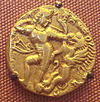 |
415–455 | He seems to have maintained control of his inherited territory, which extended from Gujarat in the west to Bengal region in the east. |
| Skanda-Gupta |  |
455–467 | It is stated that he restored the fallen fortunes of the Gupta family, which has led to suggestions that during his predecessor’s last years, the Empire may have suffered reverses, possibly against the Pushyamitras or the Hunas. He is generally considered the last of the great Gupta Emperors. |
| Puru-Gupta | 467–472 | ||
| Kumara-Gupta II Kramaditya | 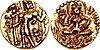 |
472–479 | |
| Buddha-Gupta |  |
479–496 | He had close ties with the rulers of Kannauj and together they sought to run the Alchon Huns (Hunas) out of the fertile plains of Northern India. |
| Narasimha-Gupta Baladitya |  |
496–530 | |
| Kumara-Gupta III | 530–540 | ||
| Vishnu-Gupta Candraditya | 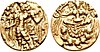 |
540–570 | |
| Bhanu-Gupta | ? | A lesser-known king with uncertain position in the list. | |
Ancient southern dynasties
Pandyan dynasty (c. 1100 BCE–1345 CE)
Central Pandyas
- Kadungkon, (c. 1100–1050 BCE)
- Pandion (c. 1050 BCE–990 BCE)
Early Pandyas
- Nedunj Cheliyan I (Aariyap Padai Kadantha Nedunj Cheliyan)
( c.990-930 BCE)
- Pudappandiyan
(c.930-885 BCE)
- Mudukudumi Paruvaludhi
(c.885-850 BCE)
- Nedunj Cheliyan II (Pasumpun Pandiyan)
(c. 850-805 BCE)
- Nan Maran
(c. 805-760 BCE)
- Nedunj Cheliyan III (Talaiyaalanganathu Seruvendra Nedunj Cheliyan )
(c. 760-720 BCE)
- Maran Valudi
(c.720-685 BCE)
- Musiri Mutriya Cheliyan
(c.685-650 BCE)
- Ukkirap Peruvaluthi
(c.650-615 BCE)
First Empire
- Kadungon (c. 600–700 CE), revived the dynasty
- Maravarman Avani Culamani (590–620)
- Cezhiyan Cendan (620–640)
- Arikesari Maravarman Nindraseer Nedumaaran (640–674)
- Kochadaiyan Ranadhiran (675–730)
- Arikesari Parankusa Maravarman Rajasinga (730–765)
- Parantaka Nedunjadaiyan (765–790)
- Rasasingan II (790–800)
- Varagunan I (800–830)
- Sirmara Srivallabha (830–862)
- Varaguna II (862–880)
- Parantaka Viranarayana (862–905)
- Rajasima Pandian II (905–920)
Pandyan Revival
- Jatavarman Sundara Pandyan (1251–1268), revived Pandyan glory, considered one of the greatest conquerors of Southern India
- Maravarman Sundara Pandyan
- Maravarman Kulasekaran I (1268–1308)
- Sundara Pandya (1308–1311), son of Maravarman Kulasekaran, fought with his brother Vira Pandya over the throne
- Vira Pandya (1308–1311), son of Maravarman Kulasekaran, fought with his brother of Sundara Pandya over the throne, Madurai was conquered by the Khalji dynasty
Pandalam dynasty (c. 1200)
- Raja Rajasekhara (c. 1200–1500), descendant of the Pandya dynasty, father of Ayyappan (often regarded as a Hindu deity)
Chera dynasty (c. 500 BCE–1124 CE)
Ancient Chera
1. Udiyancheralatan (c.500–450 BCE)
2. Antuvancheral (c.450–400 BCE)
3. Imayavaramban Nedun-Cheralatan (c.450–410 BCE)
4. Cheran Chenkutuvan (c.410–375 BCE)
5. Palyanai Sel-Kelu Kuttuvan (c.375–345 BCE)
6. Poraiyan Kadungo (c.345–300 BCE)
7. Kalankai-Kanni Narmudi Cheral (c.300–260 BCE)
8. Vel-Kelu Kuttuvan (c.260–225 BCE)
9. Selvak-Kadungo (c.225–200 BCE)
10. Adukotpattu Cheralatan (c.200–178 BCE)
11. Kuttuvan Irumporai (c.178–185 BCE)
12. Tagadur Erinda Perumcheral (c.185–145 BCE)
- Complete list of Kings were lost and last find list started with-
13. Yanaikat-sey Mantaran Cheral (201–241 CE)
14. Ilamcheral Irumporai (241–257 CE)
15. Perumkadungo (257–287 CE)
16. Ilamkadungo (287–317 CE)
17. Kanaikal Irumporai (367–397 CE)
Kulashekhara dynasty (1020–1314)
- Kulashekhara Varman (800–820), also called Kulashekhara Alwar
- Rajashekhara Varman (820–844), also called Cheraman Perumal
- Sthanu ravi Varman (844–885), contemporary of Aditya Chola
- Rama Varma Kulashekhara (885–917)
- Goda Ravi Varma (917–944)
- Indu Kotha Varma (944–962)
- Bhaskara Ravi Varman I (962–1019)
- Bhaskara Ravi Varman II (1019–1021)
- Vira Kerala (1021–1028)
- Rajasimha (1028–1043)
- Bhaskara Ravi Varman III (1043–1082)
- Rama Varman Kulashekhara (1090–1122), also called Cheraman Perumal
- Ravi Varman Kulashekhara (c. 1250–1314), last of the Cheras.
Chola dynasty (c. 600 BCE–1279 CE)
Sangam Cholas
- Ilamcetcenni
(c. 600-550 BCE)
- Karikala Chola
(c. 550-500 BCE)
- Nedunkilli
(c.500-455 BCE)
- Nalankilli
(c.455-410 BCE)
- Killivalavan
(c.410-375 BCE )
- Perunarkilli
(c.375-345 BCE)
- Kocengannan
(c.345-305 BCE)
Imperial Cholas (848–1279)
- Vijayalaya Chola (848–881)
- Aditya (871–907)
- Parantaka I (907–955)
- Gandaraditya (950–957)
- Arinjaya (956–957)
- Parantaka Chola II (957–970)
- Uttama Chola (973–985)
- Rajaraja Chola I (985–1014)
- Rajendra Chola I (1014–1018)
- Rajadhiraja Chola I (1018–1054)
- Rajendra Chola II (1054–1063)
- Virarajendra Chola (1063–1070)
- Athirajendra Chola (1067–1070)
- Kulottunga Chola I (1071–1122)
- Vikkrama Chola (1118–1135)
- Kulottunga Chola II (1133–1150)
- Rajaraja Chola II (1146–1163)
- Rajadiraja Chola II (1163–1178)
- Kulottunga Chola III (1178–1218)
- Rajaraja Chola III (1216–1246)
- Rajendra Chola III (1246–1279), last of the Cholas
Foreign invaders in north-western India
These empires were vast, centered in Persia or the Mediterranean; their satrapies (provinces) in India were at their outskirts.
- The boundaries of the Achaemenid Empire reached the Indus River.
- Alexander the Great (326–323 BCE) of the Argead dynasty who defeated Porus in the Battle of the Hydaspes River.
- Seleucus I Nicator (323–321 BCE), diadochos was defeated by Chandragupta Maurya in 305 BCE.
- The Hellenistic Euthydemid Dynasty also reached the north-western frontiers of India (c. 221–85 BCE).
- Muhammad bin Qasim (711–715), an Arab general of the Umayyad Caliphate, conquered Sindh and Balochistan and ruled these lands on behalf of the Umayyad Caliph, Al-Walid ibn Abd al-Malik
Satavahana dynasty (c. 271 BCE–220 CE)
The beginning of the Satavahana rule is dated variously from 271 BCE to 30 BCE. Satavahanas dominated the Deccan region from 1st century BCE to 3rd century CE. It lasted till the early 3rd century CE. The following Satavahana kings are historically attested by epigraphic records, although the Puranas name several more kings (see Satavahana dynasty#List of rulers):
- Simuka Satavahana (c. 230–207 BCE)
- Kanha Satavahana (c. 207–189 BCE)
- Malia Satakarni (c. 189–179 BCE)
- Purnothsanga (c. 179–161 BCE)
- Shathakarni (c. 179–133 BCE)
- Lambodara Satavahana (c. 87–67 BCE)
- Hāla (c. 20–24 CE)
- Mandalaka (c. 24–30)
- Purindrasena (c. 30–35)
- Sundara Satakarni (c. 35–36)
- Cakora Satakarni (c. 36)
- Mahendra Satkarni (c. 36–65)
- Gautamiputra Satakarni (c. 106–130)
- Vashishtiputra Pulumayi (c. 130–158)
- Vashishtiputra Satakarni (c. 158–170)
- Sri Yajna Satakarni (c. 170–199)
Vakataka dynasty (c. 250–c. 500)
- Vindhyasakti (250–270)
- Pravarasena I (270–330)
The Pravarapura-Nandivardhana branch
- Rudrasena I (330–355)
- Prithivishena I (355–380)
- Rudrasena II (380–385)
- Divakarasena (385–400)
- Prabhavatigupta (fem.), Regent (385–405)
- Damodarasena (Pravarasena II) (400–440)
- Narendrasena (440–460)
- Prithvishena II (460–480)
The Vatsagulma branch
- Sarvasena (330–355)
- Vindhyasena (Vindhyashakti II) (355–442)
- Pravarasena II (400–415)
- Unknown (415–450)
- Devasena (450–475)
- Harishena (475–500)
Indo-Scythian rulers (c. 90 BCE–45 CE)
Northwestern India (c. 90 BCE–10 CE)
- Maues (c. 85–60 BCE)
- Vonones (c. 75–65 BCE)
- Spalahores (c. 75–65 BCE)
- Spalarises (c. 60–57 BCE)
- Azes I (c. 57–35 BCE)
- Azilises (c. 57–35 BCE)
- Azes II (c. 35–12 BCE)
- Zeionises (c. 10 BCE–10 CE)
- Kharahostes (c. 10 BCE–10 CE)
- Hajatria
- Liaka Kusuluka, satrap of Chuksa
- Kusulaka Patika, satrap of Chuksa and son of Liaka Kusulaka
Mathura area (c. 20 BCE–20 CE)
- Hagamasha (satrap)
- Hagana (satrap)
- Rajuvula (Great Satrap) (c. 10 CE)
- Sodasa, son of Rajuvula
Apracharaja rulers (12 BCE–45 CE)
- Vijayamitra (12 BCE–15 CE)
- Itravasu (c. 20 CE)
- Aspavarma (15–45)
Minor local rulers
- Bhadrayasha Niggas
- Mamvadi
- Arsakes
Indo-Parthian rulers (c. 21–100)
- Gondophares I (c. 21–50)
- Abdagases I (c. 50–65)
- Satavastres (c. 60)
- Sarpedones (c. 70)
- Orthagnes (c. 70)
- Ubouzanes (c. 77)
- Sases or Gondophares II (c. 85)
- Abdagases II (c. 90)
- Pakores (c. 100)
Western Satraps (c. 35–405)
- Nahapana (119–124)
- Chashtana (c. 120)
- Rudradaman I (c. 130–150)
- Damajadasri I (170–175)
- Jivadaman (175, d. 199)
- Rudrasimha I (175–188, d. 197)
- Isvaradatta (188–191)
- Rudrasimha I (restored) (191–197)
- Jivadaman (restored) (197–199)
- Rudrasena I (200–222)
- Samghadaman (222–223)
- Damasena (223–232)
- Damajadasri II (232–239) with
- Viradaman (234–238)
- Yasodaman I (239–240)
- Yasodaman II (240)
- Vijayasena (240–250)
- Damajadasri III (251–255)
- Rudrasena II (255–277)
- Visvasimha (277–282)
- Bhartridaman (282–295) with
- Visvasena (293–304)
- Rudrasimha II (304–348) with
- Yasodaman II (317–332)
- Rudradaman II (332–348)
- Rudrasena III (348–380)
- Simhasena (380–?)
Kushana dynasty (1–225)
| Ruler | Reign | Notes | |
|---|---|---|---|
| Heraios |  |
1–30 | King or clan chief of the Kushans. Founder of the dynasty. |
| Kujula Kadphises |  |
30–80 | United the Yuezhi confederation during the 1st century, and became the first Kushan emperor. |
| Vima Takto Soter Megas |  |
80–90 | Alias The Great Saviour. His empire covered northwestern Gandhara and greater Bactria towards China, where Kushan presence has been asserted in the Tarim Basin. Under his reign, embassies were also sent to the Chinese court. |
| Vima Kadphises |  |
90–127 | The first great Kushan emperor. He introduced gold coinage, in addition to the existing copper and silver coinage. Most of the gold seems to have been obtained through trade with the Roman Empire. |
| Kanishka I the Great |  |
127–144 | Came to rule an empire in Bactria extending to Pataliputra on the Gangetic plain. His conquests and patronage of Buddhism played an important role in the development of the Silk Road, and in the transmission of Mahayana Buddhism from Gandhara across the Karakoram range to China. |
| Huvishka |  |
144–191 | His rule was a period of retrenchment and consolidation for the Empire. |
| Vasudeva I |  |
191–232 | He was the last great Kushan emperor, and the end of his rule coincides with the invasion of the Sassanians as far as northwestern India, and the establishment of the Indo-Sassanians or Kushanshahs from around 240. |
| Kanishka II |  |
232–245 | It is likely he lost part of his empire to the Kushano-Sassanians. |
| Vashishka |  |
245–250 | |
| Kanishka III |  |
250–275 | |
| Vasudeva II |  |
275–310 | |
| Chhu | 310–325 | ||
| Vasudeva III | c.300? | Kings whose existence is uncertain. | |
| Vasudeva IV | |||
| Vasudeva V | |||
| Shaka Kushan/Shaka I |  |
325–350 | |
| Kipunada |  |
350–375 | May have been a subject of Samudragupta from Gupta Empire. |
Nagas of Padmavati (early 3rd century–mid-4th century)
- Vrisha-naga alias Vrisha-bhava or Vrishabha, possibly ruled at Vidisha in the late 2nd century
- Vrishabha or Vrisha-bhava may also be the name of a distinct king who succeeded Vrisha-naga
- Bhima-naga, r. c. 210–230, probably the first king to rule from Padmavati
- Skanda-naga
- Vasu-naga
- Brihaspati-naga
- Vibhu-naga
- Ravi-naga
- Bhava-naga
- Prabhakara-naga
- Deva-naga
- Vyaghra-naga
- Ganapati-naga
Pallava dynasty (275–882)
Early Pallavas (275–355)
- Simha Varman I (King) (275–300 or 315–345)
- Skanda Varman I (Queen) (345–355)
- singh vishnu / vappdev
Middle Pallavas (355–537)
- Vishnugopa (350–355)
- Kumaravisnu I (355–370)
- Skanda Varman II (370–385)
- Vira Varman (385–400)
- Skanda Varman III (400–438)
- Simha Varman II (438–460)
- Skanda Varman IV (460–480)
- Nandi Varman I (480–500)
- Kumaravishnu II (c. 500–510)
- Buddha Varman (c. 510–520)
- Kumaravisnu III (c. 520–530)
- Simha Varman III (c. 530–537)
Later Pallavas (537–882)
- Simha Vishnu (537–570)
- Mahendra Varman I (571–630)
- Narasimha Varman I (Mamalla) (630–668)
- Mahendra Varman II (668–672)
- Paramesvara Varman I (672–700)
- Narasimha Varman II (Raja Simha) (700–728)
- Paramesvara Varman II (705–710)
- Nandi Varman II (Pallavamalla) (732–796)
- Thandi Varman (775–825)
- Nandi Varman III (825–869)
- Nirupathungan (869–882)
- Aparajitha Varman (882–901)
Kadambas of Chandravalli at Chitradurga (345–525)
- Mayurasharma (Varma) (345–365)
- Kangavarma (365–390)
- Bagitarha (390–415)
- Raghu (415–435)
- Kakusthavarma (435–455)
- Santivarma (455–460)
- Mrigeshavarma (460–480)
- Shivamandhativarma (480–485)
- Ravivarma (485–519)
- Harivarma (519–525)
- Kadambas of Goa (until 1345)
- Kadambas of Hangal (until 1347)
Western Ganga dynasty of Talakad (350–1024)
- Konganivarma Madhava (350–370)
- Madhava II (370–390)
- Harivarman (390–410)
- Vishnugopa (410–430)
- Tadangala Madhava (430–466)
- Avinita (466–495)
- Durvinita (495–535)
- Mushkara (535–585)
- Srivikrama (585–635)
- Bhuvikarma (635–679)
- Shivamara I (679–725)
- Sripurusha (725–788)
- Shivamara II (788–816)
- Rajamalla I (817–853)
- Nitimarga Ereganga (853–869)
- Rajamalla II (870–907)
- Ereyappa Nitimarga II (907–919)
- Narasimhadeva (919–925)
- Rajamalla III (925–935)
- Butuga II (935–960)
- Takkolam in (949)
- Maruladeva (960–963)
- Marasimha III (963–974)
- Rajamalla IV (974–985)
- Rakkasa Ganga (985–1024)
Maitrakas of Vallabhi (470–776 )
- Bhatarka (c. 470–c. 492)
- Dharasena I (c. 493–c. 499)
- Dronasinha (also known as Maharaja) (c. 500–c. 520)
- Dhruvasena I (c. 520–c. 550)
- Dharapatta (c. 550–c. 556)
- Guhasena (c. 556–c. 570)
- Dharasena II (c. 570–c. 595)
- Siladitya I (also known as Dharmaditya) (c. 595–c. 615)
- Kharagraha I (c. 615–c. 626)
- Dharasena III (c. 626–c. 640)
- Dhruvasena II (also known as Baladitya) (c. 640–c. 644)
- Chkravarti king Dharasena IV (also known as Param Bhatarka, Maharajadhiraja, Parameshwara) (c. 644–c. 651)
- Dhruvasena III (c. 651–c. 656)
- Kharagraha II (c. 656–c. 662)
- Siladitya II (c. 662–?)
- Siladitya III
- Siladitya IV
- Siladitya V
- Siladitya VI
- Siladitya VII (c. 766–c. 776)
Chahamana or Chauhan dynasty (500–1315 CE)
The ruling dynasties belonging to the Chauhan clan included:-
- Chahamanas of Shakambhari (Chauhans of Ajmer)
- Chahamanas of Naddula (Chauhans of Nadol)
- Chahamanas of Lata
- Chahamanas of Dholpur
- Chahamanas of Partabgarh
- Chahamanas of Jalor (Chauhans of Jalore); branched off from the Chahamanas of Naddula
- Chahamanas of Ranastambhapura (Chauhans of Ranthambore); branched off from the Chahamanas of Shakambhari.
Chahamanas of Shakambhari (500–1194)
Following is a list of Chahamana rulers of Shakambhari and Ajmer, with approximate period of reign, as estimated by R. B. Singh:
- Chahamana (c. 2nd century CE)
- Vasu-deva (c. 6th century CE)
- Samanta-raja (c. 684-709 CE); identified as the legendary Manik Rai by R. B. Singh
- Nara-deva (c. 709-721 CE)
- Ajaya-raja I (c. 721-734 CE), alias Jayaraja or Ajayapala
- Vigraha-raja I (c. 734-759 CE)
- Chandra-raja I (c. 759-771 CE)
- Gopendra-raja (c. 771-784 CE)
- Durlabha-raja I (c. 784-809 CE)
- Govinda-raja I (c. 809-836 CE), alias Guvaka I
- Chandra-raja II (c. 836-863 CE)
- Govindaraja II (c. 863-890 CE), alias Guvaka II
- Chandana-raja (c. 890-917 CE)
- Vakpati-raja (c. 917-944 CE); his younger son established the Naddula Chahamana branch
- Simha-raja (c. 944-971 CE)
- Vigraha-raja II (c. 971-998 CE)
- Durlabha-raja II (c. 998-1012 CE)
- Govinda-raja III (c. 1012-1026 CE)
- Vakpati-raja II (c. 1026-1040 CE)
- Viryarama (c. 1040 CE)
- Chamunda-raja (c. 1040-1065 CE)
- Durlabha-raja III (c. 1065-1070 CE), alias Duśala
- Vigraha-raja III (c. 1070-1090 CE), alias Visala
- Prithvi-raja I (c. 1090-1110 CE)
- Ajaya-raja II (c. 1110-1135 CE), moved the capital to Ajayameru (Ajmer)
- Arno-raja (c. 1135-1150 CE), alias Ana
- Jagad-deva (c. 1150 CE)
- Vigraha-raja IV (c. 1150-1164 CE), alias Visaladeva
- Apara-gangeya (c. 1164-1165 CE)
- Prithvi-raja II (c. 1165-1169 CE)
- Someshvara (c. 1169-1178 CE)
- Prithvi-raja III (c. 1178-1192 CE), better known as Prithviraj Chauhan
- Govinda-raja IV (c. 1192 CE); banished by Hari-raja for accepting Muslim suzerainty; established the Chahamana branch of Ranastambhapura
- Hari-raja (c. 1193-1194 CE)
Chahamanas of Naddula (c. 950–1197)
Following is a list of Chahmana rulers of Naddula, with approximate period of reign, as estimated by R. B. Singh:
- Lakshmana (c. 950-982), alias Rao Lakha or Lakhana
- Shobhita (c. 982-986)
- Baliraja (c. 986-990)
- Vigrahapala (c. 990-994)
- Mahindra (c. 994-1015), alias Mahindu or Mahendra
- Ashvapala (c. 1015-1019)
- Ahila (c. 1019-1024)
- Anahilla (c. 1024-1055)
- Balaprasada (c. 1055-1070)
- Jendraraja (c. 1070-1080)
- Prithvipala (c. 1080-1090)
- Jojalladeva (c. 1090-1110)
- Asharaja (c. 1110-1119), alias Ashvaraja
- Ratnapala (c. 1119-1132)
- Rayapala (c. 1132-1145)
- Katukaraja (c. 1145-1148)
- Alhanadeva (c. 1148-1163)
- Kelhanadeva (c. 1163-1193)
- Jayatasimha (c. 1193-1197)
Chahamanas of Jalor (1160–1311)
The Chahamana rulers of the Jalor branch, with their estimated periods of reign, are as follows:
- Kirti-pala (c. 1160-1182 CE)
- Samara-simha (c. 1182-1204 CE)
- Udaya-simha (c. 1204-1257 CE)
- Chachiga-deva (c. 1257-1282 CE)
- Samanta-simha (c. 1282-1305 CE)
- Kanhada-deva (c. 1292-1311 CE)
- Virama-deva (1311 CE); crowned during the Siege of Jalore, but died 2½ days later.
Chahamanas of Ranastambhapura (1192–1301)
- Govinda-raja (1192 CE)
- Balhana-deva or Balhan, son of Govinda
- Prahlada or Prahlad, son of Balhana
- Viranarayana or Vir Narayan, son of Prahlada
- Vagabhata, son of Balhana; known as Bahar Deo in bardic chronicles
- Jaitra-simha or Jaitra Singh
- Hammira-deva or Hammir Dev (1301 CE)
Chalukya dynasty (500–1200)
| Ruler | Reign | Capital | Notes | |
|---|---|---|---|---|
| Jayasimha I | 500–520 | Badami | Founder of the dynasty. He ruled the area around modern Bijapur in the early 6th century. | |
| Ranaraga | 520–540 | Badami | ||
| Pulakeshin I | 540–567 | Badami | He ruled parts of the present-day Maharashtra and Karnataka states in the western Deccan region of India. | |
| Kirtivarman I | 567–592 | Badami | He expanded the Chalukya kingdom by defeating the Nalas, the Mauryas of Konkana, the Kadambas, the Alupas, and the Gangas of Talakad. | |
| Mangalesha |  |
592–610 | Badami | Brother of Kirtivarman. Expanded the Chalukya power in present-day Gujarat and Maharashtra after defeating the Kalachuri king Buddharaja. He also consolidated his rule in the Konkan coastal region of Maharashtra and Goa after conquering Revati-dvipa from the rebel Chalukya governor Svamiraja. His reign ended when he lost a war of succession to his nephew Pulakeshin II, a son of Kirttivarman I. |
| Pulakeshin II |  |
610–642 | Badami | Son of Kirtivarman I, he overthrew his uncle Mangalesha to gain control of the throne. Suppressed a rebellion by Appayika and Govinda, and decisively defeated the Kadambas of Banavasi in the south. Consolidated the Chalukya control over the western coast by subjugating the Mauryas of Konkana. He was victorious against thepowerful northern emperor Harsha-vardhana. He also achieved some successes against the Pallavas in the south, but was ultimately defeated, and probably killed, during an invasion by the Pallava king Narasimhavarman I. |
| Kubja Vishnu-Vardhana I | 615/24–641 | Vengi (Eastern) | Brother of Pulakeshin II. Ruled under him as viceroy in Vengi, and then declared independence in 624. | |
| Jayasimha II | 641–673 | Vengi (Eastern) | ||
| Adityavarman | 642–645 | Badami | First son of Pulakeshin II. Probably ruled under the Pallavas. | |
| Abhinavaditya | 645–646 | Badami | Son of the predecessor. | |
| Chandraditya | 646–649 | Badami | Second son of Pulakeshin II. | |
| Vijaya-Bhattarika (regent) | 649-655 | Badami | Regent for her minor son. She was deposed by her brother-in-law. | |
| A son of Chandraditya | Badami | |||
| Vikramaditya I | 655–680 | Badami | He restored order in the fractured kingdom and made the Pallavas retreat from the capital. | |
| Indra Bhattaraka | 673 | Vengi (Eastern) | Brother of Jayasimha II. Ruled for a week. | |
| Vishnu-Vardhana II | 673–682 | Vengi (Eastern) | ||
| Vinayaditya | 680–696 | Badami | He carried campaigns against the Pallavas, Kalabhras, Haihayas, Vilas, Cholas, Pandyas, Gangas and many more. | |
| Mangi Yuvaraja | 682–706 | Vengi (Eastern) | ||
| Vijayaditya I | 696–733 | Badami | His long reign was marked by general peace and prosperity. Vijayaditya also built a number of temples. He fought against the Pallavas and extracted tributes from Parameshwar Varma V. | |
| Jayasimha III | 706–718 | Vengi (Eastern) | ||
| Kokkli | 718–719 | Vengi (Eastern) | ||
| Vishnu-Vardhana III | 719–755 | Vengi (Eastern) | ||
| Vikramaditya II |  |
733–746 | Badami | Conducted successful military campaigns against their enemy, the Pallavas of Kanchipuram, in three occasions: the first time as a crown prince, the second time as an emperor and the third time under the leadership of his son and crown prince Kirtivarman II. |
| Kirtivarman II Rahappa | 746- 757 | Badami | His reign was continuously troubled by the growing power of the Rashtrakutas and Pandyas. He finallt succumbed to the Rashtrakutas, who ended the power of the family in Badami. | |
| Vijayaditya II | 755–772 | Vengi (Eastern) | ||
| Vishnu-Vardhana IV | 755–808 | Vengi (Eastern) | ||
| Vijayaditya III | 808–847 | Vengi (Eastern) | His first military victories against the Rashtrakutas made the path for the independence of the dynasty from this occupant. | |
| Kali Vishnu-Vardhana V | 847–849 | Vengi (Eastern) | ||
| Vijayaditya IV | 849–892 | Vengi (Eastern) | Brothers, ruled together. | |
| Vikramaditya III | Vengi (Eastern) | |||
| Yuddhamalla I | Vengi (Eastern) | |||
| Bhima I | 892–921 | Vengi (Eastern) | During his rule, Vengi could claim some independence as capital from the Rashtrakutas. | |
| Vijayaditya V | 921 | Vengi (Eastern) | ||
| Amma I | 921–927 | Vengi (Eastern) | Probably brothers, ruled jointly. | |
| Vishnu-Vardhana VI | Vengi (Eastern) | |||
| Vijayaditya VI | 927 | Vengi (Eastern) | Ruled for fifteen days. | |
| Tadapa | 927 | Vengi (Eastern) | Ruled for a month. | |
| Vikramaditya IV | 927–928 | Vengi (Eastern) | ||
| Bhima II | 928–929 | Vengi (Eastern) | ||
| Yuddhamalla II | 929–935 | Vengi (Eastern) | ||
| Bhima III | 935–947 | Vengi (Eastern) | ||
| Amma II | 947–970 | Vengi (Eastern) | ||
| Danarnava | 970–973 | Vengi (Eastern) | Deposed by Jata Choda Bhima. Sought for help within the Chola Empire. | |
| Tailapa II Ahvamalla |  |
973–997 | Kalyani (Western) | 6th great-grandson of Vijayaditya I. Ousted the Rashtrakutas in the West and recovered the power once held by his family. |
| Jata Choda Bhima | 973–999 | Vengi (Eastern) | ||
| Satyashraya | 997–1008 | Kalyani (Western) | ||
| Shaktivarman I | 999–1011 | Vengi (Eastern) | First son of Danarnava. Returned from exile and recovered his throne. Now free from the usurper, however Eastern Vengi dynasty lost some of the independence they have gained some generations ago. Begin of the growing Chola influence in Vengi kingdom. | |
| Vikramaditya V | 1008–1015 | Kalyani (Western) | Nephew of Satyahraya, as son of his brother, Dashavarman. | |
| Vimaladitya | 1011–1018 | Vengi (Eastern) | Second son of Danarnava. In his exile period with his father and brother, he was married to Kundavai, daughter of Rajaraja I from the Chola Empire. | |
| Jayasimha III |  |
1015–1043 | Kalyani (Western) | He had to fight on many fronts, against the Cholas of Tanjore in the south and the Paramara dynasty in the north, to protect his kingdom. His rule however was an important period of development of Kannada literature. He saw his cousins in Vengi fall firmly into the hands of the Cholas who would use their marital relations with the Eastern Chalukyas and their over lordship over Vengi to frustrate and threaten the Western Chalukyas from two fronts, from the east and from the South. But, at the same time, he consolidated more firmly the Western Chalukya power in the Deccan. |
| Rajaraja Narendra |  |
1018–1061 | Vengi (Eastern) | Son of Vimaladitya, had support in the throne from the Cholas, whose influence grew significantly. He supported Cholas against his cousins, the Western Chalukyas. His own son managed to succeed in the Chola Empire, in 1070, as Kulottunga I, beginning the Later Cholas period, in which the Chola Empire was ruled by a branch of the Eastern Chalukyas renamed Chola. |
| Someshvara I Trilokyamalla |  |
1042–1068 | Kalyani (Western) | His several military successes in Central India made him a formidable ruler of a vast empire. During his rule, the Chalukyan empire extended to Gujarat and Central India in the north. |
| Shaktivarman II | 1061–1062 | Vengi (Eastern) | ||
| Vijayaditya VII | 1062–1075 | Vengi (Eastern) | Also son of Vimaladitya, but half-brother of Rajaraja Narendra. Ascended to the throne with support from Western Chalukyas. | |
| Someshvara II Bhuvanaikamalla |  |
1068–1076 | Kalyani (Western) | First son of Someshvara I, deposed by his younger brother, Vikramaditya. |
| Rajaraja | 1075–1079 | Vengi (Eastern) | ||
| Vikramaditya VI Tribhuvanamalla |  |
1076–1126 | Kalyani (Western) | Second son of Someshvara I. Under his reign, the Western Chalukya Empire reached its zenith. He is noted for his patronage of art and letters. His court was adorned with famous Kannada and Sanskrit poets. Intervened in Chola politics, sitting his brother-in-law, Athirajendra Chola, on the Chola Empire throne. |
| Vishnu-Vardhana VII | 1079–1102 | Vengi (Eastern) | Last known Chalukya ruler of Vengi. | |
| Someshvara III |  |
1126–1138 | Kalyani (Western) | He was a noted historian, scholar, and poet, and authored the Sanskrit encyclopedic text Manasollasa touching upon such topics as polity, governance, astronomy, astrology, rhetoric, medicine, food, architecture, painting, poetry and music: making his work a valuable modern source of socio-cultural information of the 11th- and 12th-century India. |
| Jagadhekamalla II |  |
1138–1151 | Kalyani (Western) | His rule saw the slow decline of the Chalukya empire with the loss of Vengi entirely, though he was still able to control the Hoysalas in the south and the Seuna and Paramara in the north. |
| Tailapa III | 1151–1164 | Kalyani (Western) | Faced many feudatory risings against Chalukya rule. | |
| Jagadhekamalla III | 1164–1183 | Kalyani (Western) | His rule was completely overshowded by the emergence of the Southern Kalachuris under Bijjala II who took control of Kalyani. He had to escape to the Banavasi region. | |
| Someshvara IV |  |
1183–1200 | Kalyani (Western) | Recovered his capital, by defeating the Kalachuris, but failed to prevent his old allies, Seuna, Hoysala and the Kakatiya dynasty, who, after deposing Someshvara by 1200, divided his empire among themselves. |
Shahi Kingdom (500–1026 CE)
In Kabul Shahi Kingdom two Dynasties ruled (both were Hindu dynasties) from:
- Turk Shahi (500–850 CE)
- Hindu Shahi (850–1026 CE)
Turk Shahi dynasty (500–850)
- Nandin Rulers of Gilgit (500–552)
- Khingala of Kapisa (535–552)
- Patoladeva / Navasurendradiyta (552–575)
- Srideva / Surendra Vikrmadiyta (575–605)
- Patoladeva / Vajraditya (605–645)
- Barha Tegin (645–680)
- Tegin Sha (680–739)
- Fromo Kesar / Gesar (739-755)
Hindu Shahi dynasty (850–1026)
- Samantadeva Kallar / Lalliya (850–895)
- Kamalavarmadeva / Kamaluka (895–921)
- Bhimadeva (921–964)
- Ishtthapala (ruled 8 months)
- Jayapala (964–1001)
- Anandapala (1001–1010)
- Trilochanapala (1010–22) assassinated by mutinous troops)
- Bhimapala (died in 1022–1026)
Rai dynasty (c. 524–632)
- Rai Diwa ji (Devaditya)
- Rai Sahiras (Shri Harsha)
- Rai Sahasi (Sinhasena)
- Rai Sahiras II, died battling the King of Nimroz
- Rai Sahasi II, the last of the line
Gurjara-Pratihara dynasty (550–1036)
Mandor Branch (550–880)
- Harishchandra Pratihara, (550–575)
- Rajjila Pratihara, (575–600)
- Nerabhatta Pratihara, (600–625)
- Naggabhatta Pratihara, (625–650)
- Tate Pratihara, (650–675)
- Yashovardhan, (675–700)
- Chanduka, (700–725)
- Shiluka, (725–750)
- Jhotta, (750–775)
- Bhilladhai, (775–800)
- Kake Pratihara, (800–825)
- Baauka, (825–850)
- Kakkuka, (850–880)
Bhinmala Branch (725–1036)
- Nagabhata I (725–756)
- Kakustha (756–765)
- Devaraja (765–778)
- Vatsaraja (778–805)
- Nagabhata II (800–833)
- Ramabhadra (833–836)
- Mihira Bhoja (836–890)
- Mahendrapala I (890–910)
- Bhoja II (910–913)
- Mahipala I (913–944)
- Mahendrapala II (944–948)
- Devpala (948–954)
- Vinaykpala (954–955)
- Mahipala II (955–956)
- Vijaypala II (956–960)
- Rajapala (960–1018)
- Trilochanpala (1018–1027)
- Jasapala (Yashpala) (1024–1036)
Baddoch Branch (600–700)
- Dhaddha 1 (600–627)
- Dhaddha 2 (627–655)
- Jaibhatta (655–700)
Rajogarh Branch
NOTE: Badegujar were rulers of Rajogarh
- Parmeshver Manthandev, (885–915)
- No records found after Parmeshver Manthandev
Mewar Dynasty (550–1950)
Guhila dynasty (550–1303)
- Bappaka (550–566)
- Guhaditya / Guhlia (566–580)
- Bhoja (580–602)
- Mahendra (I) (602–616)
- Nāga (616–646)
- Śiladitya (646–661 )
- Aparājita (661–697 )
- Mahendra (II) (697–728)
- Bappa Rawal / Kālabhoja (728–753)
- Khommāṇa (I) (753–773)
- Mattaṭa (773–790)
- Bhartṛipaṭṭa (I) (790–813)
- Rawalsiṃha (813–820)
- Khommāṇa (II) (820–853)
- Mahāyaka (853–885)
- Khommāṇa (III) (885–942)
- Bhartṛipaṭṭa (II) (942–943 CE)
- Allaṭa (951–953 )
- Naravāhana (953–971 )
- Śalivāhana (971–977 )
- Śaktikumāra (977–795 )
- Āmraprasāda (795–810)
- Śuchivarman (810–835)
- Naravarman (835–850)
- Kīrtivarman (850–876)
- Yogarāja (876–898)
- Vairaṭa (898–915)
- Vaṃśapāla (915–941)
- Vairisiṃha (941–955)
- Vijayasiṃha (955–993)
- Vairisiṃha (II) (993–1038)
- Arisiṃha (1038–1072)
- Choḍa (1072–1117)
- Vikramasiṃha (1117–1158)
- Raṇasiṃha (1158–1165 )
Branching of Guhil Dynasty
- Ranasingh (1158 CE) During his reign, the Guhil dynasty got divided into two branches.
- First (Rawal Branch)—Kṣemasiṃha, son of Raṇasiṃha, ruled over Mewar by building Rawal Branch.
- Second (Rana Branch)—Rahapa, the second son of Raṇasiṃha started the Rana Branch by establishing Sisoda bases. Due to his stay in Rana Sisoda hideout, he was later called Sisodia.
Post-split Rawal branch
- Kṣemasiṃha (1165–1172)
- Sāmantasiṃha (1172–1179)
- Kumārasiṃha (1179–1185)
- Mathanasiṃha (1185–1201)
- Padmasiṃha (1201–1213)
- Jaitrasiṃha (1213–1261)
- Tejasiṃha (1261–1273)
- Samarasiṃha (1273–1301)
- Ratnasiṃha (1301–1303).
Rana branch (1162–1326)
Rahapa, a son of Ranasimha alias Karna, established the Rana branch. According to the 1652 Eklingji inscription, Rahapa’s successors were:
- Rahapa/Karna (1162)
- Narapati (1185)
- Dinakara (1200)
- Jasakarna (1218)
- Nagapala (1238)
- Karnapala (1266)
- Bhuvanasimha (1280)
- Bhimasimha (1297)
- Jayasimha (1312)
- Lakhanasimha (1318)
- Arisimha (Arasi) (1322)
- Hammira (Hammir Singh)
(1326)
Sisodia Dynasty (1326-1950)
- Hammir Singh (1326–1364)
- Kshetra Singh (1364–1382)
- Lakha Singh (1382–1421)
- Mokal Singh (1421–1433)
- Rana Kumbha (1433–1468)
- Udai Singh I (1468–1473)
- Rana Raimal (1473–1508)
- Rana Sanga (1508–1527), under his rule Mewar reached its pinnacle in power and prosperity.
- Ratan Singh II (1528–1531)
- Vikramaditya Singh (1531–1536)
- Vanvir Singh (1536–1540)
- Udai Singh II (1540–1572)
- Maharana Pratap (1572–1597), 13th king of Mewar, notable for his military resistance against the Mughal Empire
- Amar Singh I (1597–1620)
- Karan Singh II (1620–1628)
- Jagat Singh I (1628–1652)
- Raj Singh I (1652–1680)
- Jai Singh (1680–1698)
- Amar Singh II (1698–1710)
- Sangram Singh II (1710–1734)
- Jagat Singh II (1734–1751)
- Pratap Singh II (1751–1754)
- Raj Singh II (1754–1762)
- Ari Singh II (1762–1772)
- Hamir Singh II (1772–1778)
- Bhim Singh (1778–1828)
- Jawan Singh (1828–1838)
- Shambhu Singh (1861–1874)
- Sajjan Singh (1874–1884)
- Fateh Singh (1884–1930)
- Bhupal Singh (1930–1947)
Gauda Kingdom (590–626)
- Shashanka (590–625), first recorded independent king of Bengal, created the first unified political entity in Bengal
- Manava (625–626), ruled for 8 months before being conquered by Harshavardana and Bhaskarvarmana
Pushyabhuti dynasty (606–647)
- Harshavardhana (606–647), unified Northern India and ruled it for over 40 years, he was the last non-Muslim emperor to rule a unified Northern India
Karkota Empire of Kashmir (625–955)
- Durlabhavardhana
(625-661)
- Durlabhaka or Pratipaditya
(661-711)
- Chandrapeeda or Varnaditya
(711-719)
- Tarapida or Udayaditya
(719-724)
- Lalitaditya Muktapida
(724-760) This Lalitaditya built the famous Martand Sun Temple in Kashmir.
- Kuvalayaditya
(760-761)
- Vajraditya or Bapyayika or Lalitapida
(761-768)
- Prithivyapida
(768-772)
- Sangramapida
(772-779)
- Jayapida (Pandit and poet)
(779-813)
- Lalitapida
(813-825)
- Sangramapida II
(825-832)
- Chipyata-Jayapida
(832-884)
- Ajitapida
(884-940)
- Anangapida
(940-943)
- Utpalapida
(943-948)
- Sukhavarma
(948-955) .
Rashtrakutas of Manyaketha (736–980)
- Dantidurga (735–756)
- Krishna I (756–774)
- Govinda II (774–780)
- Dhruva Dharavarsha (780–793)
- Govinda III (793–814)
- Amoghavarsha I (814–878)
- Krishna II Akalavarsha (878–914)
- Indra III (914–929)
- Amoghavarsha II (929–932)
- Govinda IV (930–935)
- Amoghavarsha III (934–939)
- Krishna III (939–967)
- Khottiga Amoghavarsha (967–972)
- Karka II Amoghhavarsha IV (972–973)
- Indra IV (973–982), only a claimer for the lost throne
Tomar dynasty of Delhi (736–1151)
Various historical texts provide different lists of the Tomara kings:
- Khadag Rai’s history of Gwalior (Gopācala ākhyāna) names 18 Tomara kings, plus Prithvi Pala (who is probably the Chahamana king Prithviraja III). According to Khadag Rai, Delhi was originally ruled by the legendary king Vikramaditya. It was deserted for 792 years after his death, until Bilan Dev of Tomara dynasty re-established the city (in 736 CE).
- The Kumaon-Garhwal manuscript names only 15 rulers of “Toar” dynasty, and dates the beginning of their rule to 789 CE (846 Vikram Samvat).
- Abul Fazl’s Ain-i-Akbari (Bikaner manuscript, edited by Syed Ahmad Khan) names 19 Tomara kings. It places the first Tomara king in 372 CE (429 Vikram Samvat). It might be possible that the era mentioned in the original source used by Abul Fazl was Gupta era, which starts from 318-319 CE; Abul Fazl might have mistaken this era to be Vikrama Samvat. If this is true, then the first Tomara king can be dated to 747 CE (429+318), which is better aligned with the other sources.
As stated earlier, the historians doubt the claim that the Tomaras established Delhi in 736 CE.
| # | Abul Fazl’s Ain-i-Akbari / Bikaner manuscript | Gwalior manuscript of Khadag Rai | Kumaon-Garhwal manuscript | Ascension year in CE (according to Gwalior manuscript) | Length of reign | ||
|---|---|---|---|---|---|---|---|
| Years | Months | Days | |||||
| 1 | Ananga Pāla | Bilan Dev | 736 | 18 | 0 | 0 | |
| 2 | Vasu Deva | 754 | 19 | 1 | 18 | ||
| 3 | Gangya | Ganggeva | 773 | 21 | 3 | 28 | |
| 4 | Prithivi Pāla (or Prithivi Malla) | Prathama | Mahi Pāla | 794 | 19 | 6 | 19 |
| 5 | Jaya Deva | Saha Deva | Jadu Pāla | 814 | 20 | 7 | 28 |
| 6 | Nīra Pāla or Hira Pāla | Indrajita (I) | Nai Pāla | 834 | 14 | 4 | 9 |
| 7 | Udiraj (or Adereh) | Nara Pāla | Jaya Deva Pāla | 849 | 26 | 7 | 11 |
| 8 | Vijaya (or Vacha) | Indrajita (II) | Chamra Pāla | 875 | 21 | 2 | 13 |
| 9 | Biksha (or Anek) | Vacha Raja | Bibasa Pāla | 897 | 22 | 3 | 16 |
| 10 | Rīksha Pāla | Vira Pāla | Sukla Pāla | 919 | 21 | 6 | 5 |
| 11 | Sukh Pāla (or Nek Pāla) | Go-Pāla | Teja Pāla | 940 | 20 | 4 | 4 |
| 12 | Go-Pāla | Tillan Dev | Mahi Pāla | 961 | 18 | 3 | 15 |
| 13 | Sallakshana Pāla | Suvari | Sursen | 979 | 25 | 10 | 10 |
| 14 | Jaya Pāla | Osa Pāla | Jaik Pāla | 1005 | 16 | 4 | 3 |
| 15 | Kunwar Pāla | Kumara Pāla | 1021 | 29 | 9 | 18 | |
| 16 | Ananga Pāla (or Anek Pāla) | Ananga Pāla | Anek Pāla | 1051 | 29 | 6 | 18 |
| 17 | Vijaya Pāla (or Vijaya Sah) | Teja Pāla | Teja Pāla | 1081 | 24 | 1 | 6 |
| 18 | Mahi Pāla (or Mahatsal) | Mahi Pāla | Jyūn Pāla | 1105 | 25 | 2 | 23 |
| 19 | Akr Pāla (or Akhsal) | Mukund Pāla | Ane Pāla | 1130 | 21 | 2 | 15 |
| Prithivi Raja (Chahamana) | Prithvi Pala | 1151 | |||||
Pala Empire (c. 750–1174)
Most of the Pala inscriptions mention only the regnal year as the date of issue, without any well-known calendar era. Because of this, the chronology of the Pala kings is hard to determine. Based on their different interpretations of the various epigraphs and historical records, different historians estimate the Pala chronology as follows:
| RC Majumdar (1971) | AM Chowdhury (1967) | BP Sinha (1977) | DC Sircar (1975–76) | D. K. Ganguly (1994) | |
|---|---|---|---|---|---|
| Gopala I | 750–770 | 756–781 | 755–783 | 750–775 | 750–774 |
| Dharmapala | 770–810 | 781–821 | 783–820 | 775–812 | 774–806 |
| Devapala | 810–c. 850 | 821–861 | 820–860 | 812–850 | 806–845 |
| Mahendrapala | NA (Mahendrapala’s existence was conclusively established through a copper-plate charter discovered later.) | 845–860 | |||
| Shurapala I | 850–853 | 861–866 | 860–865 | 850–858 | 860–872 |
| Vigrahapala I | 858–60 | 872–873 | |||
| Narayanapala | 854–908 | 866–920 | 865–920 | 860–917 | 873–927 |
| Rajyapala | 908–940 | 920–952 | 920–952 | 917–952 | 927–959 |
| Gopala II | 940–957 | 952–969 | 952–967 | 952–972 | 959–976 |
| Vigrahapala II | 960–c. 986 | 969–995 | 967–980 | 972–977 | 976–977 |
| Mahipala I | 988–c. 1036 | 995–1043 | 980–1035 | 977–1027 | 977–1027 |
| Nayapala | 1038–1053 | 1043–1058 | 1035–1050 | 1027–1043 | 1027–1043 |
| Vigrahapala III | 1054–1072 | 1058–1075 | 1050–1076 | 1043–1070 | 1043–1070 |
| Mahipala II | 1072–1075 | 1075–1080 | 1076–1078/9 | 1070–1071 | 1070–1071 |
| Shurapala | 1075–1077 | 1080–1082 | 1071–1072 | 1071–1072 | |
| Ramapala | 1077–1130 | 1082–1124 | 1078/9–1132 | 1072–1126 | 1072–1126 |
| Kumarapala | 1130–1125 | 1124–1129 | 1132–1136 | 1126–1128 | 1126–1128 |
| Gopala III | 1140–1144 | 1129–1143 | 1136–1144 | 1128–1143 | 1128–1143 |
| Madanapala | 1144–1162 | 1143–1162 | 1144–1161/62 | 1143–1161 | 1143–1161 |
| Govindapala | 1155–1159 | NA | 1162–1176 or 1158–1162 | 1161–1165 | 1161–1165 |
| Palapala | NA | NA | NA | 1165–1199 | 1165–1200 |
Note:
- Earlier historians believed that Vigrahapala I and Shurapala I were the two names of the same person. Now, it is known that these two were cousins; they either ruled simultaneously (perhaps over different territories) or in rapid succession.
- AM Chowdhury rejects Govindapala and his successor Palapala as the members of the imperial Pala dynasty.
- According to BP Sinha, the Gaya inscription can be read as either the “14th year of Govindapala’s reign” or “14th year after Govindapala’s reign”. Thus, two sets of dates are possible.
Seuna Yadava dynasty of Devagiri (850–1334)
- Dridhaprahara
- Seunachandra (850–874)
- Dhadiyappa (874–900)
- Bhillama I (900–925)
- Vadugi (Vaddiga) (950–974)
- Dhadiyappa II (974–975)
- Bhillama II (975–1005)
- Vesugi I (1005–1020)
- Bhillama III (1020–1055)
- Vesugi II (1055–1068)
- Bhillama III (1068)
- Seunachandra II (1068–1085)
- Airamadeva (1085–1115)
- Singhana I (1115–1145)
- Mallugi I (1145–1150)
- Amaragangeyya (1150–1160)
- Govindaraja (1160)
- Amara Mallugi II (1160–1165)
- Kaliya Ballala (1165–1173)
- Bhillama V (1173–1192), proclaimed independence from Kalyani Chalukya
- Jaitugi I (1192–1200)
- Singhana II (1200–1247)
- Kannara (1247–1261)
- Mahadeva (1261–1271)
- Amana (1271)
- Ramachandra (1271–1312)
- Singhana III (1312–1313)
- Harapaladeva (1313–1318)
- Mallugi III (1318–1334)
Paramara dynasty of Malwa (c. 9th century to 1305)
According to historial Kailash Chand Jain, “Knowledge of the early Paramara rulers from Upendra to Vairisimha is scanty; there are no records, and they are known only from later sources.” The Paramara rulers mentioned in the various inscriptions and literary sources include:
- Upendra, last quarter of 8th century, first quarter of 9th century, or first quarter of 10th century (sources vary)
- Vairisimha (I)
- Siyaka (I)
- Vakpati (I)
- Vairisimha (II), 10th century
- Siyaka (II), late 940s–972
- Vakpati (II) alias Munja, 972–990s
- Sindhuraja, 990s–1000 or 1010 (sources vary)
- Bhoja, c. 1000–1055
- Jayasimha I, 1055–1070
- Udayaditya, 1070–1086
- Lakshmadeva, c. 1086–1094
- Naravarman, 1094–1130
- Yashovarman, 1133–1142
- Jayavarman I, 1142–1143
- Interregnum under an usurper named Ballala and later the Solanki king Kumarapala
- Vindhyavarman, 1175–1194
- Subhatavarman, 1194–1209
- Arjunavarman I, 1210–1215
- Devapala, 1218–1239
- Jaitugideva, 1239–1255
- Jayavarman II, 1255–1274
- Arjunavarman II, 13th century
- Bhoja II, 13th century
- Mahalakadeva, died 1305
Chandra dynasty (900-1050)
- Traillokyachandra (900–930)
- Srichandra (930–975)
- Kalyanachandra (975–1000)
- Ladahachandra (1000–1020)
- Govindachandra
Paramaras of Chandravati (c. 910-1220)
- Utpala-raja Utpalarāja c. 910-930
- Arnno-raja, or Aranya-raja c. 930-950
- Krishna-raja Kṛṣṇarāja c. 950-979
- Dhara-varaha or Dharani-varaha c.970-990
- Dhurbhata Dhūrbhaṭa c. 990-1000
- Mahi-pala Mahīpāla c. 1000-1020 son of Dharavaraha
- Dhandhuka Dhaṃdhuka c. 1020-1040
- Punya-pala or Purna-pala c. 1040-1050
- Danti-varmman Daṃtivarmman c. 1050-1060 son of Dhandhuka
- Krishna-deva, or Krishna-raja II c. 1060-1090 son of Dhandhuka
- Kakkala-deva, or Kakala-deva c. 1090-1115
- Vikrama-simha Vikramāsiṃha c. 1115-1145
- Yasho-dhavala Yaśodhavala c. 1145-1160 great-grandson of Dantivarman through Yogaraja and Ramadeva
- Rana-simha Raṇāsiṃha ? son of Vikramasimha; possibly a regent for Dharavarsha
- Dhara-varsha Dhāravarṣa c. 1160-1220 son of Yashodhavala
Solanki dynasty or Chalukyas of Gujarat (c. 940-1244)
The Chalukya rulers of Gujarat, with approximate dates of reign, are as follows:
- Mularaja (c. 940–c. 995)
- Chamundaraja (c. 996–c. 1008)
- Vallabharaja (c. 1008)
- Durlabharaja (c. 1008–c. 1022)
- Bhima I (c. 1022–c. 1064)
- Karna (c. 1064–c. 1092)
- Jayasimha Siddharaja (c. 1092–c. 1142)
- Kumarapala (c. 1142–c. 1171)
- Ajayapala (c. 1171–c. 1175)
- Mularaja II (c. 1175–c. 1178)
- Bhima II (c. 1178–c. 1240)
- Tribhuvanapala (c. 1240–c. 1244)
Kachchhapaghata dynasty (950–1150)
Simhapaniya (Sihoniya) and Gopadri (Gwalior) branch
- Lakshmana (r. c. 950–975)
- Vajradaman (r. c. 975–1000)
- Mangalaraja (r. c. 1000–1015)
- Kirtiraja (r. c. 1015–1035)
- Muladeva (r. c. 1035–1055)
- Devapala (r. c. 1055–1085)
- Padmapala (r. c. 1085–1090)
- Mahipala (r. c. 1090–1105)
- Ratnapala (r. c. 1105–1130)
- Ajayapala (r. c. 1192–1194)
- Sulakshanapala (r. c. 1196)
Dubkund (Dobha) branch
- Yuvaraja (r. c. 1000)
- Arjuna (r. c. 1015–1035)
- Abhimanyu (r. c. 1035–1045)
- Vijayapala (r. c. 1045–1070)
- Vikramasimha (r. c. 1070–1100)
Nalapura (Narwar) branch
- Gaganasimha (r. c. 1075–1090)
- Sharadasimha (r. c. 1090–1105)
- Virasimha (r. c. 1105–1125)
- Tejaskarana (r. c. 1125–1150)
Kachwahas Dynasty (967 CE–1949 CE)
Kachwahas King Sorha Dev and Dulha Rao defeated Meena of Dhundhar Kingdom & established Kachwaha Dynasty, which ruled for more than 1000 years & still ruling in Jaipur district of Rajasthan.
Rulers
- 27 Dec 966 – 15 Dec 1006 ‘Sorha Dev’ (d. 1006)
- 15 Dec 1006 – 28 Nov 1036 ‘Dulha Rao’ (d. 1036)
- 28 Nov 1036 – 20 Apr 1039 ‘Kakil’ (d. 1039)
- 21 Apr 1039 – 28 Oct 1053 ‘Hanu’ (d. 1053)
- 28 Oct 1053 – 21 Mar 1070 ‘Janddeo’ (d. 1070)
- 22 Mar 1070 – 20 May 1094 ‘Pajjun Rai’ (d. 1094)
- 20 May 1094 – 15 Feb 1146 ‘Malayasi’ (d. 1146)
- 15 Feb 1146 – 25 Jul 1179 ‘Vijaldeo’ (d. 1179)
- 25 Jul 1179 – 16 Dec 1216 ‘Rajdeo’ (d. 1216)
- 16 Dec 1216 – 18 Oct 1276 ‘Kilhan’ (d. 1276)
- 18 Oct 1276 – 23 Jan 1317 ‘Kuntal’ (d. 1317)
- 23 Jan 1317 – 6 Nov 1366 ‘Jonsi’ (d. 1366)
- 6 Nov 1366 – 11 Feb 1388 ‘Udaikarn’ (d. 1388)
- 11 Feb 1388 – 16 Aug 1428 ‘Narsingh’ (d. 1428)
- 16 Aug 1428 – 20 Sep 1439 ‘Banbir’ (d. 1439)
- 20 Sep 1439 – 10 Dec 1467 ‘Udharn’ (d. 1467)
- 10 Dec 1467 – 17 Jan 1503 ‘Chandrasen’ (d. 1503)
- 17 Jan 1503 – 4 Nov 1527 ‘Prithviraj Singh I’ (d. 1527)
- 4 Nov 1527 – 19 Jan 1534 ‘Puranmal’ (d. 1534)
- 19 Jan 1534 – 22 Jul 1537 ‘Bhim Singh’ (d. 1537)
- 22 Jul 1537 – 15 May 1548 ‘Ratan Singh’ (d. 1548)
- 15 May 1548 – 1 June 1548 ‘Askaran’ (d. 1599)
- 1 June 1548 – 27 Jan 1574 ‘Bharmal’ (d. 1574)
- 27 Jan 1574 – 4 Dec 1589 ‘Bhagwant Das’ (b. 1527 – d. 1589)
- 4 Dec 1589 – 6 Jul 1614 ‘Man Singh’ (b. 1550 – d. 1614)
- 6 Jul 1614 – 13 Dec 1621 ‘Bhau Singh’ (d. 1621)
- 13 Dec 1621 – 28 Aug 1667 ‘Jai Singh I‘ (b. 1611 – d. 1667)
- 10 Sep 1667 – 30 Apr 1688: ‘Ram Singh I’ (b. 1640 – d. 1688)
- 30 Apr 1688 – 19 Dec 1699: ‘Bishan Singh’ (b. 1672 – d. 1699)
- 19 Dec 1699 – 21 Sep 1743: ‘Jai Singh II’ (b. 1688 – d. 1743)
- 1743 – 12 Dec 1750: ‘Ishwari Singh’ (b. 1721 – d. 1750)
- 1750 – 5 Mar 1768: ‘Madho Singh I’ (b. 1728 – d. 1768)
- 1768 – 13 Apr 1778: ‘Prithvi Singh II’ (b. c. 1762 – d. 1778)
- 1778 – 1803: ‘Pratap Singh’ (b. 1764 – d. 1803)
- 1803 – 21 Nov 1818: ‘Jagat Singh II’ (b. … – d. 1818)
- 22 Dec 1818 – 25 Apr 1819: ‘Mohan Singh’ (regent) (b. 1809 – d. …)
- 25 Apr 1819 – 6 Feb 1835: ‘Jai Singh III’ (b. 1819 – d. 1835)
- Feb 1835 – 18 Sep 1880: ‘Ram Singh II’ (b. 1835 – d. 1880)
- 18 Sep 1880 – 7 Sep 1922: ‘Madho Singh II’ (b. 1861 – d. 1922)
- 7 Sep 1922 – 15 Aug 1947 (subsidiary): ‘Sawai Man Singh II’ (b. 1912 – d. 1970)
- 15 Aug 1947 – 7 Apr 1949 (independent): ‘Sawai Man Singh II’ (b. 1912 – d. 1970)
Titular rulers
- 7 Apr 1949 – 24 Jun 1970: ‘Sawai Man Singh II’
- 24 Jun 1970 – 28 Dec 1971: ‘Sawai Bhawani Singh’ (b. 1931 – d. 2011)
Ceremonial rulers
- 28 Dec 1971 – 17 Apr 2011: ‘Sawai Bhawani Singh’ (b. 1931 – d. 2011)
- 17 Apr 2011 – present: ‘Padmanabh Singh’ (b. 1998)
Hoysala dynasty (1000–1346)
- Nripa Kama (1000–1045)
- Vinayaditya I (1045–1098)
- Ereyanga (1098–1100)
- Ballala (1100–1108)
- Vishnuvardhana (1108–1142)
- Narasimha I (1142–1173), proclaimed independence from Kalyani Chalukya
- Ballala II (1173–1220)
- Narasimha II (1220–1235)
- Vira Someshwara (1235–1253)
- Narasimha III and Ramanatha (1253–1295)
- Ballala III (1295–1342)
Sena dynasty (1070–1230)
- Hemanta Sen (1070–1096)
- Vijay Sen (1096–1159)
- Ballal Sen (1159–1179)
- Lakshman Sen (1179–1206)
- Vishwarup Sen (1206–1225)
- Keshab Sen (1225–1230)
Eastern Ganga dynasty (1078–1434)
- Anantavarman Chodaganga (1078–1147)
- Ananga Bhima Deva II (1170–1198)
- Anangabhima Deva III (1211–1238)
- Narasimha Deva I (1238–1264)
- Bhanu Deva I (1264–1279)
- Narasimha Deva II (1279–1306)
- Bhanu Deva II (1306–1328)
- Narasimha Deva III (1328–1352)
- Bhanu Deva III (1352–1378)
- Narasimha Deva IV (1378–1414)
- Bhanu Deva IV (1414–1434)
Kakatiya dynasty (1083–1323)
- Beta I (1000–1030)
- Prola I (1030–1075)
- Beta II (1075–1110)
- Prola II (1110–1158)
- Prataparudra I/Rudradeva I (1158–1195)
- Mahadeva (1195–1198). Brother of King Rudradeva
- Ganapathi deva (1199–1261)
- Rudrama Devi (1262–1296)
- Prataparudra II/ Rudradeva II (1296–1323). Grandson of Queen Rudrama
Gahadavala dynasty (1089–1197)
- Chandradeva (c. 1089-1103 CE)
- Madanapala (c. 1104-1113 CE)
- Govindachandra (c. 1114-1155 CE
- Vijayachandra (c. 1155-1169 CE), alias Vijayapala or Malladeva
- Jayachandra (c. 1170-1194 CE), called Jaichand in vernacular legends
- Harishchandra (c. 1194-1197 CE)
Kalachuris of Kalyani (1130–1184)
- Bijjala II (1130–1167), proclaimed independence from Kalyani Chalukyas in 1162
- Sovideva (1168–1176)
- Mallugi → overthrown by his brother Sankama
- Sankama (1176–1180)
- Ahavamalla (1180–83)
- Singhana (1183–84)
Chero dynasty (1174–1813)
- Ghughulia
- Raja Ramchandar Rai
- Raja Sita Ram Rai
- Raja Salabahim
- Raja Phulchand
- Raja Maharata Rai
- Raja Kumkum Chand Rai
- Raja Sambhal Rai
- Raja Bhagwant Rai (1585-1605)
- Raja Anant Rai (1605-1612)
- Raja Shambhal Rai (1612-1627)
- Raja Bhupal Rai (1637-1657)
- Maharaja Medini Rai (1658 – 1674)
- Raja Pratap Rai
- Raja Rudra Rai (1674-1680)
- Raja Dikpal Rai (1680-1697)
- Raja Saheb Rai (1697-1716)
- Raja Ranjit Rai (1716-1722)
- Raja Devi Batesh Rai
- Raja Jai Kishan Rai (1722-1770)
- Raja Chitrajeet Rai (1771-1771)
- Raja Gopal Rai (1771-1776)
- Raja Gajraj Rai (1777-1780)
- Raja Basant Rai (1780-1783)
- Raja Churaman Rai (1783-1813)
Chutia Kingdom of Assam (1187–1524)
- Birpal (1187–1224)
- Ratnadhwajpal (1224–1250)
- Vijayadhwajpal (1250–1278)
- Vikramadhwajpal (1278–1302)
- Gauradhwajpal (1302–1322)
- Sankhadhwajpal (1322–1343)
- Mayuradhwajpal (1343–1361)
- Jayadhwajpal (1361–1383)
- Karmadhwajpal (1383–1401)
- Satyanarayan (1401–1421)
- Laksminarayan (1421–1439)
- Dharmanarayan (1439–1458)
- Pratyashnarayan (1458–1480)
- Purnadhabnarayan (1480–1502)
- Dharmadhajpal (1502–1522)
- Nitypal (1522–1524)
Bana dynasty ruled over Magadaimandalam (c. 1190–1260)
Kadava dynasty (c. 1216–1279)
- Kopperunchinga I (c. 1216–1242)
- Kopperunchinga II (c. 1243–1279)
Vaghela dynasty (c. 1244–1304)
The sovereign Vaghela rulers include:
- Visala-deva (r. c. 1244–c. 1262)
- Arjuna-deva (r. c. 1262–c. 1275), son of Pratapamalla
- Rama (r. c. 1275), son of Arjunadeva
- Saranga-deva (r. c. 1275–c. 1296), son of Arjunadeva
- Karna-deva (r. c. 1296–c. 1304), son of Rama; also called Karna II to distinguish him from Karna Chaulukya
Delhi Sultanate (1206–1526)
Mamluk dynasty of Delhi (1206–1290)
- Qutb-ud-din Aibak (1206–1210)
- Aram Shah (1210–1211)
- Shams-ud-din Iltutmish (1211–1236)
- Rukn-ud-din Firuz (1236)
- Raziyyat ud din Sultana (1236–1240)
- Muiz-ud-din Bahram (1240–1242)
- Ala-ud-din Masud (1242–1246)
- Nasir-ud-din Mahmud (1246–1266)
- Ghiyas-ud-din Balban (1266–1286)
- Muiz-ud-din Qaiqabad (1286–1290)
- Shamsudin Kayumars(1290)
Khilji dynasty (1290–1320)
- Jalal ud din Firuz Khilji (1290–1296)
- Alauddin Khilji (1296–1316)
- Shihabuddin Omar Khan Khilji (1316)
- Qutb ud din Mubarak Shah Khilji (1316–1320)
- Khusro Khan khilji (1320)
Tughlaq dynasty (1321–1414)
- Ghiyasu-Din Tughluq I (1321–1325)
- Muhammad Shah Tughuluq I (1325–1351)
- Firuz Shah Tughluq (1351–1388)
- Ghiyas-ud-Din Tughluq II (1388–1389)
- Abu Bakr Shah (1389–1390)
- Muhammad Shah Tughluq III (1390–1394)
- Ala ud-din Sikandar Shah Tughluq (1394)
- Muhammad Shah Tughuluq IV (1394–1413)
After the invasion of Timur in 1398, the governor of Multan, Khizr Khan abolished the Tughluq dynasty in 1414.
Jaunpur Sultanate (1394–1479)
- Malik Sarwar 1394–1399 C.E.
- Mubarak Shah Malik Qaranfal 1399–1402
- Shams-ud-Din Ibrahim Shah Ibrahim Khan 1402–1440
- Nasir-ud-Din Mahmud Shah Mahmud Khan 1440–1457
- Muhammad Shah Bhi Khan 1457–1458
- Hussain Shah Hussain Khan 1458–1479
Sayyid dynasty (1414–1451)
- Khizr Khan (1414–1421)
- Mubarak Shah (1421–1434)
- Muhammad Shah (1434–1445)
- Alam Shah (1445–1451)
Lodi dynasty (1451–1526)
- Bahlol Khan Lodi (1451–1489)
- Sikandar Lodi (1489–1517)
- Ibrahim Lodi (1517–1526), defeated by Babur (who replaced the Delhi Sultanate with the Mughal Empire)
Bahmani Sultanate (1347–1527)
- Ala-ud-Din Bahman Mohamed bin Laden Shah (1347–1358)
- Muhammad Shah I (1358–1375)
- Ala ud din Mujahid Shah (1375–1378)
- Daud Shah I (1378)
- Muhammad Shah II (1378–1397)
- Ghiyas ud din Tahmatan Shah (1397)
- Shams ud din Daud Shah II (1397)
- Taj ud-Din Firuz Shah (1397–1422)
- Ahmad Shah I Wali (1422–1435), established his capital at Bidar
- Ala ud din Ahmad Shah II (1436–1458)
- Ala ud din Humayun Shah (1458–1461)
- Nizam-Ud-Din Ahmad III (1461–1463)
- Muhammad Shah III Lashkari (1463–1482)
- Mahmood Shah Bahmani II(1482–1518)
- Ahmad Shah IV (1518–1521)
- Ala ud din Shah (1521–1522)
- Waliullah Shah (1522–1524)
- Kalimullah Shah (1524–1527)
Malwa Sultanate (1392–1562)
Ghoris (1390–1436)
- Dilavar Khan Husain (1390–1405)
- Alp Khan Hushang (1405–1435)
- Ghazni Khan Muhammad (1435–1436)
- Mas’ud Khan (1436)
Khaljis (1436–1535)
- Mahmud Shah I (1436–1469)
- Ghiyath Shah (1469–1500)
- Nasr Shah (1500–1511)
- Mahmud Shah II (1511–1530)
Under Gujarat (1530–1534)
- Amit parsagandites (1534–1535)
Tomara dynasty of Gwalior (1375–1523)
The Tomara rulers of Gwalior include the following.
| Name in dynasty’s inscriptions (IAST) | Reign | Names in Muslim chronicles and vernacular literature |
|---|---|---|
| Vīrasiṃha-deva | c. 1375-1400 (c. 1394-1400 in Gwalior) | Virsingh Dev, Bir Singh Tomar, Bar Singh (in Yahya’s writings), Har Singh (in Badauni’s writings), Nar Singh (in Firishta’s and Nizamuddin’s writings). |
| Uddharaṇa-deva | c. 1400-1402 | Uddharan Dev, Usaran or Adharan (in Khadagrai’s writings) |
| Virāma-deva | c. 1402-1423 | Viram Dev, Biram Deo (in Yahya’s writings), Baram Deo (in Firishta’s writings) |
| Gaṇapati-deva | 1423-1425 | Ganpati Dev |
| Dungarendra-deva alias Dungara-siṃha | 1425-1459 | Dungar Singh, Dungar Sen |
| Kirtisiṃha-deva | 1459-1480 | Kirti Singh Tomar |
| Kalyāṇamalla | 1480-1486 | Kalyanmal, Kalyan Singh |
| Māna-siṃha | 1486-1516 | Mana Sahi, Man Singh |
| Vikramāditya | 1516-1523 | Vikram Sahi, Vikramjit |
Barid Shahi dynasty (1489–1619)
- Qasim Barid I 1489–1504
- Amir Barid I 1504–1542
- Ali Barid Shah I 1542–1580
- Ibrahim Barid Shah 1580–1587
- Qasim Barid Shah II 1587–1591
- Ali Barid Shah II 1591
- Amir Barid Shah II 1591–1601
- Mirza Ali Barid Shah III 1601–1609
- Amir Barid Shah III 1609–1619
Imad Shahi dynasty (1490–1572)
- Fathullah Imad-ul-Mulk (1490–1504)
- Aladdin Imad Shah (1504–1530)
- Darya Imad Shah (1530–1562)
- Burhan Imad Shah (1562–1574)
- Tufal Khan 1574
Adil Shahi dynasty (1490–1686)
- Yusuf Adil Shah (1490–1511)
- Ismail Adil Shah (1511–1534)
- Mallu Adil Shah (1534)
- Ibrahim Adil Shah I (1534–1558)
- Ali Adil Shah I (1558–1579)
- Ibrahim Adil Shah II (1580–1627)
- [[Mohammed Adil Shah, Sultan of Bijapur (1627–1657)
- Ali Adil Shah II (1657–1672)
- Sikandar Adil Shah (1672–1686)
Nizam Shahi dynasty (1490–1636)
- Malik Ahmad Nizam Shah I 1490–1510
- Burhan Nizam Shah I 1510–1553
- Hussain Nizam Shah I 1553–1565
- Murtaza Nizam Shah I 1565–1588
- Hussain Nizam Shah II 1588–1589
- Ismail Nizam Shah 1589–1591
- Burhan Nizam Shah II 1591–1595
- Ibrahim Nizam Shah 1595–1596
- Malik Ahmad Nizam Shah II 1596
- Bahadur Nizam Shah 1596–1600
- Murtaza Nizam Shah II 1600–1610
- Burhan Nizam Shah III 1610–1631
- Hussain Nizam Shah III 1631–1633
- Murtaza Nizam Shah III 1633–1636
Qadirid (1535–1555)
- Qadir Shah (1535–1542)
- Under the Mughal Empire (1542–1555)
Qutb Shahi dynasty (1518–1687)
- Sultan Quli Qutbl Mulk (1518–1543)
- Jamsheed Quli Qutb Shah (1543–1550)
- Subhan Quli Qutb Shah (1550)
- Ibrahim Quli Qutub Shah (1550–1580)
- Muhammad Quli Qutb Shah (1580–1612)
- Sultan Muhammad Qutb Shah (1612–1626)
- Abdullah Qutb Shah (1626–1672)
- Abul Hasan Qutb Shah (1672–1687)
Ahom dynasty of Assam (1228–1826)
- Sukaphaa (1228–1268)
- Suteuphaa (1268–1281)
- Subinphaa (1281–1293)
- Sukhaangphaa (1293–1332)
- Sukhrampha (1332–1364)
- Interregnum (1364–1369)
- Sutuphaa (1369–1376)
- Interregnum (1376–1380)
- Tyao Khamti (1380–1389)
- Interregnum (1389–1397)
- Sudangphaa (1397–1407)
- Sujangphaa (1407–1422)
- Suphakphaa (1422–1439)
- Susenphaa (1439–1488)
- Suhenphaa (1488–1493)
- Supimphaa (1493–1497)
- Swarganarayan (1497–1539)
- Suklenmung (1539–1552)
- Sukhaamphaa (1552–1603)
- Pratap Singha (1603–1641)
- Jayaditya Singha (1641–1644)
- Sutingphaa (1644–1648)
- Jayadhwaj Singha (1648–1663)
- Chakradhwaj Singha (1663–1670)
- Udayaaditya Singha (1670–1672)
- Ramadhwaj Singha (1672–1674)
- Suhunga (1674–1675)
- Gobar (1675–1675)
- Sujinphaa (1675–1677)
- Sudoiphaa (1677–1679)
- Ratnadhwaj Singha (1679–1681)
- Gadadhar Singha (1681–1696)
- Rudra Singha (1696–1714)
- Siba Singha (1714–1744)
- Pramatta Singha (1744–1751)
- Rajeswar Singha (1751–1769)
- Lakshmi Singha (1769–1780)
- Gaurinath Singha (1780–1795)
- Kamaleswar Singha (1795–1811)
- Chandrakanta Singha (1811–1818)
- Purandar Singha (1818–1819)
- Chandrakanta Singha (1819–1821)
- Jogeshwar Singha (1821–1822)
- Purandar Singha (1833–1838)
Manikya dynasty (c. 1400–1949)
- Maha Manikya c.1400–1431
- Dharma Manikya I 1431–1462
- Ratna Manikya I 1462–c.1487
- Pratap Manikya c.1487
- Vijaya Manikya I 1488
- Mukut Manikya 1489
- Dhanya Manikya 1490–1515
- Dhwaja Manikya 1515–1520
- Deva Manikya 1520–1530
- Indra Manikya I 1530–1532
- Vijaya Manikya II 1532–1563
- Ananta Manikya 1563–1567
- Udai Manikya 1567–1573
- Joy Manikya I 1573–1577
- Amar Manikya 1577–1585
- Rajdhar Manikya I 1586–1600
- Ishwar Manikya 1600
- Yashodhar Manikya 1600–1623
- Kalyan Manikya 1626–1660
- Govinda Manikya 1660–1661 (first reign)
- Chhatra Manikya 1661–1667
- Govinda Manikya 1667–1673 (second reign)
- Rama Manikya 1673–1685
- Ratna Manikya II 1685–1693 (first reign)
- Narendra Manikya 1693–1695
- Ratna Manikya II 1695–1712 (second reign)
- Mahendra Manikya 1712–1714
- Dharma Manikya II 1714–1725 (first reign)
- Jagat Manikya 1725–1729
- Dharma Manikya II 1729 (second reign)
- Mukunda Manikya 1729–1739
- Joy Manikya II 1739–1744
- Indra Manikya II 1744–1746
- Vijaya Manikya III 1746–1748
- Lakshman Manikya c. 1750s
- Krishna Manikya 1760–1783
- Rajdhar Manikya II 1785–1806
- Rama Ganga Manikya 1806–1809 (first reign)
- Durga Manikya 1809–1813
- Rama Ganga Manikya 1813–1826 (second reign)
- Kashi Chandra Manikya 1826–1829
- Krishna Kishore Manikya 1829–1849
- Ishan Chandra Manikya 1849–1862
- Bir Chandra Manikya 1862–1896
- Radha Kishore Manikya 1896–1909
- Birendra Kishore Manikya 1909–1923
- Bir Bikram Kishore Manikya 1923–1947
- Kirit Bikram Kishore Manikya 1947–1949
- Kirit Bikram Kishore Manikya 1949–2006 (Tripura after mergered with India)
- Pradyot Kishore Manikya 2006–Present
Baro-Bhuyan (1576-1632)
- Isa Khan
- Musa Khan (Bengal Ruler)
- Masum Khan
Musunuri Nayaks (1323–1368)
There were at least two Musunuri Nayak rulers:
- Musunuri Prolaya Nayudu (1323–1333)
- Musunuri Kapaya Nayak (1333–1368)
Reddy dynasty (1325–1548)
- Prolaya Vema Reddy (1325–1335)
- Anavota Reddy (1335–1364)
- Anavema Reddy (1364–1386)
- Kumaragiri Reddy (1386–1402)
- Kataya Vema Reddy (1395–1414)
- Allada Reddy (1414–1423)
- Veerabhadra Reddy (1423–1448)
Vijayanagara Empire (1336–1646)
Sangama dynasty (1336–1487)
- Harihara I (Deva Raya) 1336–1343
- Bukka I (1343–1379)
- Harihara II (1379–1399)
- Bukka II (1399–1406)
- Deva Raya I (1406–1412)
- Vira Vijaya (1412–1419)
- Deva Raya II (1419–1444)
- (Not known) (1444–1449)
- Mallikarjuna (1452–1465)
- Rajasekhara (1468–1469)
- Virupaksha I (1470–1471)
- Praudha Deva Raya (1476–?)
- Rajasekhara (1479–1480)
- Virupaksha II (1483–1484)
- Rajasekhara (1486–1487)
Saluva dynasty (1490–1567)
- Narasimha (1490–1503)
- Narasa (Vira Narasimha) (1503–1509)
- Achyuta (1530–1542)
- Sadasiva (1542–1567)
Tuluva dynasty (1491–1570)
- Tuluva Narasa Nayaka(1491–1503)
- Viranarasimha Raya (1503–1509)
- Krishnadevaraya (1509–1529)
- Achyuta Deva Raya (1529–1542)
- Venkata I (1542)
- Sadasiva raya (1543–1576)
Aravidu Dynasty (1542–1646)
- Aliya Rama Raya (1542–1565), regent
- Tirumala Deva Raya (1570–1572)
- Sriranga I (1572–1586)
- Venkata II (1586–1614)
- Sriranga II (1614)
- Venkata III (1630–1642)
- Sriranga III (1642-1646)
Gatti Mudalis (15th–17th century)
- Vanagamudi Gatti
- Immudi Gatti
- Gatti Mudali
Mysore
Wodeyar dynasty (first rule, 1371–1761)
- Yaduraya Wodeyar or Raja Vijaya Raj Wodeyar (1371–1423)
- Hiriya Bettada Chamaraja Wodeyar I (1423–1459)
- Thimmaraja Wodeyar I (1459–1478)
- Hiriya Chamaraja Wodeyar II (1478–1513)
- Hiriya bettada Chamaraja Wodeyar III (1513–1553)
- Thimmaraja Wodeyar II (1553–1572)
- Bola Chamaraja Wodeyar IV (1572–1576)
- Bettada Devaraja Wodeyar (1576–1578)
- Raja Wodeyar I (1578–1617)
- Chamaraja Wodeyar V (1617–1637)
- Raja Wodeyar II (1637–1638)
- (Ranadhira) Kantheerava Narasaraja Wodeyar I (1638–1659)
- Dodda Devaraja Wodeyar (1659–1673)
- Chikka Devaraja Wodeyar (1673–1704)
- Kantheerava Narasaraja Wodeyar II (1704–1714)
- Dodda Krishnaraja Wodeyar I (1714–1732)
- Chamaraja Wodeyar VI (1732–1734)
- (Immadi) Krishnaraja Wodeyar II (1734–1766), ruled under Hyder Ali from 1761
- Nanajaraja Wodeyar (1766–1772), ruled under Hyder Ali
- Bettada Chamaraja Wodeyar VII (1772–1776), ruled under Hyder Ali
- Khasa Chamaraja Wodeyar VIII (1776–1796), ruled under Hyder Ali until 1782, then under Tipu Sultan until his deposition in 1796
The reign of the Kings of Mysore (Wodeyar line) was interrupted from 1761 to 1799.
Hyder Ali’s dynasty of Mysore (1761–1799)
- Hyder Ali (1761–1782), Muslim commander deposing the Hindu Maharaja, fought the British and Nizams of Hyderabad in the first of 4 Anglo-Mysore Wars
- Tipu Sultan–(1782–1799), son of Hyder Ali, considered the greatest ruler of Mysore, assumed the novel style Badhshah Bahadur of Khudadad (thus claiming the paramountcy of India instead of the Mughal ‘mere’ Badhshah), fought the British, Marathas and Nizams of Hyderabad in the 3 Anglo-Mysore Wars (where iron rockets) were first used, allied to the French and lost.
Wodeyar dynasty (second rule, 1799–1950)
- (Mummudi) Krishnaraja Wodeyar III (1799–1868)
- Chamaraja Wodeyar IX (1868–1894)
- H.H. Vani Vilas Sannidhana, queen of Chamaraja Wodeyar IX served as regent from 1894 to 1902
- (Nalvadi) Krishnaraja Wodeyar IV (1894–1940)
- Jayachamaraja Wodeyar Bahadur (1940–1950)
Gajapati Empire (1434–1541)
- Kapilendra Deva (1434–67)
- Purushottama Deva (1467–97)
- Prataparudra Deva (1497–1540)
- Kalua Deva (1540–41)
- Kakharua Deva (1541)
Maharajas of Cochin (1503–1964)
Veerakerala Varma, nephew of Cheraman Perumal Nayanar, is supposed to have been the first king of Cochin around the 7th century. But the records we have start in 1503.
- Unniraman Koyikal I (?–1503)
- Unniraman Koyikal II (1503–1537)
- Veera Kerala Varma (1537–1565)
- Keshava Rama Varma (1565–1601)
- Veera Kerala Varma (1601–1615)
- Ravi Varma I (1615–1624)
- Veera Kerala Varma (1624–1637)
- Godavarma (1637–1645)
- Veerarayira Varma (1645–1646)
- Veera Kerala Varma (1646–1650)
- Rama Varma I (1650–1656)
- Rani Gangadharalakshmi (1656–1658)
- Rama Varma II (1658–1662)
- Goda Varma (1662–1663)
- Veera Kerala Varma (1663–1687)
- Rama Varma III (1687–1693)
- Ravi Varma II (1693–1697)
- Rama Varma IV (1697–1701)
- Rama Varma V (1701–1721)
- Ravi Varma III (1721–1731)
- Rama Varma VI (1731–1746)
- Veera Kerala Varma I (1746–1749)
- Rama Varma VII (1749–1760)
- Veera Kerala Varma II (1760–1775)
- Rama Varma VIII (1775–1790)
- Shaktan Thampuran (Rama Varma IX) (1790–1805)
- Rama Varma X (1805–1809), Vellarapalli-yil Theepetta Thampuran (King who died in “Vellarapali”)
- Veera Kerala Varma III (1809–1828), Karkidaka Maasathil Theepetta Thampuran (King who died in “karkidaka” month (Kollam Era))
- Rama Varma XI (1828–1837), Thulam-Maasathil Theepett1a Thampuran (King who died in “Thulam” month (ME))
- Rama Varma XII (1837–1844), Edava-Maasathil Theepett1a Thampuran (King who died in “Edavam” month (ME))
- Rama Varma XIII (1844–1851), Thrishur-il Theepetta Thampuran (King who died in “Thrishivaperoor” or Thrishur)
- Veera Kerala Varma IV (1851–1853), Kashi-yil Theepetta Thampuran (King who died in “Kashi” or Varanasi)
- Ravi Varma IV (1853–1864), Makara Maasathil Theepetta Thampuran (King who died in “Makaram” month (ME))
- Rama Varma XIV (1864–1888), Mithuna Maasathil Theepetta Thampuran (King who died in “Mithunam” month (ME))
- Kerala Varma V (1888–1895), Chingam Maasathil Theepetta Thampuran (King who died in “Chingam” month (ME))
- Rama Varma XV (1895–1914), a.k.a. Rajarshi, abdicated (d. in 1932)
- Rama Varma XVI (1915–1932), Madrasil Theepetta Thampuran (King who died in Madras or Chennai)
- Rama Varma XVII (1932–1941), Dhaarmika Chakravarthi (King of Dharma), Chowara-yil Theepetta Thampuran (King who died in “Chowara”)
- Kerala Varma VI (1941–1943), Midukkan (syn: Smart, expert, great) Thampuran
- Ravi Varma V (1943–1946), Kunjappan Thampuran (Brother of Midukkan Thampuran)
- Kerala Varma VII (1946–1948), Ikya-Keralam (Unified Kerala) Thampuran
- Rama Varma XVIII (1948–1964), Pareekshit Thampuran
Mughal Empire (1526–1857)
- Zahir ud din Muhammad Babur (1526–1530), descendant of Mongol conqueror Chenghiz Khan and Amir Timur , established the Mughal Empire (one of the 3 states Age of the Islamic Gunpowders) after defeating the Delhi Sultanate
- Nasir ud din Muhammad Humayun (1530–1540), temporarily lost his empire to the Afghan warrior Sher Shah Suri after being defeated by him, restored his rule after defeating Adil Shah Suri in 1556.
- Jalal ud din Muhammad Akbar (Akbar) (1556–1605), considered the greatest of all Mughals, he restored the rule of his dynasty after defeating Hemchandra Vikramaditya. He carried out the biggest expansion of the Mughal Empire in Northern India. He was known for his many victories in battle.
- Nur ud din Muhammad Jahangir (1605–1627), known in legends as Shehzada Salim. Mainly focused on the North-Eastern frontiers.
- Shahab-ud-din Shah Jahan (1627–1657), constructed the Taj Mahal, which is often regarded as one of the Seven Wonders of the World
- Muhiuddin Muhammad Aurangzeb Alamgir (1658–1707), expanded the Mughal Empire to its greatest extent, ruling over most of South Asia and Afghanistan
- Muhammad Azam Shah (1707)
- Bahadur Shah I (1707–1712)
- Jahandar Shah (1712–1713)
- Farrukh Siyar (1713–1719)
- Rafi ud Darajat (1719)
- Rafi ud Daulah (1719)
- Nikusiyar (1719)
- Muhammad Shah (first rule, 1719–1720)
- Muhammad Ibrahim (1720)
- Muhammad Shah (restored) (1720–1748)
- Ahmad Shah Bahadur (1748–1754)
- Alamgir II (1754–1759)
- Shah Jahan III (1760)
- Shah Alam II (1759–1806)
- Akbar Shah II (1806–1837)
- Bahadur Shah Zafar (1837–1857)
Suri dynasty (1540–1555)
- Sher Shah (1540–1545), seized the Mughal Empire after defeating the second Mughal Emperor Humayun
- Islam Shah Suri (1545–1554)
- Firuz Shah Suri (1554)
- Muhammad Adil Shah (1554–1555)
- Ibrahim Shah Suri (1555)
- Sikandar Shah Suri (1554–1555)
- Adil Shah Suri (1555–1556)
Chogyal rulers of Sikkim and Ladakh (1642–1975)
1. 1642–1670 Phuntsog Namgyal (1604–1670) Ascended the throne and was consecrated as the first Chogyal of Sikkim. Made the capital in Yuksom.
2. 1670–1700 Tensung Namgyal (1644–1700) Shifted capital to Rabdentse from Yuksom.
3. 1700–1717 Chakdor Namgyal (1686–1717) His half-sister Pendiongmu tried to dethrone Chakdor, who fled to Lhasa, but was reinstated as king with the help of Tibetans.
4. 1717–1734 Gyurmed Namgyal (1707–1733) Sikkim was attacked by Nepalis.
5. 1734–1780 Phuntsog Namgyal II (1734–1780) Nepalis raided Rabdentse, the then capital of Sikkim.
6. 1780–1793 Tenzing Namgyal (1769–1793) Chogyal fled to Tibet, and later died there in exile.
7. 1793–1863 Tsugphud Namgyal (1785–1863) The longest-reigning Chogyal of Sikkim. Shifted the capital from Rabdentse to Tumlong. Treaty of Titalia in 1817 between Sikkim and British India was signed in which territories lost to Nepal were appropriated to Sikkim. Darjeeling was gifted to British India in 1835. Two Britons, Dr. Arthur Campbell and Dr. Joseph Dalton Hooker were captured by the Sikkimese in 1849. Hostilities between British India and Sikkim continued and led to a treaty signed, in which Darjeeling was ceded to the British Raj.
8. 1863–1874 Sidkeong Namgyal, (1819–1874)
9. 1874–1914 Thutob Namgyal (1860–1914) John Claude White appointed as the first political officer in Sikkim in 1889. Capital shifted from Tumlong to Gangtok in 1894.
10. 1914 Sidkeong Tulku Namgyal (1879–1914) The shortest-reigning Chogyal of Sikkim, ruled from 10 February to 5 December 1914. Died of heart failure, aged 35, in most suspicious circumstances.
11. 1914–1963 Tashi Namgyal (1893–1963) Treaty between India and Sikkim was signed in 1950, giving India suzerainty over Sikkim.
12. 1963–1975 Palden Thondup Namgyal, (1923–1982)
Maratha Empire (1674–1818)
Chattrapati Shivaji Maharaj era
- Shivaji (born on 19 February 1630, crowned on 6 June 1674; and died on 3 April 1680)
- Sambhaji (1680–1689), elder son of Shivaji
- Rajaram Chhatrapati (1689–1700), younger son of Shivaji
- Tarabai, regent (1700–1707), widow of Chhatrapati Rajaram
- Shivaji II (b. 1696, ruled 1700–14); first of the Kolhapur Chhatrapatis
The Empire was divided between two branches of the family c. 1707–10; and the division was formalized in 1731.
Bhosale Chhatrapatis at Kolhapur (1700–1947)
- Shivaji II (b. 1696, ruled 1700–14)
- Sambhaji II of Kolhapur (b. 1698, r. 1714–60)
- Rajmata Jijibai of Kolhapur|Rajmata Jijibai, regent (1760–73), senior widow of Sambhaji II
- Rajmata Durgabai of Kolhapur|Rajmata Durgabai, regent (1773–79), junior widow of Sambhaji II
- Shahu Shivaji II of Kolhapur (r. 1762–1813); adopted by Jijibai, his predecessor’s senior widow
- Sambhaji III of Kolhapur (b. 1801, r. 1813–21)
- Shivaji III of Kolhapur (b. 1816, r. 1821–22) (council of regency)
- Shahaji I of Kolhapur (b. 1802, r. 1822–38)
- Shivaji IV of Kolhapur (b. 1830, r. 1838–66)
- Rajaram I of Kolhapur (r. 1866–70)
- Council of regency (1870–94)
- Shivaji V of Kolhapur (b. 1863, r. 1871–83); adopted by his predecessor’s widow
- Rajarshi Shahu IV of Kolhapur (b. 1874, r. 1884–1922); adopted by his predecessor’s widow
- Rajaram II of Kolhapur (b. 1897 r. 1922–40)
- Indumati Tarabai of Kolhapur, regent (1940–47), widow of Rajaram II
- Shivaji VI of Kolhapur (b. 1941, r. 1941–46); adopted by his predecessor’s widow
- Shahaji II of Kolhapur (b. 1910, r. 1947, d. 1983); formerly Maharaja of Dewas Senior; adopted by Indumati Tarabai, widow of Rajaram II
The state acceded unto the Dominion of India following the independence of India in 1947.
Bhosale Chhatrapatis at Satara (1707–1839)
- Shahu I (1708–1749). Son of Sambhaji I.
- Ramaraja (1749–1777). Grandson of Rajaram and Tarabai; adopted son of Shahu I.
- Shahu II of Satara (1777–1808). Son of Ramaraja.
- Pratapsinh (1808–1839)
- Shahaji III (1839–1848)
- Pratapsinh I (adopted)
- Rajaram III
- Pratapsinh II
- Raja Shahu III (1918–1950)
The Peshwas (1713–1858)
Technically they were not monarchs, but hereditary prime ministers, though in fact they ruled instead of the Chhatrapati (Maratha emperor) after death of Chattrapati Shahu, and were hegemon of the Maratha confederation.
- Balaji Vishwanath (1713–2 April 1720) (b. 1660, died 2 April 1720)
- Peshwa Bajirao I (17 April 1720 – 28 April 1740) (b. 18 August 1700, died 28 April 1740)
- Balaji Bajirao (4 July 1740 – 23 June 1761) (b. 8 December 1721, d. 23 June 1761)
- Madhavrao Ballal (1761–18 November 1772) (b. 16 February 1745, d. 18 November 1772)
- Narayanrao Bajirao (13 Dec 1772–30 August 1773) (b. 10 August 1755, d. 30 August 1773)
- Raghunath Rao Bajirao (5 Dec 1773–1774) (b. 18 August 1734, d. 11 December 1783)
- Sawai Madhavrao (1774–27 October 1795) (b. 18 April 1774, d. 27 October 1795)
- Baji Rao II (6 Dec 1796–3 June 1818) (d. 28 January 1851)
- Nana Sahib (1 July 1857 – 1858) (b. 19 May 1825, d. 24 September 1859)
Bhosale Maharajas of Thanjavur (?–1799)
Descended from a brother of Shivaji; ruled independently and had no formal relationship with the Maratha Empire.
- Ekoji I
- Shahuji I of Thanjavur
- Serfoji I
- Tukkoji
- Ekoji II
- Sujanbai
- Shahuji II of Thanjavur
- Pratapsingh of Thanjavur (r. 1737–63)
- Tulojirao Bhonsle of Thanjavur (b. 1738, r. 1763–87), elder son of Pratapasimha
- Serfoji II of Thanjavur (r. 1787–93 & 1798–99, d. 1832); adoptive son of Tuloji Bhonsle
- Ramaswami Amarasimha Bhonsle (r. 1793–98); younger son of Pratapasimha
The state was annexed by the British in 1799.
Bhosale Maharajas of Nagpur (1799–1881)
- Raghoji I (1738–1755)
- Janoji (1755–1772)
- Sabaji (1772–1775)
- Mudhoji I (1775–1788)
- Raghoji II (1788–1816)
- Parsoji Bhonsle (1800–1850
)
- Mudhoji II (1816–1818)
- Raghoji III (1818–1853)
- The kingdom was annexed by the British on 13 March 1854 under the Doctrine of Lapse.
Holkar rulers of Indore (1731–1948)
- Malharrao Holkar (I) (r. 2 November 1731 – 19 May 1766)
- Malerao Khanderao Holkar (r. 23 August 1766 – 5 April 1767)
- Punyaslok Rajmata Ahilyadevi Holkar (r. 5 April 1767 – 13 August 1795)
- Tukojirao Holkar (I) (r. 13 August 1795 – 29 January 1797)
- Kashirao Tukojirao Holkar (r. 29 January 1797 – 1798)
- Yashwantrao Holkar (I) (r. 1798–27 November 1811)
- Malharrao Yashwantrao Holkar II (r. November 1811–27 October 1833)
- Martandrao Malharrao Holkar (r. 17 January 1834 – 2 February 1834)
- Harirao Vitthojirao Holkar (r. 17 April 1834 – 24 October 1843)
- Khanderao Harirao Holkar II (r. 13 November 1843 – 17 February 1844)
- Tukojirao Gandharebhau Holkar II (r. 27 June 1844 – 17 June 1886)
- Shivajirao Tukojirao Holkar (r. 17 June 1886 – 31 January 1903)
- Tukojirao Shivajirao Holkar III (r. 31 January 1903 – 26 February 1926)
- Yashwantrao Holkar II (r. 26 February 1926 – 1961)
Following the independence of India in 1947, the state acceded unto the Dominion of India. The monarchy was ended in 1948, but the title is still held by Usha Devi Maharaj Sahiba Holkar XV Bahadur, Maharani of Indore since 1961.
Scindia of Gwalior (1731–1947)
- Ranojirao Scindia (1731–19 July 1745)
- Jayapparao Scindia (1745–25 July 1755)
- Jankojirao I Scindia (25 July 1755 – 15 January 1761). Born 1745
- Meharban Dattaji Rao Scindia, Regent (1755–10 January 1760). Died 1760
- Vacant 15 January 1761–25 November 1763
- Kedarjirao Scindia (25 November 1763 – 10 July 1764)
- Manajirao Scindia Phakade (10 July 1764 – 18 January 1768)
- Mahadaji Scindia (18 January 1768 – 12 February 1794). Born c. 1730, died 1794
- Daulatrao Scindia (12 February 1794 – 21 March 1827). Born 1779, died 1827
- Jankoji Rao Scindia II (18 June 1827 – 7 February 1843). Born 1805, died 1843
- Jayajirao Scindia (7 February 1843 – 20 June 1886). Born 1835, died 1886
- Madho Rao Scindia (20 June 1886 – 5 June 1925). Born 1876, died 1925
- George Jivajirao Scindia (Maharaja 5 June 1925 – 15 August 1947, Rajpramukh 28 May 1948 – 31 October 1956, later Rajpramukh). Born 1916, died 1961
Following the independence of India in 1947, the state acceded unto the Dominion of India.
- Madhavrao Scindia (6 February 1949; died 2001)
- Jyotiraditya Madhavrao Scindia (born 1 January 1971)
Gaekwad dynasty of Baroda (1721–1947)
- Pilaji Rao Gaekwad (1721–1732)
- Damaji Rao Gaekwad (1732–1768)
- Govind Rao Gaekwad (1768–1771)
- Sayaji Rao Gaekwad I (1771–1789)
- Manaji Rao Gaekwad (1789–1793)
- Govind Rao Gaekwad (restored) (1793–1800)
- Anand Rao Gaekwad (1800–1818)
- Sayaji Rao Gaekwad II (1818–1847)
- Ganpat Rao Gaekwad (1847–1856)
- Khande Rao Gaekwad (1856–1870)
- Malhar Rao Gaekwad (1870–1875)
- Maharaja Sayajirao Gaekwad III (1875–1939)
- Pratap Singh Gaekwad (1939–1951)
The Muslim vassals of the Mughal/British Paramountcy (1707–1856)
Nawabs of Bengal (1707–1770)
- Murshid Quli Jafar Khan (1707–1727)
- Sujauddin Khan (1727–1739)
- Sarfraz Khan (1739–1740)
- Alivardi Khan (1740–1756)
- Siraj Ud Daulah (1756–1757)
- Mir Jafar (1757–1760)
- Mir Qasim (1760–1763)
- Mir Jafar (1763–1765)
- Najm ud Daulah (1765–1766)
- Saif ud Daulah (1766–1770)
Nawabs of Oudh (1719–1858)
- Saadat Ali Khan I (1719–1737)
- Safdarjung (1737–1753)
- Shuja-ud-Daula (1753–1775)
- Asaf-ud-Daula (1775–1797)
- Wazir Ali Khan (1797–1798)
- Saadat Ali Khan II (1798–1814)
- Ghazi-ud-Din Haider (1814–1827)
- Nasiruddin Haider (1827–1837)
- Muhammad Ali Shah (1837–1842)
- Amjad Ali Shah (1842–1847)
- Wajid Ali Shah (1847–1856)
- Birjis Qadra (1856–1858)
Nizams of Hyderabad (1720–1948)
- Mir Qamaruddin Khan, Nizal ul Mulk, Asif Jah I (1720–1748)
- Mir Ahmed Ali Khan Nasir Jang Nazam-ud-Dowlah (1748–1750)
- Nawab Hidayat Mohuddin Sa’adu’llah Khan Bahadur, Muzaffar Jang (1750–1751)
- Nawab Syed Mohammed Khan, Amir ul Mulk, Salabat Jang (1751–1762)
- Nawab Mir Nizam Ali Khan Bahadur, Nizam ul Mulk, Asif Jah II (1762–1803)
- Nawab Mir Akbar Ali Khan Sikandar Jah, Asif Jah III (1803–1829)
- Nawab Mir Farkhonda Ali Khan Nasir-ud-Daulah, Asif Jah IV (1829–1857)
- Nawab Mir Tahniat Ali Khan Afzal ud Daulah, Asif Jah V (1857–1869)
- Nawab Mir Mahboob Ali Khan, Asif Jah VI (1869–1911)
- Nawab Mir Osman Ali Khan, Asif Jah VII (1911–1948)
Travancore (1729–1949)
- Marthanda Varma (1729–1758)
- Dharma Raja (1758–1798)
- Balarama Varma (1798–1810)
- Gowri Lakshmi Bayi (1810–1815)
- Gowri Parvati Bayi (1815–1829)
- Swathi Thirunal (1829–1846)
- Uthram Thirunal (1846–1860)
- Ayilyam Thirunal (1860–1880)
- Visakham Thirunal (1880–1885)
- Moolam Thirunal (1885–1924)
- Sethu Lakshmi Bayi (1924–1931)
- Chithira Thirunal (1931–1949)
Sikh Empire (1801–1849)
- Maharaja Ranjit Singh (b. 1780, crowned 12 April 1801; d. 1839)
- Kharak Singh (b. 1801, d. 1840), eldest son of Ranjit Singh
- Nau Nihal Singh (b. 1821, d. 1840), grandson of Ranjit Singh
- Chand Kaur (b. 1802, d. 1842) was briefly Regent
- Sher Singh (b. 1807, d. 1843), son of Ranjit Singh
- Duleep Singh (b. 1838, crowned 1843, d. 1893), youngest son of Ranjit Singh
The British Empire annexed the Punjab c. 1845–49; after the First and Second Anglo-Sikh Wars
Jammu and Kashmir (1846–1952)
| Ruler | Reign | Notes | |
|---|---|---|---|
| Gulab Singh |  |
1846–1856 | Founder of Dogra dynasty and the first Maharaja of the Princely State of Jammu and Kashmir, the second largest princely state under the British Raj, which was created after the defeat of the Sikh Empire in the First Anglo-Sikh War. The Treaty of Amritsar (1846) formalised the sale by the British to Gulab Singh for 7,500,000 Nanakshahee Rupees of all the lands in Jammu and Kashmir that were ceded to them by the Sikhs by the Treaty of Lahore. |
| Ranbir Singh |  |
1856–1885 | Ascended the throne in 1856 after Gulab Singh’s abdication due to poor health. He allied with the British during the Sepoy Mutiny. Unlike European women and children, Indian mutineers were not allowed to take refuge in his state. He also sent his troops to help the British to besiege Delhi. He was subsequently rewarded for his behaviour during the mutiny. He went on to annex Gilgit which had previously witnessed a rebellion against the state. He also established a modern judicial system. Civil and criminal laws were compiled into the Ranbir Penal Code during his reign. |
| Pratap Singh |  |
1885–1925 | Reigned for 40 years from 1885 to 1925, the longest of the all the Dogra rulers. Out of the four Dogra rulers, Maharaja Pratap Singh’s era was a period of enlightenment for his subjects, particularly for Kashmiris. He established local self governing bodies, democratic processes, educational systems, health care and hygiene and infrastructure development during his reign. A beginning was made in local self-government by establishing municipalities at Jammu, Srinagar, Sopore and Baramulla. By 1925, then Kashmir, particularly Srinagar had undergone significant social and cultural transformation. |
| Hari Singh |  |
1925–1952 | Ascended the throne following the death of his uncle, Maharaja Pratap Singh in 1925. He made primary education compulsory in the state, introduced laws prohibiting child marriage, and opened places of worship to the low castes. He signed the Instrument of Accession of Jammu and Kashmir to the Union of India on 26 October 1947, through which the Princely State of Jammu and Kashmir became a part of the Dominion of India. He remained the titular Maharaja of the state until 1952, when the monarchy was abolished by Government of India under Jawaharlal Nehru. |
| Karan Singh (Prince Regent) |
 |
1949-1952 | Appointed as Prince Regent of Jammu and Kashmir in 1949, at age of eighteen and served till the monarchy’s abolition in 1952. He was appointed ‘Sadr-e-Riyasat’ (‘Head of State’) in 1952 and Governor of the State in 1964. |
Emperors/Empresses of India (1857–1947)
- Queen-Empress Victoria (1876–1901)
- King-Emperor Edward VII (1901–1910)
- King-Emperor George V (1910–1936)
- King-Emperor Edward VIII (1936)
- King-Emperor George VI (1936–1947)
Viceroy and Governor-General of India (1773–1950)
- Warren Hastings (1773–1785)
- John Macpherson (1785–1786)
- The Marquess Cornwallis (1786–1793)
- John Shore (1793–1798)
- Alured Clarke (1798)
- Richard Wellesley (1798–1805)
- The Marquess Cornwallis (1805)
- Sir George Barlow, Bt (1805–1807)
- The Lord Minto (1807–1813)
- Francis Rawdon-Hastings (1813–1823)
- John Adam (1823)
- The Lord Amherst (1823–1828)
- William Butterworth Bayley (1828)
- Lord William Bentinck (1828–1835)
- Charles Metcalfe, Bt (1835–1836)
- The Lord Auckland (1836–1842)
- The Lord Ellenborough (1842–1844)
- William Wilberforce Bird (1844)
- Henry Hardinge (1844–1848)
- The Earl of Dalhousie (1848–1856)
- The Viscount Canning (1856–1862)
- The Earl of Elgin (1862–1863)
- Robert Napier (1863)
- William Denison (1863–1864)
- Sir John Lawrence, Bt (1864–1869)
- The Earl of Mayo (1869–1872)
- Sir John Strachey (1872)
- The Lord Napier (1872)
- The Lord Northbrook (1872–1876)
- The Lord Lytton (1876–1880)
- The Marquess of Ripon (1880–1884)
- The Earl of Dufferin (1884–1888)
- The Marquess of Lansdowne (1888–1894)
- The Earl of Elgin (1894–1899)
- The Lord Curzon of Kedleston (1899–1905)
- The Earl of Minto (1905–1910)
- The Lord Hardinge of Penshurst (1910–1916)
- The Lord Chelmsford (1916–1921)
- The Earl of Reading (1921–1926)
- The Lord Irwin (1926–1931)
- The Earl of Willingdon (1931–1936)
- The Marquess of Linlithgow (1936–1943)
- The Viscount Wavell (1943–1947)
- The Viscount Mountbatten of Burma (1947–1948)
- Chakravarti Rajagopalachari (1948–1950)
Dominion of India (1947–1950)
- George VI, King of India (1947–1950) retained the title “Emperor of India” until 22 June 1948.
Dominion of Pakistan (1947–1956)
- George VI, King of Pakistan (1947–1952)
- Elizabeth II, Queen of Pakistan (1952–1956)