
Marsha Blackburn (née Wedgeworth; born June 6, 1952) is an American politician and businesswoman serving as the senior United States Senator from Tennessee. A member of the Republican Party, Blackburn served in the U.S. House for Tennessee’s 7th congressional district from 2003 to 2019, and as a state senator from 1999 to 2003. On November 6, 2018, she became the first woman to be elected to the U.S. Senate from Tennessee, defeating former Democratic Tennessee Governor Phil Bredesen. Blackburn became the state’s senior senator in January 2021 when Lamar Alexander retired from the Senate. She is the most junior Republican who is the senior senator from their state. Blackburn was a supporter of the Tea Party movement, and has been described as staunchly conservative.
Early life and education
Marsha Wedgeworth Blackburn was born in Laurel, Mississippi, to Mary Jo (Morgan) and Hilman Wedgeworth, who worked in sales and management. She was a beauty pageant winner in high school. Blackburn attended Mississippi State University on a 4-H scholarship, earning a B.S. in home economics in 1974.
Early career and political activity
In 1973, Blackburn worked a sales manager for the Times Mirror Company. From 1975 to 1978, she worked in the Castner Knott Division of Mercantile Stores, Inc. In 1978, she became the owner of Marketing Strategies, a promotion-event management firm. She continues to run this business.
Blackburn was a founding member of the Williamson County Young Republicans. She was chair of the Williamson County Republican Party from 1989 to 1991. In 1992, she was a candidate for Congress and a delegate to the 1992 Republican National Convention. She lost the congressional race. In 1995, Blackburn was appointed executive director of the Tennessee Film, Entertainment, and Music Commission by Tennessee governor Don Sundquist, and held that post through 1997.
In 1998, she was elected to the Tennessee Senate, where she served until 2003 and rose to be minority whip. In 2000, she took part in the effort to prevent the passage of a state income tax bill.
U.S. House of Representatives
Tenure

Rep. Marsha Blackburn official photo in 2005.
In 2002, Republican Ed Bryant resigned his seat as U.S. Representative from Tennessee’s 7th District to run for the Senate. In the Republican primary election for the seat, Blackburn defeated six other candidates, including David Kustoff and Mark Norris. In the general election, she defeated Democratic nominee Tim Barron with 70% of the vote. In 2004, she was reelected unopposed.
In 2006, she was elected to a third term in the House of Representatives. In November 2007, she unsuccessfully ran for the position of Republican conference chair. Blackburn joined Mitt Romney’s 2008 presidential campaign as a senior advisor. In May 2007, she resigned her position in the Romney campaign and endorsed former U.S. Senator Fred Thompson for president. She was reelected in 2008, 2010, 2012, 2014, and 2016.

Blackburn and Donald Rumsfeld at Fort Campbell in 2004

Marsha Blackburn with Eric Cantor, Mike Pence and Cynthia Lummis at a Press Conference in 2010
Committee assignments
- Committee on the Budget
- Committee on Education and the Workforce
- Committee on Energy and Commerce
- Subcommittee on Commerce, Manufacturing and Trade, vice chair
- Subcommittee on Communications and the Internet, chair
- Subcommittee on Health Care
- Subcommittee on Oversight and Investigations, vice chair – Commerce, Manufacturing and Trade
- Committee on Judiciary
- Committee on Oversight and Government Reform
- Select Investigative Panel on Planned Parenthood, chair
Blackburn was an assistant whip in Congress from 2003 to 2005, and deputy whip since 2005.
Political campaigns

Rep. Marsha Blackburn speaking at the 2011 Republican Leadership Conference in New Orleans, Louisiana
Redistricting after the 2000 Census moved Blackburn’s home from the 6th district into the 7th district. The 6th District’s Democratic incumbent congressman, Bart Gordon, had faced three tough races in the 1990s, including a near defeat in 1994, in part due to the growing Republican trend in Nashville’s suburbs. This was especially pronounced in Williamson County, the state’s richest county and the most Republican county in Middle Tennessee. It appeared that the Democratic-controlled Tennessee General Assembly wanted to protect Gordon by moving Williamson County into the already heavily Republican 7th District. To maintain approximately equal district sizes (as required by Wesberry v. Sanders) and to compensate for the substantial increase in the 7th’s population by the addition of Williamson County, the legislature shifted some of the more Democratic parts of Clarksville to the nearby 8th district. This created a district that, in the words of Memphis Magazine, stretched “in reptilian fashion” for 200 miles from eastern Memphis to southwest Nashville.
In 2002, 7th District incumbent congressman Ed Bryant decided to run for the Senate seat being vacated by Fred Thompson. Blackburn entered the primary to replace Bryant—the real contest in this Republican stronghold. Of the four main candidates, she was the only one from the Nashville suburbs. The other three were all from Memphis and its suburbs: future state senate majority leader Mark Norris, conservative activist and future U.S. Attorney and congressman David Kustoff, and Memphis city councilman Brent Taylor. Blackburn was endorsed by the conservative Club for Growth. The three Memphians split the vote in that area, allowing her to win the primary by nearly 20 percentage points. (Kustoff went on to win in the neighboring 8th district in 2016 after the 7th’s share of Memphis was moved there, and served alongside Blackburn for his first term.)
In the general election, Blackburn defeated Democratic nominee Tim Barron with 70% of the vote. She was the fourth woman elected to Congress from Tennessee, but the first not to serve as a stand-in for her husband. She ran unopposed for reelection in 2004, which is somewhat unusual for a freshman member of Congress, even from a district as heavily Republican as the 7th. A 2004 survey of congressional aides by the Washingtonian identified her as one of the three “best newcomers” in the House of Representatives. Redistricting after the 2010 census made the 7th district more compact; it lost its shares of Nashville and Memphis while regaining all of Clarksville. But it is no less Republican than its predecessor; with a Cook Partisan Voting Index of R+18, it is one of the most Republican districts in the South.

Rep. Marsha Blackburn official photo in 2011
U.S. Senate
2018 election
In October 2017, Tennessee governor Bill Haslam declined to run for the Senate seat being vacated by Bob Corker. Shortly thereafter, Blackburn announced her candidacy for the seat. In her announcement, she said that House Republicans were frustrated with Senate Republicans, who they believe act like Democrats on important issues, including Obamacare. In the announcement of her candidacy, Blackburn called herself a “hard-core, card-carrying Tennessee conservative”, said she was “politically incorrect”, and noted with pride that liberals have characterized her as a “wingnut”. Blackburn dismissed compromise and bipartisanship, saying “No compromise, no apologies.” She also said that she carried a gun in her purse. On August 2, Blackburn received 610,302 votes (84.48%) in the Republican primary, winning the nomination.
Early in the campaign, retiring Republican incumbent Bob Corker said that Blackburn’s opponent, Democrat Phil Bredesen, was “a very good mayor, a very good governor, a very good businessperson”, that he had “real appeal” and “crossover appeal”, and that the two of them had cooperated well over the years. But Corker said he would vote for Blackburn and donate to her campaign, and questioned whether Bredesen would be able to win a Senate seat in a red state like Tennessee. After Corker’s praise for Bredesen, Senate Majority Leader Mitch McConnell warned Corker that such comments could cost the Republican Party its Senate majority. Shortly after Corker’s comments, President Trump tweeted an endorsement of Blackburn. Blackburn largely backed Trump’s policies, including a U.S.–Mexico border wall, and shares his opinion regarding National Football League national anthem protests. Vice President Mike Pence endorsed Blackburn on April 23, 2018. During the campaign, Blackburn pledged to support Trump’s agenda and suggested that Bredesen would not, asking, “Do you think Phil Bredesen would vote with crying Chuck Schumer or would he vote with our president when it comes to support our troops and supporting our veterans?”
In October 2018, singer-songwriter Taylor Swift endorsed Bredesen. The endorsement was notable given that Swift had been publicly apolitical, but spoke out because Blackburn’s “voting record in Congress appall and terrifie” her. Swift shared a link to nonpartisan voter registration website Vote.org, which saw a significant spike in page views and new registrations. Swift’s endorsement was criticized by Trump and Mike Huckabee, who said, ” has every right to be political but it won’t impact election unless we allow 13 yr old girls to vote”. (Swift was 28 years old at the time of Huckabee’s statement.)
For most of the campaign, polls showed the two candidates nearly tied. But after Brett Kavanaugh’s Supreme Court confirmation hearings, Blackburn pulled ahead. The hearings are believed by some to have mobilized Republican voters in the state, even though Democrats won the House. Blackburn won the election with 54.7% of the vote to Bredesen’s 43.9%, an unexpectedly big margin. She carried all but three counties in the state (Davidson, Shelby and Haywood), the most counties ever won in an open Senate election in Tennessee.

Blackburn with William Barr in 2019
Blackburn was sworn in on January 3, 2019.
Committee assignments
- Committee on Armed Services
- Subcommittee on Cybersecurity
- Subcommittee on Emerging Threats and Capabilities
- Subcommittee on Readiness and Management Support
- Committee on Commerce, Science, and Transportation
- Subcommittee on Aviation and Space
- Subcommittee on Communications, Technology, Innovation, and the Internet
- Subcommittee on Manufacturing, Trade, and Consumer Protection
- Subcommittee on Security
- Committee on the Judiciary
- Subcommittee on Antitrust, Competition Policy and Consumer Rights
- Subcommittee on Intellectual Property
- Subcommittee on the Constitution
- Committee on Veterans’ Affairs
Political positions
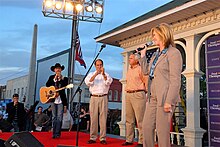
Blackburn in 2007 with John Rich, Zach Wamp, and Ron Ramsey

Marsha Blackburn speaking at the 2015 Conservative Political Action Conference (CPAC) in National Harbor, Maryland on February 26, 2015
Blackburn is a Tea Party Republican. She has been called staunchly conservative, and has called herself “a hard-core, card-carrying Tennessee conservative.” She scored 100% on American Conservative Union’s 2004, 2005, 2007, 2009 Ratings of Congress. According to GovTrack, a website that tracks the histories and positions of congresspeople, Blackburn was the most ideologically conservative member of the U.S. Senate for the 2019 legislative year.
Abortion and stem cell research
Blackburn opposes abortion and seeks to overturn Roe v. Wade. In 2013, she was chosen to manage debate on a bill promoted by House Republicans that would have prohibited abortions after 22 weeks’ gestation, with limited exceptions for rape or incest. She replaced the bill’s prior sponsor, U.S. Representative Trent Franks, after Franks made controversial and dubious statements.
In 2015, Blackburn led a panel that investigated the Planned Parenthood undercover video controversy, in which anti-abortion activists published a video purporting to show that Planned Parenthood illicitly sold fetal tissue. Subsequent investigations into Planned Parenthood found no evidence of fetal tissue sales or of wrongdoing. In 2017, when Blackburn announced that she was running for Senate, she ran an advertisement saying that she “fought Planned Parenthood and we stopped the sale of baby body parts”. Twitter banned the advertisement on its platform because of her assertion about the sale of baby body parts. In 2015, Blackburn claimed that 94% of Planned Parenthood’s business revolves around abortion services; FactCheck.Org noted that abortions account for 3% of the total services Planned Parenthood provided in 2013 and that most of Planned Parenthood’s work is dedicated to treatment of sexually transmitted diseases, contraception, pregnancy tests, prenatal services and cancer screenings.
In March 2016, Blackburn chaired the Republican-led Select Investigative Panel, a committee convened to “explore the ethical implications of using fetal tissue in biomedical research”. Democrats on the panel characterized the probe as a politically motivated witch hunt, and objected to subpoenas demanding “names of researchers, technicians and medical personnel involved in fetal tissue handling”. Subpoenaed biotechnology executives Eugene Gu of the Ganogen Research Institute and Cate Dyer of StemExpress argued in an article in Nature that the panel was intimidating researchers and patients. Gu went on Science Friday on NPR and detailed his experiences living in close proximity to Blackburn’s Congressional district and having United States Marshals deliver the subpoena to his home. The Republican majority on the panel released a report concluding that fetal tissue “makes a vanishingly small contribution to clinical and research efforts, if it contributes at all”; scientists widely hold that fetal tissue research is valuable for science and medicine. A fact-check by Science magazine identified a number of falsehoods in the panel’s report.
Birth certificate bill
In 2009, Blackburn sponsored legislation requiring presidential candidates to show their birth certificates. The bill was in response to birther conspiracy theories that alleged that Obama was not born in the United States. Her spokesperson said that Blackburn did not doubt that Obama was an American citizen.
Health care and pharmaceuticals
Blackburn opposed the Affordable Care Act (Obamacare), saying upon its passage, “freedom dies a little bit today.” She subsequently supported efforts to repeal the legislation, arguing that it “means well” but fails to live up to its promise. In 2017, while arguing for its repeal, Blackburn falsely stated that two of its popular provisions (protections for people with preexisting conditions and allowing adult children to be on their parents’ health plans until they’re 26) “were two Republican provisions which made it into the bill.” In her declaration that she would run for the Senate in 2018, she said that the failure to repeal the Affordable Care Act was “a disgrace”.
At October 2013 congressional hearings on the Affordable Care Act, Blackburn said the health.gov website violated HIPAA and health information privacy rights. The next day, when a CNN interviewer pointed out that the only health-related question the site asks is “do you smoke?,” Blackburn repeated her criticism of the site for violating privacy rights.
According to The New York Times, Blackburn’s best-known legislation was her co-sponsorship of a bill that revised the legal standard the Drug Enforcement Administration (DEA) had used to establish that “a significant and present risk of death or serious bodily harm that is more likely than not to occur”, rather than the previous tougher standard of “imminent danger”, before suspending the manufacturer’s opioid drug shipments. The legislation passed the House and the Senate unanimously but was criticized in internal Justice Department documents and by the DEA’s chief administrative law judge as hampering DEA enforcement actions against drug distribution companies engaging in black-market sales. Joe Rannazzisi, who had led the Drug Enforcement Administration’s Office of Diversion Control, said he informed Blackburn’s staffers precisely what the effects would be as a result of passage of a 2016 law she co-sponsored, as national awareness of a crisis in the prescriptions of opioids in the United States sharpened. Blackburn said her bill had “unintended consequences”, but Rannazzisi said they should have been anticipated. He said that during a July 2014 conference call he informed congressional staffers the bill would cause more difficulties for the DEA if it pursued corporations that were illegally distributing such drugs. Blackburn and Representative Tom Marino, the main co-sponsor of her House bill, sent a letter requesting an Office of Inspector General investigation regarding Rannazzisi, saying he tried to intimidate Congress in the July conversation. Rannazzisi said he was removed from his DEA position in August 2015.
Climate change
Blackburn rejects the scientific consensus on climate change. In a February 16, 2014, debate on NBC’s Meet the Press with science communicator Bill Nye, Blackburn rejected the science and urgency of the issue, claiming that there is “not consensus” in the scientific community, and that climate change remains “unproven”. In the debate she also incorrectly cited the works of Richard Lindzen and Judith Curry as denial of the science of climate change. She said in 2015 “The jury is still out saying man is the cause for global warming, after the earth started to cool 13 years ago.”
In April 2009, an exchange between Blackburn and former Vice President Al Gore received significant publicity. During a congressional hearing on energy policy, Blackburn asked Gore, “The legislation that we are discussing here today, is that something that you are going to personally benefit from?” Gore indicated in response that all income he earned from renewable technology investment went to nonprofits.
Blackburn appears in Koch Brothers Exposed, a 2012 documentary about the political activities of the Koch brothers, major fossil fuel interests, and is listed as a top recipient of campaign contributions.
Technology and telecommunications
Blackburn opposes net neutrality in the United States, calling it “socialistic”. She opposes municipal broadband initiatives that aim to compete with Internet service providers. She supported bills that restrict municipalities from creating their own broadband networks, and wrote a bill to prevent the Federal Communications Commission (FCC) from preempting state laws that blocked municipal broadband.
In early 2017, Blackburn introduced to the House a measure to dismantle an Obama-administration online privacy rule that the FCC adopted in October 2016. Her measure, which was supported by broadband providers but criticized by privacy advocates, repealed the rule that required broadband providers to obtain consumers’ permission before sharing their online data, including browsing histories. The measure passed the House in a party-line vote in March 2017, after a similar measure had been passed the Senate the same week. She subsequently proposed legislation that expanded the requirement to include internet companies as well as broadband providers.
As of 2017, Blackburn had accepted at least $693,000 in campaign contributions from telecom companies.
Blackburn has advocated for increased regulation of technology companies and has criticized alleged anti-conservative bias on major platforms. In June 2018, she published an op-ed arguing for greater oversight and restrictions on technology companies that sparked a vocal backlash among employees at Google including charges that she was a “terrorist” and “thug”. During a 2020 Commerce Committee hearing in which she claimed that tech companies stifle free speech, Blackburn asked Google chief Sundar Pichai about the employment status of an employee who had criticized her.
LGBT rights
During her tenure as a Representative, Blackburn fought to remove Kevin Jennings, an openly gay man who served as Assistant Deputy Secretary of the Office of Safe and Healthy Students in the United States Department of Education. She made several comments about Jennings, saying that he “has played an integral role in promoting homosexuality and pushing a pro-homosexual agenda in America’s schools”.
In 2010, Blackburn voted against repealing the military’s Don’t Ask, Don’t Tell policy.
In 2013, Blackburn voted in favor of the reauthorization of the Violence Against Women Act in the House, but voted against the Senate’s version of the act, which expanded VAWA to apply to people regardless of sexual orientation. Blackburn argued that increasing the number of targets for VAWA funding would “dilute the money that needs to go into the sexual assault centers, domestic abuse centers, child advocacy centers” and said VAWA ought to remain focused on supporting women’s shelters and facilitating law enforcement against crimes against women, rather than addressing other groups or issues.
Blackburn opposes same-sex marriage and in 2004 and 2006 voted for proposed constitutional amendments to ban it. Of the Supreme Court’s 2015 decision in Obergefell v. Hodges, Blackburn said, “I have always supported traditional marriage. Despite this decision, no one can overrule the truth about what marriage actually is–a sacred institution between a man and a woman.”
Blackburn also voted against the Employment Non-Discrimination Act to ban discrimination against LGBT employees. In August 2019, she co-signed an amicus brief to the U.S. Supreme Court arguing that Title VII of the Civil Rights Act of 1964 does not prohibit employment discrimination based upon sexual orientation or gender identity. Blackburn has a 0% rating from the Human Rights Campaign, a gay rights group.
Donald Trump
In November 2016, Blackburn joined Trump’s presidential transition team as vice chair. She was a staunch supporter of his, and backed most of his policies and proposals. She nominated him for a Nobel Peace Prize for his negotiations with North Korea. Vox speculated that Blackburn’s ties to Trump, who won Tennessee in the 2016 election by 26 points, helped boost her Senate candidacy.

Blackburn and President Donald Trump waving at Nashville Rally in 2018
During Trump’s first Senate impeachment trial, Blackburn left the chamber for a television interview. She also garnered attention by reading a book during the proceedings. Blackburn spent time during the trial to tweet about Lt. Col. Vindman, calling him unpatriotic for allegedly “badmouth and ridicul” the United States in front of Russia. In November 2019, #MoscowMarcia started trending on Twitter after Blackburn tweeted a conspiratorial smear against Vindman on her Twitter account. In her post, she wrote “Vindictive Vindman is the ‘whistleblower’s’ handler”. The tweet was in reference to Vindman, a decorated army official and purple heart veteran, who became a central figure in Trump’s impeachment proceedings in Congress after testifying he heard Trump pressure the president of Ukraine to investigate the son of one of his chief political rivals, former Vice President Joe Biden.
After Biden won the 2020 United States presidential election, Blackburn supported Trump’s claims of victory and raised funds to support the Trump campaign’s effort to overturn the election results in court. In an interview on November 20, she briefly called Biden the “president-elect”, but later retracted this as a mistake. On January 2, 2021, Blackburn and 10 other Republican senators announced that they would vote to oppose certification of the results of the election on January 6, the joint session of Congress in which the certification of a presidential election occurs, citing allegations of widespread election fraud, irregularities, and unconstitutional changes to voting laws and voting restrictions. But after a mob of Trump supporters violently stormed Capitol Hill that day, she voted to certify the results of the election.
Immigration
Blackburn supported Trump’s 2017 executive order imposing a temporary travel and immigration ban barring citizens of seven Muslim-majority countries from entering the U.S. She has often expressed support of Trump’s immigration policy, especially his plan to greatly expand the Mexico–United States barrier. In March 2021, Blackburn visited the southern border of the United States with several other Republican senators, and accused President Biden of encouraging a surge of illegal immigration.
Guns
After the 2018 Thousand Oaks shooting on November 7, 2018, which resulted in 12 deaths, Blackburn responded to a question about the shooting in a Fox News interview with Sandra Smith by saying “how do we make certain that we protect the Second Amendment and protect our citizens? We’ve always done that in this country. Mental health issues need to be addressed.”
Women’s rights
In 2009, Blackburn voted against the Lilly Ledbetter Fair Pay Act and the Paycheck Fairness Act.
China
In December 2020, Blackburn posted, “China has a 5,000 year history of cheating and stealing. Some things will never change…” on her Twitter account, two hours after she thanked Trump for his import ban on cotton from China’s Xinjiang Uyghur Autonomous Region over human rights violations targeting the Uighur minority. The European Union bureau chief for China Daily, Chen Weihua, responded on Twitter by calling Blackburn a “lifetime bitch”. In what appeared to be a thinly veiled reference to Chen, Blackburn asserted in her response that the U.S. would “not bow down to sexist communist thugs”. One of Chen’s tweets was, with an apparently sarcastic comment, retweeted by Republican Senator Marco Rubio.
The Chinese American rights group Tennessee Chinese American Alliance protested Blackburn’s comments, arguing that she insulted people of Chinese descent.
On February 3, 2021, Blackburn posted, “Human rights mean nothing to the Chinese Communist Party”.
Electoral history
| Year | Democratic | Votes | Pct | Republican | Votes | Pct | 3rd Party | Party | Votes | Pct | ||||
|---|---|---|---|---|---|---|---|---|---|---|---|---|---|---|
| 1992 | Bart Gordon | 120,177 | 57% | Marsha Blackburn | 86,289 | 41% | H. Scott Benson | Independent | 5,952 | 3% | * |
*Write-in and minor candidate notes: In 1992, write-ins received 10 votes.
| Year | Democratic | Votes | Pct | Republican | Votes | Pct | 3rd Party | Party | Votes | Pct | ||||
|---|---|---|---|---|---|---|---|---|---|---|---|---|---|---|
| 2002 | Tim Barron | 51,790 | 26% | Marsha Blackburn | 138,314 | 71% | Rick Patterson | Independent | 5,423 | 3% | * | |||
| 2004 | (no candidate) | Marsha Blackburn | 232,404 | 100% | ||||||||||
| 2006 | Bill Morrison | 73,369 | 32% | Marsha Blackburn | 152,288 | 66% | Kathleen A. Culver | Independent | 1,806 | 1% | * | |||
| 2008 | Randy Morris | 98,207 | 31% | Marsha Blackburn | 214,214 | 69% | ||||||||
| 2010 | Greg Rabidoux | 54,341 | 25% | Marsha Blackburn | 158,892 | 72% | J.W. Stone | Independent | 6,319 | 3% | * | |||
| 2012 | Credo Amouzouvik | 61,050 | 24% | Marsha Blackburn | 180,775 | 71% | Howard Switzer | Green | 4,584 | 2% | * | |||
| 2014 | Daniel Cramer | 42,280 | 26.8% | Marsha Blackburn | 110,534 | 69.9% | Leonard Ladner | Independent | 5,093 | 3.2% | ||||
| 2016 | Tharon Chandler | 65,226 | 23.5% | Marsha Blackburn | 200,407 | 72.2% | Leonard Ladner | Independent | 11,880 | 4.3% |
| Year | Republican | Votes | Pct | Democratic | Votes | Pct | 3rd Party | Party | Votes | Pct | ||||
|---|---|---|---|---|---|---|---|---|---|---|---|---|---|---|
| 2018 | Marsha Blackburn | 1,227,483 | 54.71% | Phil Bredesen | 985,450 | 43.92% | Other candidates | Independent | 30,807 | 1.37% |
Personal life
Blackburn is married to Chuck Blackburn. They live in Brentwood, a suburb of Nashville in Williamson County, and have two children. She is a Presbyterian.
Blackburn is a member of The C Street Family, a prayer group that includes members of Congress. She is a former member of the Smithsonian Libraries Advisory Board.
Marsha Blackburn is the author of The Mind of a Conservative Woman: Seeking the Best for Family and Country. The book was published on September 1, 2020, by Worthy Books.