
Michelle Marie Pfeiffer born April 29, 1958 is an American actress and producer. Known for pursuing disparate roles in a wide range of film genres, she has consistently received acclaim for her versatile performances. One of the most prolific actresses of the 1980s and 1990s, her accolades include a Golden Globe Award and a British Academy Film Award, as well as nominations for three Academy Awards and one Primetime Emmy Award.
Pfeiffer began to pursue an acting career in 1978 with minor television appearances before earning her first leading role in the musical film Grease 2 (1982). Disillusioned with being typecast based on her appearance, she actively sought more serious material until landing her breakthrough role as gangster moll Elvira Hancock in the crime film Scarface (1983). She achieved further success with the fantasy The Witches of Eastwick (1987) and the comedy Married to the Mob (1988), for which she was nominated for her first of six consecutive Golden Globe Awards. Her performances in Dangerous Liaisons (1988) and The Fabulous Baker Boys (1989) earned her two consecutive Academy Award nominations, for Best Supporting Actress and Best Actress, respectively; she won widespread acclaim and the Golden Globe Award for Best Actress in a Motion Picture – Drama for her portrayal of lounge singer Susie Diamond in the latter.
Pfeiffer continued to establish herself as a leading lady with roles in The Russia House (1990) and Frankie and Johnny (1991). In 1992, Pfeiffer starred as Catwoman / Selina Kyle in the superhero film Batman Returns, one of the most admired portrayals of the comic book character. The same year, she received her third Academy Award nomination for her performance as a troubled housewife in the drama Love Field (1992). She continued to gain praise for her performances in the dramas The Age of Innocence (1993) and White Oleander (2002), and the horrors Wolf (1994) and What Lies Beneath (2000), while producing several successful films under her production company Via Rosa Productions. After a hiatus from acting in 2002, she returned in 2007 with the musical Hairspray and fantasy Stardust.
Following another hiatus, she earned rave reviews for the independent drama Where Is Kyra? (2017) before returning to prominence in 2017 with supporting roles in the polarizing horror Mother! and mystery Murder on the Orient Express, while earning her first Emmy Award nomination for portraying Ruth Madoff in the television biopic The Wizard of Lies. She also ventured into blockbuster franchises, debuting in the Marvel Cinematic Universe as Janet van Dyne in Ant-Man and the Wasp (2018) and a villainous queen in Maleficent: Mistress of Evil (2019). Considered a Hollywood sex symbol, several media outlets have cited Pfeiffer among the world’s most beautiful women, with her physical appearance being heavily discussed by journalists since the beginning of her career. She has been married twice: to actor Peter Horton from 1981 to 1988, and television writer David E. Kelly since 1993.
Early life
Michelle Marie Pfeiffer was born on April 29, 1958, in Santa Ana, California, the second of four children of Richard Pfeiffer (1933–1998), an air-conditioning contractor, and Donna Jean (née Taverna; 1932–2018), a housewife. She has one elder brother, Rick (born 1955), and two younger sisters, Dedee Pfeiffer (born 1964), a television and film actress, and Lori Pfeiffer (born 1965). Her parents were both originally from North Dakota. Her paternal grandfather was of German ancestry and her paternal grandmother was of English, Welsh, French, Irish, and Dutch descent, while her maternal grandfather was of Swiss-German descent and her maternal grandmother of Swedish ancestry. The family moved to Midway City, another Orange County community around seven miles (11km) away, where Pfeiffer spent her early years.
Pfeiffer attended Fountain Valley High School, graduating in 1976. She worked as a check-out girl at Vons supermarket, and attended Golden West College where she was a member of Alpha Delta Pi sorority. After a short stint training to be a court stenographer, she decided upon an acting career. She won the Miss Orange County beauty pageant in 1978, and participated in the Miss California contest the same year, finishing in sixth place. Following her participation in these pageants, she acquired an acting agent and began to audition for television and films.
Career
Late 1970s and 1980s
Pfeiffer made her acting debut in 1978, in a one-episode appearance of Fantasy Island. Other roles on television series followed, including Delta House, CHiPs, Enos and B.A.D. Cats. Her TV movie debut was in “The Solitary Man” (1979) for CBS. Pfeiffer transitioned to film with the comedy The Hollywood Knights (1980), with Tony Danza, appearing as high school sweethearts. She subsequently played supporting roles in Falling in Love Again (1980) with Susannah York and Charlie Chan and the Curse of the Dragon Queen (1981), none of which met with much critical or box office success. She appeared in a television commercial for Lux soap, and took acting lessons at the Beverly Hills Playhouse, before appearing in three 1981 television movies – Callie and Son, with Lindsay Wagner, The Children Nobody Wanted and Splendor in the Grass.
Pfeiffer obtained her first major film role as the female lead in Grease 2 (1982), the sequel to the smash-hit musical film Grease (1978). With only a few television roles and small film appearances, the 23-year-old Pfeiffer was an unknown actress when she attended the casting call audition for the role, but according to director Patricia Birch, she won the part because she “has a quirky quality you don’t expect”. The film was a critical and commercial failure, but The New York Times remarked: “lthough she is a relative screen newcomer, Miss Pfeiffer manages to look much more insouciant and comfortable than anyone else in the cast.” Despite escaping the critical mauling, her agent later admitted that her association with the film meant that “she couldn’t get any jobs. Nobody wanted to hire her.” On her early screen roles, she asserted: “I needed to learn how to act … in the meantime, I was playing bimbos and cashing in on my looks.”
Director Brian De Palma, having seen Grease 2, refused to audition Pfeiffer for Scarface (1983), but relented at the insistence of Martin Bregman, the film’s producer. She was cast as cocaine-addicted trophy wife Elvira Hancock. The film was considered excessively violent by most critics, but became a commercial hit and gained a large cult following in subsequent years. Pfeiffer received positive reviews for her supporting turn; Richard Corliss of Time Magazine wrote, “most of the large cast is fine: Michelle Pfeiffer is better …” while Dominick Dunne, in an article for Vanity Fair titled “Blonde Ambition”, wrote, “he is on the verge of stardom. In the parlance of the industry, she is hot.”

Pfeiffer in 1985
Following Scarface, she played Diana in John Landis’ comedy Into the Night (1985), with Jeff Goldblum, Isabeau d’Anjou in Richard Donner’s fantasy film Ladyhawke (1985), with Rutger Hauer and Matthew Broderick, Faith Healy in Alan Alda’s Sweet Liberty (1986), with Michael Caine, and Brenda Landers in a segment of the 1950s sci-fi parody Amazon Women on the Moon (1987), all of which, despite achieving only modest commercial success, helped to establish her as an actress. She finally scored a major box-office hit as Sukie Ridgemont in the 1987 adaptation of John Updike’s novel The Witches of Eastwick, with Jack Nicholson, Cher, and Susan Sarandon. The film grossed over $63.7 million domestically, the equivalent to $143.5 million in 2019 dollars, becoming one of her earliest critical and commercial successes. Praising their comedic timing, Roger Ebert wrote that Pfeiffer and her female co-stars each “have a delicious good time with their roles”, while the Los Angeles Times film critic Sheila Benson said Pfeiffer makes her character “a warm, irresistible character.”
Pfeiffer was cast against type, as a murdered gangster’s widow, in Jonathan Demme’s mafia comedy Married to the Mob (1988), with Matthew Modine, Dean Stockwell and Mercedes Ruehl. For the role of Angela de Marco, she donned a curly brunette wig and a Brooklyn accent, and received her first Golden Globe Award nomination as Best Actress in a Motion Picture Musical or Comedy, beginning a six-year streak of consecutive Best Actress nominations at the Golden Globes. Pfeiffer then appeared as chic restaurateuse Jo Ann Vallenari in Tequila Sunrise (1988) with Mel Gibson and Kurt Russell, but experienced creative and personal differences with director Robert Towne, who later described her as the “most difficult” actress he has ever worked with.
At Demme’s personal recommendation, Pfeiffer joined the cast of Stephen Frears’s Dangerous Liaisons (1988), with Glenn Close and John Malkovich, playing the virtuous victim of seduction, Madame Marie de Tourvel. Her performance won her widespread acclaim; Hal Hinson of The Washington Post saw Pfeiffer’s role as “the least obvious and the most difficult. Nothing is harder to play than virtue, and Pfeiffer is smart enough not to try. Instead, she embodies it. Her porcelain-skinned beauty, in this regard, is a great asset, and the way it’s used makes it seem an aspect of her spirituality.” She won the BAFTA Award for Best Actress in a Supporting Role and received a nomination for the Academy Award for Best Supporting Actress.
Pfeiffer then accepted the role of Susie Diamond, a hard-edged former call girl turned lounge singer, in The Fabulous Baker Boys (1989), which co-starred Jeff Bridges and Beau Bridges as the eponymous Baker Boys. She underwent intense voice training for the role for four months, and performed all of her character’s vocals. The film was a modest success, grossing $18.4 million in the US (equivalent to $38 million in 2019 dollars ). Her portrayal of Susie, however, drew unanimous acclaim from critics. Critic Roger Ebert compared her to Rita Hayworth in Gilda and to Marilyn Monroe in Some Like It Hot, adding that the film was “one of the movies they will use as a document, years from now, when they begin to trace the steps by which Pfeiffer became a great star”. During the 1989–1990 awards season, Pfeiffer dominated the Best-actress category at every major awards ceremony, winning awards at the Golden Globes, the National Board of Review, the National Society of Film Critics, the New York Film Critics Circle, the Los Angeles Film Critics Association Award for Best Actress and the Chicago Film Critics Association. Pfeiffer’s performance as Susie is considered to be the most critically acclaimed of her career.
1990s
Pfeiffer took the part of the Soviet book editor Katya Orlova in the 1990 film adaptation of John le Carré’s The Russia House, with Sean Connery, a role that required her to adopt a Russian accent. For her efforts, she was rewarded with a Golden Globe nomination for Best Performance by an Actress in a Motion Picture – Drama. Pfeiffer then landed the role of damaged waitress Frankie in Garry Marshall’s Frankie and Johnny (1991), a film adaptation of Terrence McNally’s Broadway play Frankie and Johnny in the Clair de Lune, which reunited her with her Scarface co-star, Al Pacino. The casting was seen as controversial by many, as Pfeiffer was considered far too beautiful to play an “ordinary” waitress; Kathy Bates, the original Frankie on Broadway, also expressed disappointment over the producers’ choice. Pfeiffer herself stated that she took the role because it “wasn’t what people would expect of “. Pfeiffer was once again nominated for a Golden Globe Award for Best Actress – Motion Picture Drama for her performance.
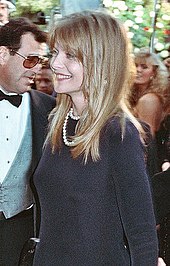
Pfeiffer at the 1990 Academy Awards
In 1990, Pfeiffer formed her own boutique film production company, Via Rosa Productions, which ran for 10 years. The company allowed her to produce and/or star in films tailored for strong women. She asked her best friend Kate Guinzburg to be her producing partner at the company. The two met on the set of the film Sweet Liberty (1986) and quickly became friends. Kate was the Production Coordinator on the film and became close with Pfeiffer over the course of the shoot. Via Rosa Productions was under a picture deal with Touchstone Pictures, a film label of The Walt Disney Studios. The first film the duo produced was the independent drama Love Field, which was released in late 1992. Reviewers embraced the film and The New York Times felt that Pfeiffer was “again demonstrating that she is as subtle and surprising as she is beautiful”. For her portrayal of the eccentric Dallas housewife, she earned nominations for the Academy Award for Best Actress and the Golden Globe for Best Actress – Drama and won the Silver Bear for Best Actress at the 43rd Berlin International Film Festival.
Pfeiffer took the role of Catwoman in Tim Burton’s superhero film Batman Returns (1992), with Michael Keaton and Danny DeVito, after Annette Bening withdrew due to pregnancy. For the role of Catwoman, she trained in martial arts and kickboxing. Pfeiffer has received universal critical acclaim for the role, and her performance is consistently referred to as the greatest portrayal of Catwoman of all time by critics and fans, and is also one of the best regarded performances of her career. Premiere retrospectively lauded her performance: “Arguably the outstanding villain of the Tim Burton era, Michelle Pfeiffer’s deadly kitten with a whip brought sex to the normally neutered franchise. Her stitched-together, black patent leather costume, based on a sketch of Burton’s, remains the character’s most iconic look. And Michelle Pfeiffer overcomes Batman Returns‘ heavy-handed feminist dialogue to deliver a growling, fierce performance.” Batman Returns was a big box office success, grossing over US$267 million worldwide.
In Martin Scorsese’s period drama The Age of Innocence (1993), a film adaptation of Edith Wharton’s 1920 novel, Pfeiffer starred with Daniel Day-Lewis and Winona Ryder, portraying a Countess in upper-class New York City in the 1870s. For her role, she received the Elvira Notari Prize at the Venice Film Festival, and a Golden Globe nomination for Best Actress – Motion Picture. Also in 1993, she was awarded the Women in Film Los Angeles’ Crystal Award for outstanding women who, through their endurance and the excellence of their work, have helped to expand the role of women within the entertainment industry.
Following the formation of her producing company in 1990, Pfeiffer saw a growing professional expansion as a producer. While she continued to act steadily throughout the decade, she and her producing partner Guinzburg experienced a winning streak of producing back to back films next under their Via Rosa Productions header. In the 1994 horror film Wolf, she starred with Jack Nicholson, portraying the sardonic and willful interest of a writer who becomes a wolf-man at night after being bitten by a creature. The film was released to a mixed critical reception; The New York Times wrote: “Ms. Pfeiffer’s role is underwritten, but her performance is expert enough to make even diffidence compelling.” Wolf was a commercial success, grossing US$65 million (equivalent to $112.1 million) at the domestic box office and US$131 million worldwide (equivalent to $226 million).
Pfeiffer’s next role was that of high school teacher and former United States Marine LouAnne Johnson in the drama Dangerous Minds (1995), which was co-produced under her company Via Rosa Productions. She appeared as her character in the music video for the soundtrack’s lead single, “Gangsta’s Paradise” by Coolio, featuring L.V.; the song won the 1996 Grammy Award for Best Rap Solo Performance, and the video won the MTV Video Music Award for Best Rap Video. While Dangerous Minds received negative reviews, it was a box office success, grossing US$179.5 million around the globe. Pfeiffer portrayed Sally Atwater in the romantic drama Up Close & Personal (1996), with Robert Redford.
Pfeiffer took the role of Gillian Lewis in To Gillian on Her 37th Birthday (1996), which was adapted by her husband David Kelley from Michael Brady’s play of the same name. Under their Via Rosa Productions header, Pfeiffer and Guinzburg produced the films One Fine Day (1996), A Thousand Acres (1997) and The Deep End of the Ocean (1998). She voiced of Tzipporah for animated film The Prince of Egypt (1998). She served as an executive producer and starred as the divorced single mother architect Melanie Parker in the romantic comedy One Fine Day (1996) with George Clooney, Subsequent performances included Rose Cook Lewis in the film adaptation of Jane Smiley’s Pulitzer Prize-winning novel A Thousand Acres (1997) with Jessica Lange and Jennifer Jason Leigh; Beth Cappadora in The Deep End of the Ocean (1998) about a married couple who found their son who was kidnapped nine years ago; Titania the Queen of the Fairies in A Midsummer Night’s Dream (1999) with Kevin Kline, Rupert Everett and Stanley Tucci; and Katie Jordan in Rob Reiner’s comedy-drama The Story of Us (1999) with Bruce Willis.
2000s

Pfeiffer at the premiere of Stardust in 2007
Pfeiffer chose to begin the process of dissolving her film production company, Via Rosa Productions, in 1999, and moved into semi-retirement in order to spend more quality time with her children and family, meaning that she would continue to star in films sporadically into the 2000s and beyond. Pfeiffer handed her producing partner Guinzburg one final film to produce under the Via Rosa Productions header. The film was called Original Sin (2001). It was originally intended to star Pfeiffer, who later changed her mind as she was looking to work less for a while. The film was produced by her company, but instead starred Angelina Jolie and Antonio Banderas.
In the Hitchcockian thriller What Lies Beneath (2000), Pfeiffer and Harrison Ford starred as a well-to-do couple who experience a strange haunting that uncovers secrets about their past. While critical response towards the film was mixed, it opened atop at the box office in July 2000, and went on to gross US$291 million worldwide. She then accepted the role of Rita Harrison, a highly strung lawyer helping a father with a developmental disability, in the drama I Am Sam (2001), with Sean Penn. Despite grossing $97.8 million worldwide, the movie received unfavorable reviews; Seattle Post-Intelligencer wrote: “Pfeiffer, apparently stymied by the bland clichés that prop up her screechy role, delivers her flattest, phoniest performance ever.” Meanwhile, SF Gate observed: “In one scene, she breaks down in tears as she unburdens herself to him about her miserable life. It’s hard not to cringe, watching this emotionally ready actress fling herself headlong into false material.”
Pfeiffer took on the role of a murderous artist, named Ingrid Magnussen, in the drama White Oleander (2002), with Alison Lohman (in her film début), Renée Zellweger and Robin Wright. The film was an arthouse success and Pfeiffer garnered a substantial amount of critical praise; Stephen Holden of The New York Times wrote that “Ms. Pfeiffer, giving the most complex screen performance of her career, makes her Olympian seductress at once irresistible and diabolical.” Kenneth Turan of the Los Angeles Times described her as “incandescent”, bringing “power and unshakable will to her role as mother-master manipulator” in a “riveting, impeccable performance”. She earned Best Supporting Actress Awards from the San Diego Film Critics Society and the Kansas City Film Critics Circle, as well as a Screen Actors Guild Award nomination.
Pfeiffer lent her voice for the character of goddess of chaos Eris in Sinbad: Legend of the Seven Seas (2003), an animated film featuring Brad Pitt as the voice of Sinbad the Sailor. She had struggles with finding the character’s villainies. Initially the character was “too sexual”, then she lacked fun. After the third rewrite, Pfeiffer called producer Jeffrey Katzenberg and told him “You know, you really can fire me,” but he assured her that this was just part of the process. Following the release of the film, she took a four-year hiatus from acting, during which she remained largely out of the public eye to devote time to her husband and children. At the time, she turned down the role of the White Witch in the fantasy film The Chronicles of Narnia: The Lion, The Witch and The Wardrobe (2005), which went to Tilda Swinton.
Pfeiffer returned to the screen in 2007 with villainous roles in two major summer blockbusters — Hairspray and Stardust. In the film adaptation of the Broadway musical Hairspray, she starred with John Travolta, Christopher Walken, Zac Efron and Queen Latifah, in the role of Velma Von Tussle, the racist manager of a television station. Travolta requested that Pfeiffer play the part of the villainess, which was her first film role in five years. A widely positive reception greeted the film upon its release, while it made an impressive US$118.9 million and US$202.5 million worldwide. The cast of Hairspray was nominated for the Screen Actors Guild Award for Best Cast in a Motion Picture, but won the Broadcast Film Critics Association Award for Best Cast, the Hollywood Film Festival Award for Ensemble of the Year and the Palm Springs International Film Festival Award for Ensemble Cast. Her next film release, the fantasy adventure Stardust, with Claire Danes, Charlie Cox and Robert De Niro, saw her play the ancient witch Lamia. Filmed before Hairspray, the film premiered three weeks afterwards; it garnered largely positive reviews but, budgeted at US$70 million, it made a modest US$135.5 million globally.
Pfeiffer starred in Amy Heckerling’s romantic comedy I Could Never Be Your Woman (2007), with Paul Rudd and Saoirse Ronan, portraying Rosie, a 40-year-old divorced mother working as a scriptwriter and producer for a television show who falls in love with a much younger man (Rudd). Her reported salary was US$1 million, with an advance on 15 percent of the gross. However, the film was only distributed on home video markets. Reviews for I Could Never Be Your Woman were moderately positive, with critic James Berardinelli finding Pfeiffer and Rudd to “have adequate chemistry to pull off the romance” in what he described as an “enjoyable romantic comedy that has enough going for it to make it worth a recommendation”. She next starred in Personal Effects (2009), with Ashton Kutcher, playing two grieving people coping with the pain and frustration of their loss whose bond spawns an unlikely romance. The drama premiered at Iowa City’s Englert Theatre.
Pfeiffer’s next film, an adaptation of Colette’s Chéri (2009), reunited her with the director (Stephen Frears) and screenwriter (Christopher Hampton) of Dangerous Liaisons (1988). Pfeiffer played the role of aging retired courtesan Léa de Lonval, with Rupert Friend in the title role, with Kathy Bates as his mother. Chéri premiered at the 2009 Berlin International Film Festival, where it received a nomination for the Golden Bear award. The Times of London reviewed the film favorably, describing Hampton’s screenplay as a “steady flow of dry quips and acerbic one-liners” and Pfeiffer’s performance as “magnetic and subtle, her worldly nonchalance a mask for vulnerability and heartache”. Roger Ebert in the Chicago Sun-Times wrote that it was “fascinating to observe how Pfeiffer controls her face and voice during times of painful hurt”. Kenneth Turan in the Los Angeles Times praised the “wordless scenes that catch Léa unawares, with the camera alone seeing the despair and regret that she hides from the world. It’s the kind of refined, delicate acting Pfeiffer does so well, and it’s a further reminder of how much we’ve missed her since she’s been away.”
2010s
Following a two-year sabbatical from acting, Pfeiffer made part of a large ensemble cast in Garry Marshall’s romantic comedy New Year’s Eve (2011), her second collaboration with Marshall after Frankie and Johnny. The film, also starring Halle Berry, Jessica Biel, Robert De Niro, Josh Duhamel, Zac Efron, Sarah Jessica Parker, and Sofía Vergara, among many others, saw her take on the supporting role of Ingrid Withers, an overwhelmed secretary befriending a deliveryman (Efron). While the film was panned by critics, it made US$142 million worldwide. In 2012, she appeared with Chris Pine and Elizabeth Banks in the drama People Like Us, as the mother of a struggling New York City corporate trader (Pine). Rolling Stone found her to be “luminous” in the film, and The New York Times, positively pointing out Pfeiffer and Banks, noted that their performances “partly compensate for the holes in a story whose timing is hard to swallow”. People Like Us debuted to US$4.26 million, described as “meager” by Box Office Mojo, and only made US$12 million in North America.
Pfieffer reunited with Tim Burton, her Batman Returns director, in Dark Shadows (2012), based on the gothic television soap opera of the same name. In the film, co-starring Johnny Depp, Eva Green, Helena Bonham Carter and Chloë Grace Moretz, she played Elizabeth Collins Stoddard, the matriarch of the Collins family. Critical response towards the film was mixed, but writers acclaimed the actors’ performances—most notably Depp and Pfeiffer’s. IGN found her to be “commanding” in her role and felt that the main characters were “played by one of Burton’s best ensemble casts yet”. While Dark Shadows grossed a modest US$79.7 million in North America, it ultimately made US$245.5 million globally. In Luc Besson’s mob-comedy The Family (2013), co-starring Robert De Niro, Tommy Lee Jones, Dianna Agron and John D’Leo, she played the “tough mother” in a Mafia family wanting to change their lives under the witness protection program. Although reviews for the film were mixed, THV11 said on the cast’s portrayals: “The core actors of The Family were really solid, and the whole film comes together to make a solid movie.” Meanwhile, The Huffington Post felt that “De Niro, Pfieffer and Jones all brought 100% to their roles.” The film grossed US$78.4 million worldwide.
—Pfeiffer in 2017 on her comeback
Pfeiffer has stated that her lack of acting throughout the 2000s was due to her children, and now with both her children away at college, she intends to “work a lot”. She has commented that she feels that her best performance is “still in her”, and that she thinks that’s what keeps her going. The slew of films that would follow in 2017 would prompt the media to dub her career resurgence a “Pfeiffer-sance”. In the independent drama Where Is Kyra?, she starred as a sensitive and fragile woman who loses her mother and “faces a crisis in which she must find a means for survival, all the while hiding her struggles from her new lover”. The film premiered at the Sundance Film Festival on January 23, 2017, and received a limited release on April 6, 2018, to critical acclaim; Her role as Kyra was dubbed the “performance of her life” by Village Voice’s Bilge Ebiri, and “the performance of her career”, by Rolling Stone.

Pfeiffer in 2017 at a press conference in Venice, Italy for the film Mother!
Pfeiffer landed the role of Ruth Madoff for the HBO Films drama The Wizard of Lies, based on the book of the same name. The film, directed by Barry Levinson, reunites her with actor Robert De Niro, who played her husband, disgraced financier Bernard Madoff. The Wizard of Lies premiered on HBO on May 20, 2017, garnering favorable reviews from critics and an audience of 1.5 million viewers, HBO’s largest premiere viewership for a film in four years. Tolucan Times remarked that Pfeiffer “steals the show as Madoff’s wife, Ruth, and is a remarkable lookalike”, while Los Angeles Times asserted: “As Ruth, Pfeiffer convincingly portrays a pampered woman left with utterly nothing —she’s lost her homes, status and, most important, her relationship with her sons.” Pfeiffer earned her first Emmy nomination for her performance in the category of Outstanding Supporting Actress in a Limited Series or Movie.
In Darren Aronofsky’s psychological horror film Mother! (2017), with Jennifer Lawrence and Javier Bardem, Pfeiffer portrayed one of the mysterious guests disrupting the tranquil life of a couple. While Mother! polarized viewers and prompted mass walkouts, the film was better received by critics. Despite its divisiveness, critics unanimously praised Pfeiffer’s contribution, some of whom felt that her performance was worthy of an Oscar nomination. Vulture remarked: “Out of the main actors, it’s Pfeiffer who is able to root the character in meaning — she bracingly marries the exploration of Biblical creation, mythological overtones, and hellish domestic commentary. There’s a gravity to Pfeiffer’s performance that allows her to succeed where the other main actors fail, save for brief spurts — she straddles the boundaries between embodying a symbol and granting the character enough interiority to feel like a flesh and blood woman, too.”
Pfeiffer had a supporting role in Kenneth Branagh’s Murder on the Orient Express (2017), the fourth adaptation of Agatha Christie’s 1934 novel of the same name. The mystery–drama ensemble film follows world-renowned detective Hercule Poirot, who seeks to solve a murder on the famous European train in the 1930s. Pfeiffer played an aging socialite with Johnny Depp, Penélope Cruz, and Judi Dench. Pfeiffer sang the song “Never Forget”, which plays over the film’s closing credits and appears on the film’s official soundtrack. The film grossed US$351.7 million worldwide and received decent reviews from critics, with praise for the performances, but criticism for not adding anything new to previous adaptations. Although most critics agreed that the ensemble cast was underused, Pfeiffer’s performance earned positive reviews, with Richard Roeper of the Chicago Sun-Times opining that the actress delivers the film’s best performance. The New Yorker‘s Anthony Lane found Pfeiffer to be the only actor who appears to be enjoying their material. David Edelstein of Vulture described the actress as “a hoot and a half … stealing every scene”. Mick LaSalle, writing for the San Francisco Chronicle, identified Pfeiffer as the film’s “most interesting bit of casting”, crediting her performance with reminding audiences that she is one of today’s best film actresses and “help Branagh make the case for his remake over the original”.
Making her Marvel Cinematic Universe debut, Pfeiffer starred as Janet van Dyne, the original Wasp, in Ant-Man and the Wasp (2018). Critics felt Pfeiffer used her limited screen time well. Variety’s Owen Gleiberman described her presence as “lovely” and “wistful”, while Josh Spiegel of Film felt the film suffers from a lack of the actress, describing her appearance as “cruelly brief”. She briefly reprised the role the following year in Avengers: Endgame.
In 2019, Pfeiffer starred alongside Angelina Jolie and Elle Fanning in the dark fantasy sequel Maleficent: Mistress of Evil as the villainous Queen Ingrith, the mother of Aurora’s (Fanning) fiancée Prince Philip. Despite mixed reviews, critics mostly praised Pfeiffer and her co-star Jolie’s performances in the film. Describing her as a scene stealer, The Plain Dealer‘s Laura DeMarco wrote that veteran actresses “clearly relish their roles.”
2020s
In October 2019, she began work on the dark comedy French Exit (2020), based on the acclaimed novel of the same name by Patrick deWitt, directed by Azazel Jacobs. In the film, which co-stars Lucas Hedges and Tracy Letts, Pfeiffer played a widow who moves to Paris, France, with her son (Hedges) and cat, who happens to be her reincarnated husband (Letts). The film premiered at the New York Film Festival, with Pfeiffer garnering critical acclaim; Peter Debruge of Variety remarked that she gave a performance “for which she’ll be remembered.” Pfeiffer received a Golden Globe Award nomination for Best Actress – Motion Picture Comedy or Musical for her performance. On May 11, 2019, it was announced that Pfeiffer would be teaming with actress Annette Bening for the psychological thriller, Turn of Mind, set to be directed by Gideon Raff.
On January 21, 2021, it was announced that Pfeiffer had been cast as Betty Ford in the upcoming Showtime television series, The First Lady.
Artistry
Acting style
Pfeiffer maintains that she has never received formal acting training. Instead, she credits director Milton Katselas with teaching her the difference between how an actor thinks a character would behave during a particular scene, and how the actor themself would behave during the same scene. Vulture.com’s Angelica Jade Bastién described Pfeiffer as “an actress of such depth, breadth, and tenacity” that “she obliterates the argument that an untrained actor has less capability than her trained counterparts.” Pfeiffer has said she sometimes feels fraudulent about her lack of conventional training, explaining, “I was just getting by and learning in front of the world. So I’ve always had this feeling that one day they’re going to find out that I’m really a fraud, that I really don’t know what I’m doing.” In 1992, Rolling Stone‘s Gerri Hirshey identified Pfeiffer as a character actress comfortable wearing unflattering costumes. Drawn towards playing “imperfect” women who are “a little bit broken,” Pfeiffer claims to rarely accept traditionally glamorous roles because she finds few of them interesting, opting to play characters that “move” her instead: “I know that if I can hear the character as I’m reading, it’s made some connection .” Film critics have described the actress as “a character actress in a screen siren’s body”. Often commended for her ability to mask her true feelings and emotions, Pfeiffer frequently uses this technique to her advantage in period films, a genre that has become a trademark of hers. Pfeiffer herself has admitted to being particularly skilled in this area but also believes disguising one’s feelings is not uncommon, speculating, “We may not be as mannered or as proper as people were in the 19th century, but very rarely are we talking about what we’re really thinking.” Pfeiffer has referred to acting as a “sadomasochistic” profession due to how “brutal” she finds the process at times.
In a profile on the actress, Lynn Hirschberg of W wrote that Pfeiffer’s “best roles always seem to involve a woman at war with herself. Whether in the biggest of blockbusters or the smallest of indie films, Pfeiffer has a way of pitting her characters’ wit and self-awareness against their flaws and trauma.” During the 1980s, Pfeiffer typically played smart, funny, sexually attractive and strong female characters. According to Rachel Syme of The New Yorker, such characters were often “both ditzy and wily, high-femme and high-maintenance, scrappy and … armed with claws”. Adam Platt of New Woman observed that Pfeiffer’s characters tends to “play the world at a distance, mostly, and are often wise beyond their years. They get romanced, but are not overtly romantic. They may be trashy … but they all retain an air of invulnerability, a certain classical poise.” In a film review for the Miami New Times, director and film critic Bilge Ebiri observed that Pfeiffer “often played women who were somewhat removed from the world”, elaborating, “It wasn’t so much unapproachability or aloofness that she conveyed, but a reserve that suggested … melancholy, pain, dreams deferred”, even in some of her more comedic performances. Comparing her resumé to actress Barbara Stanwyck, Elizabeth Kaye of The Daily Beast wrote that Pfeiffer’s vulnerable characters share a common theme: “the only reasonable expectation is to not expect much.” Observing parallels between Pfeiffer’s roles and “concern with getting others to look beyond their own first impressions of her”, Backstage contributor Manuel Betancourt wrote the actress “has long been perfecting the ability to embody women whose inner contradictions are both revealed and concealed by their very gestures.”
Pfeiffer said she tends to become addicted to the characters she plays, once she commits to a role. Filmmakers and co-stars agree that Pfeiffer is extremely committed to her work, developing a reputation for competence and preparedness. Her acting ability continues to draw praise from directors with whom she has worked; Martin Scorsese described Pfeiffer as “an actress who could portray inner conflict with her eyes and face better than any other film star of her generation”, while Jonathan Demme declared “It’s hard for me to imagine anyone who, on a level of quality, would have an edge on her.” Pfeiffer refuses to watch her own work, describing herself as “a perfectionist” who finds “nothing perfect in what I do”. In addition to discarding old scripts, Pfeiffer does not retain film reviews, magazine clippings or covers about her performances.
Reception
Pfeiffer is widely considered to be among the most talented actresses in Hollywood, as well as one of the greatest actresses of her generation. Novelist Steve Erickson wrote that Pfeiffer had already threatened to become one of her generation’s five greatest American actresses by her thirties. Despite observing that her filmography lacks the prestige of contemporaries Anjelica Huston and Meryl Streep, Bastién believes Pfeiffer’s through line to be the most fascinating among her peers. Maclean‘s film critic Brian D. Johnson argued that Pfeiffer has yet to demonstrate her true acting range, believing she could potentially be as respected as Streep if allowed the same opportunities. Johnson claims Pfeiffer’s performances are sometimes hindered by her own beauty and apparent “lack of ambition” in accepting “safe, undemanding roles”, but simultaneously believes the actress’ same lack of ambition in turn “makes her such a good actor”. Similarly, the San Francisco Chronicle‘s Mick LaSalle remarked that Pfeiffer’s humility makes it “easy to forget” she is genuinely “one of the best we have”. Pfeiffer is particularly renowned for her versatility, having accumulated a diverse filmography spanning period, romance, fantasy, musical, comedy and drama. By 2016, Salon‘s Charles Taylor declared that no actor of the past decade had rivaled Pfeiffer in terms of versatility. In another review for Vulture.com, Bastién wrote “Pfeiffer’s greatness as an actress rests among several contradictions”, concluding, “No modern actress better evokes the rich tension between understanding the currency that comes with being a great beauty and the distaste with being seen at all.”
Pfeiffer was one of the most popular actresses of the 1980s and 1990s. Contributing to Encyclopedia.com, Robyn Karney wrote that among the many blonde, attractive actresses who debuted during the decade, “Pfeiffer seemed the most precisely cut from the cloth of a long Hollywood tradition—a sexy, beautiful, intelligent, modern answer to, say, Carole Lombard, blessed with a sophisticated gift for witty one-liners, an ability to cross class barriers, and to bring conviction to a range of contrasting characters across a spectrum”. Apart from The Witches of Eastwick, few of the actress’ films during this period had been major box office successes, an observation Pfeiffer never mentioned to studio executives in fear that they would stop casting her altogether. However, her performances continued to garner consistently positive reviews despite lackluster ticket sales and some films critics found forgettable. By 1999, Variety named Pfeiffer “the female movie star most likely to improve a film’s box-office appeal”. However, Karney felt the declining quality of her films towards the end of the decade “emphasize that the course of Pfeiffer’s career … has been dictated by the era from which she sprang” and “unassailable truth that the great female movie star of the Golden Age is no more.” In 2002, Amy Longsdorf of The Morning Call dubbed Pfeiffer “one of the most popular and critically acclaimed movie stars in the world.” Pfeiffer has managed to establish herself as a “major star” despite having yet to receive top-billing in a blockbuster film. Awarded a motion picture star on the Hollywood Walk of Fame in 2007, Pfeiffer has remained one of Hollywood’s most in-demand actresses for four decades.
In 2020, the Kenosha News voted Pfeiffer America’s 26th favorite actress. At the same time, Krizanovich dubbed her Hollywood’s most underrated actress. Similarly, Matthew Jacobs of HuffPost Canada believes Pfeiffer continues to be underappreciated by the public despite her consistent accolades, since her fame never quite rivaled that of her contemporaries. Describing Pfeiffer as an “Unheralded Comedy Maven”, Jacobs hailed her as “one of the great comedic actors of our time, though she is rarely recognized as such”, identifying her subtlety as one of her best attributes since her “magnetism never overwhelms the movies she’s in. Even when she is the most talented person on-screen (and she usually is), she still allows room for the ensemble to shine.” Jacobs concluded Pfeiffer’s power is “She finds humor in bleakness and bleakness in humor.”
In the media
Pfeiffer has long been described as one of Hollywood’s most beautiful actresses, a designation The Daily Telegraph‘s Mick Brown considers both a defining characteristic and curse. According to Encyclopædia Britannica, the actress is renowned “for her beauty and air of vulnerability”. Pfeiffer initially struggled to convince directors to take her seriously as an actress because they doubted she was more than simply an attractive face. Pfeiffer’s talent continued to be overshadowed by her appearance several years after her breakout performance in Scarface, to which she responded by actively seeking challenging roles in which physical beauty is not an essential characteristic. Rachel Syme of The New Yorker observed that, early in her career, critics struggled “to characterize her work without undermining it” by inevitably focusing “on Pfeiffer’s striking visage, as if her beauty and talent were opposing forces that needed to somehow be reconciled”. The Daily Beast‘s Elizabeth Kaye recognized Pfeiffer as a rare Hollywood talent who trusts it is indeed possible to be both physically attractive and a serious performer, believing the actress achieves this by combining “the sensibility of a modern woman” with “the glamour of a ’30s icon”. Describing Pfeiffer as popular, beautiful, mercurial and memorable, Karen Krizanovich of The Daily Telegraph observed that audiences remain captivated “by her subtle portrayals”, after initially being drawn to her beauty.
Regularly cited as one of the most beautiful women in the world, journalists have constantly discussed Pfeiffer’s perceived beauty at length. Ranking the actress among history’s most beautiful and talented actresses, Glamour named Pfeiffer “the most perfect face on the silver screen”. The same magazine ranked Pfeiffer among the greatest fashion icons of the 1980s, calling her the decade’s “go-to girl” and “one of our all-time favourite movie goddesses”. Similarly, Harper’s Bazaar ranked Pfeiffer the fourth most glamorous “beauty icon” of the same decade, while Complex ranked Pfeiffer 49th on their list of “The 80 Hottest Women of the ’80s”. Vogue contributor Alice Newbold considers her “ash-blonde hair, piercing blue eyes and porcelain skin” to be her trademark features. Pfeiffer was one of the most prominent sex symbols of the 1980s and 1990s, during which she attracted significant media attention for her beauty; in 1990, she appeared on the inaugural cover of People magazine’s annual 50 Most Beautiful People in the World issue. She was again pictured on the cover of the issue in 1999 – the first celebrity to appear on the cover of the annual issue twice, and the only person to grace the cover twice during the 1990s – having been featured in the “Most Beautiful” list a record-breaking six times during the decade (1990, 1991, 1992, 1993, 1996, 1999). Men’s Health ranked Pfeiffer 45th on their “The Hottest Woman of All Time” list and their 67th “Hottest Sex Symbol of All Time” ranking, describing her as “one of Hollywood’s most enduring hotties”. Critics often compared her to Julia Roberts in both appearance and work, another actress who rose to prominence around the same time. According to Matthew Jacobs of HuffPost Canada, critics generally conceded that Pfeiffer is “a more serious but less commercially branded actress than Roberts”.
Pfeiffer has been famously self-deprecating about her own appearance, insisting she is only “conventionally pretty”. At least two of Pfeiffer’s films, Stardust (2007) and Chéri (2009), explore themes of beautiful, youth-obsessed women struggling to accept aging, with which Pfeiffer personally identified. Pfeiffer claims to not want to appear younger than she is and has yet to undergo plastic surgery, although she admits she would “never say never” to the procedure. However, she has voiced her disapproval of actors who surgically modify their appearance beyond recognition. Famous for being “press-shy” and private like the characters she portrays, Matthew Jacobs of HuffPost identified Pfeiffer as Hollywood’s prime example of “a movie star doesn’t walk around feeling like a movie star”, which contributes to her ability to play authentic characters, never allowing her fame to consume her talent. Pfeiffer is notorious for disliking interviews, referring to herself as “the worst interviewee that ever was”. Pfeiffer revealed that attending interviews to promote her films would make her very agitated and uncomfortable at one time, but she has always “mastered the art” of maintaining a composed, polite demeanor when performing such responsibilities. However, she maintains her belief that it is not an actors’ responsibility to promote a film project. Media commentator’s named Pfeiffer’s career resurgence in 2016-2017 a “Pfeifferaissance”.
Culture commentators noted that in 2014, Pfeiffer, who was not promoting any movies at the time, had become a “pop-music muse” and was mentioned by name in the lyrics of two popular songs at the time: “Uptown Funk” by Mark Ronson and Bruno Mars, and “Riptide” by Vance Joy. Joy told reporters that the Pfeiffer film moment which led him to include her name in his song was her portrayal of Selina Kyle in Batman Returns. He said, “She comes back to her apartment after being thrown out the window by Christopher Walken and she goes mental. Her apartment’s all pink and beautiful, and kind of creepy and infantile, then she just smashes it all up and spray paints stuff and transforms into Catwoman. It’s this really kind of sexual scene; it’s amazing.” Pfeiffer is also mentioned in Mark Ronson and Bruno Mars’s 2014 song, “Uptown Funk” (“This hit, That ice cold, Michelle Pfeiffer, That white gold”). In an interview, Ronson told a reporter his favorite Pfeiffer movie was “The Fabulous Baker Boys. I also liked her in Scarface and Tequila Sunrise. She was such a babe.” Hip hop vocalist Mahawam released the song “Michelle Pfeiffer” in 2019. Singer Ethel Cain released a song “Michelle Pfeiffer” in 2021 explaining, “I’ve always idolized Michelle Pfeiffer and thought she was a picture perfect bombshell, o when I was in the back of my Uber with the windows down, headed to the studio bright and early that first morning and humming a little chorus melody to myself, I felt like a bombshell of my own. It felt like my life had finally started.”
Australian cricketers speak of “getting a Michelle” when they take five wickets in an innings. In cricketing parlance, this is referred to as a “five for”, a near-homophone for “Pfeiffer”, which resulted in the nickname “Michelle”.
Personal life

Pfeiffer and her husband, David E. Kelley, at the 47th Emmy Awards in 1994
While taking acting classes in Los Angeles, Pfeiffer was taken in by a seemingly friendly couple who ran a metaphysics and vegetarian cult. They helped her to cease drinking, smoking, and doing drugs, and over time the couple took control of her entire life. Much of her money went to the group. “I was brainwashed … I gave them an enormous amount of money.”
At an acting class taught by Milton Katselas in Los Angeles, she met fellow budding actor, Peter Horton, and they began dating. Pfeiffer and Horton married in Santa Monica in 1981, and it was on their honeymoon that she discovered she had won the lead role in Grease 2. Horton directed Pfeiffer in a 1985 ABC TV special, One Too Many, in which she played the high school girlfriend of an alcoholic student (Val Kilmer); and in 1987, the real-life couple played an on-screen couple in the ‘Hospital’ segment of John Landis’s comedy skit compilation, Amazon Women on the Moon.
In 1988, Pfeiffer had an affair with John Malkovich, her co-star in Dangerous Liaisons, who at the time was married to Glenne Headly.
Pfeiffer and Horton decided to separate in 1988, and were divorced two years later; Horton later blamed the split on their devotion to their work rather than on their marriage. After her marriage to Horton, Pfeiffer had a three-year relationship with actor/producer Fisher Stevens. They met when Pfeiffer was starring in the New York Shakespeare Festival production of Twelfth Night, in which Stevens played the role of Sir Andrew Aguecheek.
In 1993, Pfeiffer married television writer and producer David E. Kelley. She made a brief uncredited cameo appearance in one episode of Kelley’s television series Picket Fences and played the title character in To Gillian on Her 37th Birthday, for which Kelley wrote the screenplay. Pfeiffer had entered into private adoption proceedings before she met Kelley. In March 1993, she adopted a newborn daughter, Claudia Rose, who was christened on Pfeiffer and Kelley’s wedding day. In 1994, Pfeiffer gave birth to a son, John Henry Kelley II, named for his grandfather – Pfeiffer’s father-in-law – United States Hockey Hall of Fame coach John Henry “Jack” Kelley.
Other ventures

Pfeiffer meeting with Senator Dianne Feinstein to support the Personal Care Product Safety Act in 2019.
Product and endorsements
In 2005, Pfeiffer served as the face of Giorgio Armani’s spring campaign; the designer has often dressed her for public appearances. In the March 2019 issue of InStyle magazine, she announced her intention to launch a collection of fine fragrances called Henry Rose. The line launched in April, 2019.
Philanthropy
Having been a smoker for 10 years, and having a niece who suffered from leukemia for 10 years, Pfeiffer decided to support the American Cancer Society. Her charity work includes as well her support for the Humane Society. In 2016 she also attended the Healthy Child Healthy World’s L.A. Gala for people who lead the organizations for children’s environmental health and protect those most vulnerable. In December that same year, Pfeiffer, who is a vegan, joined the board of directors for Environmental Working Group, an advocacy group based in Washington. D.C.