
Muslin (/ˈmʌzlɪn/) is a cotton fabric of plain weave. It is made in a wide range of weights from delicate sheers to coarse sheeting. It gets its name from the city of Mosul, Iraq, where it was first manufactured.
Early muslin was handwoven of uncommonly delicate handspun yarn. It was imported from India into Europe for much of the 17th and early 18th-centuries.
In 2013, the traditional art of weaving Jamdani muslin in Bangladesh was included in the list of Masterpieces of the Oral and Intangible Heritage of Humanity by UNESCO. In 2020, it was given Geographical indication status as a product of Bangladesh due to efforts of the government of Bangladesh, the fourth GI-certified product after Jamdani sarees, Hilsa fish, and Khirsapat mangoes.
History
— Description of muslin by Amir Khusrau
The earliest muslin was known as Mulmul or Malmal. It was a handwoven fabric made with the finest handspun yarns. There were muslin qualities with 2425 thread count, which are questionable even with advanced technology. Some notable qualities of muslin were Mulmul khas or Kings muslin, Eksuti malmal, and Alibal malmals, etc. The yarn count, weights and textures, thread count, origin, and particular use were the main criteria to differentiate them from each other. Muslin was one of the legendary cloths of East India. These were made with locally grown cotton called “Phuti karpas” (Gossypium arboreum var. neglecta). The cotton was grown alongside the river banks of Brahmaputra.Some notable varieties were as following. Muslin from eastern parts of ancient India was praised in the international market as “woven wind” and “wonder gossamer”, and earned a great price.
Manufacturing process
Since all the processes were manual, manufacturing involves many artisans for yarn spinning and weaving activities, but the leading role lies with the material and weaving.
- Ginning: To removing trash and cleaning and combing the fibers and making them parallel ready for spinning a boalee (upper jaw of a catfish) was used.
- Spinning and Weaving: For extra humidity they used to weave during the rainy season for elasticity in the yarns and to avoid breakages. The process was so sluggish that it could take over five months to weave one piece of mulmul.
The muslins were originally made of cotton only. These were very thin, transparent, delicate and feather light breathable fabrics. There could be 1000-1800 yarns in warp and weighing 3.8 Ounces ( for 1yard X10 yards) . Some varieties of muslin were so thin that they could even pass through the aperture of a lady finger-ring.
In 1298 CE, Marco Polo described the cloth in his book The Travels. He said it was made in Mosul, Iraq. The 16th-century English traveler Ralph Fitch lauded the muslin he saw in Sonargaon. During the 17th and 18th centuries, Mughal Bengal emerged as the foremost muslin exporter in the world, with Mughal Dhaka as capital of the worldwide muslin trade. It became highly popular in 18th-century France and eventually spread across much of the Western world.
Types
— Ralph Fitch a consultant for the British East India Company
As per mentions in Ain-i-Akbari (16th-century detailed document) the Khasa, Tansukh, Nainsook, Chautar, and varieties of mulmul (Sarkar ali, Sarbati, Tarindam) were among the most delicate cotton muslins produced in the Indian subcontinent.Abrawanmeans running water was another fine muslin of the Deca region.
Extinction
Under British rule, the British East India company could not compete with local muslin with their own export of cloth to the Indian subcontinent. The colonial government favored imports of British textiles. Colonial authorities attempted to suppress the local weaving culture. Muslin production greatly declined and the knowledge of weaving was nearly eradicated. It is alleged that in some instances the weavers were rounded up and their thumbs chopped off, although this has been refuted as an alleged misreading of a report from 1772. The Bengali muslin industry was suppressed by various colonial policies. As a result, the quality of muslin suffered and the finesse of the cloth was lost as British cloths emerged in India.
Uses
Dressmaking and sewing

In Advantages of wearing Muslin Dresses! (1802), James Gillraycaricatured a hazard of untreated muslin: its flammability.
When sewing clothing, a dressmaker may test the fit of a garment, using an inexpensive muslin fabric before cutting pieces from expensive fabric, thereby avoiding potential costly mistakes. This garment is often called a “muslin,” and the process is called “making a muslin.” In this context, “muslin” has become the generic term for a test or fitting garment, regardless of what it is made from. The equivalent term in British English is Toile.
Muslin is also often used as a backing or lining for quilts, and thus can often be found in wide widths in the quilting sections of fabric stores.
In Asia, especially in Bangladesh, muslin is used to make sarees.
Cuisine
Muslin can be used as a filter:
- In a funnel when decanting fine wine or port to prevent sediment from entering the decanter
- To separate liquid from mush (for example, to make apple juice: wash, chop, boil, mash, then filter by pouring the mush into a muslin bag suspended over a jug)
- To retain a liquidy solid (for example, in home cheese-making, when the milk has curdled to a gel, pour into a muslin bag and squash between two saucers (upside down under a brick) to squeeze out the liquid whey from the cheese curd)
Muslin is the material for the traditional cloth wrapped around a Christmas pudding.
Muslin is the fabric wrapped around the items in barmbrack, a fruitcake traditionally eaten at Halloween in Ireland.
Muslin is a filter in traditional Fijian kava production.
Beekeepers use muslin to filter melted beeswax to clean it of particles and debris.
Set design and photography
Muslin is often the cloth of choice for theatre sets. It is used to mask the background of sets and to establish the mood or feel of different scenes. It receives paint well and, if treated properly, can be made translucent.
It also holds dyes well. It is often used to create nighttime scenes because when dyed, it often gets a wavy look with the color varying slightly, such that it resembles a night sky. Muslin shrinks after it is painted or sprayed with water, which is desirable in some common techniques such as soft-covered flats.
In video production, muslin is used as a cheap greenscreen or bluescreen, either pre-colored or painted with latex paint (diluted with water). It is commonly used as a background for the chroma key technique.
Muslin is the most common backdrop material used by photographers for formal portrait backgrounds. These backdrops are usually painted, most often with an abstract mottled pattern.
In the early days of silent film-making, and until the late 1910s, movie studios did not have the elaborate lights needed to illuminate indoor sets, so most interior scenes were sets built outdoors with large pieces of muslin hanging overhead to diffuse sunlight.
Medicine
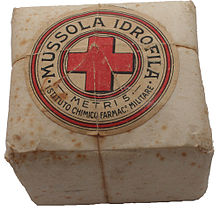
A first-aid packet of 5m of “hydrophilic muslin”, given to Italian soldiers in World War I
Surgeons use muslin gauze in cerebrovascular neurosurgery to wrap around aneurysms or intracranial vessels at risk for bleeding. The thought is that the gauze reinforces the artery and helps prevent rupture. It is often used for aneurysms that, due to their size or shape, cannot be microsurgically clipped or coiled.