
Orenthal James Simpson born July 9, 1947, nicknamed “The Juice“, is an American former football running back, broadcaster, actor, advertising spokesman, and convicted felon. Once a popular figure with the U.S. public, he is now best known for being tried for the murders of his former wife, Nicole Brown Simpson, and her friend, Ron Goldman. Simpson was acquitted of the murders in criminal court, but was later found responsible for both deaths in a civil trial.
Simpson attended the University of Southern California (USC), where he played football for the USC Trojans and won the Heisman Trophy in 1968. He played professionally as a running back in the National Football League (NFL) for 11 seasons, primarily with the Buffalo Bills from 1969 to 1977. He also played for the San Francisco 49ers from 1978 to 1979. In 1973, he became the first NFL player to rush for more than 2,000 yards in a season. He holds the record for the single season yards-per-game average, which stands at 143.1. He was the only player to ever rush for over 2,000 yards in the 14-game regular season NFL format. Simpson was inducted into the College Football Hall of Fame in 1983 and the Pro Football Hall of Fame in 1985. After retiring from football, he began new careers in acting and football broadcasting.
In 1994, Simpson was arrested and charged with the murders of his ex-wife, Nicole Brown Simpson, and her friend, Ron Goldman. He was acquitted by a jury after a lengthy and internationally publicized trial. The families of the victims subsequently filed a civil suit against him. A civil court awarded a $33.5 million judgment against him in 1997 for the victims’ wrongful deaths. In 2000, he moved to Florida and settled in Miami to avoid paying any more of the liability judgment, which as of 2019 he has mostly not paid.
In 2007, Simpson was arrested in Las Vegas, Nevada, and charged with the felonies of armed robbery and kidnapping. In 2008, he was convicted and sentenced to 33 years’ imprisonment, with a minimum of nine years without parole. He served his sentence at the Lovelock Correctional Center near Lovelock, Nevada. Simpson was granted parole on July 20, 2017. He was eligible for release from prison on October 1, 2017, and was released on that date.
Early life
Born and raised in San Francisco, California, Simpson is a son of Eunice (née Durden), a hospital administrator, and Jimmy Lee Simpson, a chef and bank custodian. His father was a well-known drag queen in the San Francisco Bay Area. Later in life, Jimmy Simpson announced that he was gay and died of AIDS in 1986.
Simpson’s maternal grandparents were from Louisiana, and his aunt gave him the name Orenthal, which she said was the name of a French actor she liked. He was called “O. J.” from birth and did not know that Orenthal was his given name until a teacher read it in third grade. Simpson has one brother, Melvin Leon “Truman” Simpson, one living sister, Shirley Simpson-Baker, and one deceased sister, Carmelita Simpson-Durio. As a child, Simpson developed rickets and wore braces on his legs until the age of five, giving him his bowlegged stance. His parents separated in 1952, and Simpson was raised by his mother.
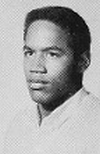
Simpson’s 1964 school portrait
Simpson grew up in San Francisco and lived with his family in the housing projects of the Potrero Hill neighborhood. In his early teenage years, he joined a street gang called the Persian Warriors and was briefly incarcerated at the San Francisco Youth Guidance Center. Future wife Marquerite, his childhood sweetheart, described Simpson as “really an awful person then”; after his third arrest, a meeting with Willie Mays during which the baseball star encouraged Simpson to avoid trouble helped persuade him to reform. At Galileo High School (currently Galileo Academy of Science and Technology) in San Francisco, Simpson played for the school football team, the Galileo Lions. He graduated in 1965.
College football and athletics career
Although Simpson was an All-City football player at Galileo, his mediocre high school grades prevented him from attracting the interest of many college recruiters. After a childhood friend’s injury in the Vietnam War influenced Simpson to stay out of the military, he enrolled at City College of San Francisco in 1965. He played football both ways as a running back and defensive back and was named to the Junior College All-American team as a running back. City College won the Prune Bowl against Long Beach State, and many colleges sought Simpson as a transfer student for football.
Simpson chose to attend the University of Southern California (USC), which he had admired as a young football fan, over the University of Utah and played running back for head coach John McKay in 1967 and 1968. Simpson led the nation in rushing both years under McKay: in 1967 with 1,543 yards and 13 touchdowns, and in 1968 with 1,880 yards on 383 carries.
As a junior in 1967, Simpson was a close runner-up in the Heisman Trophy balloting to quarterback Gary Beban of UCLA. In that year’s Victory Bell rivalry game between the teams, USC was down by six points in the fourth quarter with under eleven minutes remaining. On their own 36, USC backup quarterback Toby Page called an audible on third and seven. Simpson’s 64-yard touchdown run tied the score, and the extra point provided a 21–20 lead, which was the final score. This was the biggest play in what is regarded as one of the greatest football games of the 20th century.
Another dramatic touchdown in the same game is the subject of the Arnold Friberg oil painting, O.J. Simpson Breaks for Daylight. Simpson also won the Walter Camp Award in 1967 and was a two-time consensus All-American.
Simpson was an aspiring track athlete; in 1967 he lost a 100 m race at Stanford against the then-British record holder Menzies Campbell. Prior to playing football at Southern Cal, he ran in the USC sprint relay quartet that broke the world record in the 4 × 110-yard relay at the NCAA track championships in Provo, Utah on June 17, 1967.
As a senior in 1968, Simpson rushed for 1,709 yards and 22 touchdowns in the regular season, earning the Heisman Trophy, the Maxwell Award, and Walter Camp Award. He held the record for the Heisman’s largest margin of victory for 51 years, defeating runner-up Leroy Keyes by 1,750 points. In the Rose Bowl on New Year’s Day, #2 USC faced top-ranked Ohio State; Simpson ran for 171 yards, including an 80-yard touchdown run in a 27–16 loss.
Statistics
| Rushing | Receiving | |||||||
|---|---|---|---|---|---|---|---|---|
| YEAR | ATT | YDS | AVG | TD | NO. | YDS | AVG | TD |
| 1967 | 291 | 1,543 | 5.3 | 13 | 10 | 109 | 10.9 | 0 |
| 1968 | 383 | 1,880 | 4.9 | 23 | 26 | 211 | 8.1 | 0 |
| Totals | 674 | 3,423 | 5.1 | 36 | 36 | 320 | 8.9 | 0 |
Professional football career
Buffalo Bills

Simpson breaks the NFL’s single-season rushing record in 1973
The first selection 1969 AFL–NFL Common Draft was held by the AFL’s Buffalo Bills, after finishing 1–12–1 in 1968. They took Simpson, but he demanded what was then the largest contract in professional sports history: $650,000 over five years. This led to a standoff with Bills’ owner Ralph Wilson, as Simpson threatened to become an actor and skip professional football. Eventually, Wilson agreed to pay Simpson.
Simpson entered professional football with high expectations, but struggled in his first three years, averaging only 622 yards per season. Bills coach John Rauch, not wanting to build an offense around one running back, assigned Simpson to do blocking and receiving duties at the expense of running the ball. In 1971, Rauch resigned as head coach and the Bills brought in Harvey Johnson. Despite Johnson devising a new offense for Simpson, Simpson was still ineffective that year. After the 1971 season, the Bills fired Johnson and brought in Lou Saban as head coach. Unlike Rauch, Saban made Simpson the centerpiece of the Bills offense.
In 1972, Simpson rushed for over 1,000 yards for the first time in his career, gaining a league-leading total of 1,251 yards. In 1973, Simpson became the first player to break the highly coveted 2,000 yard rushing mark, with 2,003 total rushing yards and 12 touchdowns. Simpson broke the mark during the last game of the season against the New York Jets with a seven-yard rush. That same game also saw Simpson break Jim Brown’s single-season rushing record of 1,863 yards. For his performance, Simpson won that year’s NFL MVP Award and Bert Bell Award. While other players have broken the 2,000-yard mark since Simpson, his record was established in a time when the NFL had only 14 games per season, as opposed to the 16-game seasons that began in 1978. Simpson still holds the rushing record for 14 games.
Simpson gained more than 1,000 rushing yards for each of his next three seasons. He did not lead the league in rushing in 1974, but did cross the 1,000-yard barrier despite a knee injury. In game 11 of 1974, he passed Ken Willard as the rushing leader among active players, a position he maintained until his retirement more than five seasons later. Simpson also made his first and only playoff appearance during the 1974 season. In a divisional game against the Pittsburgh Steelers, Simpson rushed for 49 yards on 15 attempts and caught a touchdown pass, but the Bills lost the game 32–14.
Simpson won the rushing title again in 1975, rushing for 1,817 yards and 16 touchdowns. Simpson also had a career-high 426 receiving yards and seven receiving touchdowns that season. Simpson once again led the league in rushing in 1976, rushing for 1,503 yards and eight touchdowns. Simpson had the best game of his career during that season’s Thanksgiving game against the Detroit Lions on November 25. In that game, Simpson rushed for a then-record 273 yards on 29 attempts and scored two touchdowns. Despite Simpson’s performance, the Bills would lose the game 27–14.
A low light that season came during a game against the Patriots a few weeks earlier when defensive end Mel Lunsford and several other Patriots defenders stuffed the superstar running back for no gain but as Simpson tried to continue driving forward Lunsford bodyslammed him to the ground. Simpson got up and punched Lunsford which prompted Lunsford to swing back. Bills offensive lineman Reggie McKenzie then jumped on Lunsford’s back but Lunsford bent down and flung McKenzie over his head and went back to swinging at Simpson before a melee of the two teams stopped the fight and ended up in a pile on the field. Lunsford and Simpson were both ejected from the game as the Patriots solid defense persisted with New England going on to win 20-10 on their way to finishing the 1976 season 11-3. The Bills finished 2-12.
Simpson played in only seven games in 1977, as his season was cut short by injury.
San Francisco 49ers
Before the 1978 season, the Bills traded Simpson to his hometown San Francisco 49ers for a series of draft picks. Simpson played in San Francisco for two seasons, rushing for 1,053 yards and four touchdowns. His final NFL game was on December 16, 1979, a 31–21 loss to the Atlanta Falcons at Atlanta–Fulton County Stadium. His final play was a 10-yard run on 3rd and 10 for a first down.
Career summary
Simpson gained 11,236 rushing yards, placing him 2nd on the NFL’s all-time rushing list when he retired; he now stands at 21st. He was named NFL Player of the Year in 1973, and played in six Pro Bowls. He was the only player in NFL history to rush for over 2,000 yards in a 14-game season and he is the only player to rush for over 200 yards in six different games in his career. From 1972 to 1976, Simpson averaged 1,540 rushing yards per (14 game) season, 5.1 yards per carry, and he won the NFL rushing title four times. Simpson was inducted into the Pro Football Hall of Fame in 1985, his first year of eligibility. In 2019, he was named to the National Football League 100th Anniversary All-Time Team.
Simpson played in only one playoff game during his 11-season Hall of Fame career: a 1974 Divisional Playoff between the Buffalo Bills and the Pittsburgh Steelers. Simpson was held to 49 rushing yards, three receptions for 37 yards, and one touchdown, and the Bills lost 14–32 to the team which went on to win Super Bowl IX.
Simpson acquired the nickname “Juice” as a play on “O.J.”, a common abbreviation for orange juice. “Juice” is also a colloquial synonym for electricity or electrical power, and hence a metaphor for any powerful entity; the Bills’ offensive line at Simpson’s peak was nicknamed “The Electric Company”.
NFL records
- Fastest player to gain 1,000 rushing yards in season: 1,025 in seven games in 1973 and 1,005 in seven games in 1975 (tied with Terrell Davis).
- Fastest player to gain 2,000 rushing yards in season: 2,003 in 14 games in 1973.
- Most rushing yards per game in a season: 143.1 per game in 1973.
NFL career statistics
| Legend | |
|---|---|
| Led the league | |
| NFL record | |
| AP NFL MVP & Offensive Player of the Year | |
| Bold | Career high |
| Season | Rushing | Receiving | |||||||||||||||
|---|---|---|---|---|---|---|---|---|---|---|---|---|---|---|---|---|---|
| Year | Team | GP | GS | Att | Yds | TD | Lng | Y/A | Y/G | A/G | Rec | Yds | TD | Lng | Y/R | R/G | Y/G |
| 1969 | BUF | 13 | 0 | 181 | 697 | 2 | 32 | 3.9 | 53.6 | 13.9 | 30 | 343 | 3 | 55 | 11.4 | 2.3 | 26.4 |
| 1970 | BUF | 8 | 8 | 120 | 488 | 5 | 56 | 4.1 | 61.0 | 15.0 | 10 | 139 | 0 | 36 | 13.9 | 1.3 | 17.4 |
| 1971 | BUF | 14 | 14 | 183 | 742 | 5 | 46 | 4.1 | 53.0 | 13.1 | 21 | 162 | 0 | 38 | 7.7 | 1.5 | 11.6 |
| 1972 | BUF | 14 | 14 | 292 | 1,251 | 6 | 94 | 4.3 | 89.4 | 20.9 | 27 | 198 | 0 | 25 | 7.3 | 1.9 | 14.1 |
| 1973 | BUF | 14 | 14 | 332 | 2,003 | 12 | 80 | 6.0 | 143.1 | 23.7 | 6 | 70 | 0 | 24 | 11.7 | 0.4 | 5.0 |
| 1974 | BUF | 14 | 14 | 270 | 1,125 | 3 | 41 | 4.2 | 80.4 | 19.3 | 15 | 189 | 1 | 29 | 12.6 | 1.1 | 13.5 |
| 1975 | BUF | 14 | 14 | 329 | 1,817 | 16 | 88 | 5.5 | 129.8 | 23.5 | 28 | 426 | 7 | 64 | 15.2 | 2.0 | 30.4 |
| 1976 | BUF | 14 | 13 | 290 | 1,503 | 8 | 75 | 5.2 | 107.4 | 20.7 | 22 | 259 | 1 | 43 | 11.8 | 1.6 | 18.5 |
| 1977 | BUF | 7 | 7 | 126 | 557 | 0 | 39 | 4.4 | 79.6 | 18.0 | 16 | 138 | 0 | 18 | 8.6 | 2.3 | 19.7 |
| 1978 | SF | 10 | 10 | 161 | 593 | 1 | 34 | 3.7 | 59.3 | 16.1 | 21 | 172 | 2 | 19 | 8.2 | 2.1 | 17.2 |
| 1979 | SF | 13 | 8 | 120 | 460 | 3 | 22 | 3.8 | 35.4 | 9.2 | 7 | 46 | 0 | 14 | 6.6 | 0.5 | 3.5 |
| Career | 135 | 116 | 2,404 | 11,236 | 61 | 94 | 4.7 | 83.2 | 17.8 | 203 | 2,142 | 14 | 64 | 10.6 | 1.5 | 15.9 | |
| 9 yrs | BUF | 112 | 98 | 2,123 | 10,183 | 57 | 94 | 4.8 | 90.9 | 19.0 | 175 | 1,924 | 12 | 64 | 11.0 | 1.6 | 17.2 |
| 2 yrs | SF | 23 | 18 | 281 | 1,053 | 4 | 34 | 3.7 | 45.8 | 12.2 | 28 | 218 | 2 | 19 | 7.8 | 1.2 | 9.5 |
Acting career
Simpson began acting while at USC after winning the Heisman, appearing on Dragnet 1967 in a non-speaking role as a potential recruit to the LAPD. He became a professional actor before playing professional football, appearing in the first episode of Medical Center while negotiating his contract with the Bills. While in the NFL Simpson appeared in productions such as the television mini-series Roots (1977), and the dramatic motion pictures The Klansman (1974), The Towering Inferno (1974), The Cassandra Crossing (1976), and Capricorn One (1978). In 1979, he started his own film production company, Orenthal Productions, which dealt mostly in made-for-TV fare such as the family-oriented Goldie and the Boxer films with Melissa Michaelsen (1979 and 1981), and Cocaine and Blue Eyes (1983), the pilot for a proposed detective series on NBC.
Simpson said that he did not seriously consider an acting career until seeing Lee Marvin and Richard Burton, while filming The Klansman in Oroville, California, ordering chili from Chasen’s via private jet. He said in 1980 that “The Oscar or the Emmy says you’ve reached a level of competence in this business, and I would love to have one”. Simpson avoided starring in blaxploitation films, choosing third or fourth lead roles while studying experienced stars like Marvin and Burton. The Hertz commercials from 1975 benefited Simpson’s acting career but he sometimes intentionally chose non-positive roles; “I’ve got to tear down that picture of O.J. Simpson, the clean-cut athlete, to get believability into whatever part I happen to be playing”. Simpson also starred in the comedic Back to the Beach (1987) and The Naked Gun trilogy (1988, 1991, 1994). According to Arnold Schwarzenegger, Simpson was considered by director James Cameron to play the eponymous character in The Terminator (1984) when Schwarzenegger was cast as Kyle Reese, but Cameron ultimately cast Schwarzenegger as the Terminator while Simpson had no involvement in the film.
Besides his acting career, Simpson worked as a commentator for Monday Night Football and The NFL on NBC. He also appeared in the audience of Saturday Night Live during its second season and hosted an episode during its third season.
Frogmen
Simpson starred in the un-televised two-hour-long film pilot for Frogmen, an A-Team-like adventure series that Warner Bros. Television completed in 1994, a few months before the murders. NBC had not yet decided whether to order the series when Simpson’s arrest cancelled the project. While searching his home, the police obtained a videotaped copy of the pilot as well as the script and dailies. Although the prosecution investigated reports that Simpson, who played the leader of a group of former United States Navy SEALs, received “a fair amount of” military training—including use of a knife—for Frogmen, and there is a scene in which he holds a knife to the throat of a woman, this material was not introduced as evidence during the trial.
NBC executive Warren Littlefield said in July 1994 that the network would probably never air the pilot if Simpson were convicted; if he were acquitted, however, one television journalist speculated that “Frogmen would probably be on the air before the NBC peacock could unfurl its plume”. Most pilots that are two hours long are aired as TV movies whether or not they are ordered as series. Because—as the Los Angeles Times later reported—”the appetite for all things O.J. appeared insatiable” during the trial, Warner Bros. and NBC estimated that a gigantic, Super Bowl-like television audience would have watched the Frogmen film. Co-star Evan Handler said the studio’s decision not to air it or release it on home video, and forego an estimated $14 million in profits, was “just about the only proof you have that there is some dignity in the advertising and television business”.
Juiced
In 2006, Simpson starred in his own improv, hidden-camera prank TV show, Juiced. Typical of the genre, Simpson would play a prank on everyday people while secretly filming them and at the end of each prank, he would shout, “You’ve been Juiced!” Less typical, each episode opened with topless strippers dancing around Simpson, who is dressed as a pimp. He sings his own rap song, which includes the lyrics “Don’t you know there’s no stopping the Juice / When I’m on the floor I’m like a lion on the loose / Better shoot me with a tranquilizer dart / Don’t be stupid, I’m not a Simpson named Bart.” In one episode, Simpson is at a used car lot in Las Vegas where he attempts to sell his white Bronco. A bullet hole in the front of the SUV is circled with his autograph, and he pitches it to a prospective buyer by saying that if they “ever get into some trouble and have to get away, it has escapability.” In another sketch called “B-I-N-G-O.J.”, Simpson pretends to be having an affair with another man’s girlfriend. Later he transforms into an old white man whose dying wish is to call a game of bingo. Juiced aired as a one-time special on pay-per-view television and was later released on DVD.