
Pangolins, sometimes known as scaly anteaters, are mammals of the order Pholidota (/fɒlɪˈdoʊtə/, from Ancient Greek ϕολιδωτός – “clad in scales”). The one extant family, the Manidae, has three genera: Manis, Phataginus, and Smutsia. Manis comprises the four species found in Asia, while Phataginus and Smutsia include two species each, all found in sub-Saharan Africa. These species range in size from 30 to 100 cm (12 to 39 in). A number of extinct pangolin species are also known.
Pangolins have large, protective keratin scales, similar in material to fingernails and toenails, covering their skin; they are the only known mammals with this feature. They live in hollow trees or burrows, depending on the species. Pangolins are nocturnal, and their diet consists of mainly ants and termites, which they capture using their long tongues. They tend to be solitary animals, meeting only to mate and produce a litter of one to three offspring, which they raise for about two years.
Pangolins are threatened by poaching (for their meat and scales, which are used in traditional medicine) and heavy deforestation of their natural habitats, and they are the most trafficked mammals in the world. As of January 2020, there are eight species of pangolin whose conservation status is listed in the threatened tier. Three (Manis culionensis, M. pentadactyla and M. javanica) are critically endangered, three (Phataginus tricuspis, Manis crassicaudata and Smutsia gigantea) are endangered and two (Phataginus tetradactyla and Smutsia temminckii) are vulnerable on the Red List of Threatened Species of the International Union for Conservation of Nature.
Etymology
The name “pangolin” comes from the Malay word pengguling, meaning “one who rolls up”. However, the modern name in Standard Malay is tenggiling; whereas in Indonesian it is trenggiling; and in the Philippine languages, it is goling, tanggiling, or balintong (with the same meaning).
Description

Pangolin skeletons at the Museum of Osteology (2009)

Schematic drawing of pangolin scale histology
The physical appearance of a pangolin is marked by large, hardened, overlapping, plate-like scales, which are soft on newborn pangolins, but harden as the animal matures. They are made of keratin, the same material from which human fingernails and tetrapod claws are made, and are structurally and compositionally very different from the scales of reptiles. The pangolin’s scaled body is comparable in appearance to a pine cone. It can curl up into a ball when threatened, with its overlapping scales acting as armor, while it protects its face by tucking it under its tail. The scales are sharp, providing extra defense from predators.
Pangolins can emit a noxious-smelling chemical from glands near the anus, similar to the spray of a skunk. They have short legs, with sharp claws which they use for burrowing into ant and termite mounds and for climbing.
The tongues of pangolins are extremely long, and like those of the giant anteater and the tube-lipped nectar bat, the root of the tongue is not attached to the hyoid bone, but is in the thorax between the sternum and the trachea. Large pangolins can extend their tongues as much as 40 cm (16 in), with a diameter of only about 0.5 cm (1⁄5 in).
Behavior
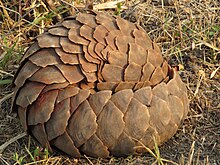
Ground pangolin in defensive posture

Indian pangolin defending itself against Asiatic lions
Most pangolins are nocturnal animals which use their well-developed sense of smell to find insects. The long-tailed pangolin is also active by day, while other species of pangolins spend most of the daytime sleeping, curled up into a ball (“volvation”).
Arboreal pangolins live in hollow trees, whereas the ground-dwelling species dig tunnels to a depth of 3.5 m (11 ft).
Some pangolins walk with their front claws bent under the foot pad, although they use the entire foot pad on their rear limbs. Furthermore, some exhibit a bipedal stance for some behaviour, and may walk a few steps bipedally. Pangolins are also good swimmers.
Diet
Pangolins are insectivorous. Most of their diet consists of various species of ants and termites, and may be supplemented by other insects, especially larvae. They are somewhat particular and tend to consume only one or two species of insects, even when many species are available to them. A pangolin can consume 140 to 200 g (5 to 7 oz) of insects per day. Pangolins are an important regulator of termite populations in their natural habitats.
Pangolins have very poor vision. They also lack teeth. They rely heavily on smell and hearing, and they have other physical characteristics to help them eat ants and termites. Their skeletal structure is sturdy and they have strong front legs that are used for tearing into termite mounds. They use their powerful front claws to dig into trees, soil, and vegetation to find prey, then proceed to use their long tongues to probe inside the insect tunnels and to retrieve their prey.
The structure of their tongue and stomach is key to aiding pangolins in obtaining and digesting insects. Their saliva is sticky, causing ants and termites to stick to their long tongues when they are hunting through insect tunnels. Without teeth, pangolins also lack the ability to chew; but while foraging, they ingest small stones (gastroliths), which accumulate in their stomachs to help to grind up ants. This part of their stomach is called the gizzard, and it is also covered in keratinous spines. These spines further aid in the grinding up and digestion of the pangolin’s prey.
Some species, such as the tree pangolin, use their strong, prehensile tails to hang from tree branches and strip away bark from the trunk, exposing insect nests inside.
Reproduction
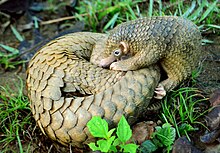
A Philippine pangolin pup and its mother, a critically endangered species endemic to the Palawan island group. It is threatened by illegal poaching for the pangolin trade to China and Vietnam, where it is regarded as a luxury medicinal delicacy.
Pangolins are solitary and meet only to mate. Males are larger than females, weighing up to 40% more. While the mating season is not defined, they typically mate once each year, usually during the summer or autumn. Rather than the males seeking out the females, males mark their location with urine or feces and the females find them. If competition over a female occurs, the males use their tails as clubs to fight for the opportunity to mate with her.
Gestation periods differ by species, ranging from roughly 70 to 140 days. African pangolin females usually give birth to a single offspring at a time, but the Asiatic species may give birth to from one to three. Weight at birth is 80 to 450 g (2+3⁄4 to 15+3⁄4 oz), and the average length is 150 mm (6 in). At the time of birth, the scales are soft and white. After several days, they harden and darken to resemble those of an adult pangolin. During the vulnerable stage, the mother stays with her offspring in the burrow, nursing it, and wraps her body around it if she senses danger. The young cling to the mother’s tail as she moves about, although in burrowing species, they remain in the burrow for the first 2–4 weeks of life. At one month, they first leave the burrow riding on the mother’s back. Weaning takes place around 3 months of age, when the young begin to eat insects in addition to nursing. At 2 years of age, the offspring are sexually mature and are abandoned by the mother.
Classification and phylogeny
Taxonomy
- Order: Pholidota (Weber, 1904) (pangolins)
- Genus: †Euromanis (Gaudin, Emry & Wible, 2009)
- †Euromanis krebsi (Storch & Martin, 1994)
- Family: †Eurotamanduidae (Szalay & Schrenk, 1994)
- Genus: †Eurotamandua (Storch, 1981)
- †Eurotamandua joresi (Storch, 1981)
- Genus: †Eurotamandua (Storch, 1981)
- Suborder: Eupholidota (Gaudin, Emry & Wible, 2009) (true pangolins)
- Superfamily: †Eomanoidea (Gaudin, Emry & Wible, 2009)
- Family: †Eomanidae (Storch, 2003)
- Genus: †Eomanis (Storch, 1978)
- †Eomanis waldi (Storch, 1978)
- Genus: †Eomanis (Storch, 1978)
- Family: †Eomanidae (Storch, 2003)
- Superfamily: Manoidea (Gaudin, Emry & Wible, 2009)
- Family: Manidae (Gray, 1821) (pangolins)
- Subfamily: Maninae (Gray, 1821) (Asiatic pangolins)
- Genus: Manis (Linnaeus, 1758) (Asiatic pangolins)
- Manis crassicaudata (Gray, 1827) (Indian pangolin)
- Manis pentadactyla (Linnaeus, 1758) (Chinese pangolin)
- †Manis hungarica (Kormos, 1934)
- †Manis lydekkeri (Dubois, 1908)
- Subgenus: Paramanis (Pocock, 1924)
- Manis javanica (Desmarest, 1822) (Sunda pangolin)
- Manis culionensis (de Elera, 1895) (Philippine pangolin)
- †Manis palaeojavanica (Dubois, 1907) (Giant asian pangolin)
- Genus: Manis (Linnaeus, 1758) (Asiatic pangolins)
- Subfamily: Phatagininae (Gaubert, 2017) (small African pangolins)
- Genus: Phataginus (Rafinesque, 1821) (African tree pangolins)
- Phataginus tetradactyla (Linnaeus, 1766) (Long-tailed pangolin)
- Phataginus tricuspis (Rafinesque, 1821) (Tree pangolin)
- Genus: Phataginus (Rafinesque, 1821) (African tree pangolins)
- Subfamily: Smutsiinae (Gray, 1873) (large African pangolins)
- Genus: Smutsia (Gray, 1865) (African ground pangolins)
- Smutsia gigantea (Illiger, 1815) (Giant pangolin)
- Smutsia temmincki (Smuts, 1832) (Ground pangolin)
- †Smutsia olteniensis (Terhune, 2021)
- Genus: Smutsia (Gray, 1865) (African ground pangolins)
- Incertae sedis
- †Fayum pangolin (manidae sp. (Gebo & Rasmussen, 1985))
- Subfamily: Maninae (Gray, 1821) (Asiatic pangolins)
- Family: †Patriomanidae (Szalay & Schrenk 1998)
- Genus: †Cryptomanis (Gaudin, Emry & Pogue, 2006)
- †Cryptomanis gobiensis (Gaudin, Emry & Pogue, 2006)
- Genus: †Patriomanis (Emry, 1970)
- †Patriomanis americana (Emry, 1970)
- Genus: †Cryptomanis (Gaudin, Emry & Pogue, 2006)
- Incertae sedis
- Genus: †Necromanis (Filhol, 1893)
- †Necromanis franconica (Quenstedt, 1886)
- †Necromanis parva (Koenigswald, 1969)
- †Necromanis quercyi (Filhol, 1893)
- Genus: †Necromanis (Filhol, 1893)
- Family: Manidae (Gray, 1821) (pangolins)
- Superfamily: †Eomanoidea (Gaudin, Emry & Wible, 2009)
- Genus: †Euromanis (Gaudin, Emry & Wible, 2009)
Phylogeny
Among placentals
The order Pholidota was considered to be the sister taxon to Xenarthra (neotropical anteaters, sloths, and armadillos), but recent genetic evidence indicates their closest living relatives are the carnivorans, with which they form a clade termed either Ferae or Ostentoria. Fossil groups like the creodonts and palaeanodonts are even closer relatives to pangolins (the latter group being classified with pangolins in the clade Pholidotamorpha). The split between carnivorans and pangolins is estimated to have occurred 79–87 Ma (million years) ago.
| Phylogenetic position of the order Pholidota in the order-level cladogram of Boreoeutheria (only living groups) |
|||||||||||||||||||||||||||||||||||||||
|
|||||||||||||||||||||||||||||||||||||||
| The cladogram has been reconstructed from mitochondrial and nuclear DNA and protein characters. |


| Phylogenetic position of order Pholidota within clade Ferae. | |||||||||||||||||||||||||||||||||||||||||||||||||||
|


| Phylogenetic position of pangolins within order Pholidota. | ||||||||||||||||||||||||||||||||||||||||||||||||||||||||||||||||||||||||||
|
Among Manidae
The first dichotomy in the phylogeny of extant Manidae separates Asian pangolins (Manis) from African pangolins (Smutsia and Phataginus). Within the former, Manis pentadactyla is the sister group to a clade comprising M. crassicaudata and M. javanica. Within the latter, a split separates the large terrestrial African pangolins of genus Smutsia from the small arboreal African pangolins of genus Phataginus.
| Phylogenetic relationships of genera and species of Manidae | ||||||||||||||||||||||||||||||
|
