
Pokémon, also known as Pocket Monsters in Japan, is a Japanese media franchise managed by The Pokémon Company, a company founded by Nintendo, Game Freak, and Creatures. The franchise was created by Satoshi Tajiri in 1995, and is centered on fictional creatures called “Pokémon”, which humans, known as Pokémon Trainers, catch and train to battle each other for sport. Games, shows and other works within the franchise are set in the Pokémon universe. The English slogan for the franchise is “Gotta Catch ‘Em All”.
The franchise began as Pocket Monsters: Red and Green (later released outside of Japan as Pokémon Red and Blue), a pair of video games for the original Game Boy handheld system that were developed by Game Freak and published by Nintendo in February 1996. It soon became a media mix franchise adapted into various different media. Pokémon has since become the highest-grossing media franchise of all time. The original video game series is the second-best-selling video game franchise (behind Nintendo’s Mario franchise) with more than 368 million copies sold and one billion mobile downloads, and it spawned a hit anime television series that has become the most successful video game adaptation with over 20 seasons and 1,000 episodes in 169 countries. In addition, the Pokémon franchise includes the world’s top-selling toy brand, the top-selling trading card game with over 30.4 billion cards sold, an anime film series, a live-action film, books, manga comics, music, merchandise, and a theme park. The franchise is also represented in other Nintendo media, such as the Super Smash Bros. series, where various Pokémon characters are playable.
In November 2005, 4Kids Entertainment, which had managed the non-game related licensing of Pokémon, announced that it had agreed not to renew the Pokémon representation agreement. The Pokémon Company International oversees all Pokémon licensing outside Asia. In 2006, the franchise celebrated its tenth anniversary. In 2016, the Pokémon Company celebrated Pokémon‘s 20th anniversary by airing an ad during Super Bowl 50 in January and re-releasing the first Pokémon video games 1996 Game Boy games Pokémon Red, Green (only in Japan), and Blue, and the 1998 Game Boy Color game Pokémon Yellow for the Nintendo 3DS on February 26, 2016. The mobile augmented reality game Pokémon Go was released in July 2016. The first live-action film in the franchise, Pokémon Detective Pikachu, based on the 2018 Nintendo 3DS spin-off game Detective Pikachu, was released in 2019. The most recently released core series games, Pokémon Sword and Shield, were released worldwide on the Nintendo Switch on November 15, 2019.
In celebration of its 25th anniversary in 2021, the upcoming core series games, Pokémon Brilliant Diamond and Shining Pearl will be released in late 2021, and Pokémon Legends: Arceus in early 2022, both for the Nintendo Switch. They are remakes and a premake of the 2006 Nintendo DS games Pokémon Diamond and Pearl, respectively.
Name
The name Pokémon is a syllabic abbreviation of the Japanese brand Pocket Monsters. The term “Pokémon”, in addition to referring to the Pokémon franchise itself, also collectively refers to the 898 fictional species that have made appearances in Pokémon media as of the release of the eighth generation titles Pokémon Sword and Shield. “Pokémon” is identical in the singular and plural, as is each individual species name; it is grammatically correct to say “one Pokémon” and “many Pokémon”, as well as “one Pikachu” and “many Pikachu”.
Concept
Gameplay of Pokémon

Gameplay of a Pokémon battle between an Ivysaur and Pikachu in Pokémon Red and Blue
Pokémon executive director Satoshi Tajiri first thought of Pokémon, albeit with a different concept and name, around 1989, when the Game Boy was released. The concept of the Pokémon universe, in both the video games and the general fictional world of Pokémon, stems from the hobby of insect collecting, a popular pastime which Tajiri enjoyed as a child. Players are designated as Pokémon Trainers and have three general goals: to complete the regional Pokédex by collecting all of the available Pokémon species found in the fictional region where a game takes place, to complete the national Pokédex by transferring Pokémon from other regions, and to train a team of powerful Pokémon from those they have caught to compete against teams owned by other Trainers so they may eventually win the Pokémon League and become the regional Champion. These themes of collecting, training, and battling are present in almost every version of the Pokémon franchise, including the video games, the anime and manga series, and the Pokémon Trading Card Game.
In most incarnations of the Pokémon universe, a Trainer who encounters a wild Pokémon is able to capture that Pokémon by throwing a specially designed, mass-producible spherical tool called a Poké Ball at it. If the Pokémon is unable to escape the confines of the Poké Ball, it is considered to be under the ownership of that Trainer. Afterwards, it will obey whatever commands it receives from its new Trainer, unless the Trainer demonstrates such a lack of experience that the Pokémon would rather act on its own accord. Trainers can send out any of their Pokémon to wage non-lethal battles against other Pokémon; if the opposing Pokémon is wild, the Trainer can capture that Pokémon with a Poké Ball, increasing their collection of creatures. In Pokémon Go, and in Pokémon: Let’s Go, Pikachu! and Let’s Go, Eevee!, wild Pokémon encountered by players can be caught in Poké Balls, but generally cannot be battled. Pokémon already owned by other Trainers cannot be captured, except under special circumstances in certain side games. If a Pokémon fully defeats an opponent in battle so that the opponent is knocked out (“faints”), the winning Pokémon gains experience points and may level up. Beginning with Pokémon X and Y, experience points are also gained from catching Pokémon in Poké Balls. When leveling up, the Pokémon’s battling aptitude statistics (“stats”, such as “Attack” and “Speed”) increase. At certain levels, the Pokémon may also learn new moves, which are techniques used in battle. In addition, many species of Pokémon can undergo a form of metamorphosis and transform into a similar but stronger species of Pokémon, a process called evolution; this process occurs spontaneously under differing circumstances, and is itself a central theme of the series. Some species of Pokémon may undergo a maximum of two evolutionary transformations, while others may undergo only one, and others may not evolve at all. For example, the Pokémon Pichu may evolve into Pikachu, which in turn may evolve into Raichu, following which no further evolutions may occur. Pokémon X and Y introduced the concept of “Mega Evolution,” by which certain fully evolved Pokémon may temporarily undergo an additional evolution into a stronger form for the purpose of battling; this evolution is considered a special case, and unlike other evolutionary stages, is reversible.
In the main series, each game’s single-player mode requires the Trainer to raise a team of Pokémon to defeat many non-player character (NPC) Trainers and their Pokémon. Each game lays out a somewhat linear path through a specific region of the Pokémon world for the Trainer to journey through, completing events and battling opponents along the way (including foiling the plans of an ‘evil’ team of Pokémon Trainers who serve as antagonists to the player). Excluding Pokémon Sun and Moon and Pokémon Ultra Sun and Ultra Moon, the games feature eight powerful Trainers, referred to as Gym Leaders, that the Trainer must defeat in order to progress. As a reward, the Trainer receives a Gym Badge, and once all eight badges are collected, the Trainer is eligible to challenge the region’s Pokémon League, where four talented trainers (referred to collectively as the “Elite Four”) challenge the Trainer to four Pokémon battles in succession. If the trainer can overcome this gauntlet, they must challenge the Regional Champion, the master Trainer who had previously defeated the Elite Four. Any Trainer who wins this last battle becomes the new champion.
Pokémon universe
Pokémon is set in the fictional Pokemon universe. There are numerous regions that have appeared in the various media of the Pokémon franchise. There are 8 main series regions set in the main series games: Kanto, Johto, Hoenn, Sinnoh, Unova, Kalos, Alola, and Galar. Each of the eight generations of the main series releases focuses on a new region. Every region consists of several cities and towns that the player must explore in order to overcome many waiting challenges, such as Gyms, Contests and villainous teams. At different locations within each region, the player can find different types of Pokémon, as well as helpful items and characters. Different regions are not accessible from one another at all within a single game, only with the exception of Kanto and Johto being linked together in Pokémon Gold, Silver, Crystal, HeartGold and SoulSilver versions. There are also regions set in spinoff games and two islands in the Pokémon anime (Orange Islands and Decolore Islands), all still set within the same fictional universe.
Each main series region in the Pokémon universe is based on a real world location. The first 4 introduced regions (Kanto, Johto, Hoenn, and Sinnoh) are based on parts of Japan, with later regions being based on parts of the United States (Unova and Alola), France (Kalos) and the United Kingdom (Galar).
| Pokémon region | Real world location basis |
|---|---|
Kanto
|
Kantō,  Japan Japan
|
| Johto | Kansai, Japan |
| Hoenn | Kyushu, Japan |
Sinnoh
|
Hokkaido, Japan
|
| Unova |  New York City, New York City,  United States United States |
| Kalos |  France France |
| Alola |  Hawaii, United States Hawaii, United States |
Galar
|
 United Kingdom United Kingdom
|


Video games
 |
This section needs additional citations for verification. (February 2021) (Learn how and when to remove this template message)
|
Generations
| 1996 | Red and Green |
|---|---|
| Blue | |
| 1997 | |
| 1998 | Yellow |
| Red and Blue | |
| 1999 | Gold and Silver |
| 2000 | Crystal |
| 2001 | |
| 2002 | Ruby and Sapphire |
| 2003 | |
| 2004 | FireRed and LeafGreen |
| Emerald | |
| 2005 | |
| 2006 | Diamond and Pearl |
| 2007 | |
| 2008 | Platinum |
| 2009 | HeartGold and SoulSilver |
| 2010 | Black and White |
| 2011 | |
| 2012 | Black 2 and White 2 |
| 2013 | X and Y |
| 2014 | Omega Ruby and Alpha Sapphire |
| 2015 | |
| 2016 | Sun and Moon |
| 2017 | Ultra Sun and Ultra Moon |
| 2018 | Let’s Go, Pikachu! and Let’s Go, Eevee! |
| 2019 | Sword and Shield |
| 2020 | |
| 2021 | Brilliant Diamond and Shining Pearl |
| 2022 | Legends: Arceus |

A rival battle between a Bulbasaur and a Charmander in Pokémon Red and Blue.
All of the licensed Pokémon properties overseen by the Pokémon Company International are divided roughly by generation. These generations are roughly chronological divisions by release; every several years, when a sequel to the 1996 role-playing video games Pokémon Red and Green is released that features new Pokémon, characters, and gameplay concepts, that sequel is considered the start of a new generation of the franchise. The main Pokémon video games and their spin-offs, the anime, manga, and trading card game are all updated with the new Pokémon properties each time a new generation begins. Some Pokémon from the newer games appear in anime episodes or films months, or even years, before the game they were programmed for came out. The first generation began in Japan with Pokémon Red and Green on the Game Boy. As of 2020, there are eight generations of main series video games. The most recent games in the main series, Pokémon Sword and Shield, began the eighth and latest generation and were released worldwide for the Nintendo Switch on November 15, 2019.
List of Pokémon main series video games
| Generation | Title | Release date | System |
|---|---|---|---|
| Generation I 1996–1999Kanto region |
Pocket Monsters: Red and Green | February 27, 1996JP | Game Boy |
| Pocket Monsters: Blue | October 15, 1996JP | ||
| Pokémon Red and Blue | September 28, 1998NA October 23, 1998AUS October 5, 1999EU |
||
| Pokémon Yellow | September 12, 1998JP October 19, 1999NA September 3, 1999AUS June 16, 2000EU |
||
| Generation II 1999–2002Johto regionKanto region |
Pokémon Gold and Silver | November 21, 1999JP October 13, 2000AUS October 14, 2000NA April 6, 2001EU April 23, 2002KO |
Game Boy Color |
| Pokémon Crystal | December 14, 2000JP July 29, 2001NA September 30, 2001AUS November 2, 2001EU |
||
| Generation III 2002–2006Hoenn regionKanto region |
Pokémon Ruby and Sapphire | November 21, 2002JP March 18, 2003NA April 3, 2003AUS July 25, 2003EU |
Game Boy Advance |
| Pokémon FireRed and LeafGreen | January 29, 2004JP September 7, 2004NA September 23, 2004AUS October 1, 2004EU |
||
| Pokémon Emerald | September 16, 2004JP April 30, 2005NA June 9, 2005AUS October 21, 2005EU |
||
| Generation IV 2006–2010Sinnoh regionJohto region Kanto region |
Pokémon Diamond and Pearl | September 28, 2006JP April 22, 2007NA June 21, 2007AUS July 27, 2007EU February 14, 2008KO |
Nintendo DS |
| Pokémon Platinum | September 13, 2008JP March 22, 2009NA May 14, 2009AUS May 22, 2009EU July 2, 2009KO |
||
| Pokémon HeartGold and SoulSilver | September 12, 2009JP February 4, 2010KO March 14, 2010NA March 25, 2010AUS March 26, 2010EU |
||
| Generation V 2010–2013Unova region |
Pokémon Black and White | September 18, 2010JP March 4, 2011EU March 6, 2011NA March 10, 2011AUS April 21, 2011KO |
|
| Pokémon Black 2 and White 2 | June 23, 2012JP October 7, 2012NA October 11, 2012AUS October 12, 2012EU |
||
| Generation VI 2013–2016Kalos regionHoenn region |
Pokémon X and Y | October 12, 2013WW | Nintendo 3DS |
| Pokémon Omega Ruby and Alpha Sapphire | November 21, 2014JP, NA, AUS November 28, 2014EU |
||
| Generation VII 2016–2019Alola regionKanto region |
Pokémon Sun and Moon | November 18, 2016JP, NA, AUS November 23, 2016EU |
|
| Pokémon Ultra Sun and Ultra Moon | November 17, 2017WW | ||
| Pokémon: Let’s Go, Pikachu! and Let’s Go, Eevee! | November 16, 2018WW | Nintendo Switch | |
| Generation VIII 2019–presentGalar regionSinnoh region |
Pokémon Sword and Shield | November 15, 2019WW | |
| Pokémon Brilliant Diamond and Shining Pearl | Late 2021 | ||
| Pokémon Legends: Arceus | Early 2022 |
In other media
Anime series
| 1997 | Indigo League |
|---|---|
| 1998 | |
| 1999 | Adventures in the Orange Islands |
| The Johto Journeys | |
| 2000 | Johto League Champions |
| 2001 | Master Quest |
| 2002 | Advanced |
| 2003 | Advanced Challenge |
| 2004 | Advanced Battle |
| 2005 | Battle Frontier |
| 2006 | Diamond and Pearl |
| 2007 | Diamond and Pearl: Battle Dimension |
| 2008 | Diamond and Pearl: Galactic Battles |
| 2009 | |
| 2010 | Diamond and Pearl: Sinnoh League Victors |
| Black & White | |
| 2011 | Black & White: Rival Destinies |
| 2012 | Black & White: Adventures in Unova |
| 2013 | Black & White: Adventures in Unova and Beyond |
| XY | |
| 2014 | XY: Kalos Quest |
| 2015 | XYZ |
| 2016 | Sun and Moon |
| 2017 | Sun & Moon: Ultra Adventures |
| 2018 | Sun & Moon: Ultra Legends |
| 2019 | Journeys |
| Season | Title | Episodes | Originally aired | |||
|---|---|---|---|---|---|---|
| First aired | Last aired | |||||
| 1 | Indigo League | 82 | April 1, 1997 | January 21, 1999 | ||
| 2 | Adventures in the Orange Islands | 36 | January 28, 1999 | October 7, 1999 | ||
| 3 | The Johto Journeys | 41 | October 14, 1999 | July 27, 2000 | ||
| 4 | Johto League Champions | 52 | August 3, 2000 | August 2, 2001 | ||
| 5 | Master Quest | 65 | August 9, 2001 | November 14, 2002 | ||
| 6 | Advanced | 40 | November 21, 2002 | August 28, 2003 | ||
| 7 | Advanced Challenge | 52 | September 4, 2003 | September 2, 2004 | ||
| 8 | Advanced Battle | 54 | September 9, 2004 | September 29, 2005 | ||
| 9 | Battle Frontier | 47 | October 6, 2005 | September 14, 2006 | ||
| 10 | Diamond and Pearl | 52 | September 28, 2006 | October 25, 2007 | ||
| 11 | Diamond and Pearl: Battle Dimension | 52 | November 8, 2007 | December 4, 2008 | ||
| 12 | Diamond and Pearl: Galactic Battles | 53 | December 4, 2008 | December 24, 2009 | ||
| 13 | Diamond and Pearl: Sinnoh League Victors | 34 | January 7, 2010 | September 9, 2010 | ||
| 14 | Black & White | 50 | September 23, 2010 | September 15, 2011 | ||
| 15 | Black & White: Rival Destinies | 49 | September 22, 2011 | October 4, 2012 | ||
| 16 | Black & White: Adventures in Unova | 45 | 25 | October 11, 2012 | April 18, 2013 | |
| Black & White: Adventures in Unova and Beyond | 20 | April 25, 2013 | September 26, 2013 | |||
| 17 | XY | 48 | October 17, 2013 | October 30, 2014 | ||
| 18 | XY: Kalos Quest | 45 | November 13, 2014 | October 22, 2015 | ||
| 19 | XYZ | 47 | October 29, 2015 | October 27, 2016 | ||
| 20 | Sun & Moon | 43 | November 17, 2016 | September 21, 2017 | ||
| 21 | Sun & Moon: Ultra Adventures | 49 | October 5, 2017 | October 14, 2018 | ||
| 22 | Sun & Moon: Ultra Legends | 54 | October 21, 2018 | November 3, 2019 | ||
| 23 | Journeys | 61 | November 17, 2019 | TBA | ||
Pokémon, also known as Pokémon the Series to Western audiences since 2013, is an anime television series based on the Pokémon video game series. It was originally broadcast on TV Tokyo in 1997. More than 1,000 episodes of the anime has been produced and aired, divided into 7 series in Japan and 22 seasons internationally. It is one of the longest currently running anime series.
The anime follows the quest of the main character, Ash Ketchum (known as Satoshi in Japan), a Pokémon Master in training, as he and a small group of friends travel around the world of Pokémon along with their Pokémon partners.
Various children’s books, collectively known as Pokémon Junior, are also based on the anime.
A new seven part anime series called Pokémon: Twilight Wings began airing on YouTube in 2020. The series was animated by Studio Colorido.
Films
| 1998 | Pokémon: The First Movie – Mewtwo Strikes Back |
|---|---|
| 1999 | Pokémon: The Movie 2000 – The Power of One |
| 2000 | Pokémon 3: The Movie – Spell of the Unown |
| 2001 | Pokémon 4Ever: Celebi – Voice of the Forest |
| 2002 | Pokémon Heroes: Latios and Latias |
| 2003 | Jirachi—Wish Maker |
| 2004 | Destiny Deoxys |
| 2005 | Lucario and the Mystery of Mew |
| 2006 | Pokémon Ranger and the Temple of the Sea |
| 2007 | The Rise of Darkrai |
| 2008 | Giratina and the Sky Warrior |
| 2009 | Arceus and the Jewel of Life |
| 2010 | Zoroark—Master of Illusions |
| 2011 | White—Victini and Zekrom |
| Black—Victini and Reshiram | |
| 2012 | Kyurem vs. the Sword of Justice |
| 2013 | Genesect and the Legend Awakened |
| 2014 | Diancie and the Cocoon of Destruction |
| 2015 | Hoopa and the Clash of Ages |
| 2016 | Volcanion and the Mechanical Marvel |
| 2017 | I Choose You! |
| 2018 | The Power of Us |
| 2019 | Mewtwo Strikes Back: Evolution |
| 2020 | Secrets of the Jungle |
| 2019 | Pokémon Detective Pikachu |
|---|---|
| 2020 | |
| TBA | untitled Detective Pikachu sequel |
There have been 23 animated theatrical Pokémon films (latest film to be released on December 25, 2020), which have been directed by Kunihiko Yuyama and Tetsuo Yajima, and distributed in Japan by Toho since 1998. The pair of films, Pokémon the Movie: Black—Victini and Reshiram and White—Victini and Zekrom are considered together as one film. Collectibles, such as promotional trading cards, have been available with some of the films. Since the 20th film, the films have been set in an alternate continuity separate from the anime series.
List of Pokémon animated theatrical films
Pokémon: Original Series
| # | English title | Japanese title | Japanese release date | North American release date |
|---|---|---|---|---|
| 1 | Pokémon: The First Movie – Mewtwo Strikes Back | Mewtwo Strikes Back (ミュウツーの逆襲, Myūtsū no Gyakushū) | July 18, 1998 | November 10, 1999 |
| 2 | Pokémon: The Movie 2000 – The Power of One | Mirage Pokémon: Lugia’s Explosive Birth (幻のポケモン ルギア爆誕, Maboroshi no Pokemon Rugia Bakutan) | July 17, 1999 | July 21, 2000 |
| 3 | Pokémon 3: The Movie – Spell of the Unown | Emperor of The Crystal Tower: ENTEI (結晶塔の帝王 ENTEI, Kesshōtō no Teiō ENTEI) | July 8, 2000 | April 6, 2001 |
| 4 | Pokémon 4Ever: Celebi – Voice of the Forest | Celebi: The Meeting that Traversed Time (セレビィ 時を超えた遭遇(であい), Serebyi Toki o Koeta Deai) | July 7, 2001 | October 11, 2002 |
| 5 | Pokémon Heroes: Latios and Latias | Guardian Gods of the Capital of Water: Latias and Latios (水の都の護神 ラティアスとラティオス, Mizu no Miyako no Mamorigami Ratiasu to Ratiosu) | July 13, 2002 | May 16, 2003 |
Pokémon: Advanced Generation
| # | English title | Japanese title | Japanese release date | North American release date |
|---|---|---|---|---|
| 6 | Jirachi—Wish Maker | Wishing Star of the Seven Nights: Jirachi (七夜の願い星 ジラーチ, Nanayo no Negaiboshi Jirāchi) | July 19, 2003 | June 1, 2004 |
| 7 | Destiny Deoxys | Visitor from the Sky-Splitting: Deoxys (裂空の訪問者 デオキシス, Rekkū no Hōmonsha Deokishisu) | July 17, 2004 | January 22, 2005 |
| 8 | Lucario and the Mystery of Mew | Mew and the Aura Hero: Lucario (ミュウと波導(はどう)の勇者 ルカリオ, Myū to Hadō no Yūsha Rukario) | July 16, 2005 | September 19, 2006 |
| 9 | Pokémon Ranger and the Temple of the Sea | The Pokémon Ranger and the Prince of the Sea: Manaphy (ポケモンレンジャーと蒼海(うみ)の王子 マナフィ, Pokemon Renjā to Umi no Ōji Manafi) | July 15, 2006 | March 23, 2007 |
Pokémon: Diamond & Pearl
| # | English title | Japanese title | Japanese release date | North American release date |
|---|---|---|---|---|
| 10 | The Rise of Darkrai | Dialga VS Palkia VS Darkrai (ディアルガVSパルキアVSダークライ, Diaruga Tai Parukia Tai Dākurai) | July 14, 2007 | February 24, 2008 |
| 11 | Giratina and the Sky Warrior | Giratina and the Bouquet of the Frozen Sky: Shaymin (ギラティナと氷空(そら)の花束 シェイミ, Giratina to Sora no Hanataba Sheimi) | July 19, 2008 | February 13, 2009 |
| 12 | Arceus and the Jewel of Life | Arceus: To Conquering Space-Time (アルセウス 超克の時空へ, Aruseusu Chōkoku no Jikū e) | July 18, 2009 | November 20, 2009 |
| 13 | Zoroark—Master of Illusions | Phantom Ruler: Zoroark (幻影の覇者 ゾロアーク, Gen’ei no Hasha Zoroāku) | July 10, 2010 | February 5, 2011 |
Pokémon: Black & White
| # | English title | Japanese title | Japanese release date | North American release date |
|---|---|---|---|---|
| 14A | White—Victini and Zekrom | Victini and the Black Hero: Zekrom (ビクティニと黒き英雄ゼクロム, Bikutini to Kuroki Eiyū Zekuromu) | July 16, 2011 | December 10, 2011 |
| 14B | Black—Victini and Reshiram | Victini and the White Hero: Reshiram (ビクティニと白き英雄 レシラム, Bikutini to Shiroki Eiyū Reshiramu) | July 16, 2011 | December 10, 2011 |
| 15 | Kyurem vs. the Sword of Justice | Kyurem vs. the Sacred Swordsman: Keldeo (キュレムVS聖剣士 ケルディオ, Kyuremu tai Seikenshi Kerudio) | July 14, 2012 | December 8, 2012 |
| 16 | Genesect and the Legend Awakened | ExtremeSpeed Genesect: Mewtwo Awakens (神速のゲノセクト ミュウツー覚醒, Shinsoku no Genosekuto Myūtsū Kakusei) | July 13, 2013 | October 19, 2013 |
Pokémon: XY
| # | English title | Japanese title | Japanese release date | North American release date |
|---|---|---|---|---|
| 17 | Diancie and the Cocoon of Destruction | Diancie and the Cocoon of Destruction (破壊の繭とディアンシー, Hakai no Mayu to Dianshī) | July 19, 2014 | November 8, 2014 |
| 18 | Hoopa and the Clash of Ages | The Archdjinni of the Rings: Hoopa (光輪の超魔神 フーパ, Ring no chōmajin Fūpa) | July 18, 2015 | December 19, 2015 |
| 19 | Volcanion and the Mechanical Marvel | Volcanion and the Exquisite Magearna (ボルケニオンと機巧のマギアナ, Borukenion to karakuri no Magiana) | July 16, 2016 | December 5, 2016 |
Pokémon: Sun & Moon (Alternate continuity)
A reboot to the film franchise began with the release of the 20th movie, Pokémon the Movie: I Choose You!, in Japan on July 15, 2017. It was followed by a continuation, Pokémon the Movie: The Power of Us, which was released in Japan on July 13, 2018.
| # | English title | Japanese title | Japanese release date | North American release date |
|---|---|---|---|---|
| 20 | I Choose You! | I Choose You! (キミにきめた!, Kimi ni kimeta!) | July 15, 2017 | November 5, 2017 |
| 21 | The Power of Us | Everyone’s Story (みんなの物語, Minna no Monogatari) | July 13, 2018 | November 24, 2018 |
| 22 | Mewtwo Strikes Back: Evolution | Mewtwo Strikes Back:Evolution (ミュウツーの逆襲 EVOLUTION, Myūtsū no Gyakushū EVOLUTION) | July 12, 2019 | February 27, 2020 |
Pokémon: Journeys (Alternate continuity)
| # | English title | Japanese title | Japanese release date | North American release date |
|---|---|---|---|---|
| 23 | Secrets of the Jungle | Pocket Monsters the Movie: Coco (劇場版ポケットモンスター ココ, Gekijō-ban Pokettomonsutā Koko) | December 25, 2020 | 2021 |
Live-action film
A live-action Pokémon film directed by Rob Letterman, produced by Legendary Entertainment, and distributed in Japan by Toho and internationally by Warner Bros. began filming in January 2018. On August 24, the film’s official title was announced as Pokémon Detective Pikachu. It was released on May 10, 2019. The film is based on the 2018 Nintendo 3DS spin-off video game Detective Pikachu. Development of a sequel was announced in January 2019, before the release of the first film.
Soundtracks
Pokémon CDs have been released in North America, some of them in conjunction with the theatrical releases of the first three and the 20th Pokémon films. These releases were commonplace until late 2001. On March 27, 2007, a tenth anniversary CD was released containing 18 tracks from the English dub; this was the first English-language release in over five years. Soundtracks of the Pokémon feature films have been released in Japan each year in conjunction with the theatrical releases. In 2017, a soundtrack album featuring music from the North American versions of the 17th through 20th movies was released.
| Year | Title |
|---|---|
| June 29, 1999 | Pokémon 2.B.A. Master |
| November 9, 1999 | Pokémon: The First Movie |
| February 8, 2000 | Pokémon World |
| May 9, 2000 | Pokémon: The First Movie Original Motion Picture Score |
| July 18, 2000 | Pokémon: The Movie 2000 |
| Unknown1 | Pokémon: The Movie 2000 Original Motion Picture Score |
| January 23, 2001 | Totally Pokémon |
| April 3, 2001 | Pokémon 3: The Ultimate Soundtrack |
| October 9, 2001 | Pokémon Christmas Bash |
| March 27, 2007 | Pokémon X: Ten Years of Pokémon |
| November 12, 2013 | Pokémon X & Pokémon Y: Super Music Collection |
| December 10, 2013 | Pokémon FireRed & Pokémon LeafGreen: Super Music Collection |
| January 14, 2014 | Pokémon HeartGold & Pokémon SoulSilver: Super Music Collection |
| February 11, 2014 | Pokémon Ruby & Pokémon Sapphire: Super Music Collection |
| March 11, 2014 | Pokémon Diamond & Pokémon Pearl: Super Music Collection |
| April 8, 2014 | Pokémon Black & Pokémon White: Super Music Collection |
| May 13, 2014 | Pokémon Black 2 & Pokémon White 2: Super Music Collection |
| December 21, 2014 | Pokémon Omega Ruby & Pokémon Alpha Sapphire: Super Music Collection |
| April 27, 2016 | Pokémon Red and Green Super Music Collection |
| November 30, 2016 | Pokémon Sun & Pokémon Moon: Super Music Collection |
| December 23, 2017 | Pokémon Movie Music Collection2 |
^ The exact date of release is unknown.
^ Featuring music from Pokémon the Movie: Diancie and the Cocoon of Destruction, Pokémon the Movie: Hoopa and the Clash of Ages, Pokémon the Movie: Volcanion and the Mechanical Marvel, and Pokémon the Movie: I Choose You!
Pokémon Trading Card Game
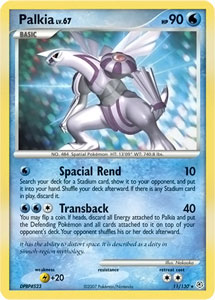
Palkia, the Spatial Pokémon’s Trading Card Game card from the Pokémon TCG Diamond and Pearl expansion.
The Pokémon Trading Card Game (TCG) is a collectible card game with a goal similar to a Pokémon battle in the video game series. Players use Pokémon cards, with individual strengths and weaknesses, in an attempt to defeat their opponent by “knocking out” their Pokémon cards. The game was published in North America by Wizards of the Coast in 1999. With the release of the Game Boy Advance video games Pokémon Ruby and Sapphire, the Pokémon Company took back the card game from Wizards of the Coast and started publishing the cards themselves. The Expedition expansion introduced the Pokémon-e Trading Card Game, where the cards (for the most part) were compatible with the Nintendo e-Reader. Nintendo discontinued its production of e-Reader compatible cards with the release of FireRed and LeafGreen. In 1998, Nintendo released a Game Boy Color version of the trading card game in Japan; Pokémon Trading Card Game was subsequently released to the US and Europe in 2000. The game included digital versions cards from the original set of cards and the first two expansions (Jungle and Fossil), as well as several cards exclusive to the game. A sequel was released in Japan in 2001.
Manga
There are various Pokémon manga series, four of which were released in English by Viz Media, and seven of them released in English by Chuang Yi. The manga series vary from game-based series to being based on the anime and the Trading Card Game. Original stories have also been published. As there are several series created by different authors, most Pokémon manga series differ greatly from each other and other media, such as the anime. Pokémon Pocket Monsters and Pokémon Adventures are the two manga in production since the first generation.
- Manga released in English
- The Electric Tale of Pikachu (Dengeki Pikachu), a shōnen manga created by Toshihiro Ono. It was divided into four tankōbon, each given a separate title in the North American and English Singapore versions: The Electric Tale of Pikachu, Pikachu Shocks Back, Electric Pikachu Boogaloo, and Surf’s Up, Pikachu. The series is based loosely on the anime.
- Pokémon Adventures (Pocket Monsters SPECIAL in Japan) by Hidenori Kusaka (story), Mato (art formerly), and Satoshi Yamamoto (art currently), the most popular Pokémon manga based on the video games. The story series around the Pokémon Trainers who called “Pokédex holders”.
- Magical Pokémon Journey (Pocket Monsters PiPiPi ★ Adventures), a shōjo manga
- Pikachu Meets the Press (newspaper style comics, not released by Chuang Yi)
- Ash & Pikachu (Satoshi to Pikachu)
- Pokémon Gold & Silver
- Pokémon Ruby-Sapphire and Pokémon Pocket Monsters
- Pokémon: Jirachi Wish Maker
- Pokémon: Destiny Deoxys
- Pokémon: Lucario and the Mystery of Mew (the third movie-to-comic adaptation)
- Pokémon Ranger and the Temple of the Sea (the fourth movie-to-comic adaption)
- Pokémon Diamond and Pearl Adventure!
- Pokémon Adventures: Diamond and Pearl / Platinum
- Pokémon: The Rise of Darkrai (the fifth movie-to-comic adaption)
- Pokémon: Giratina and the Sky Warrior (the sixth movie-to-comic adaption)
- Pokémon: Arceus and the Jewel of Life (the seventh movie-to-comic adaption)
- Pokémon: Zoroark: Master of Illusions (the eighth movie-to-comic adaption)
- Pokémon The Movie: White: Victini and Zekrom (the ninth movie-to-comic adaption)
- Pokémon Black and White
- Manga not released in English
- Pokémon Pocket Monsters by Kosaku Anakubo, the first Pokémon manga. Chiefly a gag manga, it stars a Pokémon Trainer named Red, his rude Clefairy, and Pikachu.
- Pokémon Card ni Natta Wake (How I Became a Pokémon Card) by Kagemaru Himeno, an artist for the Trading Card Game. There are six volumes and each includes a special promotional card. The stories tell the tales of the art behind some of Himeno’s cards.
- Pokémon Get aa ze! by Miho Asada
- Pocket Monsters Chamo-Chamo ★ Pretty ♪ by Yumi Tsukirino, who also made Magical Pokémon Journey.
- Pokémon Card Master
- Pocket Monsters Emerald Chōsen!! Battle Frontier by Ihara Shigekatsu
- Pocket Monsters Zensho by Satomi Nakamura
Monopoly
A Pokémon-styled Monopoly board game was released in August 2014.
Criticism and controversy
Morality and religious beliefs
Pokémon has been criticized by some fundamentalist Christians over perceived occult and violent themes and the concept of “Pokémon evolution”, which they feel goes against the Biblical creation account in Genesis. Sat2000, a satellite television station based in Vatican City, has countered that the Pokémon Trading Card Game and video games are “full of inventive imagination” and have no “harmful moral side effects”. In the United Kingdom, the “Christian Power Cards” game was introduced in 1999 by David Tate who stated, “Some people aren’t happy with Pokémon and want an alternative, others just want Christian games.” The game was similar to the Pokémon Trading Card Game but used Biblical figures.
In 1999, Nintendo stopped manufacturing the Japanese version of the “Koga’s Ninja Trick” trading card because it depicted a manji, a traditionally Buddhist symbol with no negative connotations. The Jewish civil rights group Anti-Defamation League complained because the symbol is the reverse of a swastika, a Nazi symbol. The cards were intended for sale in Japan only, but the popularity of Pokémon led to import into the United States with approval from Nintendo. The Anti-Defamation League understood that the portrayed symbol was not intended to offend and acknowledged the sensitivity that Nintendo showed by removing the product.
In 1999, two nine-year-old boys from Merrick, New York, sued Nintendo because they claimed the Pokémon Trading Card Game caused their problematic gambling.
In 2001, Saudi Arabia banned Pokémon games and the trading cards, alleging that the franchise promoted Zionism by displaying the Star of David in the trading cards (a six-pointed star is featured in the card game) as well as other religious symbols such as crosses they associated with Christianity and triangles they associated with Freemasonry; the games also involved gambling, which is in violation of Muslim doctrine.
Pokémon has also been accused of promoting materialism.
Animal cruelty
In 2012, PETA criticized the concept of Pokémon as supporting cruelty to animals. PETA compared the game’s concept, of capturing animals and forcing them to fight, to cockfights, dog fighting rings and circuses, events frequently criticized for cruelty to animals. PETA released a game spoofing Pokémon where the Pokémon battle their trainers to win their freedom. PETA reaffirmed their objections in 2016 with the release of Pokémon Go, promoting the hashtag #GottaFreeThemAll.
Health
On December 16, 1997, more than 635 Japanese children were admitted to hospitals with epileptic seizures. It was determined the seizures were caused by watching an episode of Pokémon “Dennō Senshi Porygon”, (most commonly translated “Electric Soldier Porygon”, season 1, episode 38); as a result, this episode has not been aired since. In this particular episode, there were bright explosions with rapidly alternating blue and red color patterns. It was determined in subsequent research that these strobing light effects cause some individuals to have epileptic seizures, even if the person had no previous history of epilepsy. This incident is a common focus of Pokémon-related parodies in other media, and was lampooned by The Simpsons episode “Thirty Minutes over Tokyo” and the South Park episode “Chinpokomon”, among others.
Monster in My Pocket
In March 2000, Morrison Entertainment Group, a toy developer based at Manhattan Beach, California, sued Nintendo over claims that Pokémon infringed on its own Monster in My Pocket characters. A judge ruled there was no infringement and Morrison appealed the ruling. On February 4, 2003, the U.S. Court of Appeals for the Ninth Circuit affirmed the decision by the District Court to dismiss the suit.
Pokémon Go
Within its first two days of release, Pokémon Go raised safety concerns among players. Multiple people also suffered minor injuries from falling while playing the game due to being distracted.
Multiple police departments in various countries have issued warnings, some tongue-in-cheek, regarding inattentive driving, trespassing, and being targeted by criminals due to being unaware of one’s surroundings. People have suffered various injuries from accidents related to the game, and Bosnian players have been warned to stay out of minefields left over from the 1990s Bosnian War. On July 20, 2016, it was reported that an 18-year-old boy in Chiquimula, Guatemala, was shot and killed while playing the game in the late evening hours. This was the first reported death in connection with the app. The boy’s 17-year-old cousin, who was accompanying the victim, was shot in the foot. Police speculated that the shooters used the game’s GPS capability to find the two.
Cultural influence

All Nippon Airways Boeing 747-400 in Pokémon livery, dubbed a Pokémon Jet.
Pokémon, being a globally popular franchise, has left a significant mark on today’s popular culture. The various species of Pokémon have become pop culture icons; examples include two different Pikachu balloons in the Macy’s Thanksgiving Day Parade, Pokémon-themed airplanes operated by All Nippon Airways, merchandise items, and a traveling theme park that was in Nagoya, Japan in 2005 and in Taipei in 2006. Pokémon also appeared on the cover of the U.S. magazine Time in 1999. The Comedy Central show Drawn Together has a character named Ling-Ling who is a parody of Pikachu. Several other shows such as The Simpsons, South Park and Robot Chicken have made references and spoofs of Pokémon, among other series. Pokémon was featured on VH1’s I Love the ’90s: Part Deux. A live action show based on the anime called Pokémon Live! toured the United States in late 2000. Jim Butcher cites Pokémon as one of the inspirations for the Codex Alera series of novels.
Pokémon has even made its mark in the realm of science. This includes animals named after Pokémon, such as Stentorceps weedlei (named after the Pokémon Weedle for its resemblance) and Chilicola Charizard Monckton (named after the Pokémon Charizard). There is also a protein named after Pikachu, called Pikachurin.
In November 2001, Nintendo opened a store called the Pokémon Center in New York, in Rockefeller Center, modeled after the two other Pokémon Center stores in Tokyo and Osaka and named after a staple of the video game series. Pokémon Centers are fictional buildings where Trainers take their injured Pokémon to be healed after combat. The store sold Pokémon merchandise on a total of two floors, with items ranging from collectible shirts to stuffed Pokémon plushies. The store also featured a Pokémon Distributing Machine in which players would place their game to receive an egg of a Pokémon that was being given out at that time. The store also had tables that were open for players of the Pokémon Trading Card Game to duel each other or an employee. The store was closed and replaced by the Nintendo World Store on May 14, 2005. Four Pokémon Center kiosks were put in malls in the Seattle area. The Pokémon Center online store was relaunched on August 6, 2014.
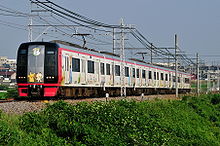
Meitetsu 2200 series train Giratina & Shaymin.
Professor of Education Joseph Tobin theorizes that the success of the franchise was due to the long list of names that could be learned by children and repeated in their peer groups. Its rich fictional universe provides opportunities for discussion and demonstration of knowledge in front of their peers. The names of the creatures were linked to its characteristics, which converged with the children’s belief that names have symbolic power. Children can pick their favourite Pokémon and affirm their individuality while at the same time affirming their conformance to the values of the group, and they can distinguish themselves from others by asserting what they liked and what they did not like from every chapter. Pokémon gained popularity because it provides a sense of identity to a wide variety of children, and lost it quickly when many of those children found that the identity groups were too big and searched for identities that would distinguish them into smaller groups.

Shinkansen E3 Series train in Pokémon livery.
Pokémon‘s history has been marked at times by rivalry with the Digimon media franchise that debuted at a similar time. Described as “the other ‘mon'” by IGN’s Juan Castro, Digimon has not enjoyed Pokémon‘s level of international popularity or success, but has maintained a dedicated fanbase. IGN’s Lucas M. Thomas stated that Pokémon is Digimon‘s “constant competition and comparison”, attributing the former’s relative success to the simplicity of its evolution mechanic as opposed to Digivolution. The two have been noted for conceptual and stylistic similarities by sources such as GameZone. A debate among fans exists over which of the two franchises came first. In actuality, the first Pokémon media, Pokémon Red and Green, were released initially on February 27, 1996; whereas the Digimon virtual pet was released on June 26, 1997.
Fan community
While Pokémon‘s target demographic is children, early purchasers of Pokémon Omega Ruby and Alpha Sapphire were in their 20s. Many fans are adults who originally played the games as children and had later returned to the series.
Numerous fan sites exist for the Pokémon franchise, including Bulbapedia, a wiki-based encyclopedia, and Serebii, a news and reference website. Other large fan communities exist on other platforms, such as the r/pokemon subreddit with over 2.2 million subscribers.
A significant community around the Pokémon video games’ metagame has existed for a long time, analyzing the best ways to use each Pokémon to their full potential in competitive battles. The most prolific competitive community is Smogon University, which has created a widely accepted tier-based battle system. Smogon is affiliated with an online Pokémon game called Pokémon Showdown, in which players create a team and battle against other players around the world using the competitive tiers created by Smogon.
In early 2014, an anonymous video streamer on Twitch launched Twitch Plays Pokémon, an experiment trying to crowdsource playing subsequent Pokémon games, starting with Pokémon Red.
A challenge called the Nuzlocke Challenge allows players to only capture the first Pokémon encountered in each area. If they do not succeed in capturing that Pokémon, there are no second chances. When a Pokémon faints, it is considered “dead” and must be released or stored in the PC permanently. If the player faints, the game is considered over, and the player must restart. The original idea consisted of 2 to 3 rules that the community has built upon. There are many fan made Pokémon games that contain a game mode similar to the Nuzlocke Challenge, such as Pokémon Uranium.
A study at Stanford Neurosciences published in Nature performed magnetic resonance imaging scans of 11 Pokémon experts and 11 controls, finding that seeing Pokémon stimulated activity in the visual cortex, in a different place than is triggered by recognizing faces, places or words, demonstrating the brain’s ability to create such specialized areas.