
Separation of powers
refers to the division of a state’s government into branches, each with separate, independent powers and responsibilities, so that the powers of one branch are not in conflict with those of the other branches. The typical division is into three branches: a legislature, an executive, and a judiciary, which is the trias politica model. It can be contrasted with the fusion of powers in parliamentary and semi-presidential systems, where the executive and legislative branches overlap.
The intention behind a system of separated powers is to prevent the concentration of power by providing for checks and balances. The separation of powers model is often imprecisely and metonymically used interchangeably with the trias politica principle. While the trias politica model is a common type of separation, there are governments that have more or fewer than three branches.
History
| Part of the Politics series |
| Republicanism |
|---|
 Politics portal Politics portal |
Antiquity
Aristotle first mentioned the idea of a “mixed government” or hybrid government in his work Politics, where he drew upon many of the constitutional forms in the city-states of Ancient Greece. In the Roman Republic, the Roman Senate, Consuls and the Assemblies showed an example of a mixed government according to Polybius (Histories, Book 6, 11–13). It was Polybius who described and explained the system of checks and balances in detail, crediting Lycurgus of Sparta with the first government of this kind.
Early modern mixed government in England and its colonies
John Calvin (1509–1564) favoured a system of government that divided political power between democracy and aristocracy (mixed government). Calvin appreciated the advantages of democracy, stating: “It is an invaluable gift if God allows a people to elect its own government and magistrates.” In order to reduce the danger of misuse of political power, Calvin suggested setting up several political institutions that should complement and control each other in a system of checks and balances.
In this way, Calvin and his followers resisted political absolutism and furthered the growth of democracy. Calvin aimed to protect the rights and the well-being of ordinary people. In 1620 a group of English separatist Congregationalists and Anglicans (later known as the Pilgrim Fathers) founded Plymouth Colony in North America. Enjoying self-rule, they established a bipartite democratic system of government. The “freemen” elected the General Court, which functioned as legislature and judiciary and which in turn elected a governor, who together with his seven “assistants” served in the functional role of providing executive power. Massachusetts Bay Colony (founded 1628), Rhode Island (1636), Connecticut (1636), New Jersey, and Pennsylvania had similar constitutions – they all separated political powers. (Except for Plymouth Colony and Massachusetts Bay Colony, these English outposts added religious freedom to their democratic systems, an important step towards the development of human rights.)
Books like William Bradford’s Of Plymouth Plantation (written between 1630 and 1651) were widely read in England. So the form of government in the colonies was well known in the mother country, including to the philosopher John Locke (1632–1704). He deduced from a study of the English constitutional system the advantages of dividing political power into the legislative (which should be distributed among several bodies, for example, the House of Lords and the House of Commons), on the one hand, and the executive and federative power, responsible for the protection of the country and prerogative of the monarch, on the other hand, as the Kingdom of England had no written constitution.
Tripartite System
During the English Civil War, the parliamentarians viewed the English system of government as composed of three branches – the King, the House of Lords and the House of Commons – where the first should have executive powers only, and the latter two legislative powers. One of the first documents proposing a tripartite system of separation of powers was the Instrument of Government, written by the English general John Lambert in 1653, and soon adopted as the constitution of England for few years during The Protectorate. The system comprised a legislative branch (the Parliament) and two executive branches, the English Council of State and the Lord Protector, all being elected (though the Lord Protector was elected for life) and having checks upon each other.
A further development in English thought was the idea that the judicial powers should be separated from the executive branch. This followed the use of the juridical system by the Crown to prosecute opposition leaders following the Restoration, in the late years of Charles II and during the short reign of James II (namely, during the 1680s).
The first constitutional document to establish the principle of the separation of powers in government between the legislative, executive, and judiciary branches were Pacts and Constitutions of Rights and Freedoms of the Zaporizhian Host written in 1710 by Ukrainian Hetman Pylyp Orlyk.
John Locke’s legislative, executive and federative powers

John Locke
An earlier forerunner to Montesquieu’s tripartite system was articulated by John Locke in his work Two Treatises of Government (1690). In the Two Treatises, Locke distinguished between legislative, executive, and federative power. Locke defined legislative power as having “… the right to direct how the force of the commonwealth shall be employed” (2nd Tr., § 143), while executive power entailed the “execution of the laws that are made, and remain in force” (2nd Tr., § 144). Locke further distinguished federative power, which entailed “the power of war and peace, leagues and alliances, and all transactions with all persons and communities without the commonwealth” (2nd Tr., § 145), or what is now known as foreign policy. Locke distinguishes between separate powers but not discretely separate institutions, and notes that one body or person can share in two or more of the powers. For instance, Locke noted that while the executive and federative powers are different, they are often combined in a single institution (2nd Tr., § 148).
Locke believed that the legislative power was supreme over the executive and federative powers, which are subordinate. Locke reasoned that the legislative was supreme because it has law-giving authority; “or what can give laws to another, must needs be superior to him” (2nd Tr., §150). According to Locke, legislative power derives its authority from the people, who have the right to make and unmake the legislature:
And when the people have said we will submit to rules, and be governed by laws made by such men… nobody else can say other men shall make laws for them; nor can the people be bound by any laws but as such as are enacted by those whom they have chosen, and authorized to make laws for them.
Locke maintains that there are restrictions on the legislative power. Locke says that the legislature cannot govern arbitrarily, cannot levy taxes or confiscate property without the consent of the governed (cf. “No taxation without representation”), and cannot transfer its law-making powers to another body, known as the nondelegation doctrine (2nd Tr., §142).
Montesquieu’s separation of powers system
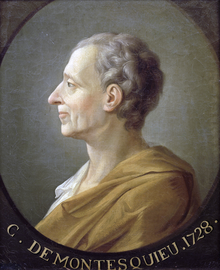
Montesquieu
The term “tripartite system” is commonly ascribed to French Enlightenment political philosopher Baron de Montesquieu, although he did not use such a term but referred to “distribution” of powers. In The Spirit of the Laws (1748), Montesquieu described the various forms of distribution of political power among a legislature, an executive, and a judiciary. Montesquieu’s approach was to present and defend a form of government whose powers were not excessively centralized in a single monarch or similar ruler (a form known then as “aristocracy”). He based this model on the Constitution of the Roman Republic and the British constitutional system. Montesquieu took the view that the Roman Republic had powers separated so that no one could usurp complete power. In the British constitutional system, Montesquieu discerned a separation of powers among the monarch, Parliament, and the courts of law.
In every government there are three sorts of power: the legislative; the executive in respect to things dependent on the law of nations; and the executive in regard to matters that depend on the civil law.
By virtue of the first, the prince or magistrate enacts temporary or perpetual laws, and amends or abrogates those that have been already enacted. By the second, he makes peace or war, sends or receives embassies, establishes the public security, and provides against invasions. By the third, he punishes criminals, or determines the disputes that arise between individuals. The latter we shall call the judiciary power, and the other simply the executive power of the state.
Montesquieu argues that each Power should only exercise its own functions. He was quite explicit here:
When the legislative and executive powers are united in the same person, or in the same body of magistrates, there can be no liberty; because apprehensions may arise, lest the same monarch or senate should enact tyrannical laws, to execute them in a tyrannical manner.
Again, there is no liberty, if the judiciary power be not separated from the legislative and executive. Were it joined with the legislative, the life and liberty of the subject would be exposed to arbitrary control; for the judge would be then the legislator. Were it joined to the executive power, the judge might behave with violence and oppression.
There would be an end of everything, were the same man or the same body, whether of the nobles or of the people, to exercise those three powers, that of enacting laws, that of executing the public resolutions, and of trying the causes of individuals.
Separation of powers requires a different source of legitimization, or a different act of legitimization from the same source, for each of the separate powers. If the legislative branch appoints the executive and judicial powers, as Montesquieu indicated, there will be no separation or division of its powers, since the power to appoint carries with it the power to revoke.
The executive power ought to be in the hands of a monarch, because this branch of government, having need of despatch, is better administered by one than by many: on the other hand, whatever depends on the legislative power is oftentimes better regulated by many than by a single person.
But if there were no monarch, and the executive power should be committed to a certain number of persons selected from the legislative body, there would be an end then of liberty; by reason the two powers would be united, as the same persons would sometimes possess, and would be always able to possess, a share in both.
Montesquieu actually specified that the independence of the judiciary has to be real, and not merely apparent. The judiciary was generally seen as the most important of the three powers, independent and unchecked.
Checks and balances
According to the principle of checks and balances, each of the branch of the state should have the power to limit or check the other two, creating a balance between the three separate powers of the state. Each branch’s efforts to prevent either of the other branches becoming supreme form part of an eternal conflict, which leaves the people free from government abuses. Immanuel Kant was an advocate of this, noting that “the problem of setting up a state can be solved even by a nation of devils” so long as they possess an appropriate constitution to pit opposing factions against each other. Checks and balances are designed to maintain the system of separation of powers keeping each branch in its place. The idea is that it is not enough to separate the powers and guarantee their independence but the branches need to have the constitutional means to defend their own legitimate powers from the encroachments of the other branches. They guarantee that the branches have the same level of power (co-equal), that is, are balanced, so that they can limit each other, avoiding the abuse of power. The origin of checks and balances, like separation of powers itself, is specifically credited to Montesquieu in the Enlightenment (in The Spirit of the Laws, 1748). Under this influence it was implemented in 1787 in the Constitution of the United States. In Federalist No. 78, Alexander Hamilton, citing Montesquieu, redefined the judiciary as a separate branch of government coequal with the legislative and the executive branches. Before Hamilton, many colonists in the American colonies had adhered to British political ideas and conceived of government as divided into executive and legislative branches (with judges operating as appendages of the executive branch).
The following example of the separation of powers and their mutual checks and balances from the experience of the United States Constitution (specifically, Federalist No. 51) is presented as illustrative of the general principles applied in similar forms of government as well:
But the great security against a gradual concentration of the several powers in the same department, consists in giving to those who administer each department the necessary constitutional means and personal motives to resist encroachments of the others. The provision for defense must in this, as in all other cases, be made commensurate to the danger of attack. Ambition must be made to counteract ambition. The interest of the man must be connected with the constitutional rights of the place. It may be a reflection on human nature, that such devices should be necessary to control the abuses of government. But what is government itself, but the greatest of all reflections on human nature? If men were angels, no government would be necessary. If angels were to govern men, neither external nor internal controls on government would be necessary. In framing a government which is to be administered by men over men, the great difficulty lies in this: you must first enable the government to control the governed; and in the next place oblige it to control itself.
A dependence on the people is, no doubt, the primary control on the government; but experience has taught mankind the necessity of auxiliary precautions. This policy of supplying, by opposite and rival interests, the defect of better motives, might be traced through the whole system of human affairs, private as well as public. We see it particularly displayed in all the subordinate distributions of power, where the constant aim is to divide and arrange the several offices in such a manner as that each may be a check on the other that the private interest of every individual may be a sentinel over the public rights. These inventions of prudence cannot be less requisite in the distribution of the supreme powers of the State.
| Legislative (Congress) | Executive (President) | Judicial (Supreme Court) |
|---|---|---|
|
|
|
Comparison between tripartite and bipartite national systems
Constitutions with a high degree of separation of powers are found worldwide. A number of Latin American countries have electoral branches of government.
The Westminster system is distinguished by a particular entwining of powers, such as in New Zealand. New Zealand’s constitution is based on the principle of separation of powers through a series of constitutional safeguards, many of which are tacit. The Executive’s ability to carry out decisions often depends on the Legislature, which is elected under the mixed member proportional system. This means the government is rarely a single party but a coalition of parties. The Judiciary is also free of government interference. If a series of judicial decisions result in an interpretation of the law which the Executive considers does not reflect the intention of the policy, the Executive can initiate changes to the legislation in question through the Legislature. The Executive cannot direct or request a judicial officer to revise or reconsider a decision; decisions are final. Should there be a dispute between the Executive and Judiciary, the Executive has no authority to direct the Judiciary, or its individual members and vice versa.
Complete separation of powers systems are almost always presidential, although theoretically this need not be the case. There are a few historical exceptions, such as the Directoire system of revolutionary France. Switzerland offers an example of non-Presidential separation of powers today: It is run by a seven-member executive branch, the Federal Council. However, the Federal Council is appointed by parliament (but not dependent on parliament) and, although the judiciary has no power of review, the judiciary is still separate from the other branches.
Typical branches
- Executive
- Legislature
- Judiciary
Additional branches
- Auditory
- Electoral – in which election commissions, tribunals or courts are maintained separately from other branches
- Prosecutory
- Civil service commission
- Ombudsman
Three branches
Australia
Australia does not maintain a strict separation between the legislative and executive branches of government—indeed, government ministers are required to be members of parliament—but the federal judiciary strictly guards its independence from the other two branches. However, under influence from the U.S. constitution, the Australian constitution does define the three branches of government separately, which has been interpreted by the judiciary to induce an implicit separation of powers. State governments have a similar level of separation of power but this is generally on the basis of convention, rather than constitution.
Austria
 |
This section provides insufficient context for those unfamiliar with the subject. (November 2018)
|
 |
This section needs expansion. You can help by adding to it. (November 2018)
|
The Constitution of Austria was originally written by Hans Kelsen, a prominent constitutional scholar in Europe at that time. Kelsen was to serve as a part of the judicial court of review for Austria as part of its tripartite government.
Canada
The Constitution Act, 1867 provides that there shall be an executive, a legislature, and the judiciary. At the federal level, the executive power is assigned to the monarch of Canada, acting through their representative, the Governor General of Canada. The legislative function is assigned to the Parliament of Canada, composed of the monarch, the Senate and the House of Commons. The judicial powers are primarily assigned to the provincial superior courts, but provision was made for the creation of federal courts by Parliament. The federal courts now include the Supreme Court of Canada, the Federal Court of Appeal, and the Federal Court of Canada.
The Supreme Court of Canada has repeatedly emphasised that the separation of powers is an important structural element of the Constitution of Canada. For example, in giving the majority judgment in Ontario v Criminal Lawyers’ Association of Ontario, Justice Karakatsanis stated:
All three branches have distinct institutional capacities and play critical and complementary roles in our constitutional democracy. However, each branch will be unable to fulfill its role if it is unduly interfered with by the others. In New Brunswick Broadcasting Co. v. Nova Scotia (Speaker of the House of Assembly), 1 S.C.R. 319, McLachlin J. affirmed the importance of respecting the separate roles and institutional capacities of Canada’s branches of government for our constitutional order, holding that “t is fundamental to the working of government as a whole that all these parts play their proper role. It is equally fundamental that no one of them overstep its bounds, that each show proper deference for the legitimate sphere of activity of the other”.
— Justice Karakatsanis
Canada, like other parliamentary countries using the Westminster system, has a fusion between the executive and the legislative branches, with the Prime Minister and other Cabinet ministers being members of Parliament. However, the two branches have distinct roles, and in certain instances can come into conflict with each other. For example, in June 2021, the Speaker of the House of Commons directed a member of the public service to comply with an order of the House of Commons to share certain documents with the Commons, and the public servant has refused to do so. The federal government has announced that it will challenge the Speaker’s ruling in the Federal Court.