
Sherwani (also known as Shairwani and less commonly as Serwani) is a long coat-like garment worn mostly in South Asia. It is very similar to a Western frock coat or a Polish and Lithuanian żupan. Sherwani is worn over a kurta with the combination of shalwar as the lower-body clothing. It can be distinguished from the achkan by the fact that it is longer than achkan in length, is often made from heavier suiting fabrics, and by the presence of a lining. Sherwani is worn on many Muslim occasions, weddings and festivals such as Eid.
Etymology
The name of attire is possibly derived from Sherwan, a region of present-day Azerbaijan due to the folk dress of that area (Chokha) which resembles Sherwani in its outlook.
Origin
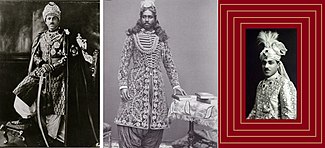
Sherwani originated in the 18th century in South Asia at first worn by Mughal nobles, before being more generally adopted in the late 19th century. It is originally associated with Muslim aristocracy during the period of British rule.
Description
Sherwani evolved from a Persian cape (balaba or chapkan) and was developed into the sherwani, with buttons down the front, following European fashion.
 |
| Part of a series on |
| Islamic culture |
|---|
| Architecture |
|
| Art |
|
| Clothing |
|
| Literature |
|
| Music |
|
| Theatre |
|
|
 Islam portal
The founders of Aligarh movement wearing Sherwani, Nawab Mohsin ul Mulk (left), Sir Syed Ahmed Khan (centre), Justice Syed Mahmood (right).
It was gradually adopted by rest of the royalty and aristocracy of Subcontinent, and later by the general population, as a more evolved form of occasional traditional attire. Therefore, the garment may also be an Indianized derivative of the Caucasian dress due to ethnic and cultural linkages of Indo-Persian during Middle Ages.
Afghanistan
Sherwanis are also worn by some Afghanistanis.
Bangladesh
In Bangladesh, the sherwani is worn by people on formal occasions such as weddings and Eid.
India
Achkan
In India, the achkan is worn rather than Sherwani for formal occasions in winter, especially by those from Rajasthan, Punjab, Delhi, Jammu, Uttar Pradesh and Hyderabad. The achkan is generally associated with the Hindus while the original and simple sherwani is historically favoured by Muslims. The two garments have significant similarities, though sherwanis typically are more flared at the hips and achkans are lengthier than simple sherwanis. The achkan later evolved into the Nehru Jacket, which is now popular in India. In India, the achkan is generally worn with the combination of Churidar as the lower garment.
-

Jawaharlal Nehru (left) wearing an achkan with churidar.
Pakistan

Jinnah (right) addressing the Constituent Assembly on 14 August 1947, wearing a sherwani.
After the independence of Pakistan, Mohammad Ali Jinnah frequently wore the sherwani. Following him, most people and government officials in Pakistan such as the President and Prime Minister started to wear the formal black sherwani over the shalwar qameez on state occasions and national holidays. General Muhammad Zia-ul-Haq made it compulsory for all officers to wear sherwani on state occasions and national holidays. Sherwani was the national dress of Pakistan until 1973 when shalwar kameez was declared as the national dress.
-

Muhammad Ali Jinnah, founder of Pakistan, is sitting on the Chair of Governor General, sometimes referred as Pakistan’s Throne, wearing Sherwani.
-

Muhammad Ali Jinnah (right), founder of Pakistan, is standing with his sister Fatima Jinnah (left), Leading member of Pakistan Movement. Muhammad Ali Jinnah is wearing a Sherwani and Fatima Jinnah is also wearing a female Sherwani.
Sri Lanka
In Sri Lanka, Sherwani was generally worn as the formal uniform of Mudaliyars and early Tamil legislators during the British colonial period. It is now no longer worn in Sri Lanka.
Modern sherwanis
Sherwanis are mostly worn in Afghanistan, Bangladesh, India and Pakistan. These garments usually feature detailed embroidery or patterns. One major difference between sherwani wearing habits is the choice of lower garment, while in India, the dress is distinguished by their preference for churidars or pyjamas, in Pakistan and Bangladesh, it is mainly worn with shalwar instead.
Pakistani journalist, filmmaker and activist, Sharmeen Obaid-Chinoy appeared in sherwani to receive Academy Award in 2012 and 2015.