
Shri (/ʃriː/; Sanskrit: श्री, romanized: Śrī, pronounced ) is a Sanskrit term denoting resplendence, wealth and prosperity, primarily used as an honorific.
The word is widely used in South and Southeast Asian languages such as Marathi, Malay (including Indonesian and Malaysian), Javanese, Balinese, Sinhala, Thai, Tamil, Telugu, Hindi, Nepali, Malayalam, Kannada, Sanskrit, Pali, Khmer, and also among Philippine languages. It is usually transliterated as Sri, Sree, Shri, Si, or Seri based on the local convention for transliteration.
The term is used in Indian subcontinent and Southeast Asia as a polite form of address equivalent to the English “Mr.” in written and spoken language, but also as a title of veneration for deities or as honorific title for local rulers.
Shri is also another name for Lakshmi, the Hindu goddess of wealth, while a yantra or a mystical diagram popularly used to worship her is called Shri Yantra.
Etymology


Mahārāja
 ShrīGupta
Great King, Lord Gupta
}in the Gupta script, on the Allahabad pillar inscription of Samudragupta (4th century CE).
Monier-Williams Dictionary gives the meaning of the root verb śrī as “to cook, boil, to burn, diffuse light”, but as a feminine abstract noun, it has received a general meaning of “grace, splendour, beauty; wealth, affluence, prosperity”.
The word śrī may also be used as an adjective in Sanskrit, which is the origin of the modern use of shri as a title. From the noun, is derived the Sanskrit adjective “śrīmat” (śrimān in the masculine nominative singular, śrīmatī in the feminine), by adding the suffix indicating possession, literally “radiance-having” (person, god, etc.). This is used in modern vernacular as form of address Shrimati (abbreviated Smt) for married women, while Sushri, (with “su”, “good”, added to the beginning), can be used for women in general (regardless of marital status).
Spelling and pronunciation
In Devanagari script for Sanskrit, Hindi, Marathi and other languages, the word ⟨श्री⟩ is combination of three sounds: श् (ś), र् (r) and ई (ī, long i). There are two conventions in India to transliterate the consonant श् (ISO: ś) to English: some use s (which in narrower transcription represents only स्) as in Sri Lanka and Srinagar, while others use sh as in Shimla and Shimoga. Similarly, री (rī; र् + ई) is also transliterated to English in two different ways as ri and ree, although the latter is non-standard in Hindi. Hence this word श्री may be rendered in English as Shri (the standard spelling), Shree, Sri or Sree. Whatever be the transliteration, the pronunciation is the same.
Sanskrit is written in many other Indian scripts as well, each of which has its own equivalents of these Devanāgari letters; the Sanskrit pronunciation remains the same regardless of script.
Usage
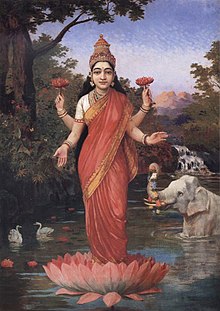
Shri is an epithet of Lakshmi, the Hindu goddess of wealth, fortune, power, beauty and prosperity.
Shri is a polite form of address equivalent to the English “Mr.” or “Ms.”.
Shri is also frequently used as an epithet of some Hindu gods, in which case it is often translated into English as Holy. Also, in language and general usage, Shri, if used by itself and not followed by any name, refers to the supreme consciousness, i.e. god.
Sridevi, also rendered Shri, is an epithet and name of Lakshmi, consort of Vishnu, the goddess of prosperity and wealth in Hinduism. The Vedas speak of Shri as a goddess, who personified ten qualities coveted by other divine beings: food, royalty, holiness, kingdom, fortune, sovereignty, nobility, power, righteousness, and beauty. The Vedic Shri is believed to have identified with later conceptions of Lakshmi, as the embodiment of royalty and dignity.
Shri is one of the names of Ganesha, the Hindu god of prosperity.
Shri is also used as a title of the Hindu deities Rāma, Krishna, Saraswati and sometimes Durgā.
Repetition
 |
This section does not cite any sources. (March 2016)
|
Shri may be repeated depending on the status of the person.
- Shri: for anybody
- Shri 2: honorific, guru, e.g. Ravi Shankar, Abhi Joshi
- Shri 3: title used by former hereditary Prime Ministers of Nepal (example- Mohan Shamsher Jang Bahadur Rana)
- Shri 4: title used by Divine factor, e.g. Afactor Abinash
- Shri 5: title used by former Maharajadhiraja (e.g. Shri pānch ko sarkār, His Majesty’s Government, where ko indicates genitive case (possessive, ‘of His Majesty’)
- Shri 108: used by spiritual leaders
- Shri 1008: used by spiritual leaders (e.g. Shri 1008 Satyatma Tirtha)
Other current usage
There is a common practice of writing Shri as the first word centralised in line at the beginning of a document.
During the Vidyāraṃbhaṃ ceremony, the mantra “Om hari shri ganapataye namah” is written in sand or in a tray of rice grains by a child, under the supervision of a Guru or Priest.
Another usage is as an emphatic compound (which can be used several times: shri shri, or shri shri shri, etc.) in princely styles, notably in Darbar Shri, Desai Shri, and Thakur Shri or Shrii Shrii Anandamurti, the founder of the social and spiritual movement Ananda Marga (the Path of Bliss).
The honorific can also be applied to objects and concepts that are widely respected, such as the Sikh religious text, the Shri Guru Granth Sahib. Similarly, when the Ramlila tradition of reenacting the Ramayana is referred to as an institution, the term Shri Ramlila is frequently used.
Indian music
The use of the term is common in the names of ragas (musical motifs), either as a prefix or postfix. Some examples are Shree, Bhagyashree, Dhanashree, Jayashree, Subhashree, Itishree, Jiteshree, and Shree ranjani.
Other languages
South and Southeast Asia
| Language/Script | Form | Notes |
|---|---|---|
| Bengali-Assamese script | শ্রী | |
| Balinese | ᬰ᭄ᬭᬶ | Comparable to the Javanese usage: a particle prefixed to royal names, the goddess of rice-culture. |
| Burmese | သီရိ (thiri) | See Tamil below. |
| Dhivehi | ސިރީ (siree or sirī) | Used in the full titles of sultans and kings |
| Gujarati | શ્રી | |
| Gurmukhi (Punjabi) | ਸ਼੍ਰੀ | |
| Javanese | ꦱꦿꦶ (Sri) alternatively written as ꦯꦿꦶ or ꦯꦿꦷ | Often used to address royal or venerated figures, such as the King of Yogyakarta, Sri Sultan Hamengkubuwono and the title “Sri Bhaginda” (equivalent to “your majesty”), and for names of deities, such as the Javanese rice goddess Dewi Sri. In modern Javanese, it is a common part of proper names of Javanese people, e.g the name of Indonesian finance minister Sri Mulyani Indrawati and Indonesian marine corps officer Lt. Col Sri Utomo. “Sri” is also a widely used name in Java used for names of placements, organizations, institutions, etc |
| Kannada | ಶ್ರೀ (Sri or Sree) | |
| Khmer | ស្រី (Srey) and សេរី (Serey) | |
| Lao | ສີ (Si) and ສຣີ (Sri or Sree) | |
| Malay (including Malaysian and Indonesian varieties) | Jawi: سري, Latin: Seri (Malaysian) Sri (Indonesian) |
Often used as a title of veneration for honorific titles in Malay kingdoms and sultanates. This includes the honorific title for the Sultan of Brunei: Kebawah Duli Yang Maha Mulia Paduka Seri Baginda Sultan Hassanal Bolkiah and King of Malaysia: Kebawah Duli Yang Maha Mulia Seri Paduka Baginda. It is also used for the name of places in the Malay world such as Bandar Seri Begawan in Brunei and Siak Sri Indrapura city in Sumatra, IndonesiaUsage of “Sri” in Indonesia is used for honorary titles for a king or other great person, for example the King of Yogyakarta Sri Sultan Hamengkubuwono and Sri Baginda which means “Your Majesty”, and is also used for people’s names, mainly Javanese people such as Indonesian finance minister Sri Mulyani, Indonesian marine officer Lt. Col Sri Utomo, Indian-Indonesian businessman Sri Prakash Lohia, etc. It also refers to the Javanese rice goddess “Dewi Sri”. “Sri” is also used as names of companies, placements, institutions, etc (e.g — Sriwijaya Air, Sriwijaya University, etc). The oldest recorded word of “Sri” founded in Indonesia was written in the Mulawarman inscription founded in Kutai, East Kalimantan dating back to the 4th century AD which read: srimatah sri-narendrasya, kundungasya mahatmanah (meaning: “the maharaja Kudungga, who was very noble”) |
| Malayalam | ശ്രീ (Sri or Sree) | |
| Odia | ଶ୍ରୀ | |
| Philippine languages / Baybayin | ᜐ᜔ᜇᜒ (Sri or Si or Sree) | Formerly used as an honorific title for rulers in old Indianized pre-Hispanic states and polities in the Philippines, such as Sri Lumay of the Rajahnate of Cebu or Sri Bata Shaja of the Rajahnate of Butuan or Sri Pada/Sipad of Lupah Sūg or Sikatuna of Kedatuan of Dapitan. |
| Sinhala | ශ්රී (Sri or Sree) also ශ්රී (Sri or Sree) or සිරි (Siri) | Meaning “resplendent”, as in Sri Lanka, “Resplendent Island”. |
| Tamil | ஸ்ரீ (Sri or Sree) | The Tamil equivalent Thiru is also used. |
| Telugu | శ్రీ (Sri or Sree) | |
| Thai | ศิริ (Siri) and ศรี (Sri or Sree or Si) | Used in many Thai place names, as seen below. |
| Vietnamese/Cham | Chế | Vietnamese transcription of honorific name prefix used among the Cham ethnic minority. |
Place names
The honorific is incorporated into many place names. A partial list follows:
- Srimangal, Bangladesh
- Srisailam, Andhra Pradesh, a Siva temple, also one of the holiest places of worship for Hindus.
- Srikakulam, a town in northern Andhra Pradesh.
- Sri City, an integrated township located on the Andhra Pradesh and Tamil Nadu border.
- Shri Kshetra, name of the Puri Jagannath Dham, Odisha. One of the four Dhams in the Hindu religion.
- Sree Mandira is a famous Hindu temple dedicated to Jagannath (Krishna) and located in the coastal town of Puri in Odisha.
- Sri Lanka, an island country at the southern tip of India.
- Sri Perumbudur, a town in the state of Tamil Nadu
- Sri Rangam, an island zone in the city of Tiruchirapalli, in Tamil Nadu.
- Srinagar, nagar meaning “city”, is the capital of the Union territory of Jammu and Kashmir
- Sri Jayawardenapura Kotte, the administrative capital of Sri Lanka.
- Sri Maha Bodhi, a sacred fig tree in the Mahamewna Gardens, Anuradhapura, Sri Lanka.
- Srivijaya, a former kingdom centered on Sumatra, Indonesia.
- Sriwijaya University, located in South Sumatra, Indonesia
- Sri (ศรี), pronounced and usually transliterated Si in Thailand place names:
- Phra Nakhon Si Ayutthaya (พระนครศรีอยุธยา), formal name of the city and province of Ayutthaya
- Nakhon Si Thammarat (นครศรีธรรมราช) city and province
- Sisaket (ศรีสะเกษ) city and province
- Wat Si Saket in Vientiane, Laos.
- Bandar Seri Begawan, the capital of Brunei.
- Seri Menanti, the royal town of Negeri Sembilan, Malaysia.
- Banteay Srei, a 10th-century Hindu temple in Angkor, Cambodia
- Srey Santhor, a district located in Kampong Cham, Cambodia.