
The Siddi (pronounced ), also known as Sidi, Siddhi, Sheedi or Habshi, are an ethnic group inhabiting India and Pakistan. Members are mostly descended from the Bantu peoples of Southeast Africa, along with Habesha immigrants. Some were merchants, sailors, indentured servants, slaves and mercenaries. The Siddi population is currently estimated at around 850,000 individuals, with Karnataka, Gujarat and Hyderabad in India and Makran and Karachi in Pakistan as the main population centres. Siddis are primarily Muslims, although some are Hindus and others belong to the Catholic Church.
Etymology
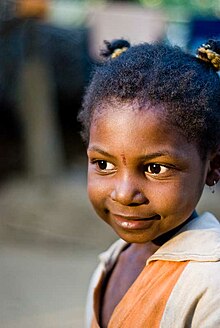
A Siddi girl from the town of Yellapur in Uttara Kannada district, Karnataka, India.
There are conflicting hypotheses on the origin of the name Siddi. One theory is that the word derives from sahibi, an Arabic term of respect in North Africa, similar to the word sahib in modern India and Pakistan. A second theory is that the term Siddi is derived from the title borne by the captains of the Arab vessels that first brought Siddi settlers to India; these captains were known as Sayyid.
Similarly, another term for Siddis, habshi, is held to be derived from the common name for the captains of the Northeast African Abyssinianships that also first delivered Siddi slaves to the subcontinent. Siddis are also sometimes referred to as Afro-Indians. Siddis were referred to as Zanji by Arabs; in China, various transcriptions of this Arabic word were used, including Xinji (辛吉) and Jinzhi (津芝).
History

Ikhlas Khan, Siddi dewan of Bijapur, c. 1650
The first Siddis are thought to have arrived in India in 628 AD at the Bharuch port. Several others followed with the first Arab Islamic conquest of the subcontinent in 712 AD. The latter group are believed to have been soldiers with Muhammad bin Qasim’s Arab army, and were called Zanjis.
Some Siddis escaped slavery to establish communities in forested areas, and some also established the small Siddi principalities of Janjira State on Janjira Island and Jafarabad State in Kathiawar as early as the twelfth century. A former alternative name of Janjira was Habshan (i.e., land of the Habshis). In the Delhi Sultanate period prior to the rise of the Mughals in India, Jamal-ud-Din Yaqutwas a prominent former Siddi slave who was appointed by Razia Sultana (1235–1240 CE) as master of the royal stables. It is speculated that he may also have been her lover, but the contemporary sources provide no evidence of this.
Siddis were also brought as slaves by the Deccan Sultanates. Several former slaves rose to high ranks in the military and administration, the most prominent of which was Malik Ambar.
Later, the Siddi population was increased by Bantu peoples from Southeast Africa who were brought to the Indian subcontinent as slaves by the Portuguese. Most of these migrants were or else became Muslims, while a small minority became Hindu. The Nizam of Hyderabadalso employed African-origin guards and soldiers.

Flag of the Siddis from Murud-Janjira, an important vassal of the Mughal Empire.
India

Sidis of Madras
Harris (1971) provides a historical survey of the eastward dispersal of slaves from Southeast Africa to places like India. Hamilton (1990) argues that Siddis in South India are a significant social group whose histories, experiences, cultures, and expressions are integral to the African Diasporaand thus, help better understand the dynamics of dispersed peoples. More recent focused scholarship argues that although Siddis are numerically a minority, their historic presence in India for over five hundred years, as well as their self-perception, and how the broader Indian society relates to them, make them a distinct Bantu/Indian. Historically, Siddis have not existed only within binary relations to the nation state and imperial forces. They did not simply succumb to the ideologies and structures of imperial forces, nor did they simply rebel against imperial rule. The Siddi are recognized as a scheduled tribe in 3 states and 1 union territory: Goa, Gujarat, Karnataka and Daman and Diu.
Hyderabad
In the 18th century, a Siddi community was established in Hyderabad State by the Arab Siddi diaspora, who have frequently served as cavalryguards to the Asif Jahi Nizam of Hyderabad’s army. The Asif Jahi rulers patronised them with rewards and the traditional Marfa music gained popularity and would be performed during official celebrations and ceremonies. The Siddis of Hyderabad have traditionally resided in the A.C. Guards (African Cavalry Guards) area near Masjid Rahmania, known locally as Siddi Risala in the city Hyderabad.
Gujarat

Siddi Folk dancers, at Devaliya Naka, Sasan Gir, Gujarat.
Supposedly presented as slaves by the Portuguese to the local Prince, Nawab of Junagadh, the Siddis also live around Gir Forest National Park and Wildlife sanctuary. On the way to Deva-dungar is the quaint village of Sirvan, inhabited entirely by Siddis. They were brought 300 years ago from Portuguese colonial territories for the Nawab of Junagadh. Today, they follow very few of their original customs, with a few exceptions like the traditional Dhamal dance.
Although Gujarati Siddis have adopted the language and many customs of their surrounding populations, some of their Bantu traditions have been preserved. These include the Goma music and dance form, which is sometimes called Dhamaal (Gujarati: ધમાલ, fun). The term is believed to be derived from the Ngoma drumming and traditional dance forms of the Bantu people inhabiting Central, East and Southern Africa. The Goma also has a spiritual significance and, at the climax of the dance, some dancers are believed to be vehicles for the presence of Siddi saints of the past.
Goma music comes from the Kiswahili word “ngoma”, which means a drum or drums. It also denotes any dancing occasion where traditional drums are principally used.
The majority of the Siddis in Gujarat are Muslims (98.7%), with very few following Hinduism (1%).
Karnataka
The Siddis of Karnataka (also spelled Siddhis) are an ethnic group of mainly Bantu descent that has made Karnataka their home for the last 400 years. There is a 50,000-strong Siddhi population across India, of which more than a third live in Karnataka. In Karnataka, they are concentrated around Yellapur, Haliyal, Ankola, Joida, Mundgod and Sirsi taluks of Uttara Kannada and in Khanapur of Belgaum and Kalaghatagi of Dharwad district. Many members of the Siddis community of Karnataka had migrated to Pakistan after independence and have settled in Karachi, Sindh. It has been reported that these Siddis believe that Barack Obama shares their genepool.They wished to gift him and honour him on his visit to India in 2010.
A plurality of the Siddis in Karnataka follow Hinduism (41.8%), followed by Islam (30.6%) and Christianity (27.4%).
Pakistan
In Pakistan, locals of Bantu descent are called “Sheedi”. They live primarily along the Makran in Balochistan, and lower Sindh. The estimated population of Sheedis in Pakistan is 250,000. In the city of Karachi, the main Sheedi centre is the area of Lyari and other nearby coastal areas. Technically, the Sheedi are a brotherhood or a subdivision of the Siddi. The Sheedis are divided into four clans, or houses: Kharadar Makan, Hyderabad Makan, Lassi Makan and Belaro Makan. The Sufi saint Pir Mangho is regarded by many as an important Wali of the Sheedis, and the annual Sheedi Mela festival, is the key event in the Sheedi community’s cultural calendar. Some glimpses of the rituals at Sidi/Sheedi Festival 2010 include visit to sacred alligators at Mangho pir, playing music and dance. Clearly, the instrument, songs and dance appear to be derived from Africa.
In Sindh, the Sheedis have traditionally intermarried only with people such as the Mallahs (fisherpeople), Khaskheli (laborers), Khatri (dyeing community) and Kori (clothmakers).
Famous Sheedis include the historic Sindhi army leader Hoshu Sheedi and Urdu poet Noon Meem Danish. Sheedis are also well known for their excellence in sports, especially in football and boxing. Qasim Umer is one cricketer who played for Pakistan in 80s. The musical anthem of the ruling Pakistan Peoples Party, “Bija Teer”, is a Balochi song in the musical style of the Sheedis with Black African style rhythm and drums. Younis Jani is a popular Sheedi singer famous for singing an Urdu version of the reggaeton song “Papi chulo… (te traigo el mmmm…).”
Sindh

Resident of village Syed Matto Shah, Tehsil Bulri Shah Karim, District Tando Muhammad Khan, Sindh
Sheedis are largely populated in different towns and villages in lower Sindh. They are very active in cultural activities and organise annual festivals, like, Habash Festival, with the support of several community organisations. In the local culture, when there is a dance it is not performed by some selected few and watched idly by others but it is participated by all the people present there, ending difference between the performers and the audience.
Sheedis in Sindh also proudly call themselves the Qambranis, (Urdu: قمبرانی ; Sindhi: قمبراڻي), in reverence to Qambar, the freed slave of Ali, the fourth Rashid Caliph. Tanzeela Qambrani became the first Sheedi woman to be elected as the member of Provincial Assembly of Sindh in 2018 Pakistani general election.
Genetics
Recent advances in genetic analyses have helped shed some light on the ethnogenesis of the Siddi. Genetic genealogy, although a novel tool that uses the genes of modern populations to trace their ethnic and geographic origins, has also helped clarify the possible background of the modern Siddi.
Y DNA
A Y-chromosome study by Shah et al. (2011) tested Siddi individuals in India for paternal lineages. The authors observed the E1b1a1-M2 haplogroup, which is frequent among Bantu peoples, in about 42% and 34% of Siddis from Karnataka and Gujarat, respectively. Around 14% of Siddis from Karnataka and 35% of Siddis from Gujarat also belonged to the Sub-Saharan B-M60. The remaining Siddis had Indian associated or Near Eastern-linked clades, including haplogroups P, H, R1a-M17, J2 and L-M20.
Thangaraj (2009) observed similar, mainly Bantu-linked paternal affinities amongst the Siddi.
Qamar et al. (2002) analysed Makrani Siddis in Pakistan and found that they instead predominantly carried Indian-associated or Near Eastern-linked haplogroups. R1a1a-M17(30.30%), J2 (18.18%) and R2 (18.18%) were their most common male lineages. Only around 12% carried Africa-derived clades, which mainly consisted of the archaic haplogroup B-M60, of which they bore the highest frequency of any Pakistani population Underhill et al. (2009) likewise detected a relatively high frequency of R1a1a-M17 (25%) subclade among Makrani Siddis.
mtDNA
According to an mtDNA study by Shah et al. (2011), the maternal ancestry of the Siddi consists of a mixture of Bantu-associated haplogroups and Indian-associated haplogroups, reflecting substantial female gene flow from neighbouring Indian populations. About 53% of the Siddis from Gujarat and 24% of the Siddis from Karnataka belonged to various Bantu-derived macro-haplogroup L subclades. The latter mainly consisted of L0 and L2a sublineages associated with Bantu women. The remainder possessed Indian-specific subclades of the Eurasian haplogroups M and N, which points to recent admixture with autochthonous Indian groups.
Autosomal DNA
Narang et al. (2011) examined the autosomal DNA of Siddis in India. According to the researchers, about 58% of the Siddis’ ancestry is derived from Bantu peoples. The remainder is associated with locals North and Northwest Indian populations, due to recent admixture events.
Similarly, Shah et al. (2011) observed that Siddis in Gujarat derive 66.90%–70.50% of their ancestry from Bantu forebears, while the Siddis in Karnataka possess 64.80%–74.40% such Southeast African ancestry. The remaining autosomal DNA components in the studied Siddi were mainly associated with local South Asian populations. According to the authors, gene flow between the Siddis’ Bantu ancestors and local Indian populations was also largely unidirectional. They estimate this admixture episode’s time of occurrence at within the past 200 years or eight generations.
However, Guha et al. (2012) observed few genetic differences between the Makrani of Pakistan and adjacent populations. According to the authors, the genome-wide ancestry of the Makrani was essentially the same as that of the neighboring Indo-European speaking Balochi and Dravidian-speaking Brahui.
Culture
The culture of the Siddi is indicative of both the length of time they have been in India and their East African origins. While they have assimilated in many ways to the dominant culture, they have also kept some ancestral practices especially in music and dance. Like other ethnic groups separated by geography, there are both differences and similarities in cultural practices among the Siddi.
Generally, the Siddi primarily associate and marry members of their own communities. It is rare for the Siddi to marry outside of their communities although in Pakistan a growing number of the Sheedi (as they are known there) intermarry as a way to dilute their African lineage and reduce racial discrimination and prejudice.
Siddi communities, although classified as a tribe by the Indian government (in order to receive benefits), primarily live in agricultural communities where men are responsible for the farming and women are responsible for the home and children. Outside of their communities, men also tend to be employed as farm hands, drivers, manual laborers, and security guards.
When it comes to dress, women and men dress in typical Indian fashion. For instance, Siddi women wear colorful saris and don bindis. Men wear what is generally appropriate for men in their communities.
Like in other aspects of life, the Siddi have adopted the common dietary practices of the dominant society. But, an example of a staple meal would be a large portions of rice with dal and pickles.
Athletics has been an important part of the Siddi community and has been a means to uplift youth and a means of escape from poverty and discrimination.
Notable Siddi people

Nawab Ibrahim Mohammad Yakut Khan II of Sachin (1833-1873)
- Shantaram Siddi, member of the Karnataka Legislative Council
- Jamal-ud-Din Yaqut (died 1240), confidante of Razia Sultana
- Yakut Khan (died 1733), naval admiral
- Hoshu Sheedi (1801-1843), Sindhi commander
- Noon Meem Danish (born 1958), Urdu poet
- Abdul Rashid Qambrani (born 1975), Pakistani boxer
- Malik Ambar (1548-1626), regent of the Ahmadnagar kingdom
- Tanzeela Qambrani (born 1979), Pakistani politician, member of the Provincial Assembly of Sindh
- Zamor (1762-1820), Jacobite French revolutionary of possibly Siddi origin from Bengal. He, as a boy of 11, was taken from Chittagong, Bengal Subah, Mughal Empire (now Bangladesh) by slave traders.
Films and books
- From Africa…To Indian Subcontinent: Sidi Music in the Indian Ocean Diaspora (2003) by Amy Catlin-Jairazbhoy, in close collaboration with Nazir Ali Jairazbhoy and the Sidi community.
- Mon petit diable (My Little Devil) (1999) was directed by Gopi Desai. Om Puri, Pooja Batra, Rushabh Patni, Satyajit Sharma.
- Razia Sultan (1983), an Indian Urdu film directed by Kamal Amrohi, is based on the life of Razia Sultan (played by Hema Malini) (1205–1240), the only female Sultan of Delhi(1236–1240), and her speculated love affair with the Abyssinian slave Jamal-ud-Din Yakut (played by Dharmendra). He was referred to in the movie as a habshee.
- A Certain Grace: The Sidi, Indians of African Descent by Ketaki Sheth, Photolink, 2013.
- Shaping Membership, Defining Nation: The Cultural Politics of African Indians in South Asia (2007) by Pashington Obeng.
- Inside a Lost African Tribe Still Living in India Today (2018) by Asha Stuart