
Starlink is a satellite internet constellation being constructed by SpaceX providing satellite Internet access. The constellation will consist of thousands of mass-produced small satellites in low Earth orbit (LEO), working in combination with ground transceivers. SpaceX plans to sell some of the satellites for military, scientific, or exploratory purposes. The SpaceX satellite development facility in Redmond, Washington houses the Starlink research, development, manufacturing, and orbit control. The cost of the decade-long project to design, build, and deploy the constellation was estimated by SpaceX in May 2018 to be at least US$10 billion.
Product development began in 2015. Two prototype test-flight satellites were launched in February 2018. Additional test satellites and 60 operational satellites were deployed in May 2019. As of September 2020, SpaceX was launching up to 60 satellites at a time, aiming to deploy 1,584 of the 260 kg (570 lb) spacecraft to provide near-global service by late 2021 or 2022. SpaceX started a private beta service in the Northern United States in August 2020 and a public beta in October 2020, service beginning at high latitudes between 44° and 52° North.
On 15 October 2019, the United States Federal Communications Commission (FCC) submitted filings to the International Telecommunication Union (ITU) on SpaceX’s behalf to arrange spectrum for 30,000 additional Starlink satellites to supplement the 12,000 Starlink satellites already approved by the FCC.
Astronomers have raised concerns about the constellations’ effect on ground-based astronomy and how the satellites will add to an already jammed orbital environment. It ignited conversations about the ethics of a single company unilaterally changing the night sky’s appearance.
History
2015–2017

The SpaceX satellite development facility, Redmond, Washington, in use from 2015 to mid-2018.
The communication satellite network SpaceX envisions was publicly announced in January 2015, with bandwidth to carry up to 50% of all backhaul communications traffic, and up to 10% of local Internet traffic, in high-density cities. CEO Elon Musk said that there is significant unmet demand for low-cost global broadband capabilities.
The opening of the SpaceX satellite development facility in Redmond was announced by SpaceX in January 2015 with partners, to develop and build out the new communication network. At the time, the Seattle-area office planned to initially hire approximately 60 engineers, and potentially 1000 people by 2018. The company operated in 2,800 m2 (30,000 sq ft) of leased space by late 2016, and by January 2017 had taken on a 2,800 m2 (30,000 sq ft) second facility, both in Redmond. In August 2018, SpaceX consolidated all their Seattle-area operations with a move to a larger three-building facility at Redmond Ridge Corporate Center to support satellite manufacturing in addition to R&D.
In July 2016, SpaceX acquired a 740 m2 (8,000 sq ft) creative space in Irvine, California (Orange County). SpaceX job listings indicated the Irvine office would include signal processing, RFIC, and ASIC development for the satellite program.
By January 2016, the company had publicly disclosed plans to have two prototype satellites flying in 2016, and to have the initial satellite constellation in orbit and operational by approximately 2020.
By October 2016, SpaceX had developed the initial satellites that they hoped to launch and test in 2017, but the satellite division was focusing on a significant business challenge of achieving a sufficiently low-cost design for the user equipment, aiming for something that ostensibly can be installed easily at end-user premises for approximately US$200. Overall, SpaceX President Gwynne Shotwell said then that the project remained in the “design phase as the company seeks to tackle issues related to user-terminal cost”. Deployment of the constellation was not then projected until “late in this decade or early in the next”.
In November 2016, SpaceX filed an application with the Federal Communications Commission (FCC) for a “non-geostationary orbit (NGSO) satellite system in the Fixed-Satellite Service using the Ku- and Ka- frequency bands”.
In March 2017, SpaceX filed plans with the FCC to field a second orbital shell of more than 7,500 “V-band satellites in non-geosynchronous orbits to provide communications services” in an electromagnetic spectrum that has not previously been heavily employed for commercial communications services. Called the “Very-Low Earth Orbit (VLEO) constellation”, it would comprise 7,518 satellites and would orbit at just 340 km (210 mi) altitude, while the smaller, originally planned group of 4,425 satellites would operate in the Ka – and Ku-bands and orbit at 1,200 km (750 mi) altitude.
SpaceX’s plans were unusual in two ways:
- the company intended to utilize the little-used V-band of the communications spectrum
- they intended to use a new orbital regime, the very-low Earth orbit regime of ~340 km (210 mi) altitude, where atmospheric drag is quite high, which normally results in short orbital lifetimes
The March 2017 plan called for SpaceX to launch test satellites of the initial Ka/Ku-bands type in both 2017 and 2018, and begin launching the operational constellation in 2019. Full build-out of the approximately 1,200 km (750 mi) constellation of around 4,440 satellites was not then expected to be completed until 2024.
The first two test satellites built were not flown but were used in ground testing. The planned launch of two revised test satellites was then moved to 2018.
Some controversy arose in 2015–2017 with regulatory authorities on licensing of the communications spectrum for these large constellations of satellites. The traditional and historical regulatory rule for the licensing spectrum has been that satellite operators could “launch a single spacecraft to meet their in-service deadline , a policy is seen as allowing an operator to block the use of valuable radio spectrum for years without deploying its fleet”. By 2017, the FCC had set a six-year deadline to have an entire large constellation deployed to comply with licensing terms. The international regulator, International Telecommunication Union (ITU), proposed in mid-2017 a guideline that would be considerably less restrictive. In September 2017, both Boeing and SpaceX petitioned the United States FCC for a waiver of the six-year rule, but they were denied. By 2019, the FCC had ruled that half of the constellation must be in orbit in six years, with the full system in orbit nine years from the date of the license.
SpaceX trademarked the name Starlink for their satellite broadband network in 2017; the name was inspired by the book The Fault in Our Stars.
SpaceX filed documents in late 2017 with the Federal Communications Commission (FCC) to clarify their space debris mitigation plan, under which the company was to:
“…implement an operations plan for the orderly de-orbit of satellites nearing the end of their useful lives (roughly five to seven years) at a rate far faster than is required under international standards. will de-orbit by propulsively moving to a disposal orbit from which they will re-enter the Earth’s atmosphere within approximately one year after completion of their mission.”
2018–2019

Falcon 9 lifts off from Cape Canaveral Air Force Station (CCAFS), Florida, delivering 60 Starlink satellites to orbit on 11 November 2019.
In March 2018, the FCC issued SpaceX approval, with some conditions. SpaceX would need to obtain a separate approval from the International Telecommunication Union (ITU). The FCC supported a NASA request to ask SpaceX to achieve an even higher level of de-orbiting reliability than the standard that NASA had previously used for itself: reliably de-orbiting 90% of the satellites after their missions are complete.
In May 2018, SpaceX expected the total cost of development and buildout of the constellation to approach US$10 billion. In mid-2018, SpaceX reorganized the satellite development division in Redmond, and terminated several members of senior management.
In November 2018, SpaceX received U.S. regulatory approval to deploy 7,518 broadband satellites, in addition to the 4,425 approved earlier. SpaceX’s initial 4,425 satellites had been requested in the 2016 regulatory filings to orbit at altitudes of 1,110 km (690 mi) to 1,325 km (823 mi), well above the International Space Station. The new approval was for the addition of a very-low Earth orbit non-geostationary satellite orbit constellation, consisting of 7,518 satellites operating at altitudes from 335 km (208 mi) to 346 km (215 mi), below the ISS. Also in November 2018, SpaceX made new regulatory filings with the U.S. Federal Communications Commission (FCC) to request the ability to alter its previously granted license in order to operate approximately 1,600 of the 4,425 Ka-/Ku-band satellites approved for operation at 1,150 km (710 mi) in a “new lower shell of the constellation” at only 550 km (340 mi) orbital altitude. These satellites would effectively operate in a third orbital shell, a 550 km (340 mi) orbit, while the higher and lower orbits at approximately 1,200 km (750 mi) and approximately 340 km (210 mi) would be used only later, once a considerably larger deployment of satellites becomes possible in the later years of the deployment process. The FCC approved the request in April 2019, giving approval to place nearly 12,000 satellites in three orbital shells: initially approximately 1,600 in a 550 km (340 mi) – altitude shell, and subsequently placing approximately 2,800 Ku- and Ka-band spectrum satellites at 1,150 km (710 mi) and approximately 7,500 V-band satellites at 340 km (210 mi).
With plans by several providers to build commercial space-Internet mega-constellations of thousands of satellites increasingly likely to become a reality, the U.S. military began to perform test studies in 2018 to evaluate how the networks might be used. In December 2018, the U.S. Air Force issued a US$28 million contract for specific test services on Starlink.
In February 2019, a sister company of SpaceX, SpaceX Services Inc., filed a request with the FCC to receive a license for the operation of up to a million fixed satellite Earth stations that would communicate with its non-geostationary orbit (NGSO) satellite Starlink system.
SpaceX’s plans in 2019 were for the initial 12,000 satellites to orbit in three orbital shells:
- First shell: 1,440 in a 550 km (340 mi) altitude shell
- Second shell: 2,825 Ku-band and Ka-band spectrum satellites at 1,110 km (690 mi)
- Third shell: 7,500 V-band satellites at 340 km (210 mi)
In total, nearly 12,000 satellites were planned to be deployed, with (as of 2019) a possible later extension to 42,000.
By April 2019, SpaceX was transitioning their satellite efforts from research and development to manufacturing, with the planned first launch of a large group of satellites to orbit, and the clear need to achieve an average launch rate of “44 high-performance, low-cost spacecraft built and launched every month for the next 60 months” to get the 2,200 satellites launched to support their FCC spectrum allocation license assignment. SpaceX said they will meet the deadline of having half the constellation “in orbit within six years of authorization… and the full system in nine years”.
By the end of June 2019, SpaceX had communicated with all 60 satellites but lost contact with three; the remaining 57 worked as intended. Forty-five satellites had reached their final orbital altitude of 550 km (340 mi), five were still raising their orbits, and another five were undergoing systems checks before they raise their orbits. The remaining two satellites were intended to be quickly removed from orbit and re-enter the atmosphere in order to test the satellite de-orbiting process; the three that lost contact were also expected to re-enter, but will do so passively from atmospheric drag as SpaceX was no longer able to actively control them.
In June 2019, SpaceX applied to the FCC for a license to test up to 270 ground terminals – 70 nationwide across the United States and 200 in Washington (state) at SpaceX employee homes – and aircraft-borne antenna operation from four distributed United States airfields; as well as five ground-to-ground test locations.
By September 2019, SpaceX had gone back to the FCC to apply for more changes to the orbital constellation. SpaceX asked to triple the number of orbital planes in the 550 km (340 mi) orbital shell, from 24 to 72, arguing that they could then place satellites into multiple planes from a single launch. SpaceX argued that this change could bring coverage to the southern United States in time for the 2020 hurricane season. The change was approved in December 2019, and will now see only 22 satellites in each plane rather than the 66 that had been a part of the original design. The total number of satellites in the 550 km shell would remain the same, at around 1,600.
In October 2019, Elon Musk publicly tested the Starlink network by using an Internet connection routed through the network to post a tweet to social media site Twitter.
2020–2021

Starlink satellites passing overhead and visible with a naked eye. These satellites launched on 22 April 2020.
As of 7 April 2021, SpaceX has launched 1,445 Starlink satellites, including demo satellites Tintin A and B. They plan to launch up to 60 more per Falcon 9 flight, with launches as often as every two weeks in 2021..
In April 2020 SpaceX modified the architecture of the Starlink network. SpaceX submitted an application to the Federal Communications Commission (FCC) proposing to operate more satellites in lower orbits in the first phase than the FCC previously authorized. The first phase will still include 1,440 satellites in the first shell orbiting at 550 km (340 mi) in planes inclined 53.0°, with no change to the first shell of the constellation launched largely in 2020.
- First shell: 1,440 in a 550 km (340 mi) altitude shell at 53.0º inclination.
- Second shell: 1,440 in a 540 km (340 mi) shell at 53.2º inclination.
- Third shell: 720 in a 570 km (350 mi) shell at 70º inclination.
- Fourth shell: 336 in a 560 km (350 mi) shell at 97.6º.
- Fifth shell: 172 satellites in a 560 km (350 mi) shell at 97.6º.
SpaceX previously had regulatory approval from the FCC to operate another 2,825 satellites in higher orbits between 1,110 km (690 mi) and 1,325 km (823 mi), in orbital planes inclined at 53.8°, 70.0°, 74.0° and 81.0°. The modified plan submitted to the FCC by SpaceX foresees Ku-band and Ka-band satellites in the next phase of the Starlink network all operated at altitudes between 540 km (340 mi) and 570 km (350 mi) at inclinations of 53.2°, 70.0° and 97.6°. The application covers 4,408 Starlink satellites, one fewer than envisioned under the previous architecture. SpaceX plans to launch another 7,500 V-band satellites into orbits around 345 km (214 mi)
In June 2020, SpaceX applied in the United States for use of the E-band in the Gen2 constellation. The generation 2 Starlink constellation is expected to include up to 30,000 satellites and provide complete global coverage.
By June 2020, SpaceX had filed with Canadian regulatory authorities for a license to offer Starlink high-speed Internet services in Canada.
By August 2020, a Falcon rocket was sent to SpaceX’s Starlink Internet network with 58 more broadband relay nodes, to make the total of 653 satellites since May 2019. SpaceX is producing approximately 120 satellites a month.
In October 2020, SpaceX stated plans to deorbit all 60 prototype v0.9 satellites for “on-orbit debris mitigation”. As of October 2020, 39 of 60 have reentered the Earth atmosphere. In October 2020, Canada granted a license to work there.
On 4 November 2020, SpaceX conducted its one millionth Starlink test and doubled the connection speed. Starlink beta testers have been reporting speeds over 150 megabits per second, above the range announced for the public beta test.
On 6 November 2020, Innovation, Science and Economic Development Canada announced regulatory approval for the Starlink low Earth orbit satellite constellation.
The Federal Communications Commission awarded SpaceX with nearly US$900 million worth of federal subsidies to support rural broadband customers through the company’s Starlink satellite Internet network. SpaceX won subsidies to bring service to customers in 35 U.S. states. The Free Press advocacy group called the award to Starlink “another Hyperloop-style boondoggle”, showing examples of territory awarded to Starlink in New York City, a strip mall near McCarran International Airport in Las Vegas, and other urban blocks that were labelled as underserved by the FCC. The National Rural Electric Cooperative Association also filed a complaint about the awards to Starlink.
SpaceX released a new group of 10 Starlink satellites on 24 January 2021, the first Starlink satellites in polar orbits. The launch also surpassed ISRO’s record of launching the most of satellites in one mission (143), taking to 1,025 the cumulative number of satellites deployed for that telecommunications constellation so far.
In February 2021, SpaceX announced that Starlink has over 10,000 users, and opened up pre-orders to the public.
In March 2021, SpaceX put an application into FCC for mobile variations of their terminal for vehicles, vessels and aircraft.
In February 2021 SpaceX completed raising an additional US$3.5 billion in equity financing over the previous six months, to support the capital-intensive phase of the operational fielding of Starlink, plus the development of the Starship launch system. In April, SpaceX clarified that they have already tested two generations of Starlink technology, with the second one having been less expensive than the first. The third generation, with laser intersatellite links, is expected to begin being launched “in the next few months much less expensive than earlier versions.”
Launches

Starlink satellites in orbit since May 2019 (target=1440) – (6 September 2020)
The deployment of the first 1,440 satellites will be into 72 orbital planes of 20 satellites each, with a requested lower minimum elevation angle of beams to improve reception: 25° rather than the 40° of the other two orbital shells.:17 SpaceX launched the first 60 satellites of the constellation in May 2019 into a 450 km (280 mi) orbit and expected up to six launches in 2019 at that time, with 720 satellites (12 × 60) for continuous coverage in 2020.
In August 2019, SpaceX expected four more launches in 2019 and at least nine launches in 2020, but since January 2020 expectations had increased to 24 total launches in 2020.
In March 2020, SpaceX reported producing six satellites per day.
Starlink satellites are also planned to launch on Starship, an under-development rocket of SpaceX that will launch 400 satellites at a time.
In February 2021, Musk stated that the satellites are traveling on 25 orbital planes clustered between 53 degrees north and south of the equator.
| Flight No. | Mission | COSPAR ID | Date and time (UTC) | Launch vehicle | Launch site | Orbit altitude | Inclination | Number deployed |
Deorbited | Outcome |
|---|---|---|---|---|---|---|---|---|---|---|
| – | Tintin v0.1 |
2018-020 | 22 February 2018, 14:17 | F9 FT ♺ B1038.2 | Vandenberg, SLC-4E | 514 km (319 mi) | 97.5° | 2 | 2 | Success |
| Two test satellites known as Tintin A and B (MicroSat-2a and 2b) that were deployed as co-payloads to the Paz satellite. As of 1 September 2020, the orbits have decayed and both satellites have reentered the atmosphere. | ||||||||||
| 1 | v0.9 | 2019-029 | 24 May 2019, 02:30 | F9 B5 ♺ B1049.3 | CCAFS, SLC-40 | 440–550 km (270–340 mi) | 53.0° | 60 | 48 | Success |
| First launch of 60 Starlink test satellites. Said to be “production design”, these are used to test various aspects of the network, including deorbiting. They do not yet have the planned satellite interlink capabilities and they only communicate with antennas on Earth. A day after launch an amateur astronomer in the Netherlands was one of the first to publish a video showing the satellites flying across the sky as a “train” of bright lights. By five weeks post launch, 57 of the 60 satellites were “healthy” while 3 had become non-operational and were derelict, but will deorbit due to atmospheric drag. As of 17 September 2020, most satellites have been deorbited or sent to a much lower orbit. | ||||||||||
| 2 | v1.0 L1 | 2019-074 | 11 November 2019, 14:56 | F9 B5 ♺ B1048.4 | CCAFS, SLC-40 | 550 km (340 mi) | 53.0° | 60 | 1 | Success |
| First launch of Starlink “operational” satellites (v1.0), with an increased mass of 260 kg each and included Ka-band antennas. Satellites were released in a circular orbit at around 290 km altitude, from which the satellites raised their altitude by themselves. | ||||||||||
| 3 | v1.0 L2 | 2020-001 | 7 January 2020, 02:19 | F9 B5 ♺ B1049.4 | CCAFS, SLC-40 | 550 km (340 mi) | 53.0° | 60 | 3 | Success |
| One of the satellites, dubbed DarkSat, has an experimental coating to make it less reflective, and to reduce the impact on ground-based astronomical observations. | ||||||||||
| 4 | v1.0 L3 | 2020-006 | 29 January 2020, 14:06 | F9 B5 ♺ B1051.3 | CCAFS, SLC-40 | 550 km (340 mi) | 53.0° | 60 | 3 | Success |
| 5 | v1.0 L4 | 2020-012 | 17 February 2020, 15:05 | F9 B5 ♺ B1056.4 | CCAFS, SLC-40 | 550 km (340 mi) | 53.0° | 60 | 1 | Success |
| First time the satellites were released in an elliptical orbit (212 × 386 km). | ||||||||||
| 6 | v1.0 L5 | 2020-019 | 18 March 2020, 12:16:39 | F9 B5 ♺ B1048.5 | KSC, LC-39A | 550 km (340 mi) | 53.0° | 60 | 2 | Success |
| 7 | v1.0 L6 | 2020-025 | 22 April 2020, 19:30:30 | F9 B5 ♺ B1051.4 | KSC, LC-39A | 550 km (340 mi) | 53.0° | 60 | 0 | Success |
| 8 | v1.0 L7 | 2020-035 | 4 June 2020, 01:25:00 | F9 B5 ♺ B1049.5 | CCAFS, SLC-40 | 550 km (340 mi) | 53.0° | 60 | 2 | Success |
| One of the satellites, dubbed VisorSat, has a sunshade to reduce the impact on ground-based astronomical observations. | ||||||||||
| 9 | v1.0 L8 | 2020-038 | 13 June 2020, 09:21:18 | F9 B5 ♺ B1059.3 | CCAFS, SLC-40 | 550 km (340 mi) | 53.0° | 58 | 0 | Success |
| First Starlink rideshare launch, carrying only 58 of SpaceX’s satellites plus three Planet Labs, SkySats 16-18 Earth-observation satellites. | ||||||||||
| 10 | v1.0 L9 | 2020-055 | 7 August 2020, 05:12:05 | F9 B5 ♺ B1051.5 | KSC, LC-39A | 550 km (340 mi) | 53.0° | 57 | 0 | Success |
| Rideshare payloads BlackSky Global 7 and 8, 5th and 6th BlackSky Global satellites. All of the Starlink satellites are outfitted with the sunshade visor that was tested on a single satellite on 4 June 2020 launch. | ||||||||||
| 11 | v1.0 L10 | 2020-057 | 18 August 2020, 14:31:16 | F9 B5 ♺ B1049.6 | CCAFS, SLC-40 | 550 km (340 mi) | 53.0° | 58 | 0 | Success |
| Rideshare satellites from Planet Labs, SkySats 19-21 Earth-observation satellites. | ||||||||||
| 12 | v1.0 L11 | 2020-062 | 3 September 2020, 12:46:14 | F9 B5 ♺ B1060.2 | KSC, LC-39A | 550 km (340 mi) | 53.0° | 60 | 0 | Success |
| 13 | v1.0 L12 | 2020-070 | 6 October 2020, 11:29:34 | F9 B5 ♺ B1058.3 | KSC, LC-39A | 550 km (340 mi) | 53.0° | 60 | 1 | Success |
| 14 | v1.0 L13 | 2020-073 | 18 October 2020, 12:25:57 | F9 B5 ♺ B1051.6 | KSC, LC-39A | 550 km (340 mi) | 53.0° | 60 | 2 | Success |
| 15 | v1.0 L14 | 2020-074 | 24 October 2020, 15:31:34 | F9 B5 ♺ B1060.3 | CCAFS, SLC-40 | 550 km (340 mi) | 53.0° | 60 | 2 | Success |
| 16 | v1.0 L15 | 2020-088 | 25 November 2020, 02:13:12 | F9 B5 ♺ B1049.7 | CCAFS, SLC-40 | 550 km (340 mi) | 53.0° | 60 | 0 | Success |
| 17 | v1.0 L16 | 2021-005 | 20 January 2021, 13:02:00 | F9 B5 ♺ B1051.8 | KSC, LC-39A | 550 km (340 mi) | 53.0° | 60 | 0 | Success |
| – | v1.0 Tr-1 | 2021-006 | 24 January 2021, 15:00:00 | F9 B5 ♺ B1058.5 | CCSFS, SLC-40 | 560 km (350 mi) | 97.5° | 10 | 0 | Success |
| Part of Transporter-1 (SmallSat Rideshare Mission 1). First launch of production Starlink satellites to polar orbits. | ||||||||||
| 18 | v1.0 L18 | 2021-009 | 4 February 2021, 06:19:00 | F9 B5 ♺ B1060.5 | CCSFS, SLC-40 | 550 km (340 mi) | 53.0° | 60 | 0 | Success |
| 19 | v1.0 L19 | 2021-012 | 16 February 2021, 03:59:37 | F9 B5 ♺ B1059.6 | CCSFS, SLC-40 | 550 km (340 mi) | 53.0° | 60 | 0 | Success |
| SpaceX lost the Falcon 9 booster in the Atlantic Ocean. | ||||||||||
| 20 | v1.0 L17 | 2021-017 | 4 March 2021, 08:24:54 | F9 B5 ♺ B1049.8 | KSC, LC-39A | 550 km (340 mi) | 53.0° | 60 | 0 | Success |
| Second stage failed to deorbit actively, reentered March 26 over Oregon and Washington in the United States. | ||||||||||
| 21 | v1.0 L20 | 2021-018 | 11 March 2021, 08:13:29 | F9 B5 ♺ B1058.6 | CCSFS, SLC-40 | 550 km (340 mi) | 53.0° | 60 | 0 | Success |
| 22 | v1.0 L21 | 2021-021 | 14 March 2021, 10:01:26 | F9 B5 ♺ B1051.9 | KSC, LC-39A | 550 km (340 mi) | 53.0° | 60 | 0 | Success |
| 23 | v1.0 L22 | 2021-024 | 24 March 2021, 08:28:24 | F9 B5 ♺ B1060.6 | CCSFS, SLC-40 | 550 km (340 mi) | 53.0° | 60 | 0 | Success |
| 24 | v1.0 L23 | 2021-027 | 7 April 2021, 16:34:18 | F9 B5 ♺ B1058.7 | CCSFS, SLC-40 | 550 km (340 mi) | 53.0° | 60 | 0 | Success |
| 25 | v1.0 L24 | TBD | 28 April 2021, 04:05:00 | F9 B5 ♺ B1060.7 | CCSFS, SLC-40 | 550 km (340 mi) | 53.0° | 60 | N/A | Planned |
| 26 | v1.0 L25 | TBD | May 2021 | F9 B5 ♺ | CCSFS, SLC-40 | 550 km (340 mi) | 53.0° | 60 | N/A | Planned |
| 27 | v1.0 L26 | TBD | May 2021 | F9 B5 ♺ | CCSFS, SLC-40 | 550 km (340 mi) | 53.0° | 60 | N/A | Planned |
- Total satellites launched (7 April 2021): 1445
- Total satellites deorbited (19 January 2021): 67
- Total satellites currently in orbit (7 April 2021): 1378
Availability by country
In order to offer satellite services over any nation state, ITU regulations and long-standing international treaties require that landing rights be granted by each country jurisdiction. As a result, even though the SpaceX Starlink network has near global reach at latitudes below approximately 60 degrees, broadband services to rural and underserved areas can only be provided in a few countries to date. SpaceX can also have business operations and economics considerations that may make a difference in which countries Starlink service is offered, in which order, and how soon. For example, SpaceX formally requested authorization for Canada in June 2020, the Canadian regulatory authority approved it in November 2020, and SpaceX rolled out service two months later, in January 2021.
| Continent | Country | Debut | Status |
|---|---|---|---|
| North America |  United States United States |
March 2020 | Beta |
| North America |  Canada Canada |
January 2021 | Beta |
| Europe |  United Kingdom United Kingdom |
March 2021 | Beta |
| Europe |  Germany Germany |
March 2021 | Beta |
| Europe |  Poland Poland |
April 2021 | Beta |
| Oceania |  New Zealand New Zealand |
April 2021 | Beta |
| Oceania |  Australia Australia |
April 2021 | Beta |
Services
SpaceX intends to provide satellite internet connectivity to underserved areas of the planet, as well as provide competitively priced service to urban areas. The company has stated that the positive cash flow from selling satellite internet services would be necessary to fund their Mars plans.
In early 2015, two space entrepreneurs announced satellite Internet ventures in the same week. In addition to SpaceX CEO Elon Musk announcing the project that would later be named Starlink, serial entrepreneur Richard Branson announced an investment in OneWeb, a similar constellation with approximately 700 planned satellites that had already procured communication frequency licenses for their radio spectrum.
After the failures of previous satellite-to-consumer space ventures, satellite industry consultant Roger Rusch said in 2015, “It’s highly unlikely that you can make a successful business out of this”. Musk publicly acknowledged that business reality, and indicated in mid-2015 that while endeavoring to develop this technically complicated space-based communication system he wanted to avoid overextending the company, and stated that they are being measured in their pace of development. Nevertheless, internal documents leaked in February 2017 indicated that SpaceX expected more than US$30 billion in revenue by 2025 from its satellite constellation, while revenues from its launch business were expected to reach US$5 billion in the same year.
In February 2015, financial analysts questioned established geosynchronous orbit communications satellite fleet operators as to how they intended to respond to the competitive threat of SpaceX and OneWeb LEO communication satellites. In October 2015, SpaceX President Gwynne Shotwell indicated that while development continues, the business case for the long-term rollout of an operational satellite network was still in an early phase.
With the initial launch of the first 60 satellites of the operational constellation in 2019, SpaceX indicated that it would require 420 satellites in the constellation to achieve minor broadband coverage of Earth, and 780 of the first circa 1,600 to provide moderate coverage.
On 17 April 2020, in documentation to the FCC, SpaceX said lower altitude will put the satellites closer to Starlink consumers and allow the network “to provide low-latency broadband to unserved and underserved Americans that is on par with service previously only available in urban areas”. The change will also improve service for U.S. government users in polar regions and allow for more rapid deployment of the network, SpaceX said. The lower orbits will help ensure the satellites re-enter the atmosphere in a shorter time in case of failure and will enable them to broadcast signals at reduced power levels, because they are closer to Earth, which SpaceX said will allow the fleet to be compliant with limits to reduce radio interference with other satellite and terrestrial wireless networks.
SpaceX has long-term plans to develop and deploy a version of the satellite communication system to serve Mars.
The initial version of Starlink was limited to working with a few miles of the address customers registered, in April 2021 Musk revealed the by the end of that year following some more software updates and launches, the system will be able to me moved.
Technology
Constellation design and status
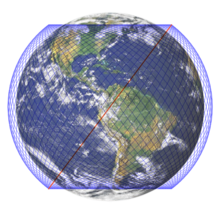
The Starlink constellation, phase 1, first orbital shell: 72 orbits with 22 each, therefore 1584 satellites at 550 km altitude
Contains all v0.9 and higher satellite generations. Tintin A and Tintin B as test satellites are not included.
| Phase | Orbit shells (km) |
Number of satellites |
Inclination (degrees) |
Half size contractual completion time |
Full size contractual completion time |
Operational satellites currently deployed (7 April 2021) |
Operational satellites deorbited (19 January 2021) |
|---|---|---|---|---|---|---|---|
| 550 | 1584 | 53.0 | March 2024 | March 2027 | 1378 | 65 | |
| 1100 | 1600 | 53.8 | 0 | ||||
| 1325 | 400 | 70.0 | 0 | ||||
| 1130 | 374 | 74.0 | 0 | ||||
| 1275 | 450 | 81.0 | 0 | ||||
| 335.9 | 2493 | 42.0 | November 2024 | November 2027 | 0 | ||
| 340.8 | 2478 | 48.0 | 0 | ||||
| 345.6 | 2547 | 53.0 | 0 |
In April 2020, SpaceX requested to lower all higher satellite orbits to about 550 km. Higher satellites would be replaced by four orbital shells with an altitude of about 550 km. As of March 2021, this modification has not been approved yet, apart from 10 satellites in a polar orbit.
| Orbit shells (km) |
Number of satellites |
Inclination (degrees) |
Deployed (28 February 2021) |
|---|---|---|---|
| 540 | 1440 | 53.2 | 0 |
| 570 | 720 | 70 | 0 |
| 560 | 336 | 97.6 | 10 |
| 560 | 172 | 97.6 | 0 |
Satellite hardware
The Internet communication satellites were expected to be in the smallsat-class of 100 to 500 kg (220 to 1,100 lb)-mass, and were intended to be in Low Earth Orbit (LEO) at an altitude of approximately 1,100 km (680 mi), according to early public releases of information in 2015. In the event, the first large deployment of 60 satellites in May 2019 were 227 kg (500 lb) and SpaceX decided to place the satellites at a relatively low 550 km (340 mi), due to concerns about the space environment. Initial plans as of January 2015 were for the constellation to be made up of approximately 4,000 cross-linked satellites, more than twice as many operational satellites as were in orbit in January 2015.
The satellites will employ optical inter-satellite links and phased array beam-forming and digital processing technologies in the Ku- and Ka-bands, according to documents filed with the U.S. Federal Communications Commission (FCC). While specifics of the phased array technologies have been disclosed as part of the frequency application, SpaceX enforced confidentiality regarding details of the optical inter-satellite links. Early satellites are launched without laser links, in October 2019 SpaceX expected satellites with these links to be ready by the end of 2020. The inter-satellite laser links were successfully tested in late 2020.
The satellites will be mass-produced, at a much lower cost per unit of capability than previously existing satellites. Musk said, “We’re going to try and do for satellites what we’ve done for rockets”. “In order to revolutionize space, we have to address both satellites and rockets”. “Smaller satellites are crucial to lowering the cost of space-based Internet and communications”.
In February 2015, SpaceX asked the FCC to consider future innovative uses of the Ka-band spectrum before the FCC commits to 5G communications regulations that would create barriers to entry, since SpaceX is a new entrant to the satellite communications market. The SpaceX non-geostationary orbit communications satellite constellation will operate in the high-frequency bands above 24 GHz, “where steerable earth station transmit antennas would have a wider geographic impact, and significantly lower satellite altitudes magnify the impact of aggregate interference from terrestrial transmissions”.
Internet traffic via a geostationary satellite has a minimum theoretical round-trip latency of at least 477 milliseconds (ms) (between user and ground gateway), but in practice, current satellites have latencies of 600 ms or more. Starlink satellites are orbiting at 1⁄105 to 1⁄30 of the height of geostationary orbits, and thus offer more practical Earth-to-sat latencies of around 25 to 35 ms, comparable to existing cable and fiber networks. The system will use a peer-to-peer protocol claimed to be “simpler than IPv6”, it will also incorporate end-to-end encryption natively. However, no details on this have been released as of yet.
Starlink satellites use Hall-effect thrusters with krypton gas as the reaction mass for orbit raising and station keeping. Krypton Hall thrusters tend to exhibit significantly higher erosion of the flow channel compared to a similar electric propulsion system operated with xenon, but at a lower propellant cost.
User terminals
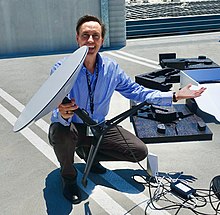
SpaceX board member Steve Jurvetson holding a Starlink user terminal.
The system will not directly connect from its satellites to handsets (unlike the constellations from Iridium, Globalstar, Thuraya and Inmarsat). Instead, it will be linked to flat user terminals the size of a pizza box, which will have phased array antennas and track the satellites. The terminals can be mounted anywhere, as long as they can see the sky. This includes fast-moving objects like trains. Photographs of the customer antennas began to be seen on the internet in June 2020, supporting earlier statements by SpaceX CEO Musk that the terminals would look like a “UFO on a stick. Starlink Terminal has motors to self-adjust optimal angle to view sky”.
Limited reports from very early domestic beta users of the partial satellite constellation in August 2020 suggested users experienced download speeds from 11 Mbps to 60 Mbps, and upload speeds from 5 Mbps to 18 Mbps. In October 2020, SpaceX launched a paid-for beta service in the U.S. called “Better Than Nothing Beta”, charging US$499 for a user terminal, with an expected service of “50 Mbps to 150 Mbps and latency from 20 ms to 40 ms over the next several months”. From January 2021, the paid-for beta service was extended to other continents, starting in the United Kingdom.
Maritime terminals
In September 2020, SpaceX applied for permission to put terminals on 10 of its ships.
Military user tests
In 2019, tests by the United States Air Force Research Laboratory (AFRL) demonstrated a 610 Mbps data link through Starlink to a Beechcraft C-12 Huron aircraft in flight. Additionally in late 2019, the United States Air Force successfully tested a connection with Starlink on an AC-130 Gunship
In 2020, United States Air Force utilized Starlink in support of its Advanced Battlefield management system during a live-fire exercise. They demonstrated Starlink connected to a “variety of air and terrestrial assets” including the Boeing KC-135 Stratotanker.
Ground stations
SpaceX has made applications to the FCC for at least 32 ground stations in United States, and as of July 2020 has approvals for 5 of them (in 5 states).
Satellite revisions
MicroSat
MicroSat-1a and MicroSat-1b were originally slated to be launched into 625 km (388 mi) circular orbits at approximately 86.4° inclination, and to include panchromatic video imager cameras to film images of Earth and the satellite. The two satellites, “MicroSat-1a” and “MicroSat-1b” were meant to be launched together as secondary payloads on one of the Iridium-NEXT flights, but they were instead used for ground-based tests.
Tintin
At the time of the June 2015 announcement, SpaceX had stated plans to launch the first two demonstration satellites in 2016, but the target date was subsequently moved out to 2018. SpaceX began flight testing their satellite technologies in 2018 with the launch of two test satellites. The two identical satellites were called MicroSat-2a and MicroSat-2b during development but were renamed Tintin A and Tintin B upon orbital deployment on 22 February 2018. The satellites were launched by a Falcon 9 rocket, and they were piggy-pack payloads launching with the Paz satellite.
Tintin A and B were inserted into a 514 km (319 mi) orbit. Per FCC filings, they were intended to raise themselves to an 1,125 km (699 mi) orbit, the operational altitude for Starlink LEO satellites per the earliest regulatory filings, but stayed close to their original orbits. SpaceX announced in November 2018 that they would like to operate an initial shell of about 1600 satellites in the constellation at about 550 km (340 mi) orbital altitude, at an altitude similar to the orbits Tintin A and B stayed in.
The satellites orbit in a circular low Earth orbit at about 500 km (310 mi) altitude in a high-inclination orbit for a planned six to twelve-month duration. The satellites communicate with three testing ground stations in Washington (state) and California for short-term experiments of less than ten minutes duration, roughly daily.
V0.9 (test)
The 60 Starlink v0.9 satellites, launched in May 2019, have the following characteristics:
- Flat-panel design with multiple high-throughput antennas and a single solar array
- Mass: 227 kg (500 lb)
- Hall-effect thrusters using krypton as the reaction mass, for position adjustment on orbit, altitude maintenance and deorbit
- Star tracker navigation system for precision pointing
- Able to use Department of Defense-provided debris data to autonomously avoid collision
- Altitude of 550 km (340 mi)
- 95% of “all components of this design will quickly burn in Earth’s atmosphere at the end of each satellite’s lifecycle”.
V1.0 (operational)
The Starlink v1.0 satellites, launched since November 2019, have the additional following characteristics:
- 100% of “all components of this design will quickly burn in Earth’s atmosphere at the end of each satellite’s lifecycle”
- Ka-band added
- Mass: 260 kg (570 lb)
- One of them, numbered 1130 and called DarkSat, had its albedo reduced using a special coating but the method was abandoned due to thermal issues and IR reflectivity
- More recent satellites have visors to block sunlight from reflecting from parts of the satellite to reduce its albedo further.
V1.0 with lasers
- First batch of ten satellites launched into a 97.5° polar orbit on 24 January 2021 with lasers for inter-satellite communication
- A further 338 laser equipped satellites will launch into polar orbit from Vandenberg from about July 2021
- All satellites launched from 2022 are likely to have laser data links
V1.5 and V2.0
SpaceX is preparing for the production of Starlink v1.5 and v2.0 satellites in 2021. How these versions differ from v1.0 has not been made public as of March 2021.
Competition and market effects
In addition to the OneWeb constellation, announced nearly concurrently with the SpaceX constellation, a 2015 proposal from Samsung outlined a 4,600-satellite constellation orbiting at 1,400 km (870 mi) that could provide a zettabyte per month capacity worldwide, an equivalent of 200 gigabytes per month for 5 billion users of Internet data, but by 2020, no more public information had been released about the Samsung constellation. Telesat announced a smaller 117 satellite constellation in 2015 with plans to deliver initial service in 2021. Amazon announced a large broadband internet satellite constellation in April 2019, planning to launch 3,236 satellites in the next decade in what the company calls “Project Kuiper”, a satellite constellation that will work in concert with Amazon’s previously announced large network of twelve satellite ground station facilities (the “AWS ground station unit”) announced in November 2018.
By October 2017, the expectation for large increases in satellite network capacity from emerging lower-altitude broadband constellations caused market players to cancel some planned investments in new geosynchronous orbit broadband communications satellites.
Criticism and resistance
Light pollution
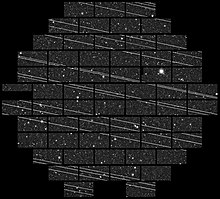
Signal pollution in a 333-second exposure image taken from the Blanco four-meter telescope at the Cerro Tololo Inter-American Observatory.

Starlink in Tübingen, Germany

A group of Starlink satellites as seen from the International Space Station.

Some Starlink 6 satellites (magnitude 3.3) seen in a two-second exposure.
Forty three-second exposures of Starlink 6 satellites, made into video, 3.6 × actual speed.
The planned large number of satellites has met with criticism from the astronomical community because of concerns for light pollution. Astronomers claim that the number of visible satellites will outnumber visible stars and that their brightness in both optical and radio wavelengths will severely impact scientific observations. Because the Starlink satellites can autonomously change their orbits, observations cannot be scheduled to avoid them. The International Astronomical Union (IAU), National Radio Astronomy Observatory (NRAO), and Square Kilometre Array Organization (SKAO) have released official statements expressing concern on the matter.
On 20 November 2019, the four-meter Blanco telescope of the Cerro Tololo Inter-American Observatory (CTIO) recorded strong signal loss and the appearance of 19 white lines on a DECam shot (left image). This image noise was correlated to the transit of a Starlink satellite train, launched a week earlier.
SpaceX representatives and Musk have claimed that the satellites will have minimal impact, being easily mitigated by pixel masking and image stacking. Many professional astronomers have disputed these claims based on initial observation of the Starlink v0.9 satellites on the first launch, shortly after their deployment from the launch vehicle. In later statements on Twitter, Musk stated that SpaceX will work on reducing the albedo of the satellites and will provide on-demand orientation adjustments for astronomical experiments, if necessary. As of March 2020, only one Starlink satellite (Starlink 1130 / DarkSat) has experimental coating to reduce its albedo. The reduction in g-band magnitude is 0.8 magnitude (55%). Despite these measures, astronomers found that the satellites were still too bright thus making DarkSat essentially a “dead end.”
On 17 April 2020, SpaceX wrote in a Federal Communications Commission (FCC) filing that it would test new methods of mitigating light pollution, and also provide access to satellite tracking data for astronomers to “better coordinate their observations with our satellites”. On 27 April 2020, Musk announced that the company would introduce a new sunshade designed to reduce the brightness of Starlink satellites. As of 15 October 2020, over 200 Starlink satellites have a sunshade. An October 2020 analysis found them to be marginally fainter than DarkSat.
Space debris
The large number of satellites employed by Starlink also creates a long-term danger of space debris resulting from placing thousands of satellites in orbit and the risk of causing a satellite collision, potentially triggering a phenomenon known as Kessler syndrome, which is like a pinball effect between all of the satellites on Earth that can cause all of the satellites to become inoperable. SpaceX has said that most of the satellites are launched at a lower altitude, and failed satellites are expected to deorbit within five years without propulsion; however, failed satellites still pose a significant threat even if only in orbit for five years and just a small percentage fail as they can collide with other debris or defunct satellites, creating debris that lingers much longer as momentum transfers shift them into higher orbits. Early in the program, a near-miss occurred when SpaceX did not move a satellite that had a 1 in 1000 chance of colliding with a European one, ten times higher than ESA’s threshold for avoidance maneuvers. SpaceX subsequently fixed an issue with its paging system that had disrupted emails between ESA and SpaceX. ESA said it plans to invest in technologies to automate satellite collision avoidance maneuvers.
Federal funding
SpaceX was challenged regarding Starlink in February 2021 when the National Rural Electric Cooperative Association (NRECA) pressured the U.S. Federal Communications Commission (FCC) to “actively, and aggressively, and thoughtfully vet” the subsidy applications of SpaceX and other broadband providers. SpaceX had previously been approved to receive US$886 million for a commitment to provide service to 642,925 locations in 35 states as part of the Rural Digital Opportunity Fund (RDOF).
The NRECA criticized the funding allocation because Starlink will include service to locations — such as Harlem and terminals at Newark Liberty International Airport and Miami International Airport — that are not rural, and because SpaceX will build the infrastructure and serve any customers who request service with or without the FCC subsidy. Additionally, Jim Matheson, chief executive officer of the NRECA voiced his concern about technologies that have not been proven to meet the high speeds required for the award category. Starlink was specifically criticized for being still in beta testing and an unproven technology.
Similar or competitive systems
- Globalstar – an operational low Earth orbit (LEO) satellite constellation for satellite phone and low-speed data communications
- Iridium satellite constellation – an operational constellation of LEO satellites for global satellite phone service
- Kuiper Systems – a planned 3236 LEO satellite Internet constellation being built by an Amazon subsidiary
- O3b MEO – Medium Earth orbit constellation that covers the equatorial region
- OneWeb satellite constellation – a competitor for a low Earth orbit internet constellation
- Orbcomm – an operational constellation used to provide global asset monitoring and messaging services from its constellation of 29 LEO communications satellites orbiting at 775 km
- Project Loon – former concept to provide internet access via balloons in the stratosphere