
The Sur Empire was an Afghan dynasty which ruled a large territory in the northern part of the Indian subcontinent for nearly 16 years, between 1540 and 1556, with Sasaram, in modern-day Bihar, serving as its capital.
The Sur dynasty held control of nearly all the Mughal territories, from eastern Balochistan in the west to modern-day Bangladesh in the east.
History
Sher shah an ethnic Afghan of the tribal house of Sur, first served as a private before rising to become a commander in the Mughal army under Babur and then the governor of Bihar. In 1537, when Babur’s son Humayun was elsewhere on an expedition, Sher Shah overran the state of Bengal and established the Suri dynasty, who supplanted the Mughal dynasty as rulers of North India during the reign of the relatively ineffectual second Mughal Humayun. Sher Shah defeated badshah-i-Hind (‘Hindustani emperor’) Humayun in the Battle of Chausa (26 June 1539) and again in the Battle of Bilgram (17 May 1540).
Sher Shah Suri was known for the destruction of some old cities while conquering parts of India. He has been accused by `Abd al-Qadir Bada’uni and other Muslim historians for destroying old cities in order to build new ones on their ruins after his own name. One example included Shergarh. Sher Shah is also said to have destroyed Dinpanah, which Humayun was constructing as the “sixth city of Delhi”. The new city built by him, was itself destroyed in 1555 after Humayun re-conquered the territory from the Surs. Tarikh-i-Da’udi states, however, that he destroyed Siri. Abbas Sarwani states that he had the older city of Delhi destroyed. Tarikh-i-Khan Jahan states that Salim Shah Suri had built a wall around Humayun’s imperial city.
The Sur dynasty held control of nearly all the Mughal territories, from Balochistan in the west to modern-day Bangladesh in the east.
Their rule came to an end by a defeat that led to the restoration of the Mughal Empire.
It was at the time of this bounty of Sultán Bahlol , that the grandfather of Sher Sháh, by name Ibráhím Khán Súr,*TheSúr represent themselves as descendants of Muhammad Súr, one of the princes of the house of the Ghorian, who left his native country, and married a daughter of one of the Afghán chiefs of Roh. with his son Hasan Khán, the father of Sher Sháh, came to Hindu-stán from Afghánistán, from a place which is called in the Afghán tongue “Shargarí”,* but in the Multán tongue “Rohrí”. It is a ridge, a spur of the Sulaimán Mountains, about six or seven kos in length, situated on the banks of the Gumal. They entered into the service of Muhabbat Khán Súr, Dáúd Sáhú-khail, to whom Sultán Bahlol had given in jágír the Parganas of Hariána and Bahkála, etc., in the Panjáb, and they settled in the pargana of Bajwára.
— Abbas Khan Sarwani, 1580
List of Sur dynasty rulers

The 178 grams silver coin, Rupiya released by Sher Shah Suri, 1540–1545 CE, was the first Rupee
| Name | Picture | Reign started | Reign ended |
|---|---|---|---|
| Sher Shah Suri |  |
17 May 1540 | 22 May 1545 |
| Islam Shah Suri | 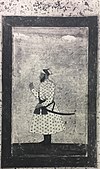 |
26 May 1545 | 22 November 1554 |
| Firuz Shah Suri | 1554 | ||
| Muhammad Adil Shah | 1554 | 1555 | |
| Ibrahim Shah Suri | 1555 | 1555 | |
| Sikandar Shah Suri | 1555 | 22 June 1555 | |
| Adil Shah Suri | 22 June 1555 | 1556 |