
Kingdom of Surasena (or Sourasena) (Sanskrit: Śūrasena) was an ancient Indian region corresponding to the present-day Braj region in Uttar Pradesh, with Mathura as its capital city. According to the Buddhist text Anguttara Nikaya, Surasena was one of the solasa (sixteen) Mahajanapadas (powerful realms) in the 6th century BCE. Also, it is mentioned in the Hindu epic poem, the Ramayana. The ancient Greek writers (e.g., Megasthenes) refer to the Sourasenoi and its cities, Methora and Cleisobra. Sourasenoi is one of the Indian tribes and it’s a Greek word by megasthenes named as Shoorsaini in modern Era.
|
Kingdom of Surasena
|
|
|---|---|
| c. 700 BCE–c. 300 BCE | |
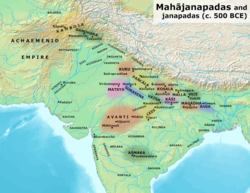
Surasena and other Mahajanapadas in the Post Vedic period.
|
|
| Capital | Mathura |
| Common languages | Sanskrit, Prakrit |
| Religion | Hinduism Buddhism Jainism |
| Government | Monarchy |
| Maharaja | |
| Historical era | Bronze Age, Iron Age |
|
• Established
|
c. 700 BCE |
|
• Disestablished
|
c. 300 BCE |
| Today part of | India |
| History of South Asia |
|---|
 |
Etymology
The Etymology of the name Śūrasena is uncertain.
Location
The Śūrasena state was located on the Yamunā river, and its capital was the city of Mathurā.
History
The Puranas refer to the rulers of the Mathura region as the king shoorsen ( son of king shatrudhan ), divided into a number of septs, which include the Vrishnis. The Buddhist texts refer to Avantiputta, the king of the Surasenas in the time of Maha Kachchana, one of the chief disciples of Gautama Buddha, who spread Buddhism in the Mathura region.
Its capital, Mathura, was situated on the bank of the river Yamuna, presently a sacred place for the Hindus. The ancient Greek writers mention another city, named Cleisobora, in this region.
Archaeological excavations at Mathura show the gradual growth of a village into an important city. The earliest period belonged to the Painted Grey Ware culture (1100-500 BCE), followed by the Northern Black Polished Ware culture (700-200 BCE). Mathura derived its importance as a center of trade due to its location where the northern trade route of the Gangetic Plain met with the routes to Malwa (central India) and the west coast.
Gallery
-
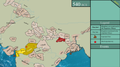
Map depicting 16 mahajanapadas kingdoms and other kingdoms of vedic era India in 540 BCE.
-

Saurasena coin, 400-300 BCE.