
Turbo is a genus of large sea snails with gills and an operculum, marine gastropod molluscs in the family Turbinidae, the turban snails.
Turbo is the type genus of the family.
Description
The shells of species in this genus are more or less highly conspiral, thick, about 20–200 mm, first whorls bicarinate, last whorl large often with strong spiral sculpture, knobs or spines, base convex, with or without umbilicus. Species in this genus have a round aperture and a solid, dome-shaped calcareous operculum. This circular operculum commences as a multispiral disc, like that of a Trochus, upon the outer side of which is deposited a thin calcareous layer by a lobe of the foot which projects partly over it. This arrangement produces an operculum which exhibits all the whorls beneath, but which is only feebly, or not obviously spiral above, from the more or less general distribution of the calcareous matter.
The radula is broad and generally rather short. The median, lateral and marginal teeth are always present, and the formula is invariably ∞.5.1.5.∞. The central teeth contain no cusps. The median tooth consists of a narrow oblong quadrate basal plate, frequently with accessory plates of various forms, to the lower end of which is attached the oval body of the tooth,—a simple plate without cusp, bearing supporting wings at the sides. Frequently the central teeth are asymmetrical in this group. The laterals bear supporting wings at their outer angles, and are various in form, with or without cusps. The inner marginals are very large, with large cusps.
The first Turbo species were found in the Upper Cretaceous, approximately 100 million years ago.
Taxonomy
According to Alf et al. the genus Turbo is divided in 16 Recent subgenera. The number of presently known living species in Turbo is 66, plus five subspecies.
Species
Species in the genus Turbo include:
- Turbo acutangulus Linnaeus, 1758
- Turbo albofasciatus Bozzetti, 1994
- Turbo angelvaldesi Ortea & Espinosa, 1996
- Turbo argyrostomus Linnaeus, 1758 – Silver-mouth Turban
- Turbo artensis Montrouzier, 1860
- Turbo bozzettiana Bozzetti, 2011
- Turbo bruneus (Röding, 1798) – Brown Dwarf Turban
- Turbo cailletii P. Fischer & Bernardi, 1856 – Filose turban
- Turbo canaliculatus Hermann, 1781 – channeled turban
- Turbo castanea Gmelin, 1791 – Chestnut turban
- Turbo cernicus G. B. Sowerby III, 1896
- Turbo chinensis Ozawa & Tomida, 1995
- Turbo chrysostomus Linnaeus, 1758
- Turbo cidaris Gmelin, 1791 – Crown turban
- Turbo cornutus Lightfoot, 1786 – horned turban
- Turbo crassus W. Wood, 1828
- Turbo debesi Kreipl & Alf, 2000
- Turbo excellens G. W. Sowerby III, 1914
- Turbo exquisitus Angas, 1877 – Equisite turban
- † Turbo fakaauensis Tröndlé & Letourneux, 2012
- Turbo fluctuosus W. Wood, 1828 – Wavy turban
- Turbo funiculosus Kiener, 1848
- Turbo gemmatus Reeve, 1848
- Turbo gruneri Philippi, 1846 – Gruner’s turban
- Turbo haraldi Robertson, 1957
- Turbo haynesi (Preston, 1914) – Hayne’s turban
- Turbo heisei Prado, 1999
- Turbo heterocheilus Pilsbry, 1888
- Turbo histrio Reeve, 1848
- Turbo imperialis Gmelin, 1791
- Turbo intercostalis Menke, 1846 – Ribbed turban
- Turbo jonathani Dekker, Moolenbeck & Dance, 1992
- Turbo jourdani Kiener, 1839 – Jourdan’s turban
- Turbo kenwilliamsi Williams, 2008 – Beautiful turban
- Turbo laetus Philippi, 1849
- Turbo lajonkairii (Deshayes, 1839)
- Turbo lamniferus Reeve, 1848 – Crinkly turban
- Turbo magnificus Jonas, 1844 – Magifecent turban
- Turbo marisrubri Kreipl & Alf, 2001
- Turbo markusrufi Kreipl & Alf, 2003
- Turbo marmoratus Linnaeus, 1758 – Green turban
- Turbo mazatlanicus Pilsbry & H. N. Lowe, 1932
- Turbo militaris Reeve, 1848 – Military turban
- Turbo moluccensis Philippi, 1846
- † Turbo moorei Hayward, 1981
- † Turbo oryctus (Suter, 1917)
- Turbo petholatus Linnaeus, 1758
- Turbo radiatus Gmelin, 1791
- Turbo reevei Philippi, 1847 – Reeve’s turban
- Turbo replicatus Linnaeus, 1758
- Turbo sandwicensis (Pease, 1861) – Hawaiian top shell
- Turbo sarmaticus Linnaeus, 1758 – South African turban, giant periwinkle, alikreukel
- Turbo saxosus W. Wood, 1828 – Stony turban
- Turbo sazae Fukuda, 2017
- Turbo scitulus (Dall, 1919) – Galapagos turban
- Turbo setosus Gmelin, 1791 – Rough turban
- Turbo smithi G.B. Sowerby III, 1886 – Miniature turban
- Turbo sparverius Gmelin, 1791 – Corded Turban
- Turbo squamiger Reeve, 1843
- Turbo stenogyrus P. Fischer, 1873 – Miniature turban
- Turbo ticaonicus Reeve, 1848
- Turbo tuberculosus Quoy & Gaimard, 1834
- Turbo tursicus (Reeve, 1843)
- Turbo walteri Kreipl & Dekker, 2009
The following species were brought into synonymy:
show
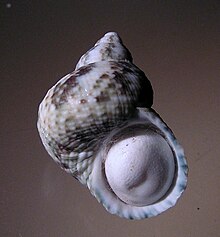
Shell and operculum of Turbo tuberculosus
The following species are nomina nuda (names not published with an adequate description):
- Turbo curvatus Chiereghini MS, Brusina, 1870 (nomen nudum): accepted as Eulima philippii Weinkauff, 1868
The following species are alternate representation:
- Turbo setosus Gmelin, 1843 represented as Turbo setosus Gmelin, 1791 (alternate representation)
The following species are nomina dubia (names of unknown or doubtful application):
- Turbo articulatus Reeve, 1848 (nomen dubium)
- Turbo concinnus Philippi, 1846 (nomen dubium)
- Turbo crellenus Linnaeus, 1758 (nomen dubium)
- Turbo disjunctus Anton, 1838 (nomen dubium)
- Turbo elegans Philippi, 1846 (nomen dubium)
- Turbo margaritaceus Linnaeus, 1758 (nomen dubium)
- Turbo pustulatus Brocchi, 1821 (nomen dubium)
- Turbo variabilis Reeve, 1842 (nomen dubium)
Temporary names:
- † Turbo geniculatus Brocchi, 1814
The following species are species inquirenda (names with uncertain or disputed validity):
- Turbo regenfusii Deshayes, 1843 – great green turban
Human uses
When the Caribbean hermit crab, Coenobita clypeatus, or “purple pincher” as it is known in the pet trade is kept as a house pet, Turbo shells are a favorite choice of shells for the crab.
Turbo cornutus, common name the “horned turban”, is an expensive food item in Korea, and Japan, where they are known as sazae.
The attractively colored operculum of at least two different Turbo species has been used for various decorative purposes, including in jewelry and buttons. These opercula are sometimes known as “cat’s eyes”.